Capacitors
Capacitors A  capacitor  is a device that stores electric charge. A capacitor consists of two conductors separated by an insulator. Capacitors have many applications: Computer RAM memory and keyboards. Electronic flashes for cameras. Electric power surge protectors. Radios and electronic circuits.
Types of Capacitors Parallel-Plate Capacitor Cylindrical Capacitor A cylindrical capacitor is a parallel-plate capacitor that has been rolled up with an insulating layer between the plates.
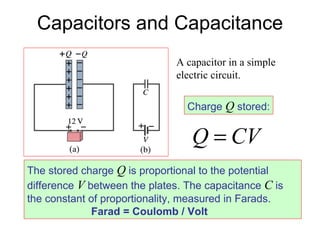
Capacitors and Capacitance Charge  Q  stored: The stored charge  Q  is proportional to the potential difference  V  between the plates. The capacitance  C  is the constant of proportionality, measured in Farads. Farad = Coulomb / Volt A capacitor in a simple electric circuit.
Parallel-Plate Capacitor A simple parallel-plate capacitor consists of two conducting plates of area  A  separated by a distance  d . Charge  +Q  is placed on one plate and  –Q  on the other plate.  An electric field  E  is created between the plates. +Q -Q +Q -Q
What is a capacitor? Electronic component Two conducting surfaces separated by an insulating material Stores charge Uses Time delays Filters Tuned circuits
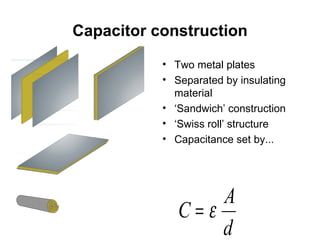
Capacitor construction Two metal plates Separated by insulating material ‘ Sandwich’ construction ‘ Swiss roll’ structure Capacitance set by...
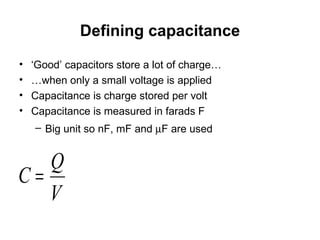
Defining capacitance ‘ Good’ capacitors store a lot of charge… … when only a small voltage is applied Capacitance is charge stored per volt Capacitance is measured in farads F Big unit so nF, mF and   F are used
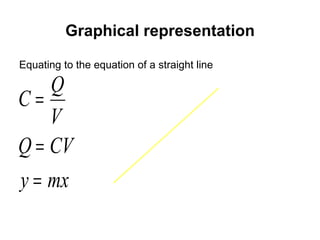
Graphical representation Equating to the equation of a straight line Gradient term is the capacitance of the capacitor Charge stored is directly proportional to the applied voltage Q V
Energy stored by a capacitor By general definition E=QV product of charge and voltage By graphical consideration... Area term is the energy stored in the capacitor Q V
Other expressions for energy By substitution of Q=CV
Charging a capacitor Current  flow Initially  High Finally Zero Exponential model Charging factors Capacitance Resistance I t
Discharging a capacitor Current  flow Initially  High Opposite to charging Finally Zero Exponential model Discharging factors Capacitance Resistance I t
Discharging a Capacitor Initially, the rate of discharge is high because the potential difference across the plates is large. As the potential difference falls, so too does the current flowing Think pressure As water level falls, rate of flow decreases
At some time t, with charge Q on the capacitor, the current that flows in an interval   t is: I =   Q/  t And I = V/R But since V=Q/C, we can say that  I = Q/RC So the discharge current is proportional to the charge still on the plates.
For a changing current, the drop in charge,   Q is given by:  Q = -I  t  (minus because charge Iarge at  t = 0 and falls as t increases) So   Q = -Q  t/RC   (because I = Q/RC) Or -  Q/Q =   t/RC
Voltage and charge characteristics Charging Discharging V or Q t V or Q t
Dielectrics A  dielectric  is an insulating material  (e.g. paper, plastic, glass) . A dielectric placed between the conductors of a capacitor increases its capacitance by a factor  κ , called the  dielectric constant .   C=  κC o   ( C o =capacitance without dielectric) For a parallel-plate capacitor: ε = κε o  =  permittivity  of the material.
Properties of Dielectric Materials Dielectric strength  is the maximum electric field that a dielectric can withstand without becoming a conductor. Dielectric materials increase capacitance. increase electric breakdown potential of capacitors. provide mechanical support. Dielectric Strength (V/m) Dielectric Constant  κ Material 3 x 10 6 1.0006 air 8 x 10 6 300 strontium titanate 150 x 10 6 7 mica 15 x 10 6 3.7 paper
Practice Quiz   A charge Q is initially placed on a parallel-plate capacitor with an air gap between the electrodes, then the capacitor is electrically isolated. A sheet of paper is then inserted between the capacitor plates. What happens to: the capacitance? the charge on the capacitor? the potential difference between the plates? the energy stored in the capacitor?
Capacitors in Parallel Capacitors in Parallel:
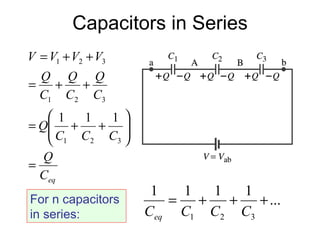
Capacitors in Series For n capacitors  in series:
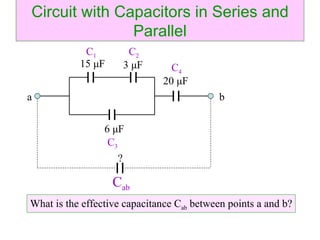
Circuit with Capacitors in Series and Parallel a b 15  μF 3  μF 6  μF What is the effective capacitance C ab  between points a and b? 20  μF C 1 C 2 C 3 C 4 C ab ?
Product of Capacitance of the capacitor being charged Resistance of the charging circuit CR Symbol    ‘Tau’ Unit seconds Time constant
When t equals tau during discharge At t = tau the capacitor has fallen to 37% of its original value. By a similar analysis tau can be considered to be the time taken for the capacitor to reach 63% of full charge.
Graphical determination of tau V at 37% Q at 37% Compared to initial maximum discharge V  or Q t
Logarithmic discharge analysis Mathematical consideration of discharge Exponential relationship  Taking natural logs equates expression to ‘y=mx+c’ Gradient is -1/Tau
Logarithmic discharge graph Gradient term is the -1/Tau lnV t
www.search for... Capacitors

Capacitors

  • 1.
  • 2.
    Capacitors A capacitor is a device that stores electric charge. A capacitor consists of two conductors separated by an insulator. Capacitors have many applications: Computer RAM memory and keyboards. Electronic flashes for cameras. Electric power surge protectors. Radios and electronic circuits.
  • 3.
    Types of CapacitorsParallel-Plate Capacitor Cylindrical Capacitor A cylindrical capacitor is a parallel-plate capacitor that has been rolled up with an insulating layer between the plates.
  • 4.
    Capacitors and CapacitanceCharge Q stored: The stored charge Q is proportional to the potential difference V between the plates. The capacitance C is the constant of proportionality, measured in Farads. Farad = Coulomb / Volt A capacitor in a simple electric circuit.
  • 5.
    Parallel-Plate Capacitor Asimple parallel-plate capacitor consists of two conducting plates of area A separated by a distance d . Charge +Q is placed on one plate and –Q on the other plate. An electric field E is created between the plates. +Q -Q +Q -Q
  • 6.
    What is acapacitor? Electronic component Two conducting surfaces separated by an insulating material Stores charge Uses Time delays Filters Tuned circuits
  • 7.
    Capacitor construction Twometal plates Separated by insulating material ‘ Sandwich’ construction ‘ Swiss roll’ structure Capacitance set by...
  • 8.
    Defining capacitance ‘Good’ capacitors store a lot of charge… … when only a small voltage is applied Capacitance is charge stored per volt Capacitance is measured in farads F Big unit so nF, mF and  F are used
  • 9.
    Graphical representation Equatingto the equation of a straight line Gradient term is the capacitance of the capacitor Charge stored is directly proportional to the applied voltage Q V
  • 10.
    Energy stored bya capacitor By general definition E=QV product of charge and voltage By graphical consideration... Area term is the energy stored in the capacitor Q V
  • 11.
    Other expressions forenergy By substitution of Q=CV
  • 12.
    Charging a capacitorCurrent flow Initially High Finally Zero Exponential model Charging factors Capacitance Resistance I t
  • 13.
    Discharging a capacitorCurrent flow Initially High Opposite to charging Finally Zero Exponential model Discharging factors Capacitance Resistance I t
  • 14.
    Discharging a CapacitorInitially, the rate of discharge is high because the potential difference across the plates is large. As the potential difference falls, so too does the current flowing Think pressure As water level falls, rate of flow decreases
  • 15.
    At some timet, with charge Q on the capacitor, the current that flows in an interval  t is: I =  Q/  t And I = V/R But since V=Q/C, we can say that I = Q/RC So the discharge current is proportional to the charge still on the plates.
  • 16.
    For a changingcurrent, the drop in charge,  Q is given by:  Q = -I  t (minus because charge Iarge at t = 0 and falls as t increases) So  Q = -Q  t/RC (because I = Q/RC) Or -  Q/Q =  t/RC
  • 17.
    Voltage and chargecharacteristics Charging Discharging V or Q t V or Q t
  • 18.
    Dielectrics A dielectric is an insulating material (e.g. paper, plastic, glass) . A dielectric placed between the conductors of a capacitor increases its capacitance by a factor κ , called the dielectric constant . C= κC o ( C o =capacitance without dielectric) For a parallel-plate capacitor: ε = κε o = permittivity of the material.
  • 19.
    Properties of DielectricMaterials Dielectric strength is the maximum electric field that a dielectric can withstand without becoming a conductor. Dielectric materials increase capacitance. increase electric breakdown potential of capacitors. provide mechanical support. Dielectric Strength (V/m) Dielectric Constant κ Material 3 x 10 6 1.0006 air 8 x 10 6 300 strontium titanate 150 x 10 6 7 mica 15 x 10 6 3.7 paper
  • 20.
    Practice Quiz A charge Q is initially placed on a parallel-plate capacitor with an air gap between the electrodes, then the capacitor is electrically isolated. A sheet of paper is then inserted between the capacitor plates. What happens to: the capacitance? the charge on the capacitor? the potential difference between the plates? the energy stored in the capacitor?
  • 21.
    Capacitors in ParallelCapacitors in Parallel:
  • 22.
    Capacitors in SeriesFor n capacitors in series:
  • 23.
    Circuit with Capacitorsin Series and Parallel a b 15 μF 3 μF 6 μF What is the effective capacitance C ab between points a and b? 20 μF C 1 C 2 C 3 C 4 C ab ?
  • 24.
    Product of Capacitanceof the capacitor being charged Resistance of the charging circuit CR Symbol  ‘Tau’ Unit seconds Time constant
  • 25.
    When t equalstau during discharge At t = tau the capacitor has fallen to 37% of its original value. By a similar analysis tau can be considered to be the time taken for the capacitor to reach 63% of full charge.
  • 26.
    Graphical determination oftau V at 37% Q at 37% Compared to initial maximum discharge V or Q t
  • 27.
    Logarithmic discharge analysisMathematical consideration of discharge Exponential relationship Taking natural logs equates expression to ‘y=mx+c’ Gradient is -1/Tau
  • 28.
    Logarithmic discharge graphGradient term is the -1/Tau lnV t
  • 29.

Editor's Notes

  • #2 Construction and charging and discharging