Ohm’s Law by: Muhamad Abdul Jalil (09330271)
Standart of competence :  5. To a pply  electricity  concept in various problem and a variety technology product.  Basic competence  :  5. 1. To  Formulates  the mulberry of  electricity is closed  series  ( one loop)
Indicator  :  To f ormulate  the mulberry of electric  current  strength in closed  series  (the electric current strength).  To f ormulate  the mulberry of electric resistance strength series  (the electric resistance strength).  To f ormulate  the mulberry of tension insimple closed series uses Kirchof Law II .
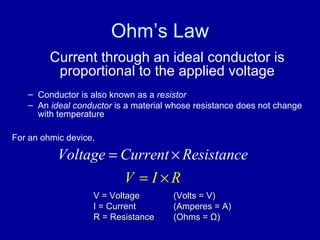
Ohm’s Law Current through an ideal conductor is proportional to the applied voltage Conductor is also known as a  resistor An  ideal conductor  is a material whose resistance does not change with temperature For an ohmic device, V = Voltage  (Volts = V) I = Current  (Amperes = A) R = Resistance  (Ohms =  Ω )
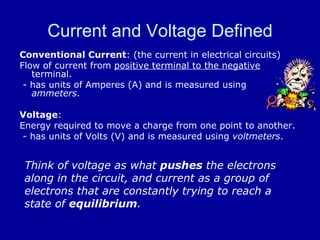
Current and Voltage Defined Conventional Current : (the current in electrical circuits)  Flow of current from  positive terminal to the negative  terminal.  - has units of Amperes (A) and is measured using  ammeters . Voltage : Energy required to move a charge from one point to another. - has units of Volts (V) and is measured using  voltmeters . Think of voltage as what  pushes  the electrons along in the circuit, and current as a group of electrons that are constantly trying to reach a state of  equilibrium .
Ohmic Resistors Metals obey Ohm’s Law linearly so long as their temperature is held constant Their resistance values do not fluctuate with temperature the  resistance  for each resistor is a constant Most ohmic resistors will behave  non-linearly outside of a given range of temperature, pressure, etc.
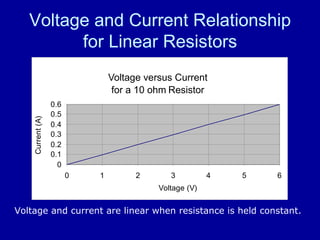
Voltage and Current Relationship for Linear Resistors Voltage and current are linear when resistance is held constant.
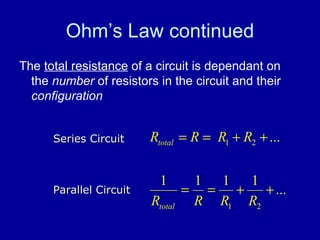
Ohm’s Law continued The  total resistance  of a circuit is dependant on the  number  of resistors in the circuit and their  configuration Series Circuit Parallel Circuit
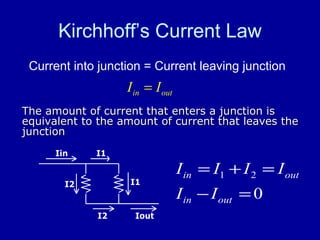
Kirchhoff’s Current Law Current into junction = Current leaving junction The amount of current that enters a junction is equivalent to the amount of current that leaves the junction
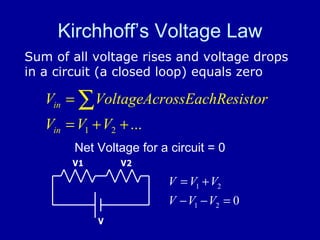
Kirchhoff’s Voltage Law Net Voltage for a circuit = 0 Sum of all voltage rises and voltage drops in a circuit (a closed loop) equals zero
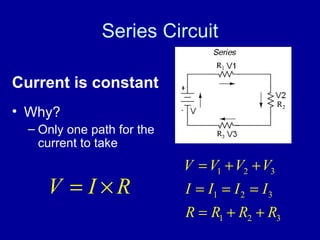
Series Circuit Current is constant Why? Only one path for the current to take
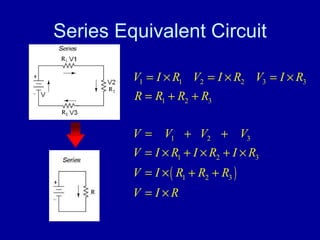
Series Equivalent Circuit
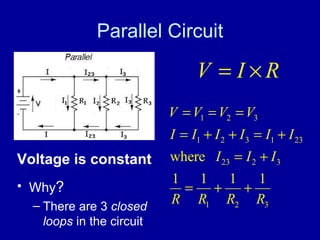
Parallel Circuit Voltage is constant Why ? There are 3  closed   loops  in the circuit
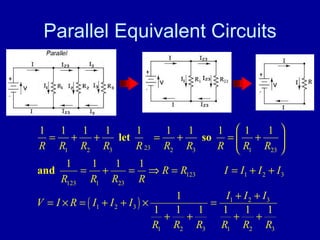
Parallel Equivalent Circuits
We’ve now looked at how basic electrical circuits work with resistors that obey Ohm’s Law linearly.  We understand  quantitatively  how these resistors work using the relationship V=IR, but lets see  qualitatively  using light bulbs.
Matur  THANKYOU

ppt Ohm's law

  • 1.
    Ohm’s Law by:Muhamad Abdul Jalil (09330271)
  • 2.
    Standart of competence: 5. To a pply electricity concept in various problem and a variety technology product. Basic competence : 5. 1. To Formulates the mulberry of electricity is closed series ( one loop)
  • 3.
    Indicator : To f ormulate the mulberry of electric current strength in closed series (the electric current strength). To f ormulate the mulberry of electric resistance strength series (the electric resistance strength). To f ormulate the mulberry of tension insimple closed series uses Kirchof Law II .
  • 4.
    Ohm’s Law Currentthrough an ideal conductor is proportional to the applied voltage Conductor is also known as a resistor An ideal conductor is a material whose resistance does not change with temperature For an ohmic device, V = Voltage (Volts = V) I = Current (Amperes = A) R = Resistance (Ohms = Ω )
  • 5.
    Current and VoltageDefined Conventional Current : (the current in electrical circuits) Flow of current from positive terminal to the negative terminal. - has units of Amperes (A) and is measured using ammeters . Voltage : Energy required to move a charge from one point to another. - has units of Volts (V) and is measured using voltmeters . Think of voltage as what pushes the electrons along in the circuit, and current as a group of electrons that are constantly trying to reach a state of equilibrium .
  • 6.
    Ohmic Resistors Metalsobey Ohm’s Law linearly so long as their temperature is held constant Their resistance values do not fluctuate with temperature the resistance for each resistor is a constant Most ohmic resistors will behave non-linearly outside of a given range of temperature, pressure, etc.
  • 7.
    Voltage and CurrentRelationship for Linear Resistors Voltage and current are linear when resistance is held constant.
  • 8.
    Ohm’s Law continuedThe total resistance of a circuit is dependant on the number of resistors in the circuit and their configuration Series Circuit Parallel Circuit
  • 9.
    Kirchhoff’s Current LawCurrent into junction = Current leaving junction The amount of current that enters a junction is equivalent to the amount of current that leaves the junction
  • 10.
    Kirchhoff’s Voltage LawNet Voltage for a circuit = 0 Sum of all voltage rises and voltage drops in a circuit (a closed loop) equals zero
  • 11.
    Series Circuit Currentis constant Why? Only one path for the current to take
  • 12.
  • 13.
    Parallel Circuit Voltageis constant Why ? There are 3 closed loops in the circuit
  • 14.
  • 15.
    We’ve now lookedat how basic electrical circuits work with resistors that obey Ohm’s Law linearly. We understand quantitatively how these resistors work using the relationship V=IR, but lets see qualitatively using light bulbs.
  • 16.