CAPACITOR
Contents:
 Introduction.
 Types.
 Capacitance.
 Basic construction.
 Storing Charge.
 Capacitor in parallel and series.
 Uses.
What is capacitor?
 Device that store electric charges.
 Consists of two plates.
 Separated by an insulator.
 Non-conductive region can either be a vacuum or an electrical insulator known as
dielectric.
(glass, air, paper, semi-conductor).
 Variety of sizes and shapes.
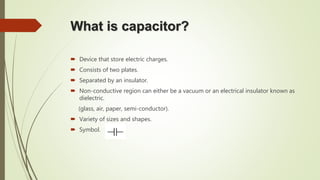
 Symbol.
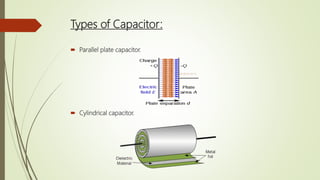
Types of Capacitor:
 Parallel plate capacitor.
 Cylindrical capacitor.
Capacitance:
 Ability to store charge.
 Unit of capacitance is Farad(F).
 Capacitance values are normally smaller, such as µF, nF or pF.
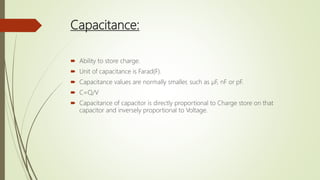
 C=Q/V
 Capacitance of capacitor is directly proportional to Charge store on that
capacitor and inversely proportional to Voltage.
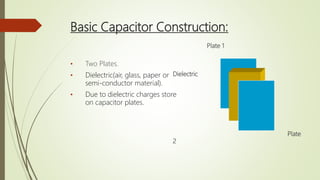
Basic Capacitor Construction:
Plate 1
Dielectric
Plate
2
• Two Plates.
• Dielectric(air, glass, paper or
semi-conductor material).
• Due to dielectric charges store
on capacitor plates.
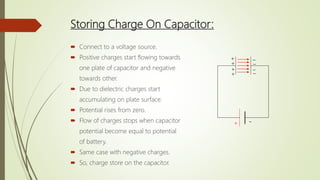
Storing Charge On Capacitor:
 Connect to a voltage source.
 Positive charges start flowing towards
one plate of capacitor and negative
towards other.
 Due to dielectric charges start
accumulating on plate surface.
 Potential rises from zero.
 Flow of charges stops when capacitor
potential become equal to potential
of battery.
 Same case with negative charges.
 So, charge store on the capacitor.
_
_
_
+
+
+ -
+
+
_
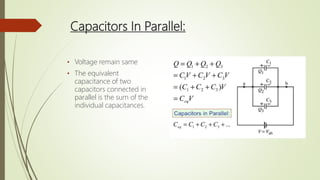
Capacitors In Parallel:
• Voltage remain same
• The equivalent
capacitance of two
capacitors connected in
parallel is the sum of the
individual capacitances.
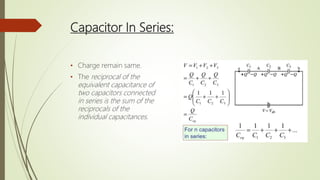
Capacitor In Series:
• Charge remain same.
• The reciprocal of the
equivalent capacitance of
two capacitors connected
in series is the sum of the
reciprocals of the
individual capacitances.
Uses of Capacitor:
 Used as batteries.
 Used as sensing devices.
 Used to separate AC and DC.
 Used in vehicle audio system.
Thank you.

Capacitor Presentation

  • 1.
  • 2.
    Contents:  Introduction.  Types. Capacitance.  Basic construction.  Storing Charge.  Capacitor in parallel and series.  Uses.
  • 3.
    What is capacitor? Device that store electric charges.  Consists of two plates.  Separated by an insulator.  Non-conductive region can either be a vacuum or an electrical insulator known as dielectric. (glass, air, paper, semi-conductor).  Variety of sizes and shapes.  Symbol.
  • 4.
    Types of Capacitor: Parallel plate capacitor.  Cylindrical capacitor.
  • 5.
    Capacitance:  Ability tostore charge.  Unit of capacitance is Farad(F).  Capacitance values are normally smaller, such as µF, nF or pF.  C=Q/V  Capacitance of capacitor is directly proportional to Charge store on that capacitor and inversely proportional to Voltage.
  • 6.
    Basic Capacitor Construction: Plate1 Dielectric Plate 2 • Two Plates. • Dielectric(air, glass, paper or semi-conductor material). • Due to dielectric charges store on capacitor plates.
  • 7.
    Storing Charge OnCapacitor:  Connect to a voltage source.  Positive charges start flowing towards one plate of capacitor and negative towards other.  Due to dielectric charges start accumulating on plate surface.  Potential rises from zero.  Flow of charges stops when capacitor potential become equal to potential of battery.  Same case with negative charges.  So, charge store on the capacitor. _ _ _ + + + - + + _
  • 8.
    Capacitors In Parallel: •Voltage remain same • The equivalent capacitance of two capacitors connected in parallel is the sum of the individual capacitances.
  • 9.
    Capacitor In Series: •Charge remain same. • The reciprocal of the equivalent capacitance of two capacitors connected in series is the sum of the reciprocals of the individual capacitances.
  • 10.
    Uses of Capacitor: Used as batteries.  Used as sensing devices.  Used to separate AC and DC.  Used in vehicle audio system.
  • 11.

Editor's Notes

  • #4 1). a device used to store an electric charge, consisting of one or more pairs of conductors separated by an insulator.
  • #5 1). Consist of two parallel conducting plates separated by a small distance or some di-electric is present between them. Potential of capacitor rises from zero. Parallel plate capacitor is the simplest form of capacitor. 2). A capacitor made of two concentric metal cylinders of the same length, with dielectric filling the space between the cylinders. Also known as coaxial capacitor. A cylindrical capacitor is made up of a conducting cylinder or wire of radius a surrounded by another concentric cylindrical shell of radius b (b>a).
  • #6 Capacitance is the electrical property of a capacitor and is the measure of a capacitors ability to store an electrical charge onto its two plates with the unit of capacitance being the Farad (abbreviated to F) named after the British physicist Michael Faraday.
  • #7 There are many different kinds of capacitors available from very small capacitor used in resonance circuits to large power factor correction capacitors, but they all do the same thing, they store charge. In its basic form, a capacitor consists of two or more parallel conductive (metal) plates which are not connected or touching each other, but are electrically separated either by air or by some form of a good insulating material such as…….The insulating layer between a capacitors plates is commonly called the Dielectric.  
  • #11 1). Because capacitors store energy. Contains three main parts; a positive terminal called the cathode, negative terminal called the anode, and the electrolyte. The battery charges and discharges through a chemical reaction that generates a voltage. 2). Because they react to changes in humidity and other factors, capacitors can be used to ensure a device is working properly. 3). Because they can pass AC signals and block DC signals. This process is known as capacitive, or AC, coupling. 4). Because In motor vehicle audio systems, large capacitors store energy for the amplifiers to use.