Electric Charge Physics 30 Topic 2-1 D.G. MacCarthy
Atoms & Electricity All matter is made of  atoms , which contain electrons, protons, and neutrons. Objects normally contain equal numbers of electrons and protons: such objects are called  neutral . When an object has an imbalance in the number of electrons and protons, it is  electrically charged . Neutrons are not involved in electric interactions.
Electric Charge An object with more  electrons  than protons is said to carry a  negative  charge. An object with more  protons  than electrons is said to carry a  positive  charge. The imbalance between p +  and e –  in a charged object is proportionally very small… The difference may be only 10 12  particles out of a total of 10 25 ; i.e. an imbalance of 1 per 10 trillion!
Electric Charge Like energy and momentum, electric charge is a conserved quantity: Charge cannot be created or destroyed, but it can be transferred between objects. Charged objects exert  electric forces  on each other: Opposite charges attract; Like charges repel.
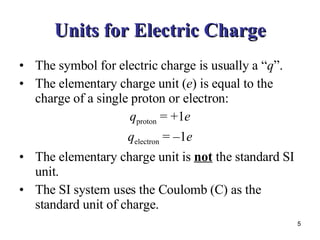
Units for Electric Charge The symbol for electric charge is usually a “ q ”. The elementary charge unit ( e ) is equal to the charge of a single proton or electron: q proton  = +1 e q electron  =  –1 e The elementary charge unit is  not  the standard SI unit. The SI system uses the Coulomb (C) as the standard unit of charge.
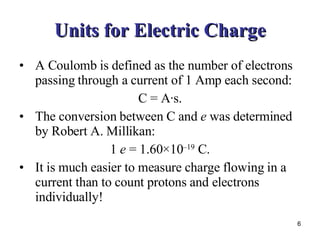
Units for Electric Charge A Coulomb is defined as the number of electrons passing through a current of 1 Amp each second: C = A · s. The conversion between C and  e  was determined by Robert A. Millikan: 1  e  = 1.60 ×10 –19  C. It is much easier to measure charge flowing in a current than to count protons and electrons individually!
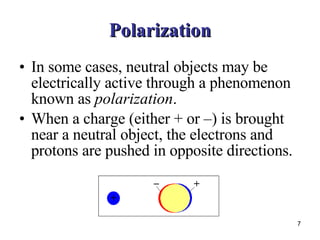
Polarization In some cases, neutral objects may be electrically active through a phenomenon known as  polarization . When a charge (either + or  –) is brought near a neutral object, the electrons and protons are pushed in opposite directions.
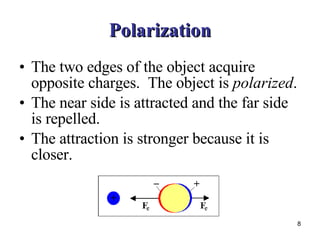
Polarization The two edges of the object acquire opposite charges.  The object is  polarized . The near side is attracted and the far side is repelled. The attraction is stronger because it is closer.
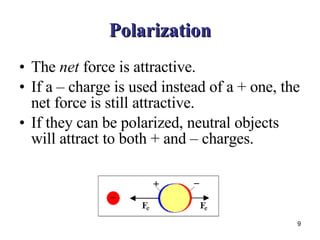
Polarization The  net  force is attractive. If a – charge is used instead of a + one, the net force is still attractive. If they can be polarized, neutral objects will attract to both + and – charges.
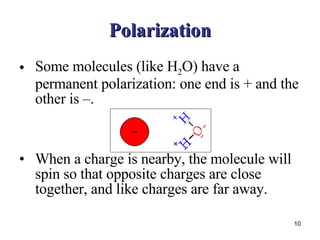
Polarization Some molecules (like H 2 O) have a permanent polarization: one end is + and the other is –. When a charge is nearby, the molecule will spin so that opposite charges are close together, and like charges are far away.
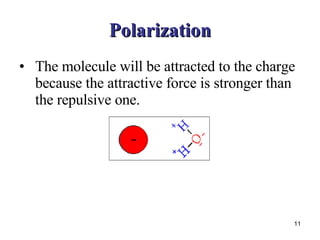
Polarization The molecule will be attracted to the charge because the attractive force is stronger than the repulsive one.
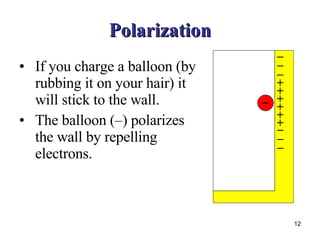
Polarization If you charge a balloon (by rubbing it on your hair) it will stick to the wall. The balloon (–) polarizes the wall by repelling electrons.
Electric Charge There are three common ways for a neutral object to become charged. Friction Conduction Induction
Charging by Friction Charging by Friction occurs when two different materials rub against each other, causing a transfer of electrons. The material with the greater affinity for electrons becomes negative, and the other material becomes positive. E.g. Clothes in a dryer. E.g. Rub a balloon on your hair.
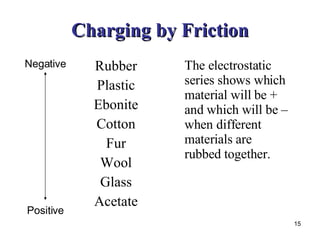
Charging by Friction Rubber Plastic Ebonite Cotton Fur Wool Glass Acetate Negative Positive The electrostatic series shows which material will be + and which will be  – when different materials are rubbed together.
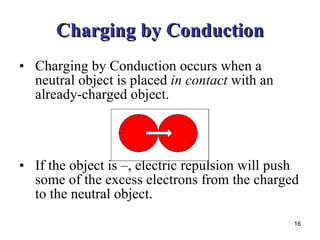
Charging by Conduction Charging by Conduction occurs when a neutral object is placed  in   contact  with an already-charged object. If the object is  –, electric repulsion will push some of the excess electrons from the charged to the neutral object.
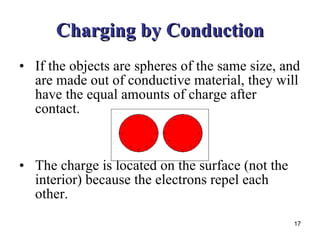
Charging by Conduction If the objects are spheres of the same size, and are made out of conductive material, they will have the equal amounts of charge after contact. The charge is located on the surface (not the interior) because the electrons repel each other.
Charging by Conduction In solids, protons are usually not mobile; only electrons are able to move. If the object is + , electric attraction will pull some electrons from the neutral object to the charged one.
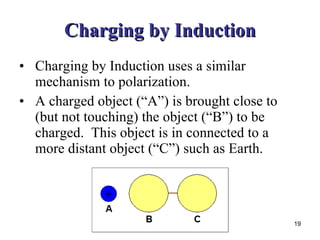
Charging by Induction Charging by Induction uses a similar mechanism to polarization. A charged object (“A”) is brought close to (but not touching) the object (“B”) to be charged.  This object is in connected to a more distant object (“C”) such as Earth.
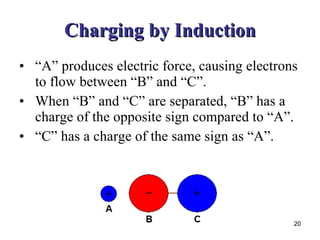
Charging by Induction “ A” produces electric force, causing electrons to flow between “B” and “C”. When “B” and “C” are separated, “B” has a charge of the opposite sign compared to “A”. “ C” has a charge of the same sign as “A”.

Electric Charge

  • 1.
    Electric Charge Physics30 Topic 2-1 D.G. MacCarthy
  • 2.
    Atoms & ElectricityAll matter is made of atoms , which contain electrons, protons, and neutrons. Objects normally contain equal numbers of electrons and protons: such objects are called neutral . When an object has an imbalance in the number of electrons and protons, it is electrically charged . Neutrons are not involved in electric interactions.
  • 3.
    Electric Charge Anobject with more electrons than protons is said to carry a negative charge. An object with more protons than electrons is said to carry a positive charge. The imbalance between p + and e – in a charged object is proportionally very small… The difference may be only 10 12 particles out of a total of 10 25 ; i.e. an imbalance of 1 per 10 trillion!
  • 4.
    Electric Charge Likeenergy and momentum, electric charge is a conserved quantity: Charge cannot be created or destroyed, but it can be transferred between objects. Charged objects exert electric forces on each other: Opposite charges attract; Like charges repel.
  • 5.
    Units for ElectricCharge The symbol for electric charge is usually a “ q ”. The elementary charge unit ( e ) is equal to the charge of a single proton or electron: q proton = +1 e q electron = –1 e The elementary charge unit is not the standard SI unit. The SI system uses the Coulomb (C) as the standard unit of charge.
  • 6.
    Units for ElectricCharge A Coulomb is defined as the number of electrons passing through a current of 1 Amp each second: C = A · s. The conversion between C and e was determined by Robert A. Millikan: 1 e = 1.60 ×10 –19 C. It is much easier to measure charge flowing in a current than to count protons and electrons individually!
  • 7.
    Polarization In somecases, neutral objects may be electrically active through a phenomenon known as polarization . When a charge (either + or –) is brought near a neutral object, the electrons and protons are pushed in opposite directions.
  • 8.
    Polarization The twoedges of the object acquire opposite charges. The object is polarized . The near side is attracted and the far side is repelled. The attraction is stronger because it is closer.
  • 9.
    Polarization The net force is attractive. If a – charge is used instead of a + one, the net force is still attractive. If they can be polarized, neutral objects will attract to both + and – charges.
  • 10.
    Polarization Some molecules(like H 2 O) have a permanent polarization: one end is + and the other is –. When a charge is nearby, the molecule will spin so that opposite charges are close together, and like charges are far away.
  • 11.
    Polarization The moleculewill be attracted to the charge because the attractive force is stronger than the repulsive one.
  • 12.
    Polarization If youcharge a balloon (by rubbing it on your hair) it will stick to the wall. The balloon (–) polarizes the wall by repelling electrons.
  • 13.
    Electric Charge Thereare three common ways for a neutral object to become charged. Friction Conduction Induction
  • 14.
    Charging by FrictionCharging by Friction occurs when two different materials rub against each other, causing a transfer of electrons. The material with the greater affinity for electrons becomes negative, and the other material becomes positive. E.g. Clothes in a dryer. E.g. Rub a balloon on your hair.
  • 15.
    Charging by FrictionRubber Plastic Ebonite Cotton Fur Wool Glass Acetate Negative Positive The electrostatic series shows which material will be + and which will be – when different materials are rubbed together.
  • 16.
    Charging by ConductionCharging by Conduction occurs when a neutral object is placed in contact with an already-charged object. If the object is –, electric repulsion will push some of the excess electrons from the charged to the neutral object.
  • 17.
    Charging by ConductionIf the objects are spheres of the same size, and are made out of conductive material, they will have the equal amounts of charge after contact. The charge is located on the surface (not the interior) because the electrons repel each other.
  • 18.
    Charging by ConductionIn solids, protons are usually not mobile; only electrons are able to move. If the object is + , electric attraction will pull some electrons from the neutral object to the charged one.
  • 19.
    Charging by InductionCharging by Induction uses a similar mechanism to polarization. A charged object (“A”) is brought close to (but not touching) the object (“B”) to be charged. This object is in connected to a more distant object (“C”) such as Earth.
  • 20.
    Charging by Induction“ A” produces electric force, causing electrons to flow between “B” and “C”. When “B” and “C” are separated, “B” has a charge of the opposite sign compared to “A”. “ C” has a charge of the same sign as “A”.