free and forced vibrations
Free oscillators Undamped oscillator Natural frequency,   o No external forces e.g. swing
Forced oscillators External forces act on oscillator Forced/driven oscillator Resonance: driving    =   o e.g. loudspeaker vibrates in response to oscillating electric signal (driver) Barton's pendulums
Problems   Resonance driver applies forces that continually supply energy to oscillator    increasing amplitude A increases indefinitely unless energy transferred away Severe case: A limit reached when oscillator destroys itself e.g. wine glass shatters when opera singer reaches particular note
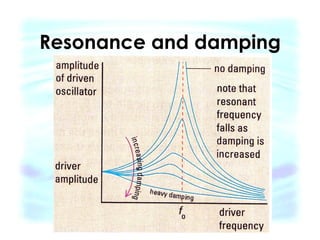
Damping Resonant Amplitude limited by damping forces At resonance: rate of energy supply = WD against damping    forces Increasing damping reduces sharpness + strength of resonance
Types of damping Oscillating masses lose energy   amplitude decreases Light damping: amplitude decreases gradually Critical damping: amplitude decreases can decrease to zero without oscillation. Minimum time = T/4
Q-factors Measure of resonance Definition: number free oscillations a free oscillator competes before decaying to zero * Light damping = large Q factor Heavy damping = small Q factor e.g.  Car = 1 Guitar string = 10 3 Watch quartz crystal = 10 5 * This is only an approximation. Q-factor does have a complicated precise mathematical definition
Resonance and damping
Examples Pushing a child on a swing  – maximum A when pushing    =   o Tuning a radio  – electrical resonance occurs when   o  of tuning circuit adjusted to match    of incoming signal Pipe instruments  -  column of air forced to vibrate. If reed    =   o  of column loud sound produced Rotating machinery  – e.g. washing machine. An out of balance drum will result in violent vibrations at certain speeds
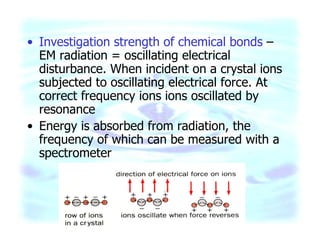
Investigation strength of chemical bonds  – EM radiation = oscillating electrical disturbance. When incident on a crystal ions subjected to oscillating electrical force. At correct frequency ions ions oscillated by resonance Energy is absorbed from radiation, the frequency of which can be measured with a spectrometer
Unwanted resonance Structures/machinery Results in destruction Damping  Changing   o  of object by changing its mass Change stiffness of supports (  moving resonant    away from driving   )
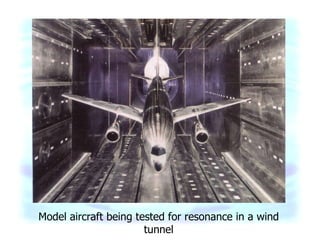
Model aircraft being tested for resonance in a wind tunnel

Free and forced Vibrations

  • 1.
    free and forcedvibrations
  • 2.
    Free oscillators Undampedoscillator Natural frequency,  o No external forces e.g. swing
  • 3.
    Forced oscillators Externalforces act on oscillator Forced/driven oscillator Resonance: driving  =  o e.g. loudspeaker vibrates in response to oscillating electric signal (driver) Barton's pendulums
  • 4.
    Problems Resonance driver applies forces that continually supply energy to oscillator  increasing amplitude A increases indefinitely unless energy transferred away Severe case: A limit reached when oscillator destroys itself e.g. wine glass shatters when opera singer reaches particular note
  • 5.
    Damping Resonant Amplitudelimited by damping forces At resonance: rate of energy supply = WD against damping forces Increasing damping reduces sharpness + strength of resonance
  • 6.
    Types of dampingOscillating masses lose energy  amplitude decreases Light damping: amplitude decreases gradually Critical damping: amplitude decreases can decrease to zero without oscillation. Minimum time = T/4
  • 7.
    Q-factors Measure ofresonance Definition: number free oscillations a free oscillator competes before decaying to zero * Light damping = large Q factor Heavy damping = small Q factor e.g. Car = 1 Guitar string = 10 3 Watch quartz crystal = 10 5 * This is only an approximation. Q-factor does have a complicated precise mathematical definition
  • 8.
  • 9.
    Examples Pushing achild on a swing – maximum A when pushing  =  o Tuning a radio – electrical resonance occurs when  o of tuning circuit adjusted to match  of incoming signal Pipe instruments - column of air forced to vibrate. If reed  =  o of column loud sound produced Rotating machinery – e.g. washing machine. An out of balance drum will result in violent vibrations at certain speeds
  • 10.
    Investigation strength ofchemical bonds – EM radiation = oscillating electrical disturbance. When incident on a crystal ions subjected to oscillating electrical force. At correct frequency ions ions oscillated by resonance Energy is absorbed from radiation, the frequency of which can be measured with a spectrometer
  • 11.
    Unwanted resonance Structures/machineryResults in destruction Damping Changing  o of object by changing its mass Change stiffness of supports (  moving resonant  away from driving  )
  • 12.
    Model aircraft beingtested for resonance in a wind tunnel