CAPACITOR
TOPIC:
Capacitor
Let’s Start…
Topics:
Introduction
Basic structure of capacitor
The characteristics of capacitors
Types of capacitor
Uses of Capacitor
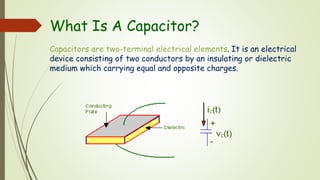
What Is A Capacitor?
Capacitors are two-terminal electrical elements. It is an electrical
device consisting of two conductors by an insulating or dielectric
medium which carrying equal and opposite charges.
History:
• In October 1745, Ewald Georg von Kleist of Pomerania, Germany, found
that charge could be stored by connecting a high-voltage electrostatic
generator by a wire to a volume of water in a hand-held glass jar.Von
Kleist's hand and the water acted as conductors, and the jar as a
dielectric.
• Daniel Gralath was the first to combine several jars in parallel into a
"battery" to increase the charge storage capacity.
• Benjamin Franklin investigated the Leyden jar and came to the
conclusion that the charge was stored on the glass, not in the water as
others had assumed
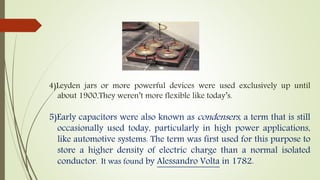
4)Leyden jars or more powerful devices were used exclusively up until
about 1900,They weren’t more flexible like today’s.
5)Early capacitors were also known as condensers, a term that is still
occasionally used today, particularly in high power applications,
like automotive systems. The term was first used for this purpose to
store a higher density of electric charge than a normal isolated
conductor. It was found by Alessandro Volta in 1782.
BASIC STRUCTURE OF CAPACITOR
• A basic capacitor has two parallel plates(Electrode) separated by an insulating material
called dielectric.
• In the neutral state, both plates have an equal number of free electrons.
• When a voltage source is connected to the capacitor, electrons are removed from one
plate and an equal number are deposited on the other plate.
• That moment no electrons flow through the dielectric.
• When the supply is removed from the capacitor, the capacitor retains the stored
charge.
• The unit of capacitance is the farad(F).
as
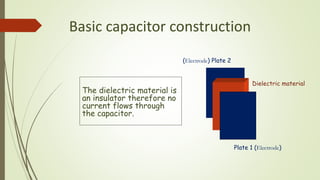
(Electrode) Plate 2
Plate 1 (Electrode)
Dielectric material
Basic capacitor construction
The dielectric material is
an insulator therefore no
current flows through
the capacitor.
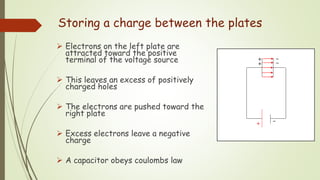
Storing a charge between the plates
 Electrons on the left plate are
attracted toward the positive
terminal of the voltage source
 This leaves an excess of positively
charged holes
 The electrons are pushed toward the
right plate
 Excess electrons leave a negative
charge
 A capacitor obeys coulombs law
+
+
+
_
_
_
Characteristics of Capacitors
There are different kinds of capacitors that have been manufactured. Some
of them may have numeric codes or colors, and some may use misleading
letters or symbols; each family type of capacitor.
The measurement of the nominal value of the capacitance—which is
expressed in picoFarads (pF), nanoFarads (nF) or microfarads (uF)—is
marked onto the body of the capacitor in the form of numbers, letters or
colored bands. The value on the side of a capacitor may not necessarily be
its actual value since the choice of capacitance is determined by the circuit
configuration.
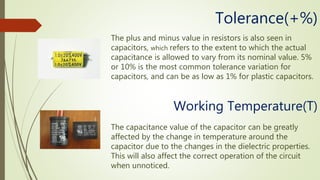
Nominal Capacitance(C)
The plus and minus value in resistors is also seen in
capacitors, which refers to the extent to which the actual
capacitance is allowed to vary from its nominal value. 5%
or 10% is the most common tolerance variation for
capacitors, and can be as low as 1% for plastic capacitors.
Tolerance(+%)
Working Temperature(T)
The capacitance value of the capacitor can be greatly
affected by the change in temperature around the
capacitor due to the changes in the dielectric properties.
This will also affect the correct operation of the circuit
when unnoticed.
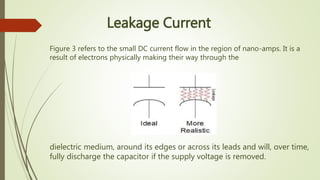
dielectric medium, around its edges or across its leads and will, over time,
fully discharge the capacitor if the supply voltage is removed.
Leakage Current
Figure 3 refers to the small DC current flow in the region of nano-amps. It is a
result of electrons physically making their way through the
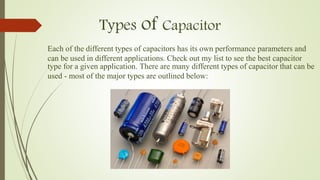
Types of Capacitor
Each of the different types of capacitors has its own performance parameters and
can be used in different applications. Check out my list to see the best capacitor
type for a given application. There are many different types of capacitor that can be
used - most of the major types are outlined below:
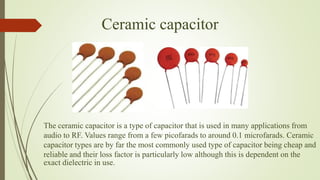
Ceramic capacitor
The ceramic capacitor is a type of capacitor that is used in many applications from
audio to RF. Values range from a few picofarads to around 0.1 microfarads. Ceramic
capacitor types are by far the most commonly used type of capacitor being cheap and
reliable and their loss factor is particularly low although this is dependent on the
exact dielectric in use.
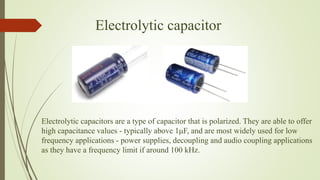
Electrolytic capacitors are a type of capacitor that is polarized. They are able to offer
high capacitance values - typically above 1μF, and are most widely used for low
frequency applications - power supplies, decoupling and audio coupling applications
as they have a frequency limit if around 100 kHz.
Electrolytic capacitor
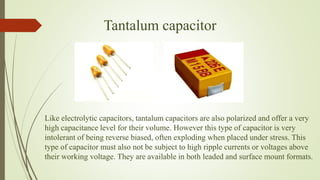
Tantalum capacitor
Like electrolytic capacitors, tantalum capacitors are also polarized and offer a very
high capacitance level for their volume. However this type of capacitor is very
intolerant of being reverse biased, often exploding when placed under stress. This
type of capacitor must also not be subject to high ripple currents or voltages above
their working voltage. They are available in both leaded and surface mount formats.
USES OF CAPACITOR
Spike Suppression
Computer Memory
Noise Filtering
Timer Circuits
Condenser Microphones
Supplemental Power Source
USES OF CAPACITOR
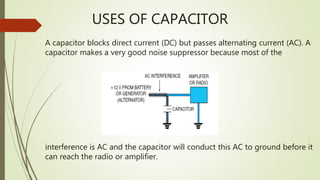
interference is AC and the capacitor will conduct this AC to ground before it
can reach the radio or amplifier.
A capacitor blocks direct current (DC) but passes alternating current (AC). A
capacitor makes a very good noise suppressor because most of the
USES OF CAPACITOR
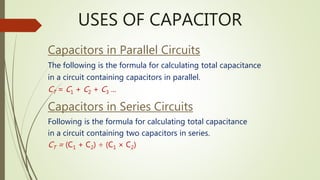
Capacitors in Parallel Circuits
The following is the formula for calculating total capacitance
in a circuit containing capacitors in parallel.
CT = C1 + C2 + C3 ...
Capacitors in Series Circuits
Following is the formula for calculating total capacitance
in a circuit containing two capacitors in series.
CT = (C1 + C2) ÷ (C1 × C2)
Suppression Capacitors
USES OF CAPACITOR
• Capacitors are installed across many circuits and switching points
to absorb voltage fluctuations.
• Among other applications, they are used across the following:
– The primary circuit of some electronic ignition modules
– The output terminal of most generators (alternators)
– The armature circuit of electric motors
Basic structure of capacitor

Basic structure of capacitor

  • 1.
  • 2.
    Topics: Introduction Basic structure ofcapacitor The characteristics of capacitors Types of capacitor Uses of Capacitor
  • 3.
    What Is ACapacitor? Capacitors are two-terminal electrical elements. It is an electrical device consisting of two conductors by an insulating or dielectric medium which carrying equal and opposite charges.
  • 4.
    History: • In October1745, Ewald Georg von Kleist of Pomerania, Germany, found that charge could be stored by connecting a high-voltage electrostatic generator by a wire to a volume of water in a hand-held glass jar.Von Kleist's hand and the water acted as conductors, and the jar as a dielectric. • Daniel Gralath was the first to combine several jars in parallel into a "battery" to increase the charge storage capacity. • Benjamin Franklin investigated the Leyden jar and came to the conclusion that the charge was stored on the glass, not in the water as others had assumed
  • 5.
    4)Leyden jars ormore powerful devices were used exclusively up until about 1900,They weren’t more flexible like today’s. 5)Early capacitors were also known as condensers, a term that is still occasionally used today, particularly in high power applications, like automotive systems. The term was first used for this purpose to store a higher density of electric charge than a normal isolated conductor. It was found by Alessandro Volta in 1782.
  • 6.
    BASIC STRUCTURE OFCAPACITOR • A basic capacitor has two parallel plates(Electrode) separated by an insulating material called dielectric. • In the neutral state, both plates have an equal number of free electrons. • When a voltage source is connected to the capacitor, electrons are removed from one plate and an equal number are deposited on the other plate. • That moment no electrons flow through the dielectric. • When the supply is removed from the capacitor, the capacitor retains the stored charge. • The unit of capacitance is the farad(F).
  • 7.
    as (Electrode) Plate 2 Plate1 (Electrode) Dielectric material Basic capacitor construction The dielectric material is an insulator therefore no current flows through the capacitor.
  • 8.
    Storing a chargebetween the plates  Electrons on the left plate are attracted toward the positive terminal of the voltage source  This leaves an excess of positively charged holes  The electrons are pushed toward the right plate  Excess electrons leave a negative charge  A capacitor obeys coulombs law + + + _ _ _
  • 9.
    Characteristics of Capacitors Thereare different kinds of capacitors that have been manufactured. Some of them may have numeric codes or colors, and some may use misleading letters or symbols; each family type of capacitor. The measurement of the nominal value of the capacitance—which is expressed in picoFarads (pF), nanoFarads (nF) or microfarads (uF)—is marked onto the body of the capacitor in the form of numbers, letters or colored bands. The value on the side of a capacitor may not necessarily be its actual value since the choice of capacitance is determined by the circuit configuration. Nominal Capacitance(C)
  • 10.
    The plus andminus value in resistors is also seen in capacitors, which refers to the extent to which the actual capacitance is allowed to vary from its nominal value. 5% or 10% is the most common tolerance variation for capacitors, and can be as low as 1% for plastic capacitors. Tolerance(+%) Working Temperature(T) The capacitance value of the capacitor can be greatly affected by the change in temperature around the capacitor due to the changes in the dielectric properties. This will also affect the correct operation of the circuit when unnoticed.
  • 11.
    dielectric medium, aroundits edges or across its leads and will, over time, fully discharge the capacitor if the supply voltage is removed. Leakage Current Figure 3 refers to the small DC current flow in the region of nano-amps. It is a result of electrons physically making their way through the
  • 12.
    Types of Capacitor Eachof the different types of capacitors has its own performance parameters and can be used in different applications. Check out my list to see the best capacitor type for a given application. There are many different types of capacitor that can be used - most of the major types are outlined below:
  • 13.
    Ceramic capacitor The ceramiccapacitor is a type of capacitor that is used in many applications from audio to RF. Values range from a few picofarads to around 0.1 microfarads. Ceramic capacitor types are by far the most commonly used type of capacitor being cheap and reliable and their loss factor is particularly low although this is dependent on the exact dielectric in use.
  • 14.
    Electrolytic capacitors area type of capacitor that is polarized. They are able to offer high capacitance values - typically above 1μF, and are most widely used for low frequency applications - power supplies, decoupling and audio coupling applications as they have a frequency limit if around 100 kHz. Electrolytic capacitor
  • 15.
    Tantalum capacitor Like electrolyticcapacitors, tantalum capacitors are also polarized and offer a very high capacitance level for their volume. However this type of capacitor is very intolerant of being reverse biased, often exploding when placed under stress. This type of capacitor must also not be subject to high ripple currents or voltages above their working voltage. They are available in both leaded and surface mount formats.
  • 16.
    USES OF CAPACITOR SpikeSuppression Computer Memory Noise Filtering Timer Circuits Condenser Microphones Supplemental Power Source
  • 17.
    USES OF CAPACITOR interferenceis AC and the capacitor will conduct this AC to ground before it can reach the radio or amplifier. A capacitor blocks direct current (DC) but passes alternating current (AC). A capacitor makes a very good noise suppressor because most of the
  • 18.
    USES OF CAPACITOR Capacitorsin Parallel Circuits The following is the formula for calculating total capacitance in a circuit containing capacitors in parallel. CT = C1 + C2 + C3 ... Capacitors in Series Circuits Following is the formula for calculating total capacitance in a circuit containing two capacitors in series. CT = (C1 + C2) ÷ (C1 × C2)
  • 19.
    Suppression Capacitors USES OFCAPACITOR • Capacitors are installed across many circuits and switching points to absorb voltage fluctuations. • Among other applications, they are used across the following: – The primary circuit of some electronic ignition modules – The output terminal of most generators (alternators) – The armature circuit of electric motors