Resistance
Resistance
Resistance defined as an obstacle to the flow of
electric current.
Is the opposition offered by any object to the passage
of an electric current through it.
Unit: Ohm ( Ω )
Resistance Equation
Resistance=Voltage/Current
R=V/I
• Resistance is measured in ohms
• Voltage in volts(V),Current in
amps(I)
• You can rearrange the equation to
find voltage & current
R=V/I
V=R*I
I=V/R
Resistors
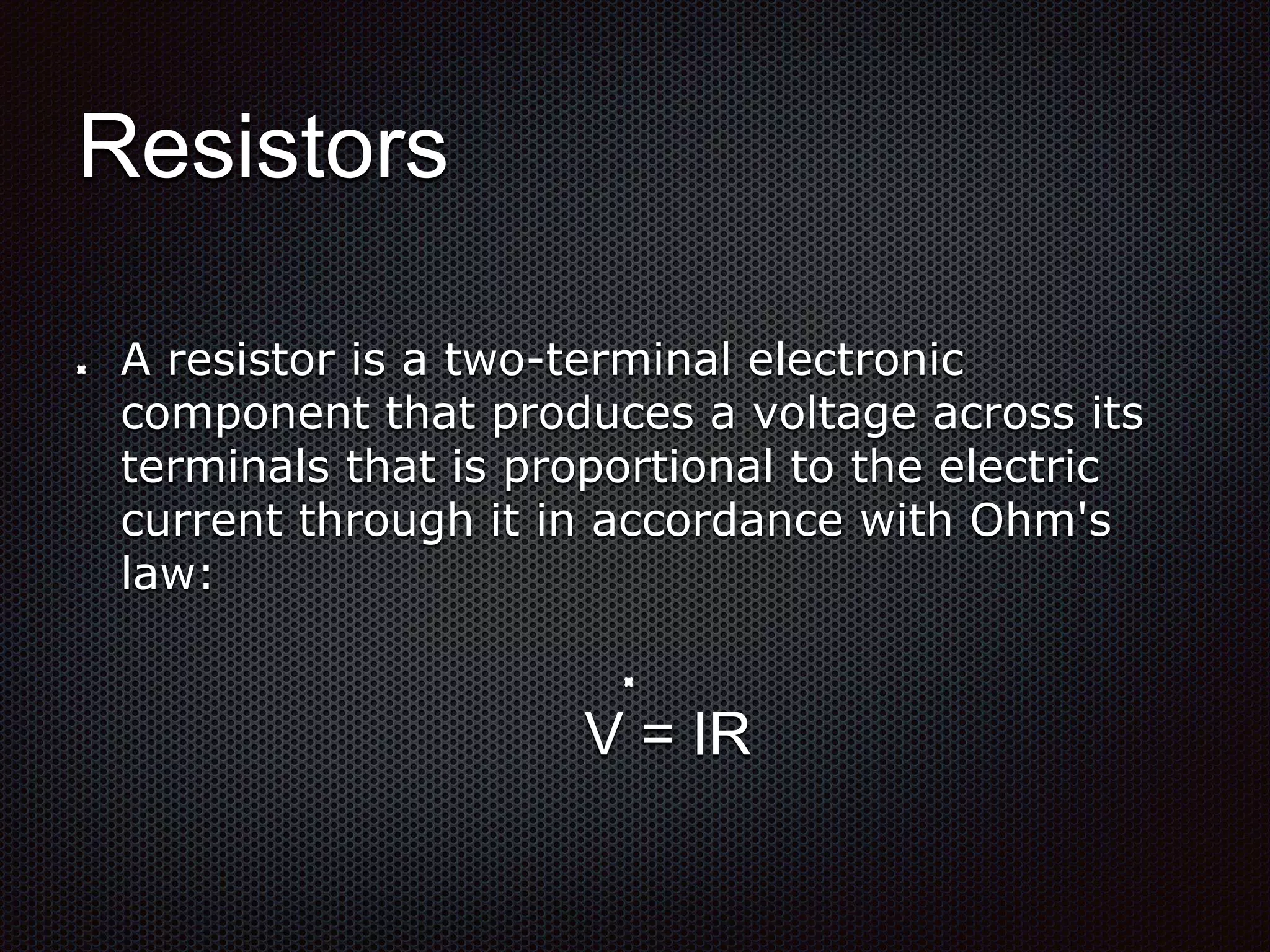
A resistor is a two-terminal electronic
component that produces a voltage across its
terminals that is proportional to the electric
current through it in accordance with Ohm's
law:
V = IR
RESISTOR IN SERIES
The total resistance of resistors in series is equal to
the sum of their individual resistances.
RESISTOR IN PARALLEL
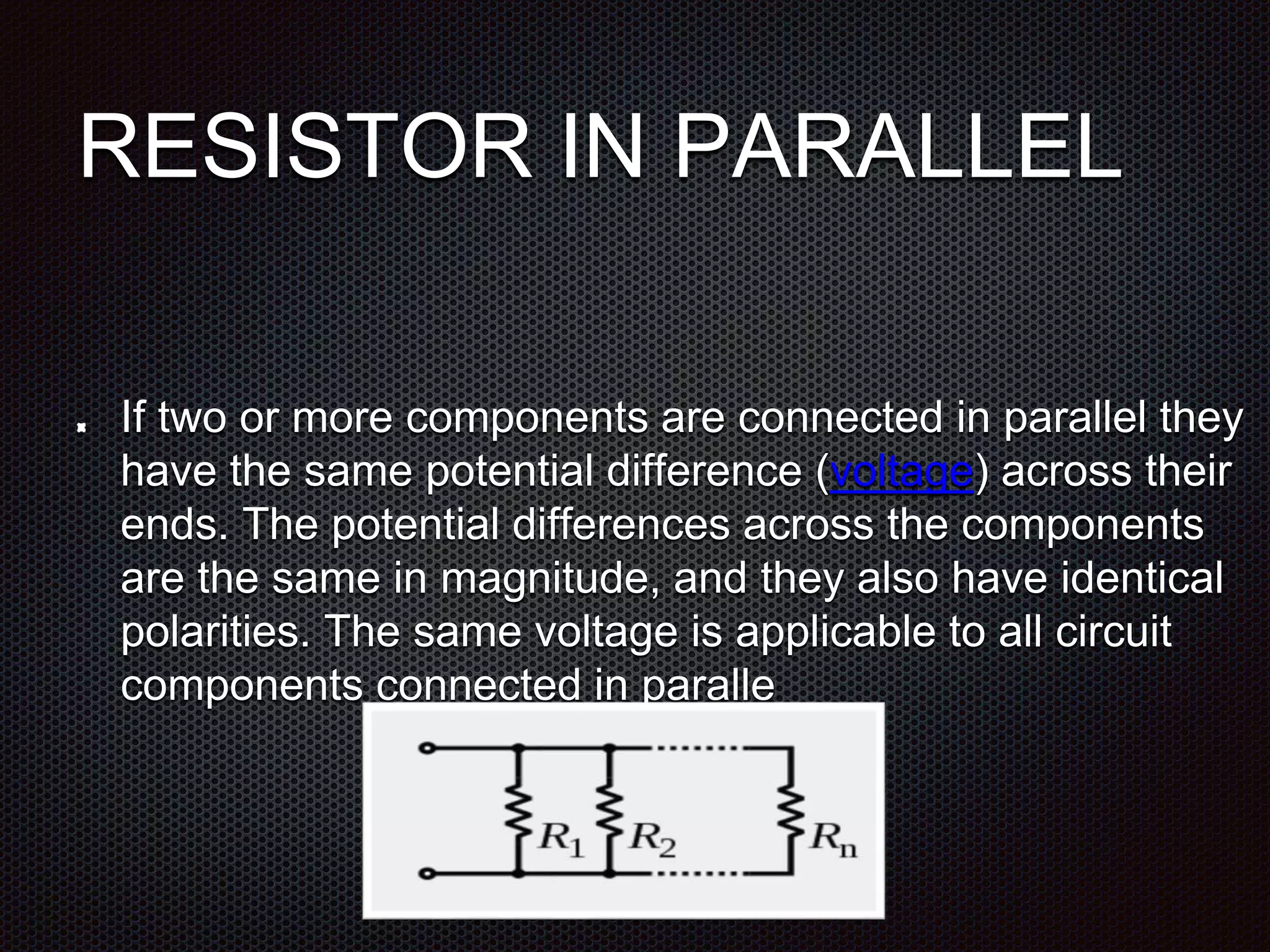
If two or more components are connected in parallel they
have the same potential difference (voltage) across their
ends. The potential differences across the components
are the same in magnitude, and they also have identical
polarities. The same voltage is applicable to all circuit
components connected in paralle
TextTypes Of Resistors
FIXED RESISTORS.
VARIABLE RESISTORS.
SPECIAL RESISTORS.
Text
Fixed Resistors
These resistors have a fixed resistance in order to
control the size of currents and voltages.Resistors are
included in circuits so that the correct voltage is applied
across the bulb and the correct current flows through it.
Text
Variable Resistors
These resistors have different resistance and
it's possible to alter their resistance.when you
alter the volume of television or speed of a
fan you use a variable resistor to do so
Text
Special Resistors
Diodes, Thermistor, LDR
Diodes
Diodes are resistors that
direct the flow of current
in one direction.
Used in rectifier circuit
to convert AC to DC.
Thermistors
A resistor whose resistance
changes with the temperature
Resistance of a thermistor⬇️
as the temperature⬆️
Eg:Temperature sensors in
fire alarms
High Temperature
Low Temperature
I
V
Light Dependent Resistors
(LDR)
A resistor whose
resistance depends on
light intensity
Resistance of a LDR⬇️ as light
intensity⬆️
Eg:Photographic equipment,
automatic lighting control, some
garage, gates
I
V
Bright light
Low light
Factors Affecting Resistance
Length
Resistance of a conductor is directly proportional
to the length of the wire i.e., longer the wire
greater will be the resistance and shorter the wire
smaller will be the resistance. If L represents the
length of the uniform wire, then
R  L
Diameter (Cross-sectional area)
Resistance of a conductor is inversely
proportional to the area of the cross-section of
the uniform wire. That means, thinner the wire,
greater the resistance and thicker the wire,
lower the resistance. If A is the area of cross-
section of the uniform wire, then,
Temperature
• The resistance of a metallic conductor
increases as the temperature increases
e.g. copper
• The resistance of a
semiconductor/insulator decreases as the
temperature increases
APPLICATION OF
RESISTANCE
The most common applications of large-scale
resistance ,
 automotive industry,
 aerospace industry,
railway industry,
 food and beverage industry,
nuclear industry,
solar industry,
 material handling industry,
 military/defense industry
THANK YOU

Resistance

  • 1.
  • 2.
    Resistance Resistance defined asan obstacle to the flow of electric current. Is the opposition offered by any object to the passage of an electric current through it. Unit: Ohm ( Ω )
  • 3.
    Resistance Equation Resistance=Voltage/Current R=V/I • Resistanceis measured in ohms • Voltage in volts(V),Current in amps(I) • You can rearrange the equation to find voltage & current R=V/I V=R*I I=V/R
  • 4.
    Resistors A resistor isa two-terminal electronic component that produces a voltage across its terminals that is proportional to the electric current through it in accordance with Ohm's law: V = IR
  • 5.
    RESISTOR IN SERIES Thetotal resistance of resistors in series is equal to the sum of their individual resistances.
  • 6.
    RESISTOR IN PARALLEL Iftwo or more components are connected in parallel they have the same potential difference (voltage) across their ends. The potential differences across the components are the same in magnitude, and they also have identical polarities. The same voltage is applicable to all circuit components connected in paralle
  • 7.
    TextTypes Of Resistors FIXEDRESISTORS. VARIABLE RESISTORS. SPECIAL RESISTORS.
  • 8.
    Text Fixed Resistors These resistorshave a fixed resistance in order to control the size of currents and voltages.Resistors are included in circuits so that the correct voltage is applied across the bulb and the correct current flows through it.
  • 9.
    Text Variable Resistors These resistorshave different resistance and it's possible to alter their resistance.when you alter the volume of television or speed of a fan you use a variable resistor to do so
  • 10.
  • 11.
    Diodes Diodes are resistorsthat direct the flow of current in one direction. Used in rectifier circuit to convert AC to DC.
  • 12.
    Thermistors A resistor whoseresistance changes with the temperature Resistance of a thermistor⬇️ as the temperature⬆️ Eg:Temperature sensors in fire alarms High Temperature Low Temperature I V
  • 13.
    Light Dependent Resistors (LDR) Aresistor whose resistance depends on light intensity Resistance of a LDR⬇️ as light intensity⬆️ Eg:Photographic equipment, automatic lighting control, some garage, gates I V Bright light Low light
  • 14.
  • 15.
    Length Resistance of aconductor is directly proportional to the length of the wire i.e., longer the wire greater will be the resistance and shorter the wire smaller will be the resistance. If L represents the length of the uniform wire, then R  L
  • 16.
    Diameter (Cross-sectional area) Resistanceof a conductor is inversely proportional to the area of the cross-section of the uniform wire. That means, thinner the wire, greater the resistance and thicker the wire, lower the resistance. If A is the area of cross- section of the uniform wire, then,
  • 17.
    Temperature • The resistanceof a metallic conductor increases as the temperature increases e.g. copper • The resistance of a semiconductor/insulator decreases as the temperature increases
  • 18.
    APPLICATION OF RESISTANCE The mostcommon applications of large-scale resistance ,  automotive industry,  aerospace industry, railway industry,  food and beverage industry, nuclear industry, solar industry,  material handling industry,  military/defense industry
  • 19.