Capacitors
Qafqaz Univeristeti:
Fizika muəllimliyi(eng):
Səid Paşayev
What is capacitor??????
Anyone can say???
Yes we are listening to you…
Capacitors
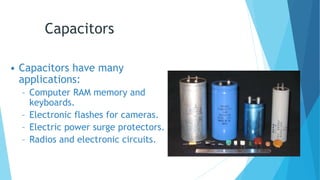
• Capacitors have many
applications:
– Computer RAM memory and
keyboards.
– Electronic flashes for cameras.
– Electric power surge protectors.
– Radios and electronic circuits.
Electronic Components
 Capacitors are
electronic components
that store charge
efficiently
 They can be charged
and discharged very
quickly and hold their
charge indefinitely
 Symbol
The structure of the capacitor
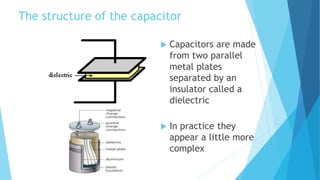
 Capacitors are made
from two parallel
metal plates
separated by an
insulator called a
dielectric
 In practice they
appear a little more
complex
Capacitors and Capacitance
Charge Q stored:
CVQ 
The stored charge Q is proportional to the potential
difference V between the plates. The capacitance C is
the constant of proportionality, measured in Farads.
Farad = Coulomb / Volt
A capacitor in a simple
electric circuit.
Capacitance (symbol C)
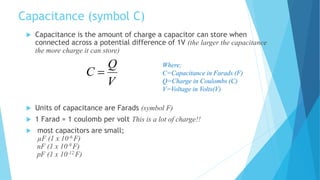
 Capacitance is the amount of charge a capacitor can store when
connected across a potential difference of 1V (the larger the capacitance
the more charge it can store)
 Units of capacitance are Farads (symbol F)
 1 Farad = 1 coulomb per volt This is a lot of charge!!
 most capacitors are small;
µF (1 x 10⁻⁶ F)
nF (1 x 10⁻⁹ F)
pF (1 x 10-12 F)
V
Q
C 
Where;
C=Capacitance in Farads (F)
Q=Charge in Coulombs (C)
V=Voltage in Volts(V)
Exercises
1. Calculate the capacitance of a capacitor that stores 1.5 
10-9C at 7.2V?
Capacitance (C)
Three factors determine
capacitance;
1. The area of the plates (CA)
2. The distance separating the
plates
(C  )
3. The properties of the dielectric
(εr)
so
C= constant x
d
1
d
A
 If there is air or a vacuum between the plates the
constant is;
the absolute permittivity of free space (symbol ε0)
(ε0 = 8.84 x 10⁻¹² Fm-1)
so;
d
A
C 0

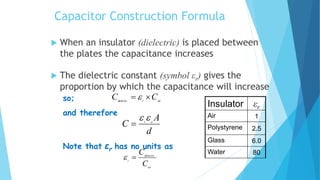
Capacitor Construction Formula
 When an insulator (dielectric) is placed between
the plates the capacitance increases
 The dielectric constant (symbol εr) gives the
proportion by which the capacitance will increase
so;
and therefore
Note that εr has no units as
d
A
C or


airrdielectic
CC  
air
dielectric
r
C
C

Insulator εr
Air 1
Polystyrene 2.5
Glass 6.0
Water 80
Capacitor Construction Formula
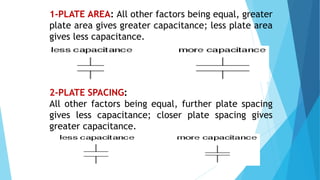
1-PLATE AREA: All other factors being equal, greater
plate area gives greater capacitance; less plate area
gives less capacitance.
2-PLATE SPACING:
All other factors being equal, further plate spacing
gives less capacitance; closer plate spacing gives
greater capacitance.
3-DIELECTRIC MATERIAL: All other factors being
equal, greater permittivity of the dielectric gives
greater capacitance; less permittivity of the
dielectric gives less capacitance.
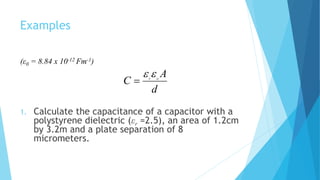
Examples
1. Calculate the capacitance of a capacitor with a
polystyrene dielectric (εr =2.5), an area of 1.2cm
by 3.2m and a plate separation of 8
micrometers.
d
A
C or


(ε0 = 8.84 x 10⁻¹² Fm-1)
Combination of
capacitors
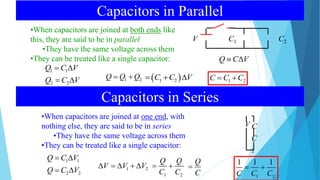
Capacitors in Parallel
V C1 C2
Q C V 
•When capacitors are joined at both ends like
this, they are said to be in parallel
•They have the same voltage across them
•They can be treated like a single capacitor:
1 1
2 2
Q C V
Q C V
 
  1 2Q Q Q   1 2C C V   1 2C C C 
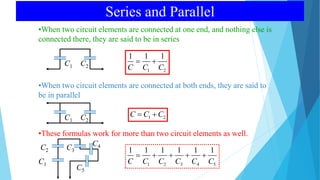
•When capacitors are joined at one end, with
nothing else, they are said to be in series
•They have the same voltage across them
•They can be treated like a single capacitor:
V C
1C
2
1 1
2 2
Q C V
Q C V
 
  1 2
Q Q
C C
 1 2V V V    
Q
C

1 2
1 1 1
C C C
 
Capacitors in Series
Series and Parallel
•When two circuit elements are connected at one end, and nothing else is
connected there, they are said to be in series
1 2
1 1 1
C C C
 
•When two circuit elements are connected at both ends, they are said to
be in parallel
1 2C C C 
C1 C2
C1 C2
•These formulas work for more than two circuit elements as well.
C1
C2 C3
C4
C5
1 2 3 4 5
1 1 1 1 1 1
C C C C C C
    
Examples
1. A circuit has three 330 μF capacitors in
series. Calculate the total capacitance of the
circuit
2. Another circuit has three 330 μF
capacitors in parallel. Calculate the total
capacitance of the circuit.
• Find the equivalent capacitance seen
between terminals a and b of the circuit
in Figure.
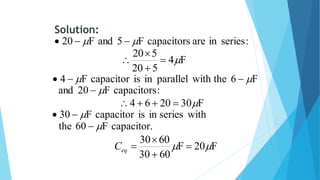
Solution:
:seriesinarecapacitorsF5andF20  
F4
520
520




F6with theparalleliniscapacitorF4  
:capacitorsF20and 
F302064 
withseriesiniscapacitorF30 
capacitor.F60the 
F20F
6030
6030
 


eqC
Problems solve at home:
1. A 330μF capacitor is charged by a 9.0V battery. How
much charge will it store?
2. A 0.1μF capacitor stores 1.5  10-7 C of the charge.
What was the voltage used to charge it?
3. Calculate the plate area required for a 1000 μF, glass
(εr=6.0) capacitor, with a plate separation of 2.8
micrometres.
4. Calculate the dielectic constant of a 10000 μF
capacitor with a 1.2μm plate separation and an area
of 16.97m2
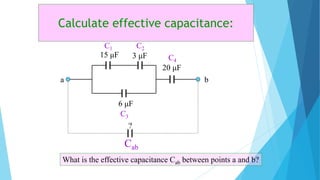
Calculate effective capacitance:
a b
15 μF 3 μF
6 μF
What is the effective capacitance Cab between points a and b?
20 μF
C1 C2
C3
C4
Cab
?

Capacitors

  • 1.
  • 2.
    What is capacitor?????? Anyonecan say??? Yes we are listening to you…
  • 3.
    Capacitors • Capacitors havemany applications: – Computer RAM memory and keyboards. – Electronic flashes for cameras. – Electric power surge protectors. – Radios and electronic circuits.
  • 4.
    Electronic Components  Capacitorsare electronic components that store charge efficiently  They can be charged and discharged very quickly and hold their charge indefinitely  Symbol
  • 5.
    The structure ofthe capacitor  Capacitors are made from two parallel metal plates separated by an insulator called a dielectric  In practice they appear a little more complex
  • 6.
    Capacitors and Capacitance ChargeQ stored: CVQ  The stored charge Q is proportional to the potential difference V between the plates. The capacitance C is the constant of proportionality, measured in Farads. Farad = Coulomb / Volt A capacitor in a simple electric circuit.
  • 7.
    Capacitance (symbol C) Capacitance is the amount of charge a capacitor can store when connected across a potential difference of 1V (the larger the capacitance the more charge it can store)  Units of capacitance are Farads (symbol F)  1 Farad = 1 coulomb per volt This is a lot of charge!!  most capacitors are small; µF (1 x 10⁻⁶ F) nF (1 x 10⁻⁹ F) pF (1 x 10-12 F) V Q C  Where; C=Capacitance in Farads (F) Q=Charge in Coulombs (C) V=Voltage in Volts(V)
  • 8.
    Exercises 1. Calculate thecapacitance of a capacitor that stores 1.5  10-9C at 7.2V?
  • 9.
    Capacitance (C) Three factorsdetermine capacitance; 1. The area of the plates (CA) 2. The distance separating the plates (C  ) 3. The properties of the dielectric (εr) so C= constant x d 1 d A
  • 10.
     If thereis air or a vacuum between the plates the constant is; the absolute permittivity of free space (symbol ε0) (ε0 = 8.84 x 10⁻¹² Fm-1) so; d A C 0  Capacitor Construction Formula
  • 11.
     When aninsulator (dielectric) is placed between the plates the capacitance increases  The dielectric constant (symbol εr) gives the proportion by which the capacitance will increase so; and therefore Note that εr has no units as d A C or   airrdielectic CC   air dielectric r C C  Insulator εr Air 1 Polystyrene 2.5 Glass 6.0 Water 80 Capacitor Construction Formula
  • 12.
    1-PLATE AREA: Allother factors being equal, greater plate area gives greater capacitance; less plate area gives less capacitance. 2-PLATE SPACING: All other factors being equal, further plate spacing gives less capacitance; closer plate spacing gives greater capacitance.
  • 13.
    3-DIELECTRIC MATERIAL: Allother factors being equal, greater permittivity of the dielectric gives greater capacitance; less permittivity of the dielectric gives less capacitance.
  • 14.
    Examples 1. Calculate thecapacitance of a capacitor with a polystyrene dielectric (εr =2.5), an area of 1.2cm by 3.2m and a plate separation of 8 micrometers. d A C or   (ε0 = 8.84 x 10⁻¹² Fm-1)
  • 15.
  • 16.
    Capacitors in Parallel VC1 C2 Q C V  •When capacitors are joined at both ends like this, they are said to be in parallel •They have the same voltage across them •They can be treated like a single capacitor: 1 1 2 2 Q C V Q C V     1 2Q Q Q   1 2C C V   1 2C C C  •When capacitors are joined at one end, with nothing else, they are said to be in series •They have the same voltage across them •They can be treated like a single capacitor: V C 1C 2 1 1 2 2 Q C V Q C V     1 2 Q Q C C  1 2V V V     Q C  1 2 1 1 1 C C C   Capacitors in Series
  • 17.
    Series and Parallel •Whentwo circuit elements are connected at one end, and nothing else is connected there, they are said to be in series 1 2 1 1 1 C C C   •When two circuit elements are connected at both ends, they are said to be in parallel 1 2C C C  C1 C2 C1 C2 •These formulas work for more than two circuit elements as well. C1 C2 C3 C4 C5 1 2 3 4 5 1 1 1 1 1 1 C C C C C C     
  • 18.
    Examples 1. A circuithas three 330 μF capacitors in series. Calculate the total capacitance of the circuit 2. Another circuit has three 330 μF capacitors in parallel. Calculate the total capacitance of the circuit.
  • 19.
    • Find theequivalent capacitance seen between terminals a and b of the circuit in Figure.
  • 20.
    Solution: :seriesinarecapacitorsF5andF20   F4 520 520     F6withtheparalleliniscapacitorF4   :capacitorsF20and  F302064  withseriesiniscapacitorF30  capacitor.F60the  F20F 6030 6030     eqC
  • 21.
    Problems solve athome: 1. A 330μF capacitor is charged by a 9.0V battery. How much charge will it store? 2. A 0.1μF capacitor stores 1.5  10-7 C of the charge. What was the voltage used to charge it? 3. Calculate the plate area required for a 1000 μF, glass (εr=6.0) capacitor, with a plate separation of 2.8 micrometres. 4. Calculate the dielectic constant of a 10000 μF capacitor with a 1.2μm plate separation and an area of 16.97m2
  • 22.
    Calculate effective capacitance: ab 15 μF 3 μF 6 μF What is the effective capacitance Cab between points a and b? 20 μF C1 C2 C3 C4 Cab ?