OBJECTIVE OF LECTURE
 Principle, construction and how charge is stored in
the capacitor
 Electrical properties of a capacitor
 Several types of capacitors
 Charging and discharging of capacitors
 Capacitive reactance
 Uses
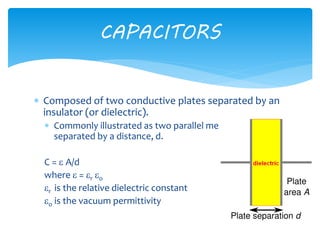
 Composed of two conductive plates separated by an
insulator (or dielectric).
 Commonly illustrated as two parallel metal plates
separated by a distance, d.
C = e A/d
where e = er eo
er is the relative dielectric constant
eo is the vacuum permittivity
CAPACITORS
Capacitance increases with
increasing surface area of the plates,
decreasing spacing between plates, and
increasing the relative dielectric constant of
the insulator between the two plates.
EFFECT OF DIMENSIONS
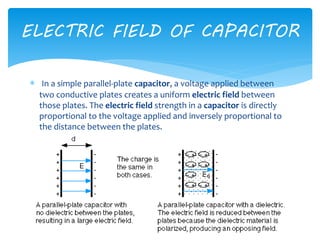
Charge separation in a parallel-plate capacitor
causes an internal electric field. A dielectric
(orange) reduces the field and increases the
capacitance.
EFFECT OF DIELECTRIC ON
CAPACITANCE
o Ceramic capacitor
o Electrolytic capacitor
o Tantalum capacitor
o Silver Mica capacitor
o Polystyrene capacitor
o Metallised polyester film
o Polycarbonate capacitor
o Polypropylene capacitor
o Glass capacitor
o Supercapacitor
TYPES OF CAPACITORS
The basic construction of all capacitors is
similar. The construction of capacitor is very
simple. A capacitor is made of two electrically
conductive plates placed close to each other,
but they do not touch each other. These
conductive plates are normally made of
materials such as aluminium, brass, or copper.
CONSTRUCTION
 In a simple parallel-plate capacitor, a voltage applied between
two conductive plates creates a uniform electric field between
those plates. The electric field strength in a capacitor is directly
proportional to the voltage applied and inversely proportional to
the distance between the plates.
ELECTRIC FIELD OF CAPACITOR
CHARGING AND DISCHARGING OF
CAPACITOR
Vc
When the Vc
becomes equal
to power
supply voltage
V0 the capacitor
is fully charged.
When the
capacitor
discharges across
the resistor R the
voltage Vc
gradually
decreases and
drops to zero.
The product of resistance R and the capacitance C is
called the time constant t.
t = R * C
A fully charged capacitor discharges to 63% of its
voltage after one time period. After 5 time periods it
has almost completely discharged all of its voltage.
Hence time taken to discharge = 5*time constant
TIME OF DISCHARGE OF
CAPACITOR
Time taken to discharge
the capacitor is,
=R × C
=(3k )×(1000 F)
= 3 sec × 5
= 15 seconds
r
DURATION OF DISCHARGE
 Capacitive reactance (XC) is a measure of
a capacitor's opposition to AC. Like resistance it is
measured in ohms, but it’s more complex than
resistance because its value depends on the.
frequency (f) of the electrical signal passing through
the capacitor as well.
CAPACITIVE REACTANCE
Capacitors are installed across many circuits & switching
points to absorb voltage fluctuation.
 Energy storage
 Power conditioning
 Coupling and Decoupling
 Motor starters
 Oscillators
 Time dependent circuits
USES OF CAPACITORS
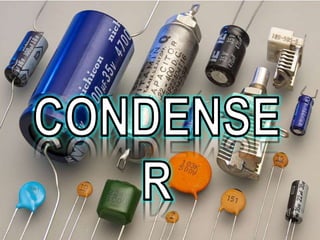
Capacitor aka condenser

Capacitor aka condenser

  • 2.
    OBJECTIVE OF LECTURE Principle, construction and how charge is stored in the capacitor  Electrical properties of a capacitor  Several types of capacitors  Charging and discharging of capacitors  Capacitive reactance  Uses
  • 3.
     Composed oftwo conductive plates separated by an insulator (or dielectric).  Commonly illustrated as two parallel metal plates separated by a distance, d. C = e A/d where e = er eo er is the relative dielectric constant eo is the vacuum permittivity CAPACITORS
  • 4.
    Capacitance increases with increasingsurface area of the plates, decreasing spacing between plates, and increasing the relative dielectric constant of the insulator between the two plates. EFFECT OF DIMENSIONS
  • 5.
    Charge separation ina parallel-plate capacitor causes an internal electric field. A dielectric (orange) reduces the field and increases the capacitance. EFFECT OF DIELECTRIC ON CAPACITANCE
  • 6.
    o Ceramic capacitor oElectrolytic capacitor o Tantalum capacitor o Silver Mica capacitor o Polystyrene capacitor o Metallised polyester film o Polycarbonate capacitor o Polypropylene capacitor o Glass capacitor o Supercapacitor TYPES OF CAPACITORS
  • 7.
    The basic constructionof all capacitors is similar. The construction of capacitor is very simple. A capacitor is made of two electrically conductive plates placed close to each other, but they do not touch each other. These conductive plates are normally made of materials such as aluminium, brass, or copper. CONSTRUCTION
  • 8.
     In asimple parallel-plate capacitor, a voltage applied between two conductive plates creates a uniform electric field between those plates. The electric field strength in a capacitor is directly proportional to the voltage applied and inversely proportional to the distance between the plates. ELECTRIC FIELD OF CAPACITOR
  • 9.
    CHARGING AND DISCHARGINGOF CAPACITOR Vc When the Vc becomes equal to power supply voltage V0 the capacitor is fully charged. When the capacitor discharges across the resistor R the voltage Vc gradually decreases and drops to zero.
  • 10.
    The product ofresistance R and the capacitance C is called the time constant t. t = R * C A fully charged capacitor discharges to 63% of its voltage after one time period. After 5 time periods it has almost completely discharged all of its voltage. Hence time taken to discharge = 5*time constant TIME OF DISCHARGE OF CAPACITOR
  • 11.
    Time taken todischarge the capacitor is, =R × C =(3k )×(1000 F) = 3 sec × 5 = 15 seconds r DURATION OF DISCHARGE
  • 12.
     Capacitive reactance(XC) is a measure of a capacitor's opposition to AC. Like resistance it is measured in ohms, but it’s more complex than resistance because its value depends on the. frequency (f) of the electrical signal passing through the capacitor as well. CAPACITIVE REACTANCE
  • 13.
    Capacitors are installedacross many circuits & switching points to absorb voltage fluctuation.  Energy storage  Power conditioning  Coupling and Decoupling  Motor starters  Oscillators  Time dependent circuits USES OF CAPACITORS