interference
Conditions for interference Sound waves Light waves Young’s double slit experiment
Conditions for interference All waves exhibit interference  Constrictive Destructive  For Interference: The sources must be coherent. The sources should be monochromatic
Sound waves
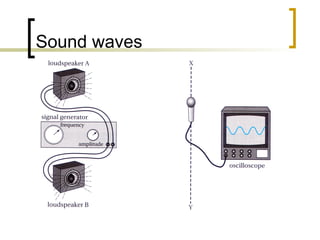
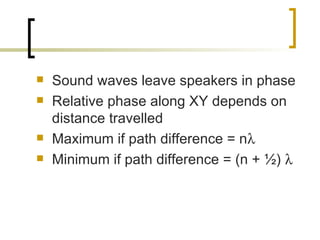
Sound waves leave speakers in phase Relative phase along XY depends on distance travelled Maximum if path difference = n  Minimum if path difference = (n + ½)  
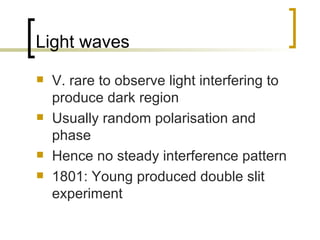
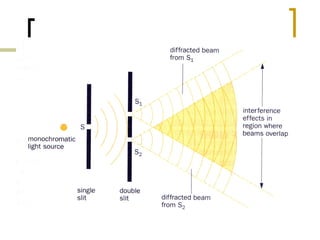
Light waves V. rare to observe light interfering to produce dark region Usually random polarisation and phase Hence no steady interference pattern 1801: Young produced double slit experiment
 
 
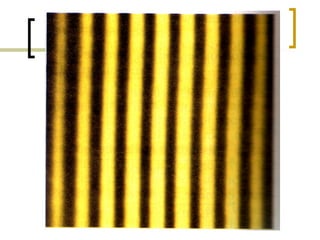
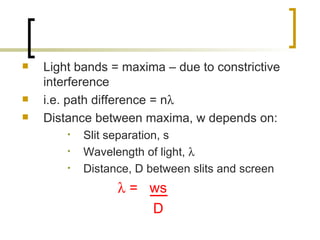
Light bands = maxima – due to constrictive interference i.e. path difference = n  Distance between maxima, w depends on: Slit separation, s  Wavelength of light,   Distance, D between slits and screen      =  ws   D

Interference

  • 1.
  • 2.
    Conditions for interferenceSound waves Light waves Young’s double slit experiment
  • 3.
    Conditions for interferenceAll waves exhibit interference Constrictive Destructive For Interference: The sources must be coherent. The sources should be monochromatic
  • 4.
  • 5.
    Sound waves leavespeakers in phase Relative phase along XY depends on distance travelled Maximum if path difference = n  Minimum if path difference = (n + ½) 
  • 6.
    Light waves V.rare to observe light interfering to produce dark region Usually random polarisation and phase Hence no steady interference pattern 1801: Young produced double slit experiment
  • 7.
  • 8.
  • 9.
    Light bands =maxima – due to constrictive interference i.e. path difference = n  Distance between maxima, w depends on: Slit separation, s Wavelength of light,  Distance, D between slits and screen  = ws D