13.1.1 simple harmonic motion Part 2: translating circular motion to simple harmonic
Simple harmonic motion Linear motion: a - constant in size + direction Circular motion: a - constant in size only Oscillatory motion: a changes periodically in size + direction (like  x  and   ) SHM is a special form of oscillating motion Pendulums and masses on springs exhibit SHM A body oscillates with SHM if the displacement changes sinusodially
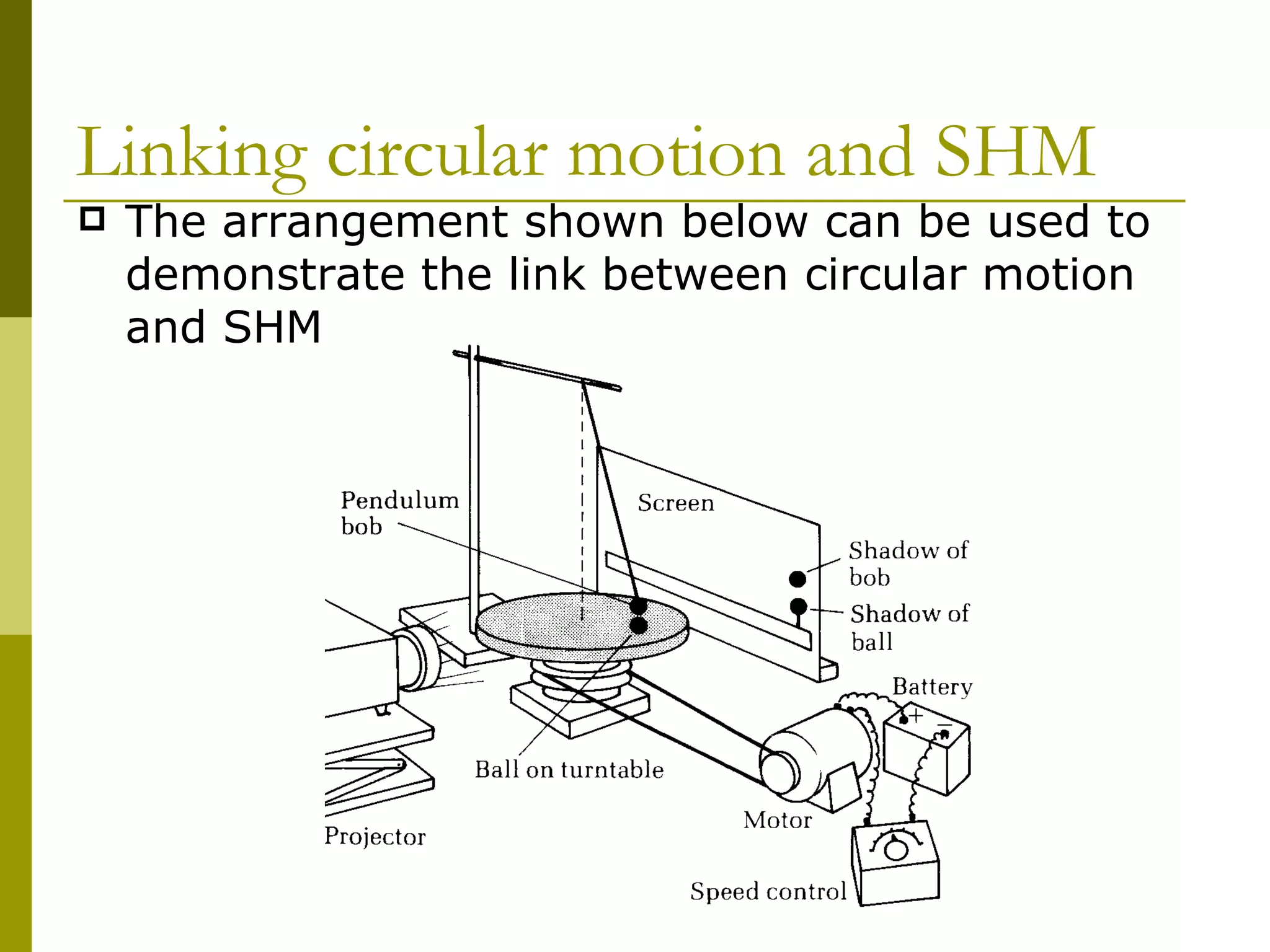
Linking circular motion and SHM The arrangement shown below can be used to demonstrate the link between circular motion and SHM
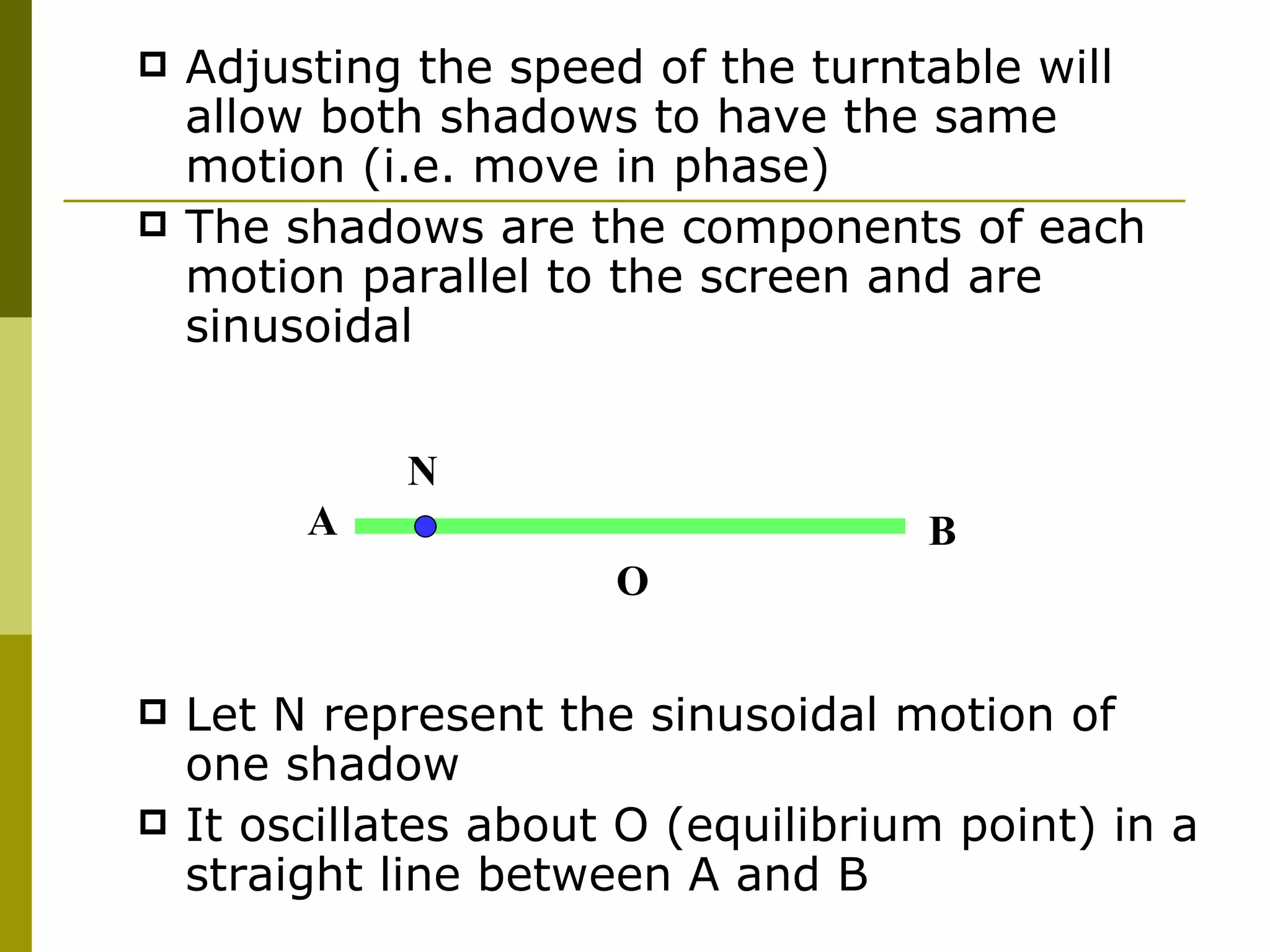
Adjusting the speed of the turntable will allow both shadows to have the same motion (i.e. move in phase) The shadows are the components of each motion parallel to the screen and are sinusoidal Let N represent the sinusoidal motion of one shadow It oscillates about O (equilibrium point) in a straight line between A and B O N A B
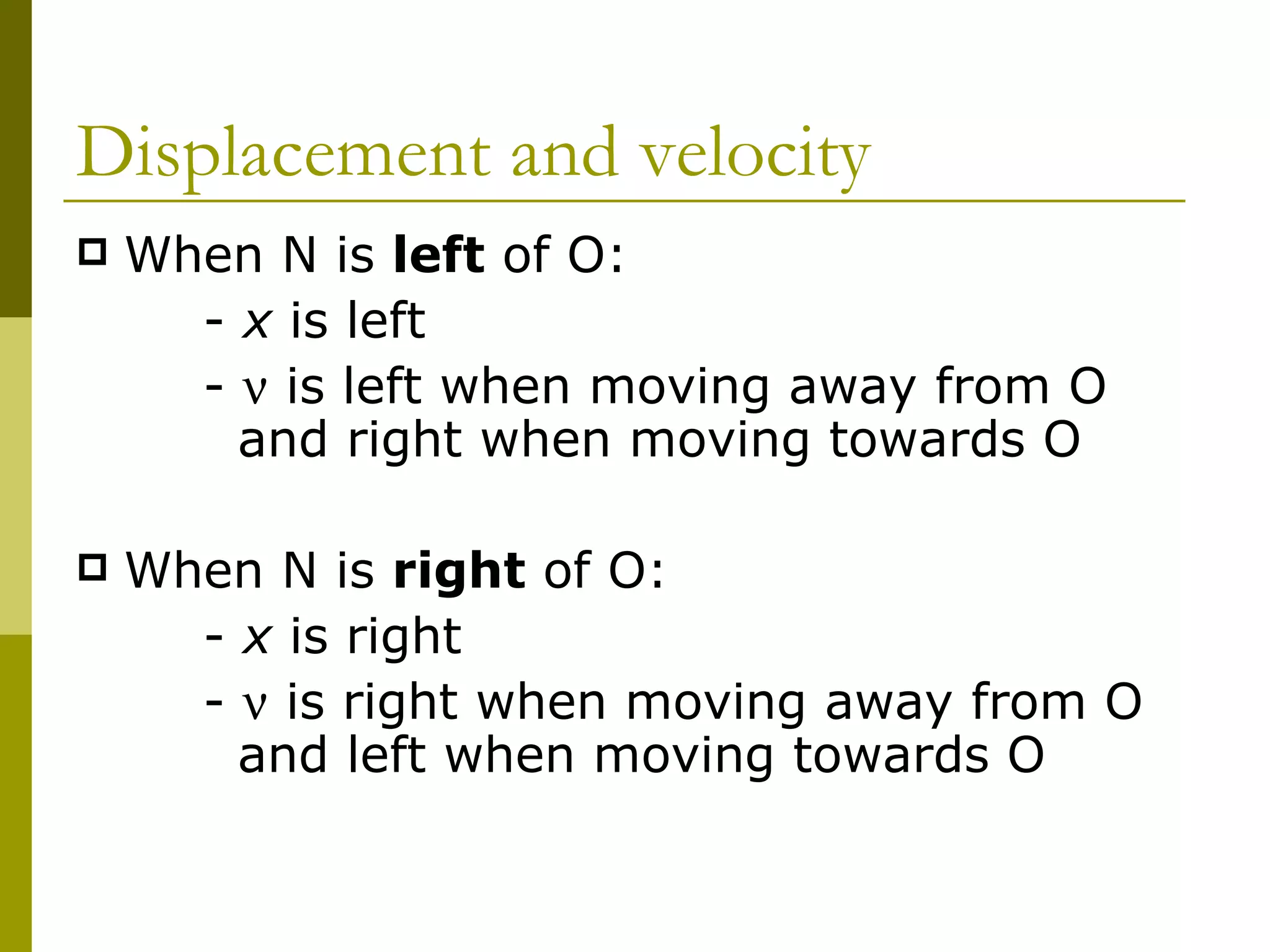
Displacement and velocity When N is  left  of O: -  x  is left -    is left when moving away from O    and right when moving towards O When N is  right  of O: -  x  is right -    is right when moving away from O    and left when moving towards O
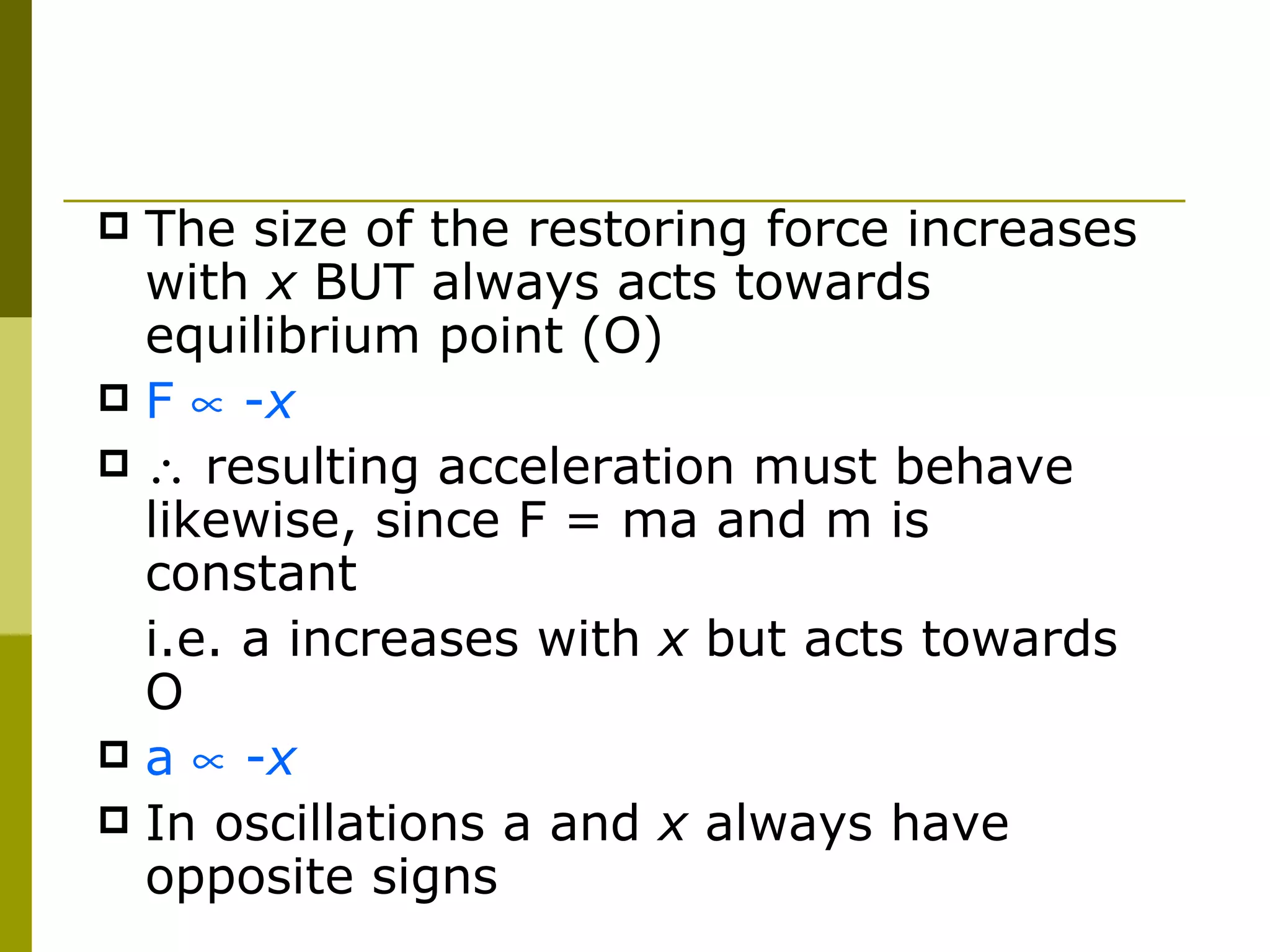
The size of the restoring force increases with  x  BUT always acts towards equilibrium point (O) F    - x   resulting acceleration must behave likewise, since F = ma and m is constant i.e. a increases with  x  but acts towards O a    - x In oscillations a and  x  always have opposite signs
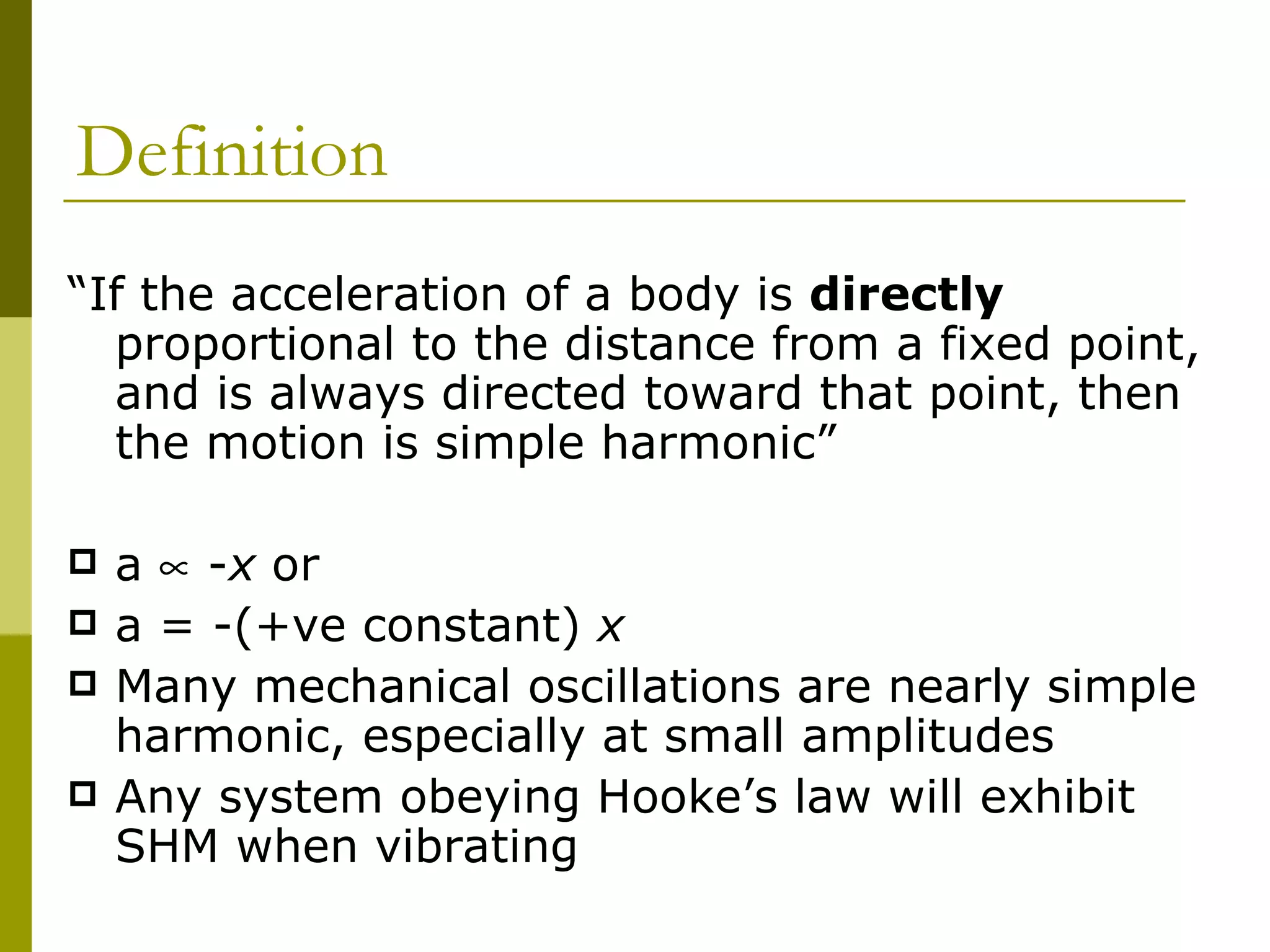
Definition  “ If the acceleration of a body is  directly  proportional to the distance from a fixed point, and is always directed toward that point, then the motion is simple harmonic” a    - x  or a = -(+ve constant)  x Many mechanical oscillations are nearly simple harmonic, especially at small amplitudes Any system obeying Hooke’s law will exhibit SHM when vibrating
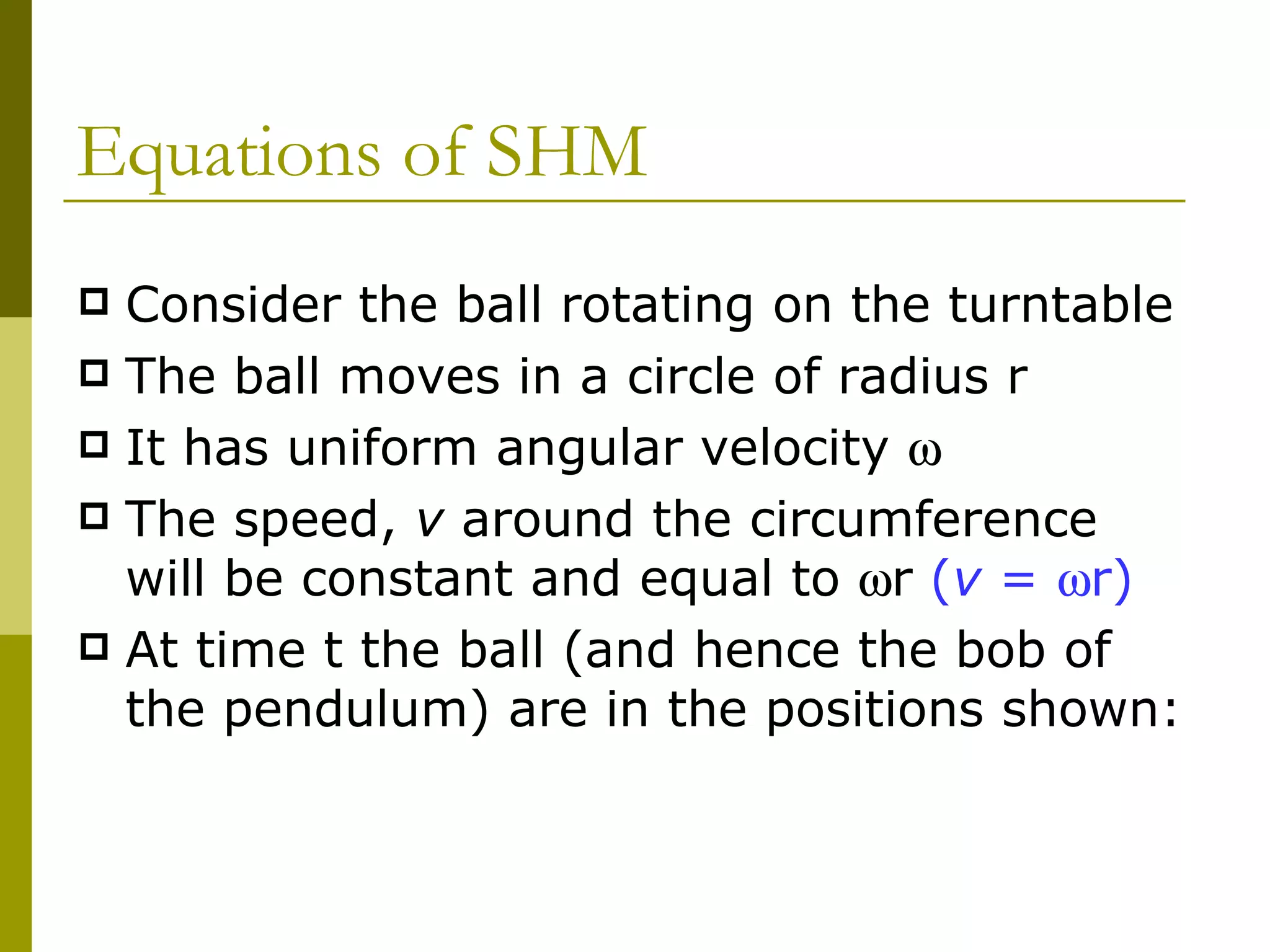
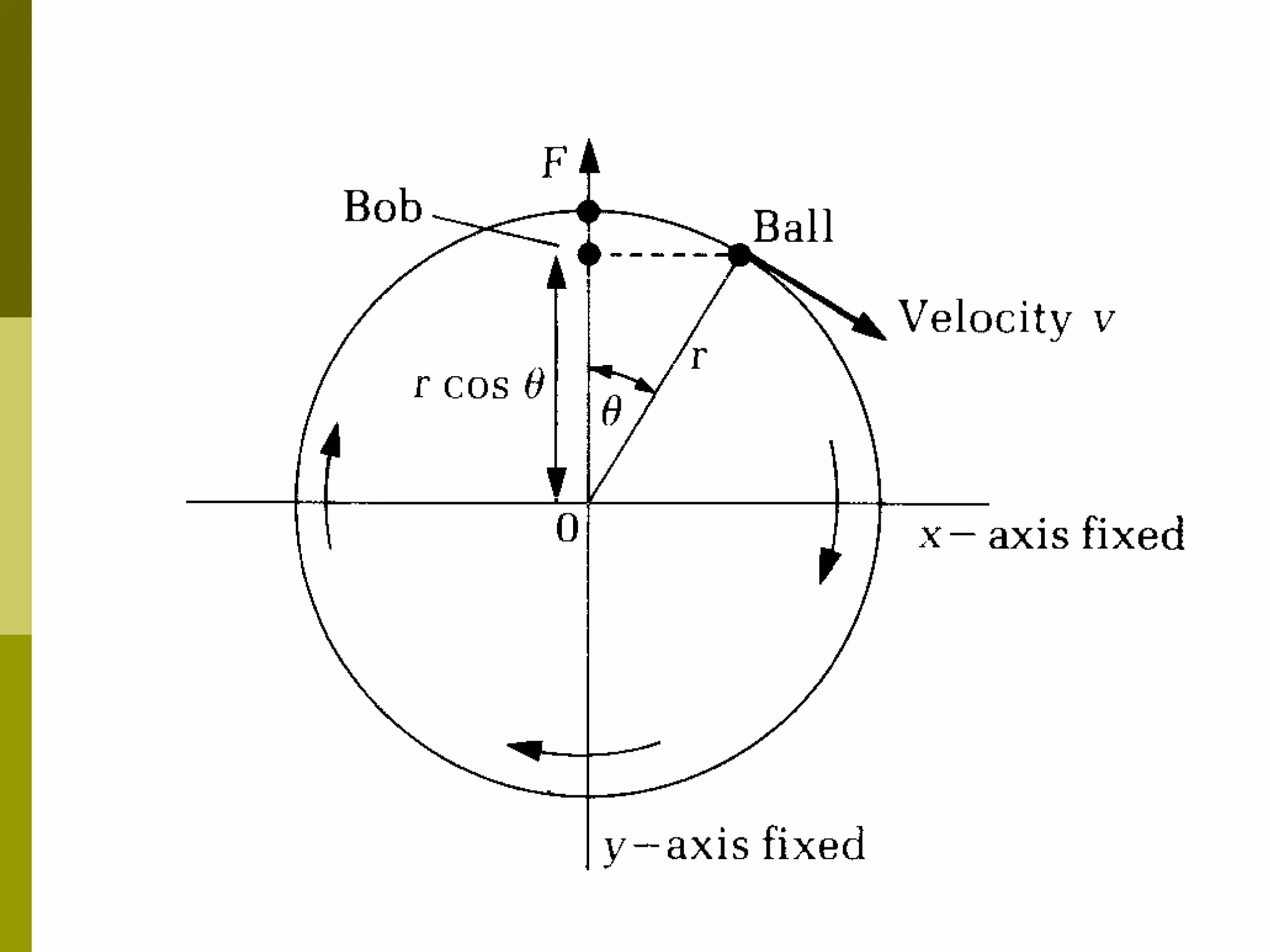
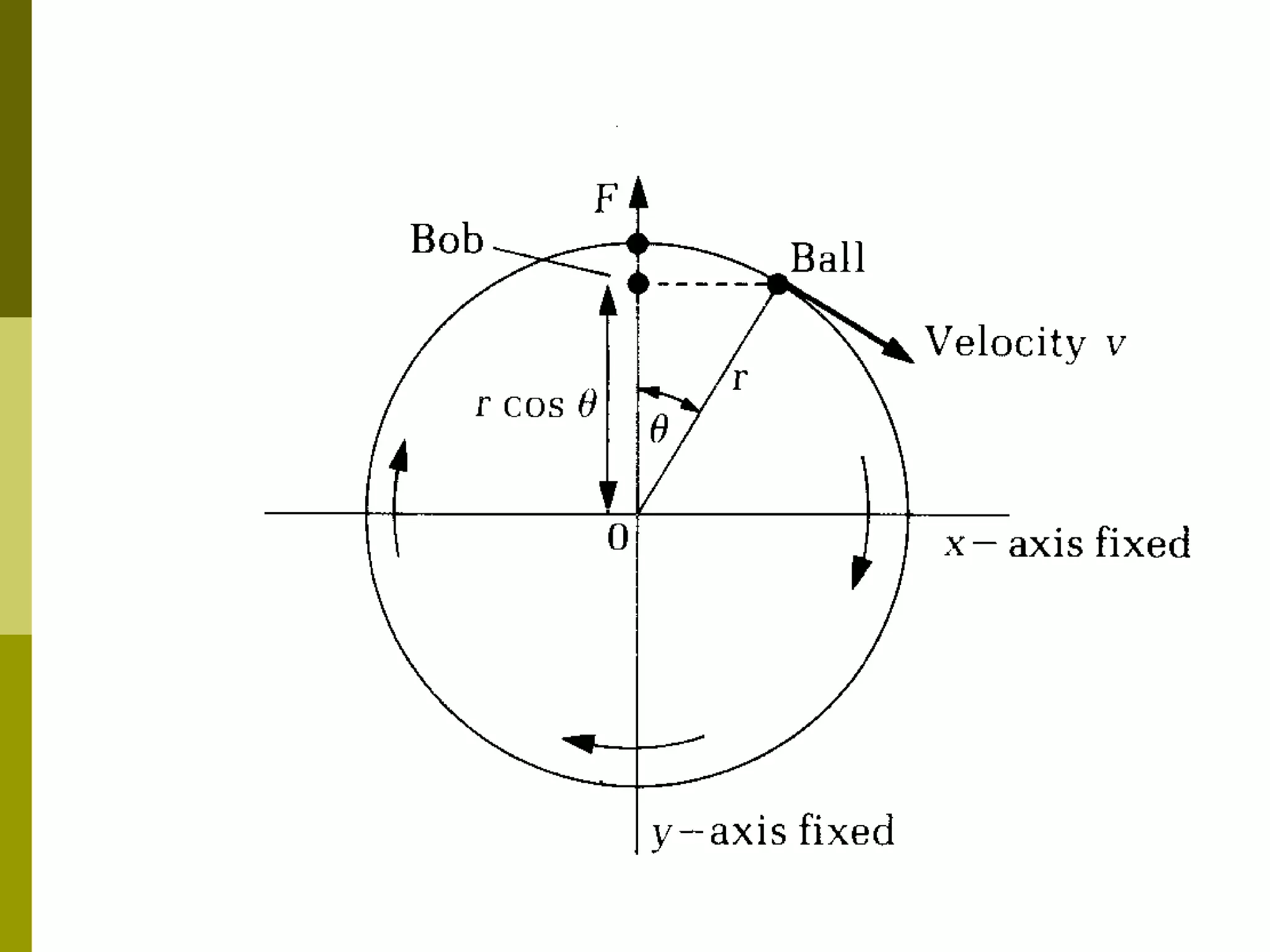
Equations of SHM Consider the ball rotating on the turntable The ball moves in a circle of radius r  It has uniform angular velocity   The speed,  v  around the circumference will be constant and equal to   r  ( v  =   r) At time t the ball (and hence the bob of the pendulum) are in the positions shown:
 
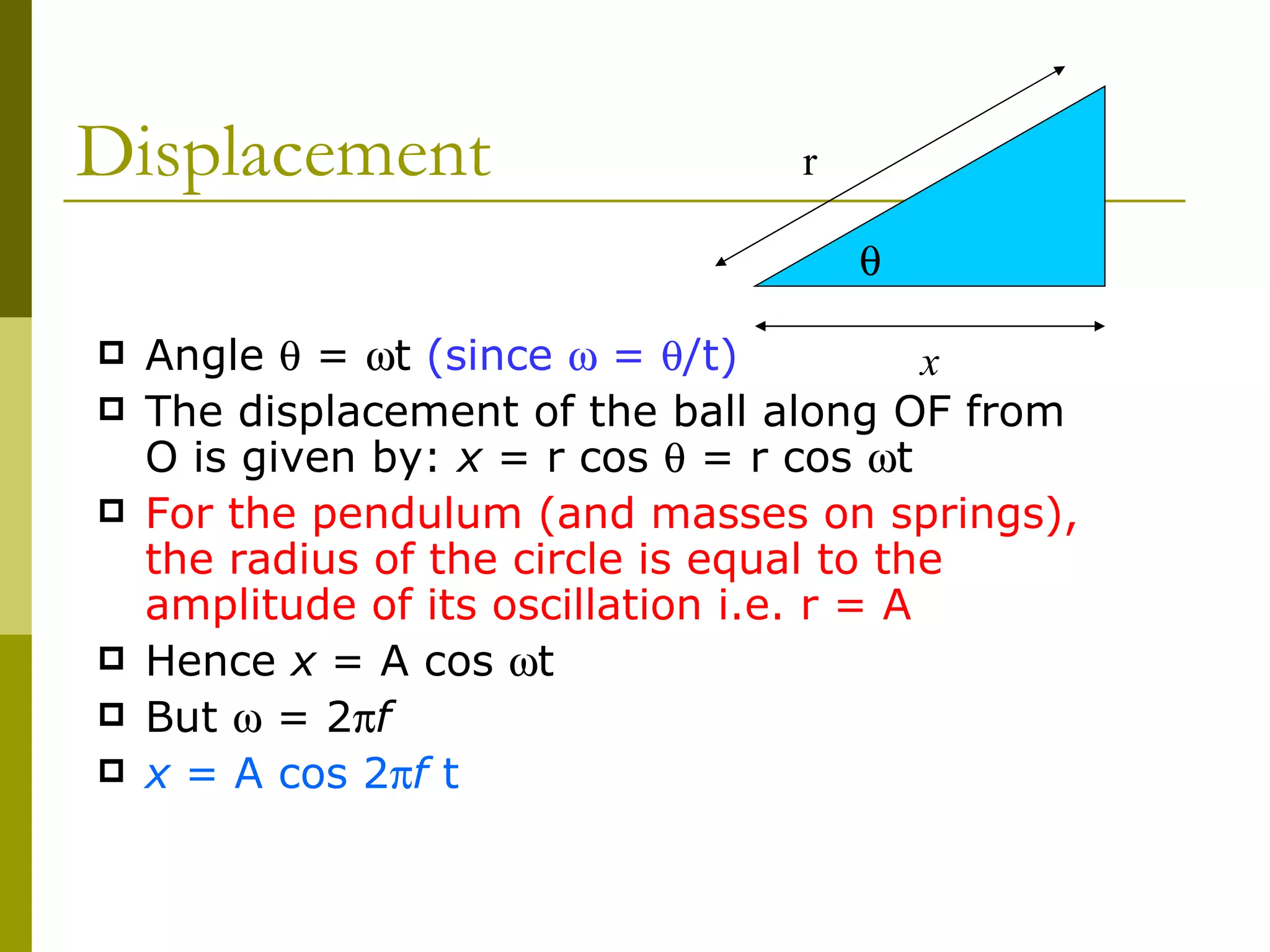
Displacement  Angle    =   t  (since    =   /t) The displacement of the ball along OF from O is given by:  x  = r cos    = r cos   t  For the pendulum (and masses on springs), the radius of the circle is equal to the amplitude of its oscillation i.e. r = A Hence  x  = A cos   t But    = 2  f x  = A cos 2  f  t  r x
 
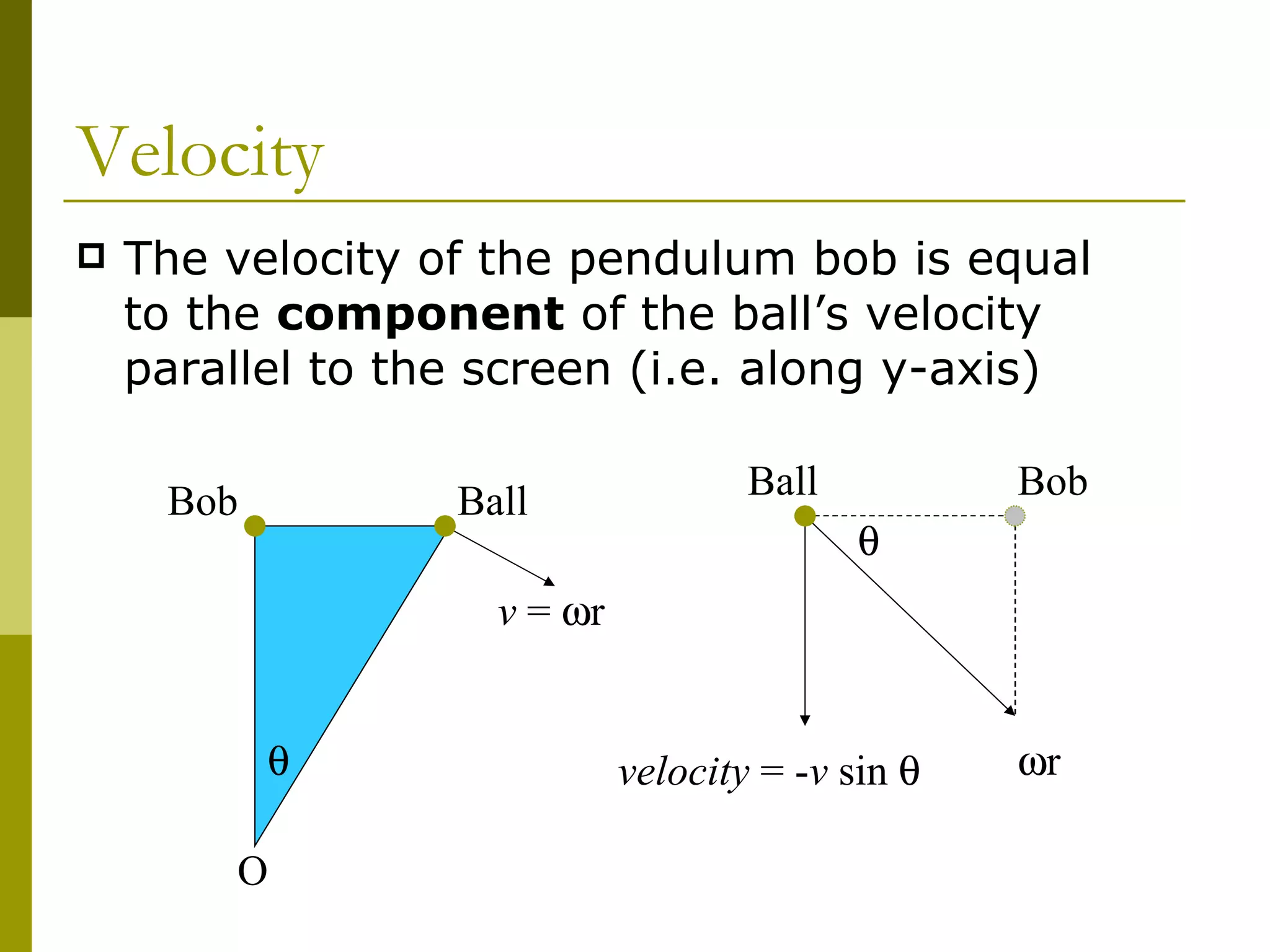
Velocity  The velocity of the pendulum bob is equal to the  component  of the ball’s velocity parallel to the screen (i.e. along y-axis) Bob Ball  v  =   r O  r  velocity  = - v  sin   Ball Bob
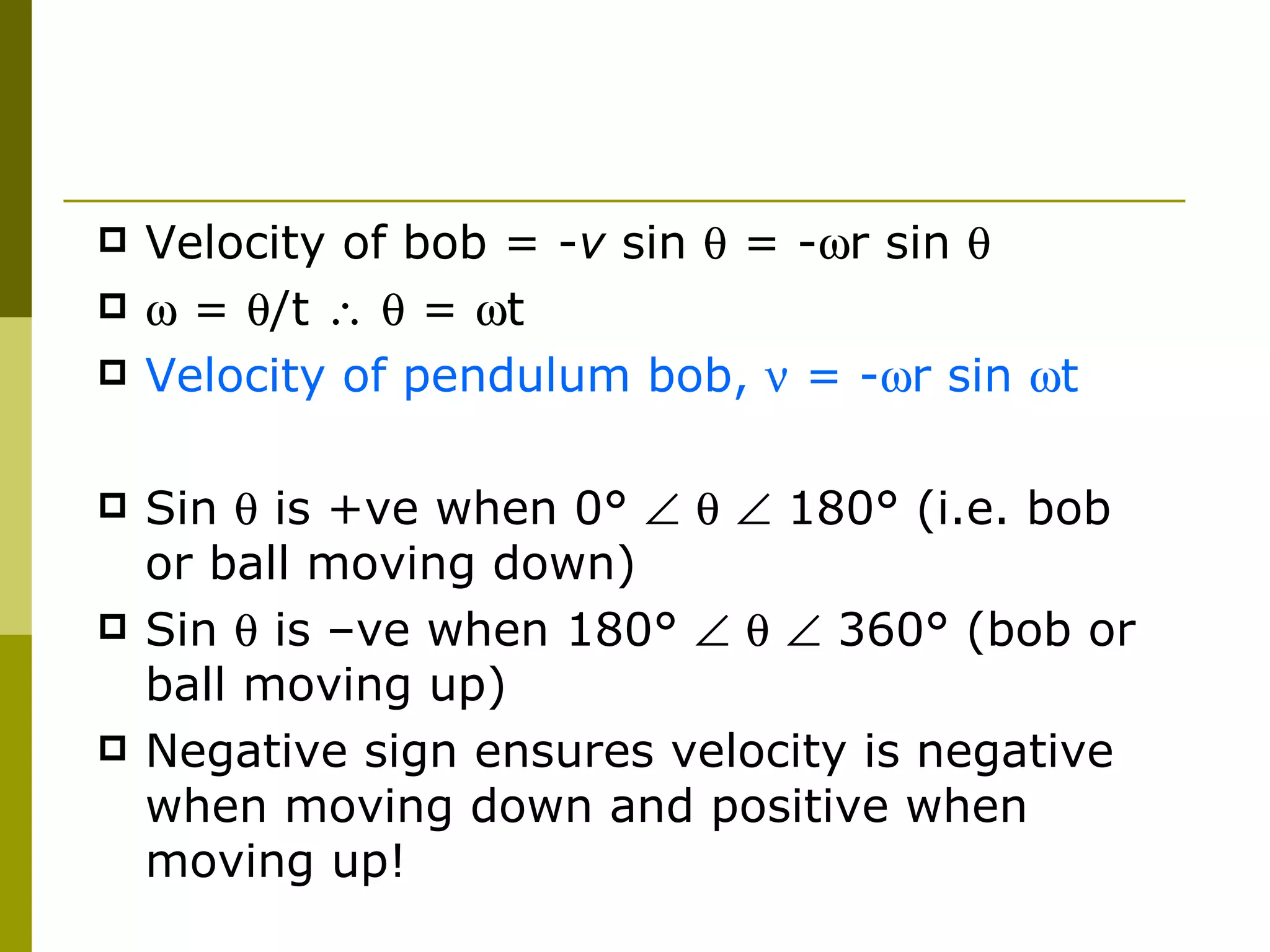
Velocity of bob = - v  sin    = -  r sin      =   /t       =   t Velocity of pendulum bob,    = -  r sin   t Sin    is +ve when 0 °          180° (i.e. bob or ball moving down)  Sin    is –ve when 180 °          360° (bob or ball moving up) Negative sign ensures velocity is negative when moving down and positive when moving up!
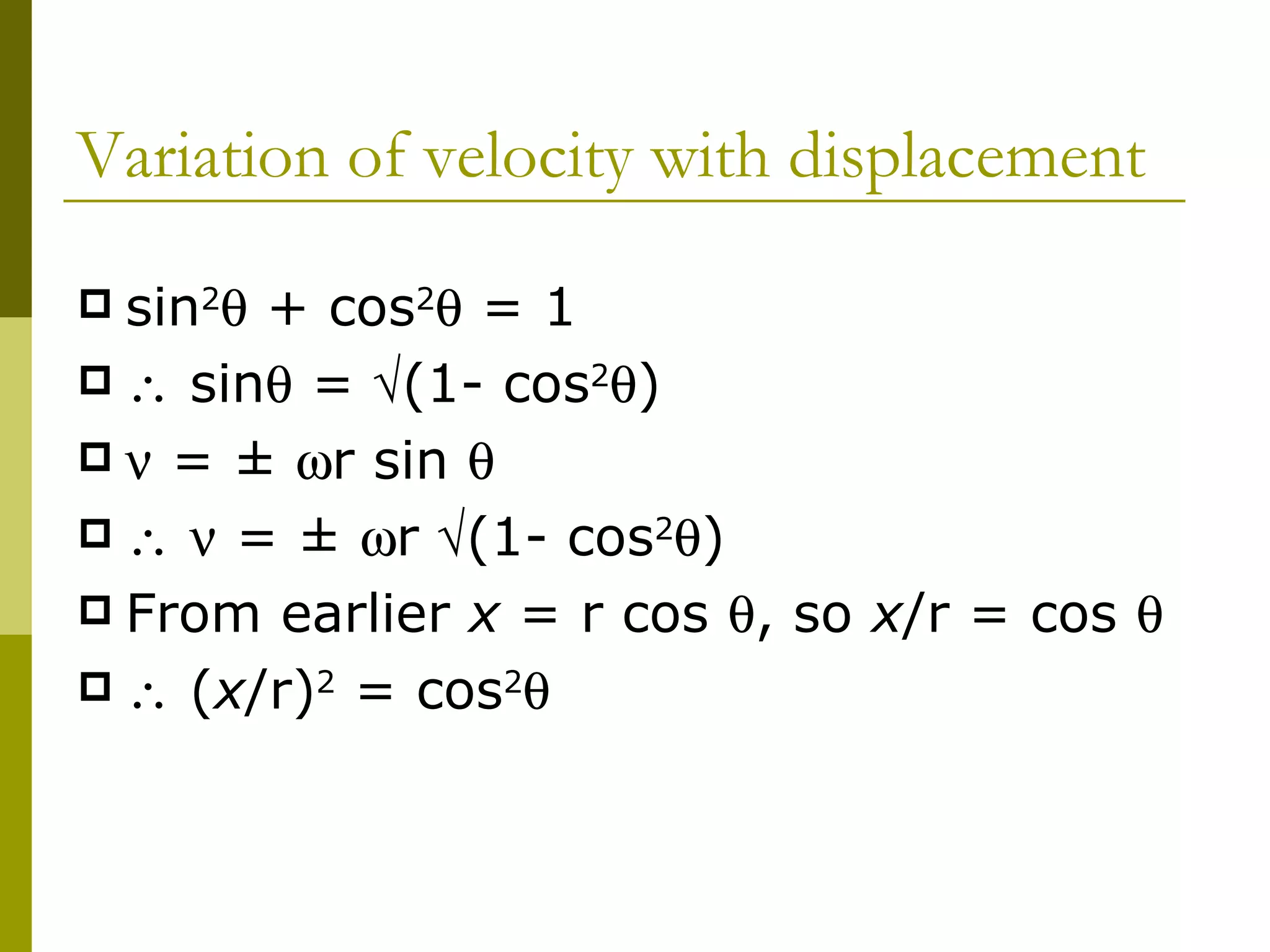
Variation of velocity with displacement sin 2   + cos 2   = 1    sin   =   (1- cos 2  )    =  ±   r sin           =  ±   r   (1- cos 2  ) From earlier  x  = r cos   , so  x /r = cos      ( x /r) 2  = cos 2 
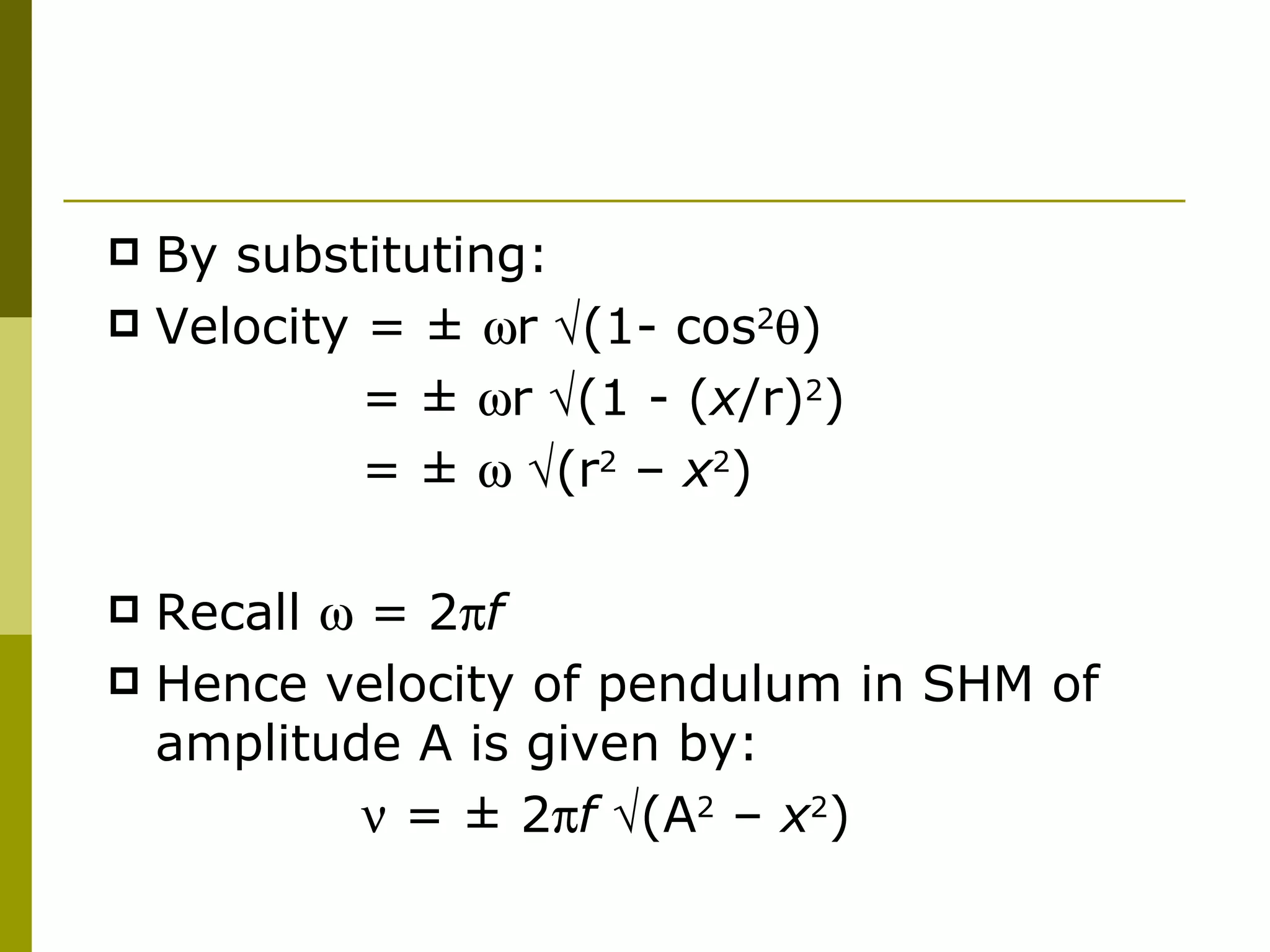
By substituting: Velocity =  ±   r   (1- cos 2  ) =  ±   r   (1 - ( x /r) 2 ) =  ±      (r 2  –  x 2 ) Recall    = 2  f Hence velocity of pendulum in SHM of amplitude A is given by:    =  ±  2  f    (A 2  –  x 2 )
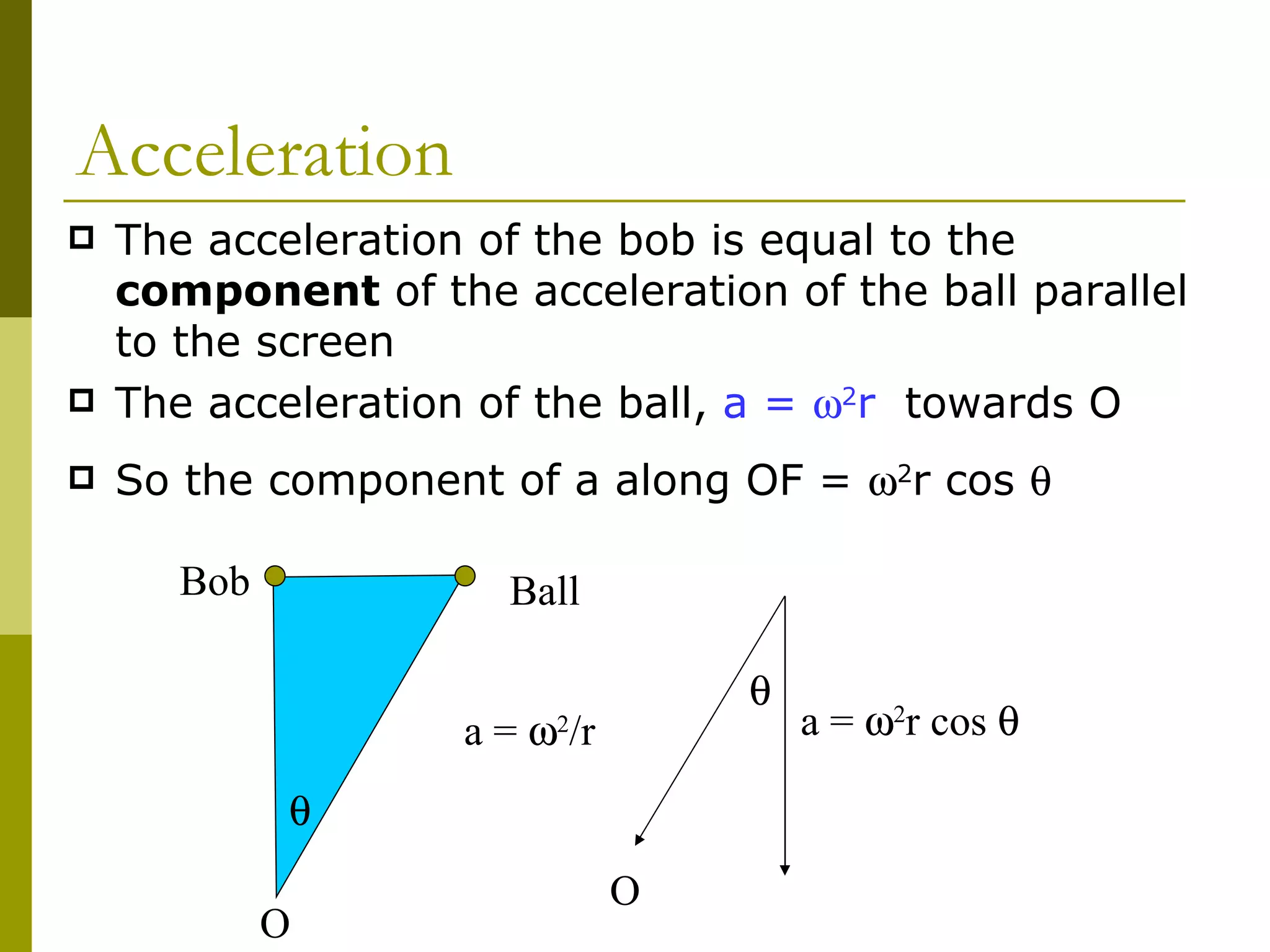
Acceleration  The acceleration of the bob is equal to the  component  of the acceleration of the ball parallel to the screen The acceleration of the ball,  a =   2 r   towards O So the component of a along OF =   2 r cos    Bob Ball a =   2 /r  a =   2 r cos   O  O
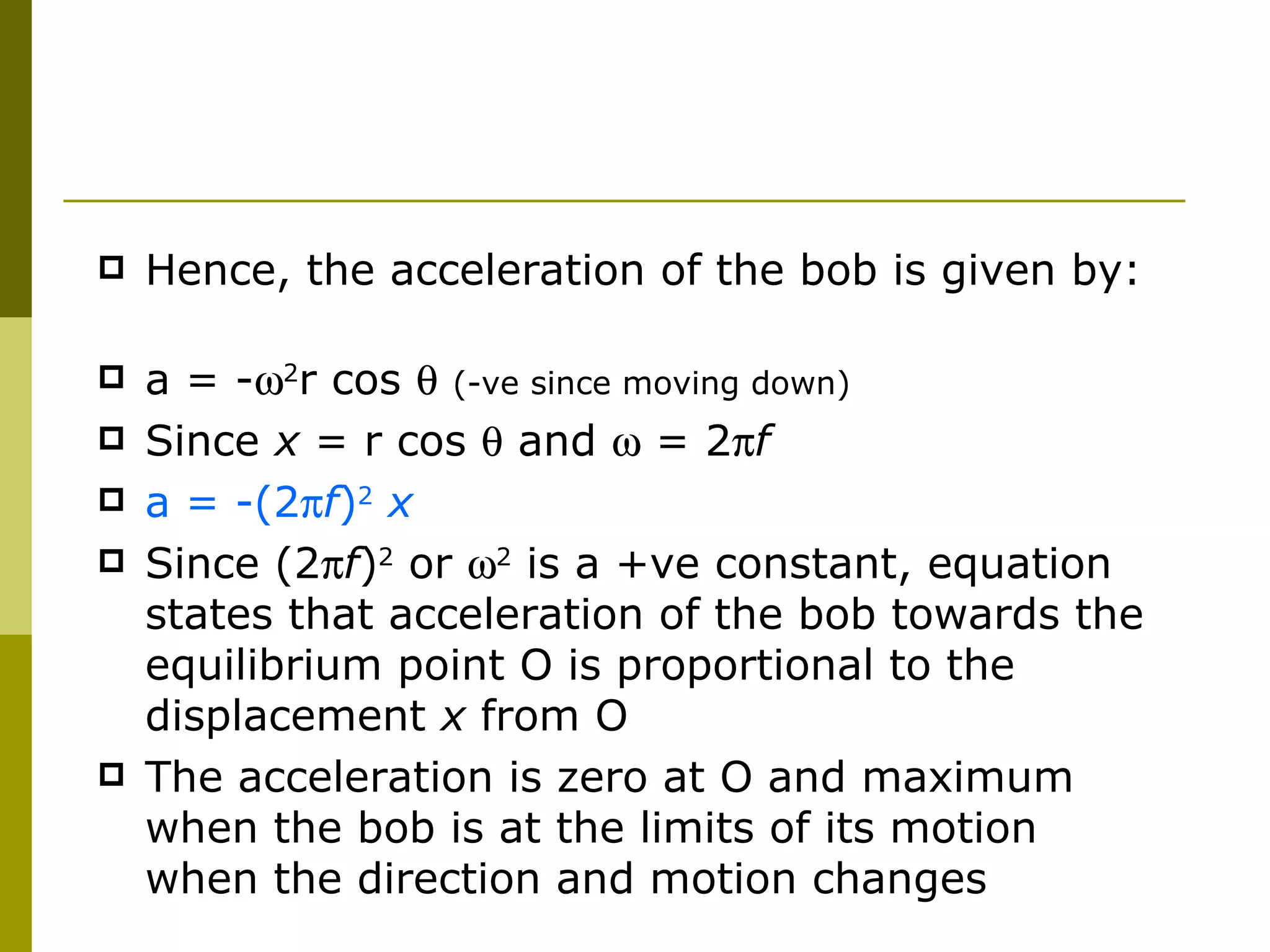
Hence, the acceleration of the bob is given by:  a = -  2 r cos     (-ve since moving down) Since  x  = r cos    and    = 2  f a = -(2  f ) 2  x Since (2  f ) 2   or    2  is a +ve constant, equation states that acceleration of the bob towards the equilibrium point O is proportional to the displacement  x  from O The acceleration is zero at O and maximum when the bob is at the limits of its motion when the direction and motion changes
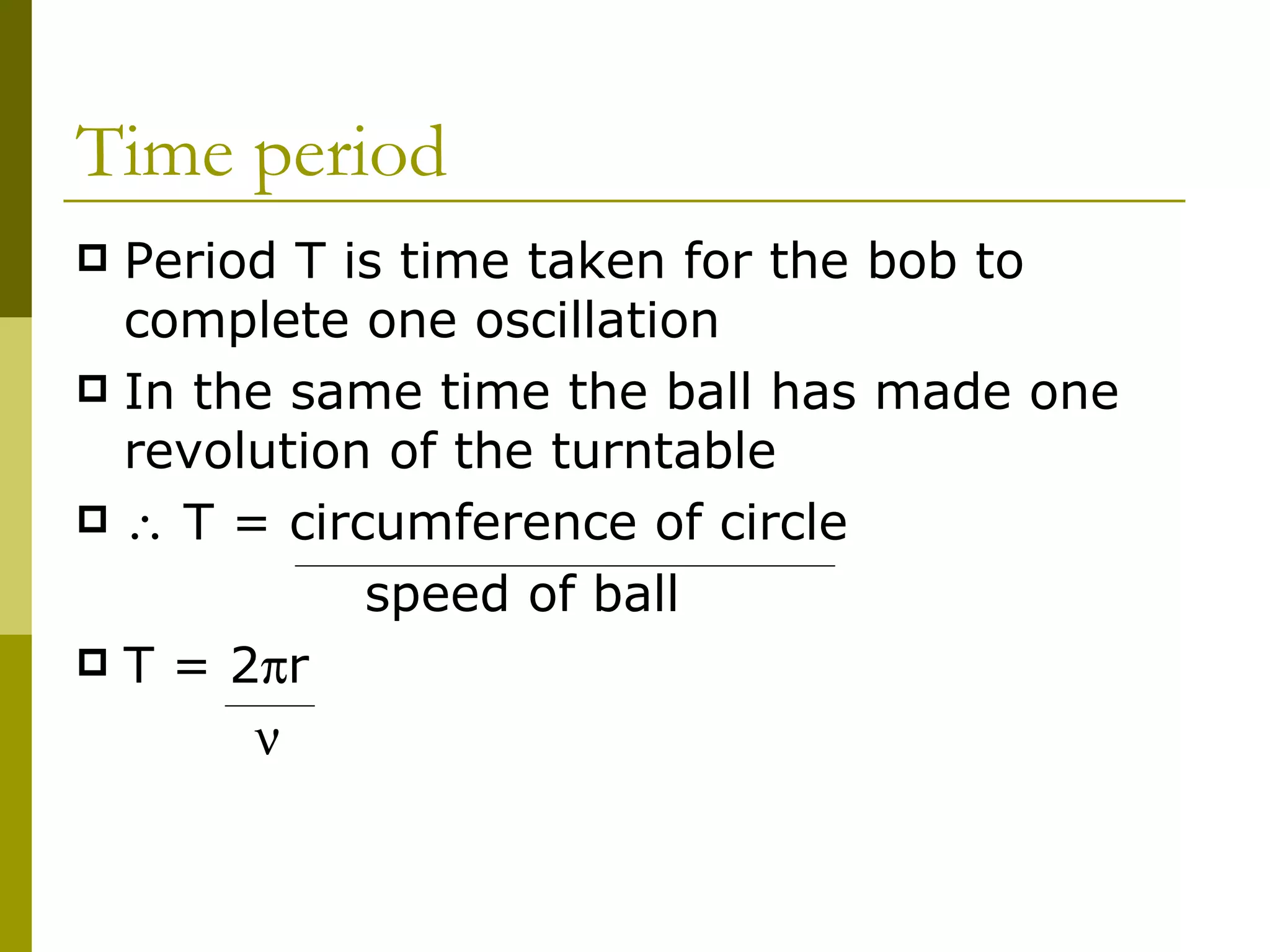
Time period Period T is time taken for the bob to complete one oscillation In the same time the ball has made one revolution of the turntable    T = circumference of circle   speed of ball T = 2  r   
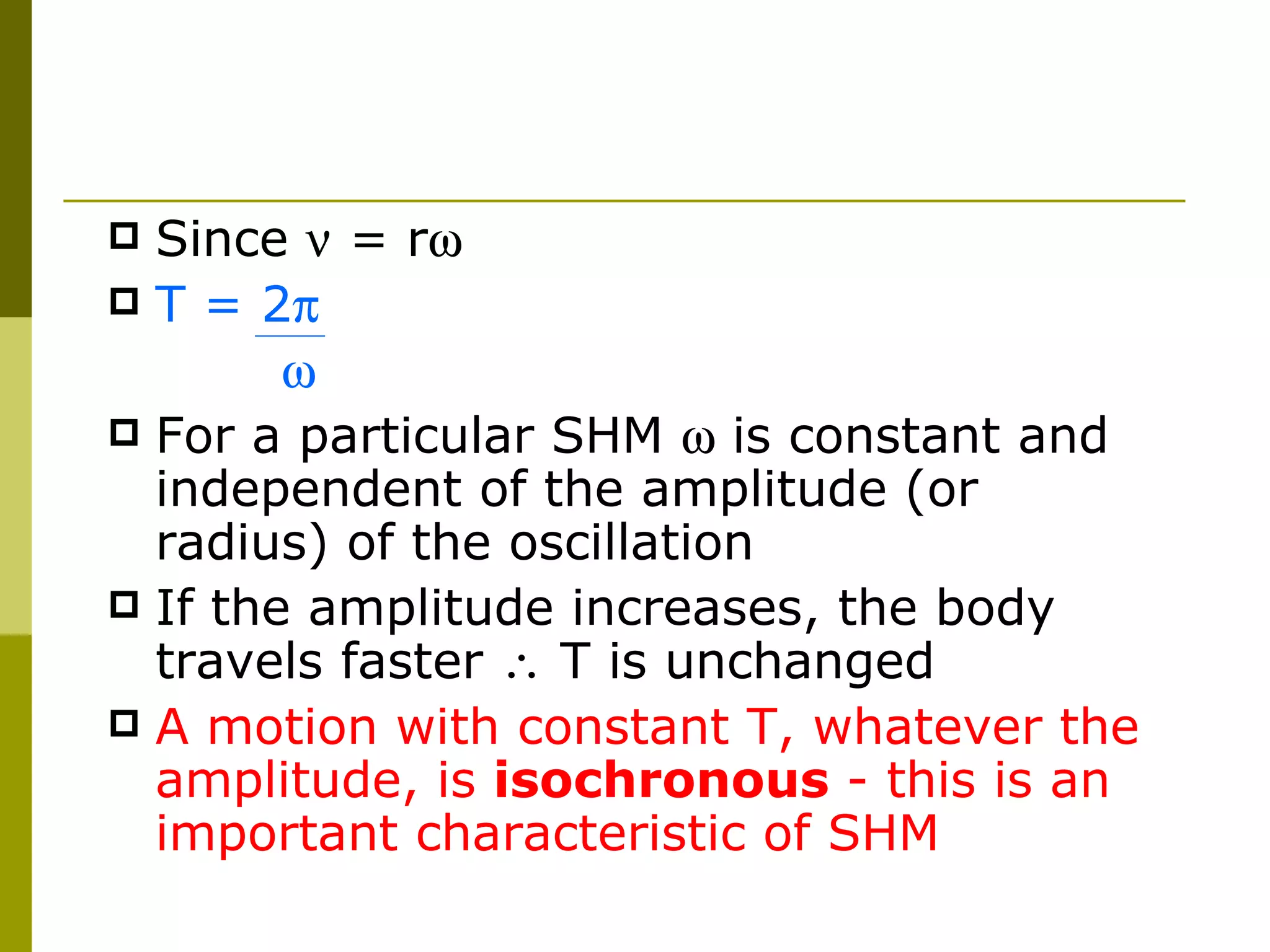
Since    = r  T = 2     For a particular SHM    is constant and independent of the amplitude (or radius) of the oscillation If the amplitude increases, the body travels faster    T is unchanged A motion with constant T, whatever the amplitude, is  isochronous  - this is an important characteristic of SHM
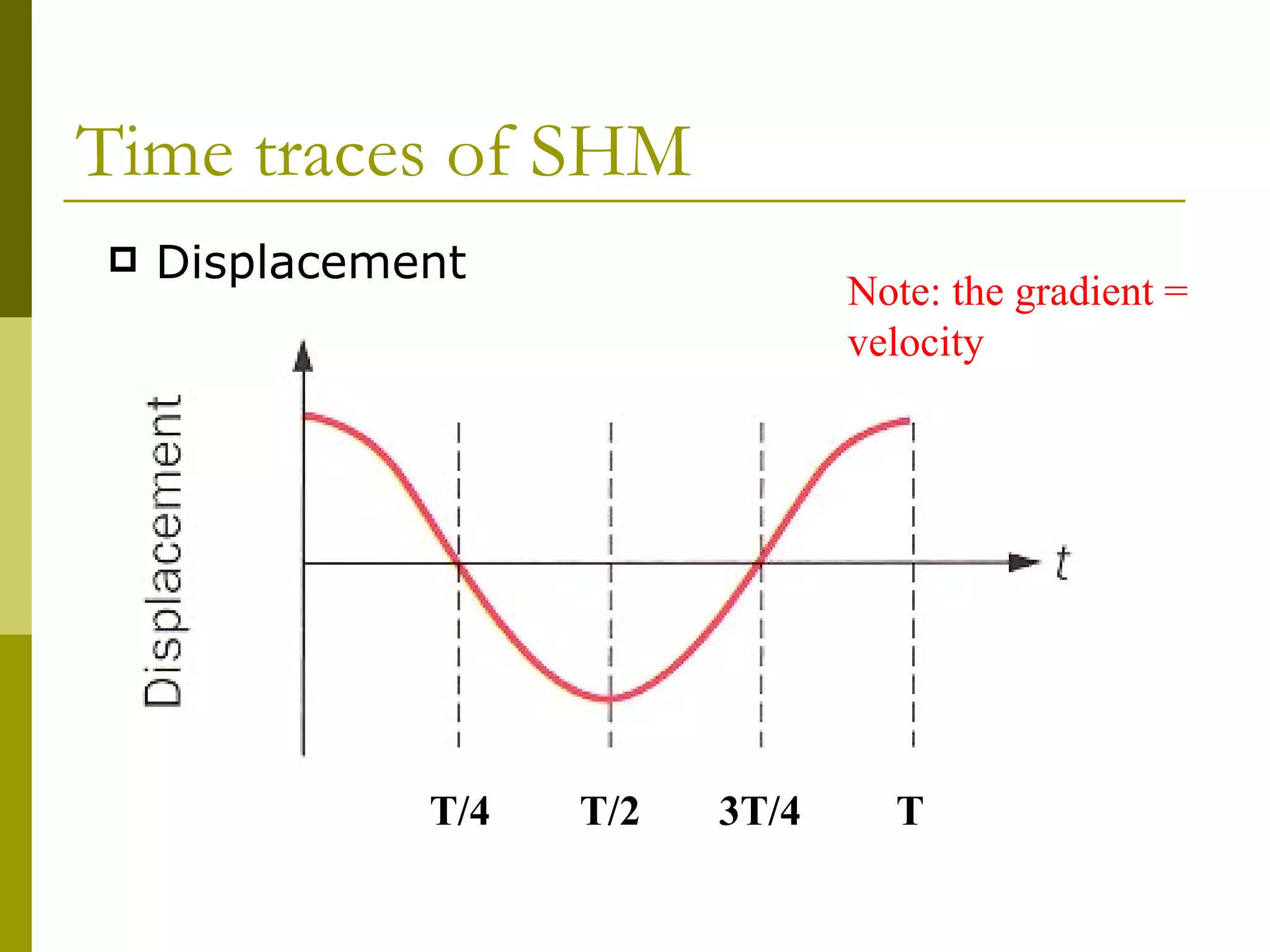
Time traces of SHM Displacement  T/4 T/2 3T/4 T Note: the gradient = velocity
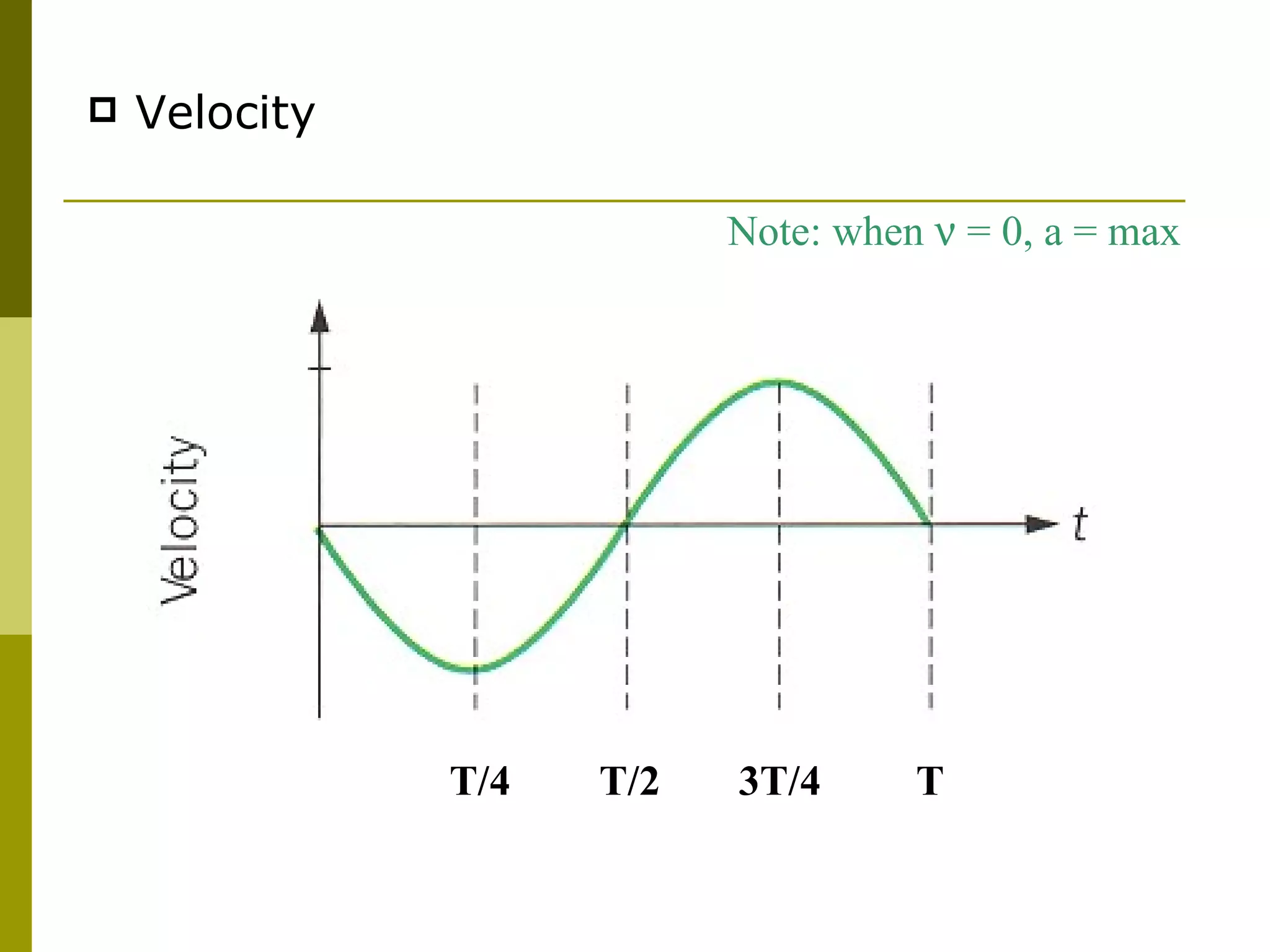
Velocity   T/4 T/2 3T/4 T Note: when    = 0, a = max
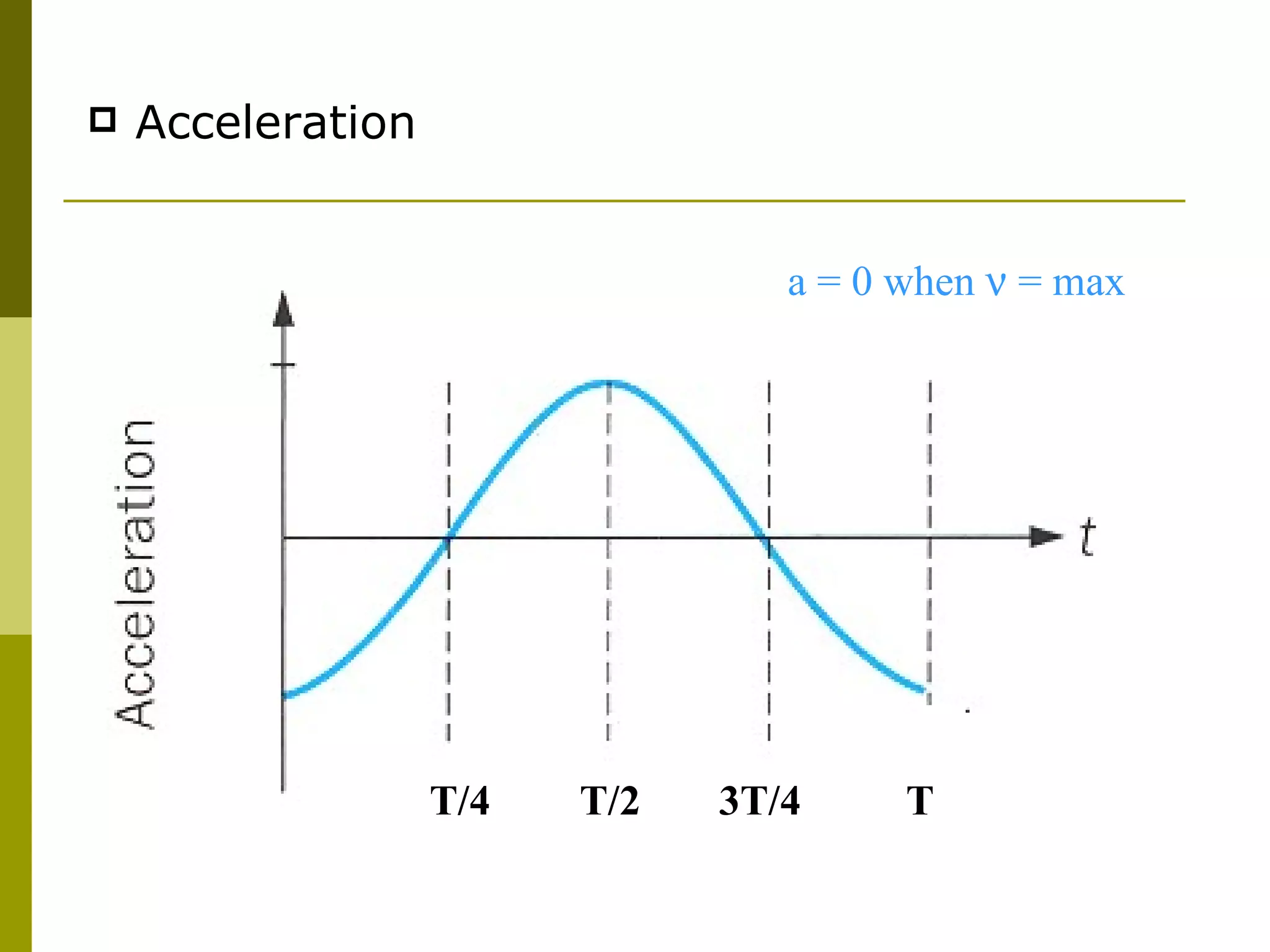
Acceleration   T/4 T/2 3T/4 T a = 0 when    = max
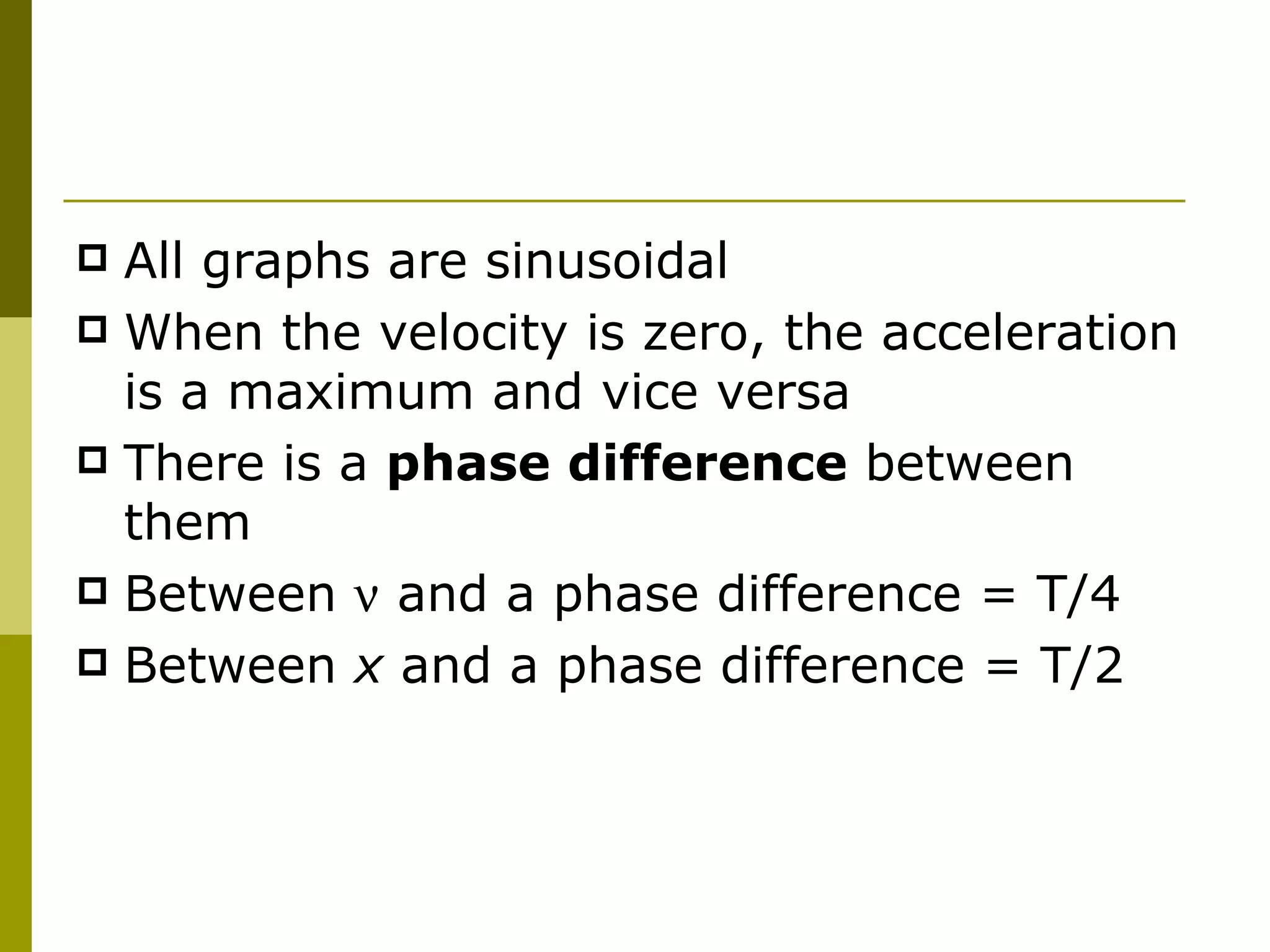
All graphs are sinusoidal When the velocity is zero, the acceleration is a maximum and vice versa There is a  phase difference  between them Between    and a phase difference = T/4 Between  x  and a phase difference = T/2
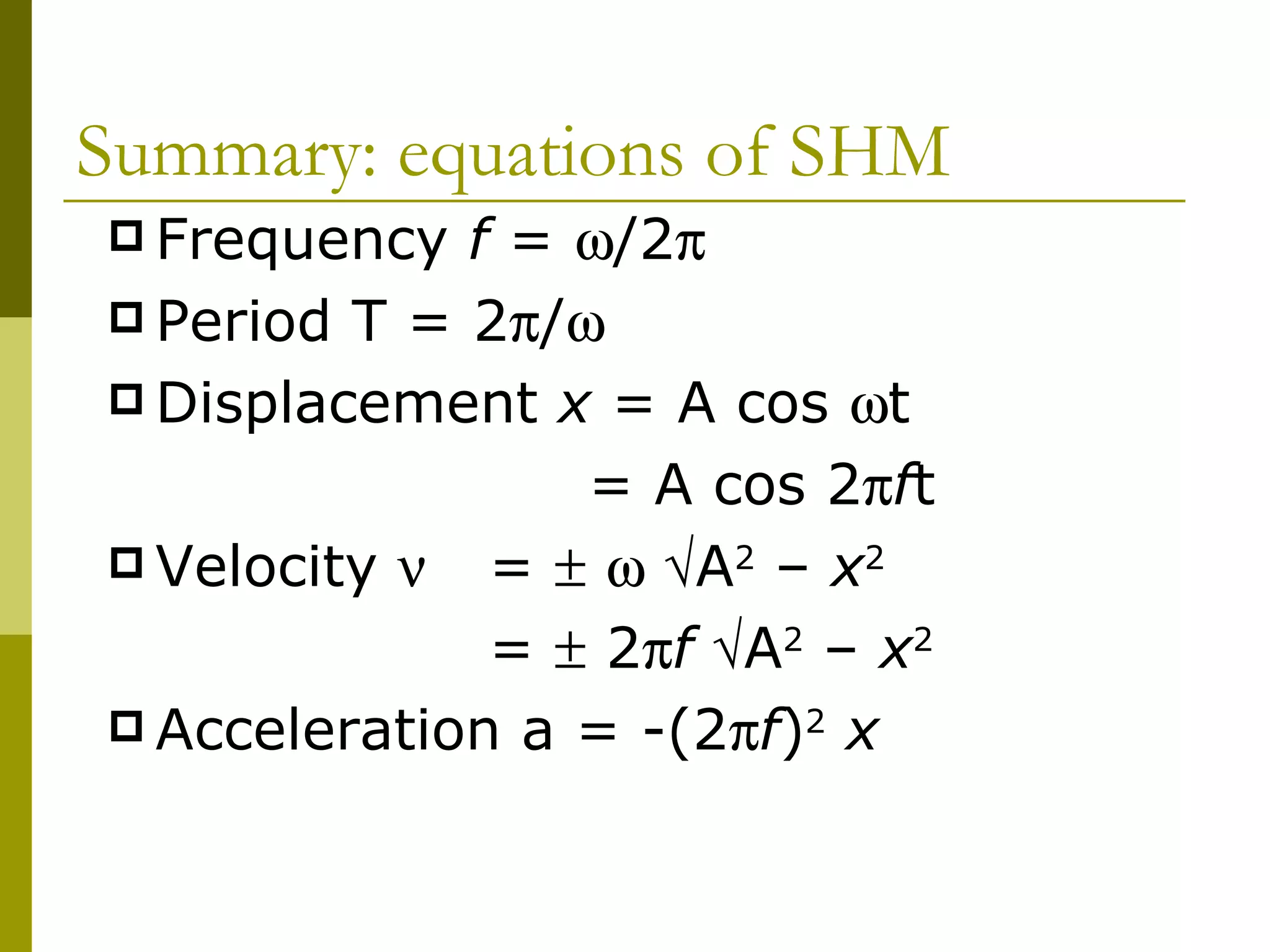
Summary: equations of SHM Frequency  f  =   /2  Period T = 2  /  Displacement  x  = A cos   t    = A cos 2  f t Velocity   =         A 2  –  x 2  =    2  f   A 2  –  x 2  Acceleration a = -(2  f ) 2   x

13.1.1 Shm Part 2 Circular To Shm

  • 1.
    13.1.1 simple harmonicmotion Part 2: translating circular motion to simple harmonic
  • 2.
    Simple harmonic motionLinear motion: a - constant in size + direction Circular motion: a - constant in size only Oscillatory motion: a changes periodically in size + direction (like x and  ) SHM is a special form of oscillating motion Pendulums and masses on springs exhibit SHM A body oscillates with SHM if the displacement changes sinusodially
  • 3.
    Linking circular motionand SHM The arrangement shown below can be used to demonstrate the link between circular motion and SHM
  • 4.
    Adjusting the speedof the turntable will allow both shadows to have the same motion (i.e. move in phase) The shadows are the components of each motion parallel to the screen and are sinusoidal Let N represent the sinusoidal motion of one shadow It oscillates about O (equilibrium point) in a straight line between A and B O N A B
  • 5.
    Displacement and velocityWhen N is left of O: - x is left -  is left when moving away from O and right when moving towards O When N is right of O: - x is right -  is right when moving away from O and left when moving towards O
  • 6.
    The size ofthe restoring force increases with x BUT always acts towards equilibrium point (O) F  - x  resulting acceleration must behave likewise, since F = ma and m is constant i.e. a increases with x but acts towards O a  - x In oscillations a and x always have opposite signs
  • 7.
    Definition “If the acceleration of a body is directly proportional to the distance from a fixed point, and is always directed toward that point, then the motion is simple harmonic” a  - x or a = -(+ve constant) x Many mechanical oscillations are nearly simple harmonic, especially at small amplitudes Any system obeying Hooke’s law will exhibit SHM when vibrating
  • 8.
    Equations of SHMConsider the ball rotating on the turntable The ball moves in a circle of radius r It has uniform angular velocity  The speed, v around the circumference will be constant and equal to  r ( v =  r) At time t the ball (and hence the bob of the pendulum) are in the positions shown:
  • 9.
  • 10.
    Displacement Angle  =  t (since  =  /t) The displacement of the ball along OF from O is given by: x = r cos  = r cos  t For the pendulum (and masses on springs), the radius of the circle is equal to the amplitude of its oscillation i.e. r = A Hence x = A cos  t But  = 2  f x = A cos 2  f t  r x
  • 11.
  • 12.
    Velocity Thevelocity of the pendulum bob is equal to the component of the ball’s velocity parallel to the screen (i.e. along y-axis) Bob Ball  v =  r O  r  velocity = - v sin  Ball Bob
  • 13.
    Velocity of bob= - v sin  = -  r sin   =  /t   =  t Velocity of pendulum bob,  = -  r sin  t Sin  is +ve when 0 °    180° (i.e. bob or ball moving down) Sin  is –ve when 180 °    360° (bob or ball moving up) Negative sign ensures velocity is negative when moving down and positive when moving up!
  • 14.
    Variation of velocitywith displacement sin 2  + cos 2  = 1  sin  =  (1- cos 2  )  = ±  r sin    = ±  r  (1- cos 2  ) From earlier x = r cos  , so x /r = cos   ( x /r) 2 = cos 2 
  • 15.
    By substituting: Velocity= ±  r  (1- cos 2  ) = ±  r  (1 - ( x /r) 2 ) = ±   (r 2 – x 2 ) Recall  = 2  f Hence velocity of pendulum in SHM of amplitude A is given by:  = ± 2  f  (A 2 – x 2 )
  • 16.
    Acceleration Theacceleration of the bob is equal to the component of the acceleration of the ball parallel to the screen The acceleration of the ball, a =  2 r towards O So the component of a along OF =  2 r cos   Bob Ball a =  2 /r a =  2 r cos  O  O
  • 17.
    Hence, the accelerationof the bob is given by: a = -  2 r cos  (-ve since moving down) Since x = r cos  and  = 2  f a = -(2  f ) 2 x Since (2  f ) 2 or  2 is a +ve constant, equation states that acceleration of the bob towards the equilibrium point O is proportional to the displacement x from O The acceleration is zero at O and maximum when the bob is at the limits of its motion when the direction and motion changes
  • 18.
    Time period PeriodT is time taken for the bob to complete one oscillation In the same time the ball has made one revolution of the turntable  T = circumference of circle speed of ball T = 2  r 
  • 19.
    Since  = r  T = 2   For a particular SHM  is constant and independent of the amplitude (or radius) of the oscillation If the amplitude increases, the body travels faster  T is unchanged A motion with constant T, whatever the amplitude, is isochronous - this is an important characteristic of SHM
  • 20.
    Time traces ofSHM Displacement T/4 T/2 3T/4 T Note: the gradient = velocity
  • 21.
    Velocity T/4 T/2 3T/4 T Note: when  = 0, a = max
  • 22.
    Acceleration T/4 T/2 3T/4 T a = 0 when  = max
  • 23.
    All graphs aresinusoidal When the velocity is zero, the acceleration is a maximum and vice versa There is a phase difference between them Between  and a phase difference = T/4 Between x and a phase difference = T/2
  • 24.
    Summary: equations ofSHM Frequency f =  /2  Period T = 2  /  Displacement x = A cos  t = A cos 2  f t Velocity  =    A 2 – x 2 =  2  f  A 2 – x 2 Acceleration a = -(2  f ) 2 x