Capacitors
What is a capacitor?
• Electronic component
• Two conducting surfaces separated by an insulating material
• Stores charge
• Uses
– Time delays
– Filters
– Tuned circuits
Capacitor construction
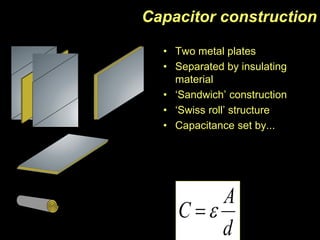
• Two metal plates
• Separated by insulating
material
• ‘Sandwich’ construction
• ‘Swiss roll’ structure
• Capacitance set by...
d
A
C 
Defining capacitance
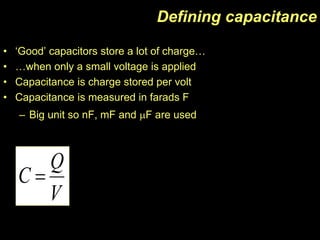
• ‘Good’ capacitors store a lot of charge…
• …when only a small voltage is applied
• Capacitance is charge stored per volt
• Capacitance is measured in farads F
– Big unit so nF, mF and F are used
V
Q
C 
Graphical representation
Equating to the equation of a straight line
mxy
CVQ
V
Q
C



Q
V
Gradient term is
the capacitance
of the capacitor
Charge stored is
directly
proportional to
the applied
voltage
Energy stored by a capacitor
• By general definition E=QV
– product of charge and voltage
• By graphical consideration...
QVE
2
1

Area term is
the energy
stored in the
capacitor
Q
V
Other expressions for energy
• By substitution of Q=CV
C
Q
E
CVE
QVE
2
2
2
1
2
1
2
1



Charging a capacitor
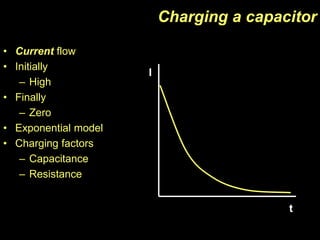
• Current flow
• Initially
– High
• Finally
– Zero
• Exponential model
• Charging factors
– Capacitance
– Resistance
I
t
Discharging a capacitor
• Current flow
• Initially
– High
– Opposite to charging
• Finally
– Zero
• Exponential model
• Discharging factors
– Capacitance
– Resistance
I
t
V
or
Q
t
V
or
Q
t
Voltage and charge characteristics
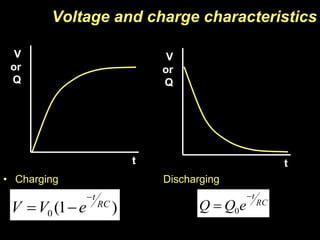
• Charging Discharging
RC
t
eQQ

 0)1(0
RC
t
eVV


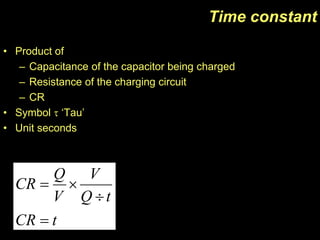
• Product of
– Capacitance of the capacitor being charged
– Resistance of the charging circuit
– CR
• Symbol  ‘Tau’
• Unit seconds
Time constant
tCR
tQ
V
V
Q
CR



When t equals tau during discharge
• At t = tau the capacitor has
fallen to 37% of its original
value.
• By a similar analysis tau can
be considered to be the time
taken for the capacitor to
reach 63% of full charge.
37.00
1
0
0
0







QQ
eQQ
eQQ
eQQ
RC
RC
RC
t
Graphical determination of tau
• V at 37%
• Q at 37%
• Compared to initial
maximum discharge
V
or
Q
t
R
tC
RCt
t



Logarithmic discharge analysis
• Mathematical consideration of
discharge
• Exponential relationship
• Taking natural logs equates
expression to ‘y=mx+c’
• Gradient is -1/Tau
0
0
0
0
ln
1
ln
lnln
Vt
RC
V
RC
tVV
e
V
V
eVV
RC
t
RC
t








Logarithmic discharge graph
lnV
t
Gradient term
is the -1/Tau
Presented By…..
130170111092 Rathor Vijendrasingh
130170111095 Rudra Pavan
130170111098 Shah Nidhi
EC- J1  5th Semester, 2015
Thank You 

Emt capacitors

  • 1.
  • 2.
    What is acapacitor? • Electronic component • Two conducting surfaces separated by an insulating material • Stores charge • Uses – Time delays – Filters – Tuned circuits
  • 3.
    Capacitor construction • Twometal plates • Separated by insulating material • ‘Sandwich’ construction • ‘Swiss roll’ structure • Capacitance set by... d A C 
  • 4.
    Defining capacitance • ‘Good’capacitors store a lot of charge… • …when only a small voltage is applied • Capacitance is charge stored per volt • Capacitance is measured in farads F – Big unit so nF, mF and F are used V Q C 
  • 5.
    Graphical representation Equating tothe equation of a straight line mxy CVQ V Q C    Q V Gradient term is the capacitance of the capacitor Charge stored is directly proportional to the applied voltage
  • 6.
    Energy stored bya capacitor • By general definition E=QV – product of charge and voltage • By graphical consideration... QVE 2 1  Area term is the energy stored in the capacitor Q V
  • 7.
    Other expressions forenergy • By substitution of Q=CV C Q E CVE QVE 2 2 2 1 2 1 2 1   
  • 8.
    Charging a capacitor •Current flow • Initially – High • Finally – Zero • Exponential model • Charging factors – Capacitance – Resistance I t
  • 9.
    Discharging a capacitor •Current flow • Initially – High – Opposite to charging • Finally – Zero • Exponential model • Discharging factors – Capacitance – Resistance I t
  • 10.
    V or Q t V or Q t Voltage and chargecharacteristics • Charging Discharging RC t eQQ   0)1(0 RC t eVV  
  • 11.
    • Product of –Capacitance of the capacitor being charged – Resistance of the charging circuit – CR • Symbol  ‘Tau’ • Unit seconds Time constant tCR tQ V V Q CR   
  • 12.
    When t equalstau during discharge • At t = tau the capacitor has fallen to 37% of its original value. • By a similar analysis tau can be considered to be the time taken for the capacitor to reach 63% of full charge. 37.00 1 0 0 0        QQ eQQ eQQ eQQ RC RC RC t
  • 13.
    Graphical determination oftau • V at 37% • Q at 37% • Compared to initial maximum discharge V or Q t R tC RCt t   
  • 14.
    Logarithmic discharge analysis •Mathematical consideration of discharge • Exponential relationship • Taking natural logs equates expression to ‘y=mx+c’ • Gradient is -1/Tau 0 0 0 0 ln 1 ln lnln Vt RC V RC tVV e V V eVV RC t RC t        
  • 15.
  • 16.
    Presented By….. 130170111092 RathorVijendrasingh 130170111095 Rudra Pavan 130170111098 Shah Nidhi EC- J1  5th Semester, 2015 Thank You 