Longitudinal and transverse waves
Longitudinal  Sound Seismic P-waves Compression waves on string Compressions Rarefactions
Transverse Water waves Waves on string Seismic S-waves EM waves  No vibrations of particles in a transmitting medium Oscillating electric and magnetic fields c = 3 x 10 8  ms -1
 
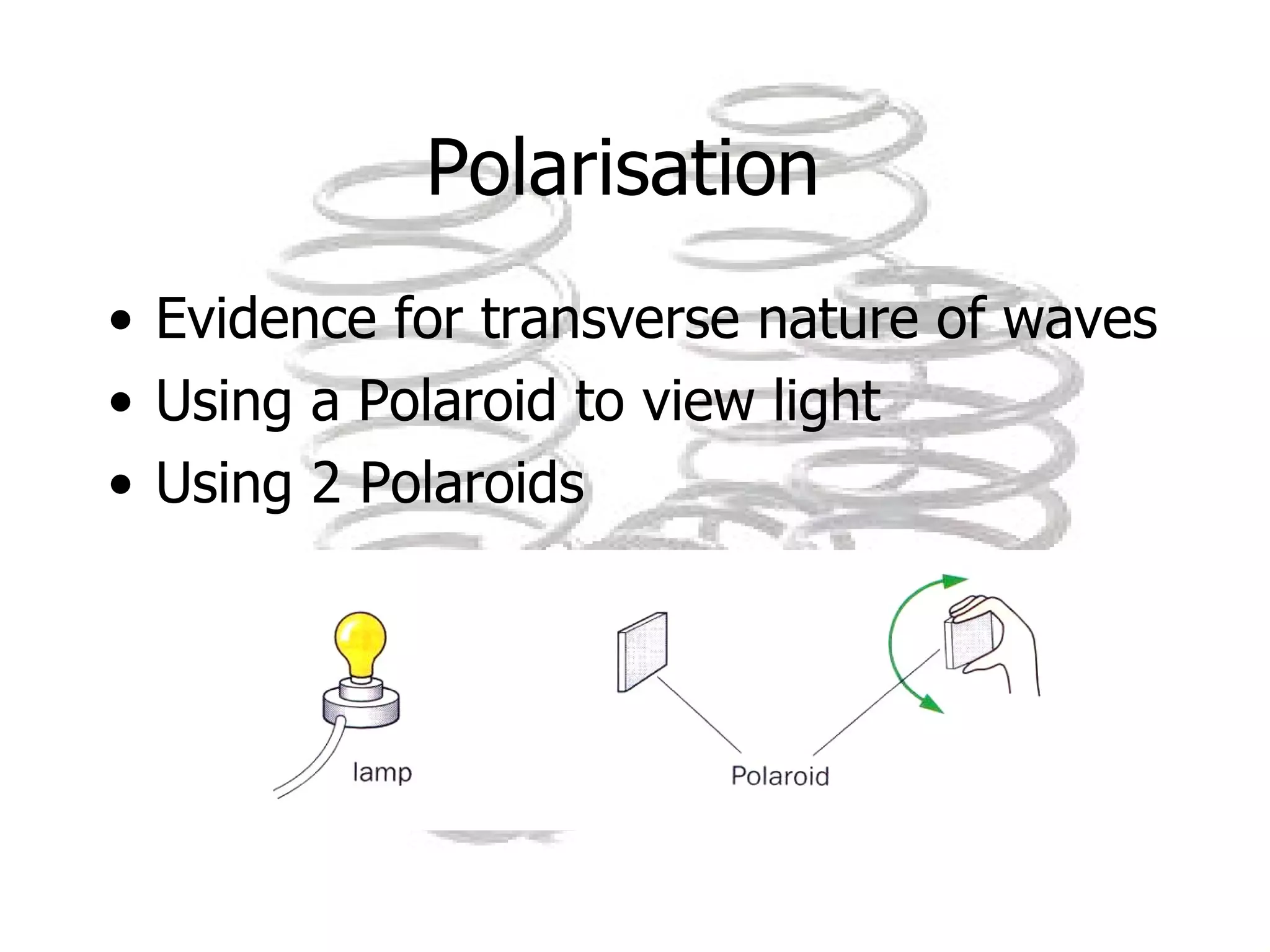
Polarisation  Evidence for transverse nature of waves Using a Polaroid to view light Using 2 Polaroids
Polaroid 1: only transmits waves in vertical plane Polaroid 2: only transmits waves in horizontal plane    absorbs all waves in other planes i.e. a polarised light detector Longitudinal waves – cannot be polarised
Light  Unpolarised Plane polarised – oscillations restricted EM radiation = varying E and B field    polarisation of plane containing E field e.g. if light is  vertically  plane polarised, plane containing E field and direction of travel (plane of vibration) is  vertical
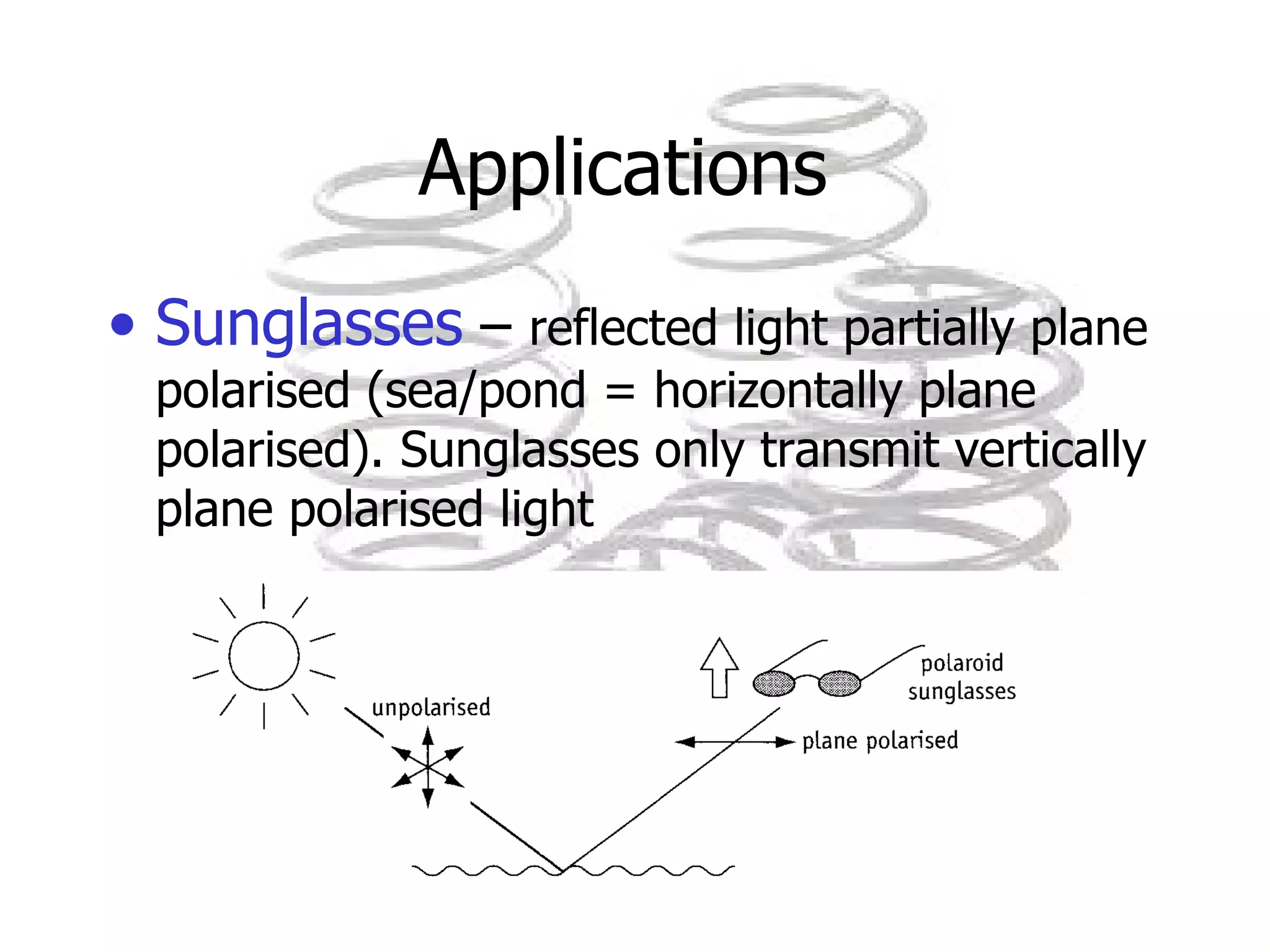
Applications  Sunglasses  –  reflected light partially plane polarised (sea/pond = horizontally plane polarised). Sunglasses only transmit vertically plane polarised light
Stress patterns  –  transparent polymers placed between crossed polarising filters Camera lenses  –  polarising film can reduce light intensity (and increase contrast) since light from sky is partially plane polarised (light from cloud  is not)
Polarising light Polarising filters transmitted light plane polarised parallel to filter Polaroid sheet Light absorbed if polarised parallel to molecular alignment
Reflect it from transparent material Reflected ray  – partially plane polarised parallel to surface (horizontal) Refracted ray  partially plane polarised perpendicular to surface (vertical) If reflected ray perpendicular to refracted ray, both completely plane polarised (when angle incidence =   b  Brewster’s angle) Sunglasses – can check if polarising by looking at reflected light
Scattering By suspension of small particles Scattered light partially plane polarised If scattered light at 90 ° to incident direction = completely  plane polarised

Longitudinal And Transverse Waves

  • 1.
  • 2.
    Longitudinal SoundSeismic P-waves Compression waves on string Compressions Rarefactions
  • 3.
    Transverse Water wavesWaves on string Seismic S-waves EM waves No vibrations of particles in a transmitting medium Oscillating electric and magnetic fields c = 3 x 10 8 ms -1
  • 4.
  • 5.
    Polarisation Evidencefor transverse nature of waves Using a Polaroid to view light Using 2 Polaroids
  • 6.
    Polaroid 1: onlytransmits waves in vertical plane Polaroid 2: only transmits waves in horizontal plane  absorbs all waves in other planes i.e. a polarised light detector Longitudinal waves – cannot be polarised
  • 7.
    Light UnpolarisedPlane polarised – oscillations restricted EM radiation = varying E and B field  polarisation of plane containing E field e.g. if light is vertically plane polarised, plane containing E field and direction of travel (plane of vibration) is vertical
  • 8.
    Applications Sunglasses – reflected light partially plane polarised (sea/pond = horizontally plane polarised). Sunglasses only transmit vertically plane polarised light
  • 9.
    Stress patterns – transparent polymers placed between crossed polarising filters Camera lenses – polarising film can reduce light intensity (and increase contrast) since light from sky is partially plane polarised (light from cloud is not)
  • 10.
    Polarising light Polarisingfilters transmitted light plane polarised parallel to filter Polaroid sheet Light absorbed if polarised parallel to molecular alignment
  • 11.
    Reflect it fromtransparent material Reflected ray – partially plane polarised parallel to surface (horizontal) Refracted ray partially plane polarised perpendicular to surface (vertical) If reflected ray perpendicular to refracted ray, both completely plane polarised (when angle incidence =  b Brewster’s angle) Sunglasses – can check if polarising by looking at reflected light
  • 12.
    Scattering By suspensionof small particles Scattered light partially plane polarised If scattered light at 90 ° to incident direction = completely plane polarised