CAPACITORS AND
CAPACITANCE
Capacitor
• Capacitor is a device used to store electric
charge and electrical energy.
• It consists of two conducting objects (usually
plates or sheets) separated by some distance.
• Capacitors are widely used in many electronic
circuits and have applications in many areas of
science and technology.
• A simple capacitor consists of two parallel
metal plates separated by a small distance
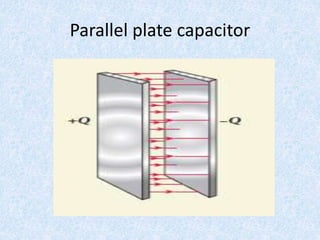
Parallel plate capacitor
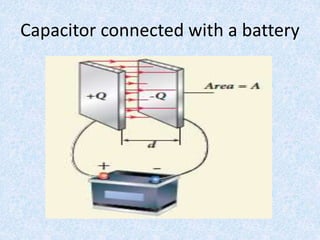
Capacitor connected with a battery
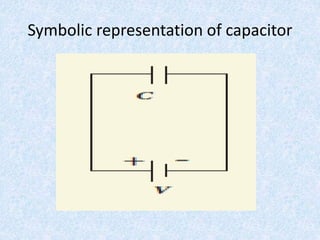
Symbolic representation of capacitor
• When a capacitor is connected to a battery of
potential difference V, the electrons are
transferred from one plate to the other plate
by battery so that one plate becomes
negatively charged with a charge of –Q and
the other plate positively charged with +Q.
• The potential difference between the plates is
equivalent to the battery’s terminal voltage.
• If the battery voltage is increased, the amount
of charges stored in the plates also increase
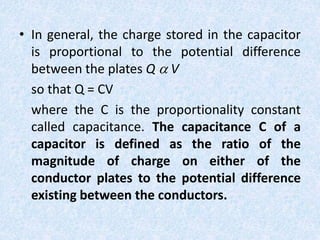
• In general, the charge stored in the capacitor
is proportional to the potential difference
between the plates Q  V
so that Q = CV
where the C is the proportionality constant
called capacitance. The capacitance C of a
capacitor is defined as the ratio of the
magnitude of charge on either of the
conductor plates to the potential difference
existing between the conductors.
C=Q/V
The SI unit of capacitance is coulomb per volt or
farad (F) in honor of Michael Faraday. Farad is
a very large unit of capacitance.
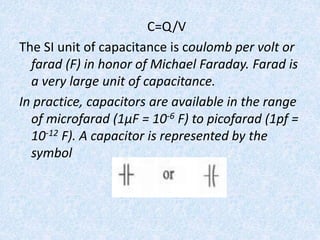
In practice, capacitors are available in the range
of microfarad (1μF = 10-6 F) to picofarad (1pf =
10-12 F). A capacitor is represented by the
symbol
• Note that the total charge stored in the
capacitor is zero (Q - Q = 0).
• When we say the capacitor stores charges, it
means the amount of charge that can be
stored in any one of the plates.
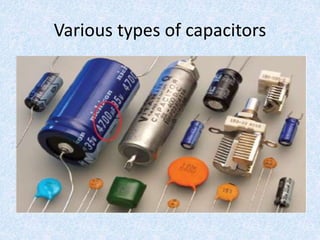
• Nowadays there are capacitors available in
various shapes (cylindrical, disk) and types
(tantalum, ceramic and electrolytic), These
capacitors are extensively used in various
kinds of electronic circuits.
Various types of capacitors
Capacitance of a parallel plate
capacitor
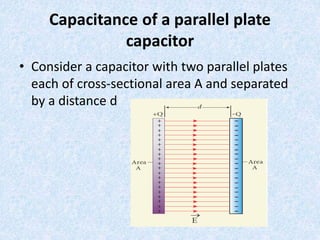
• Consider a capacitor with two parallel plates
each of cross-sectional area A and separated
by a distance d
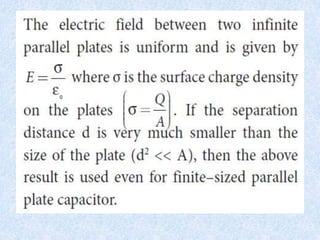
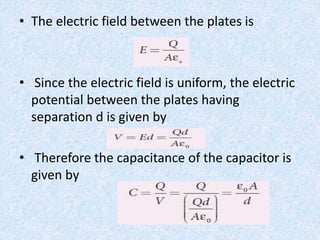
• The electric field between the plates is
• Since the electric field is uniform, the electric
potential between the plates having
separation d is given by
• Therefore the capacitance of the capacitor is
given by
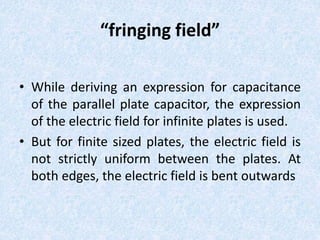
“fringing field”
• While deriving an expression for capacitance
of the parallel plate capacitor, the expression
of the electric field for infinite plates is used.
• But for finite sized plates, the electric field is
not strictly uniform between the plates. At
both edges, the electric field is bent outwards
• It is evident that capacitance is directly
proportional to the area of cross section and is
inversely proportional to the distance
between the plates
• (i) If the area of cross-section of the capacitor
plates is increased, more charges can be
distributed for the same potential difference.
As a result, the capacitance is increased
• If the distance d between the two plates is
reduced, the potential difference between the
plates (V = Ed) decreases with E constant.
• As a result, voltage difference between the
terminals of the battery increases which in turn
leads to an additional flow of charge to the plates
from the battery, till the voltage on the capacitor
equals to the battery’s terminal voltage.
• Suppose the distance is increased, the capacitor
voltage increases and becomes greater than the
battery voltage.
• Then, the charges flow from capacitor plates to
battery till both voltages becomes equal.
• Sometimes we notice that the ceiling fan does
not start rotating as soon as it is switched on.
But when we rotate the blades, it starts to
rotate as usual. Why it is so?
• We know that to rotate any object, there must
be a torque applied on the object.
• For the ceiling fan, the initial torque is given
by the capacitor widely known as a condenser.
If the condenser is faulty, it will not give
sufficient initial torque to rotate the blades
when the fan is switched on.
Energy stored in the capacitor
• Capacitor not only stores the charge but also it
stores energy.
• When a battery is connected to the capacitor,
electrons of total charge -Q are transferred
from one plate to the other plate.
• To transfer the charge, work is done by the
battery.
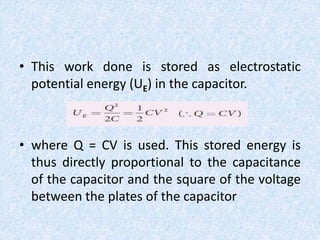
• This work done is stored as electrostatic
potential energy in the capacitor
• To transfer an infinitesimal charge dQ for a
potential difference V, the work done is given
by
• The total work done to charge a capacitor is
• This work done is stored as electrostatic
potential energy (UE) in the capacitor.
• where Q = CV is used. This stored energy is
thus directly proportional to the capacitance
of the capacitor and the square of the voltage
between the plates of the capacitor
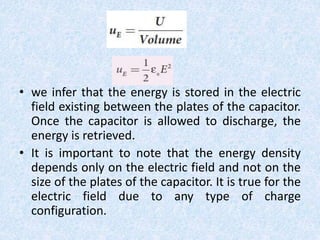
• The equation is rewritten as follows using the
• where Ad = volume of the space between the
capacitor plates. The energy stored per unit
volume of space is defined as energy density
• we infer that the energy is stored in the electric
field existing between the plates of the capacitor.
Once the capacitor is allowed to discharge, the
energy is retrieved.
• It is important to note that the energy density
depends only on the electric field and not on the
size of the plates of the capacitor. It is true for the
electric field due to any type of charge
configuration.
Applications of
capacitors
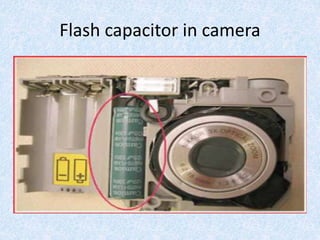
Flash capacitor in camera
• Most people are now familiar with the digital
camera.
• The flash which comes from the camera when
we take photographs is due to the energy
released from the capacitor, called a flash
capacitor
Heart defibrillator
• During cardiac arrest, a device called heart
defibrillator is used to give a sudden surge of a
large amount of electrical energy to the
patient’s chest to retrieve the normal heart
function.
• This defibrillator uses a capacitor of 175 μF
charged to a high voltage of around 2000 V
• Capacitors are used in the ignition system of
automobile engines to eliminate sparking
• Capacitors are used to reduce power
fluctuations in power supplies and to increase
the efficiency of power transmission.
DISADVANTAGES
• Even after the battery or power supply is
removed, the capacitor stores charges and
energy for some time.
• For example if the TV is switched off, it is
always advisable to not touch the back side of
the TV panel.

CAPACITORS AND CAPACITANCE

  • 1.
  • 2.
    Capacitor • Capacitor isa device used to store electric charge and electrical energy. • It consists of two conducting objects (usually plates or sheets) separated by some distance. • Capacitors are widely used in many electronic circuits and have applications in many areas of science and technology. • A simple capacitor consists of two parallel metal plates separated by a small distance
  • 3.
  • 4.
  • 5.
  • 6.
    • When acapacitor is connected to a battery of potential difference V, the electrons are transferred from one plate to the other plate by battery so that one plate becomes negatively charged with a charge of –Q and the other plate positively charged with +Q. • The potential difference between the plates is equivalent to the battery’s terminal voltage. • If the battery voltage is increased, the amount of charges stored in the plates also increase
  • 7.
    • In general,the charge stored in the capacitor is proportional to the potential difference between the plates Q  V so that Q = CV where the C is the proportionality constant called capacitance. The capacitance C of a capacitor is defined as the ratio of the magnitude of charge on either of the conductor plates to the potential difference existing between the conductors.
  • 8.
    C=Q/V The SI unitof capacitance is coulomb per volt or farad (F) in honor of Michael Faraday. Farad is a very large unit of capacitance. In practice, capacitors are available in the range of microfarad (1μF = 10-6 F) to picofarad (1pf = 10-12 F). A capacitor is represented by the symbol
  • 9.
    • Note thatthe total charge stored in the capacitor is zero (Q - Q = 0). • When we say the capacitor stores charges, it means the amount of charge that can be stored in any one of the plates. • Nowadays there are capacitors available in various shapes (cylindrical, disk) and types (tantalum, ceramic and electrolytic), These capacitors are extensively used in various kinds of electronic circuits.
  • 10.
    Various types ofcapacitors
  • 11.
    Capacitance of aparallel plate capacitor • Consider a capacitor with two parallel plates each of cross-sectional area A and separated by a distance d
  • 13.
    • The electricfield between the plates is • Since the electric field is uniform, the electric potential between the plates having separation d is given by • Therefore the capacitance of the capacitor is given by
  • 14.
    “fringing field” • Whilederiving an expression for capacitance of the parallel plate capacitor, the expression of the electric field for infinite plates is used. • But for finite sized plates, the electric field is not strictly uniform between the plates. At both edges, the electric field is bent outwards
  • 16.
    • It isevident that capacitance is directly proportional to the area of cross section and is inversely proportional to the distance between the plates • (i) If the area of cross-section of the capacitor plates is increased, more charges can be distributed for the same potential difference. As a result, the capacitance is increased
  • 17.
    • If thedistance d between the two plates is reduced, the potential difference between the plates (V = Ed) decreases with E constant. • As a result, voltage difference between the terminals of the battery increases which in turn leads to an additional flow of charge to the plates from the battery, till the voltage on the capacitor equals to the battery’s terminal voltage. • Suppose the distance is increased, the capacitor voltage increases and becomes greater than the battery voltage. • Then, the charges flow from capacitor plates to battery till both voltages becomes equal.
  • 20.
    • Sometimes wenotice that the ceiling fan does not start rotating as soon as it is switched on. But when we rotate the blades, it starts to rotate as usual. Why it is so?
  • 21.
    • We knowthat to rotate any object, there must be a torque applied on the object. • For the ceiling fan, the initial torque is given by the capacitor widely known as a condenser. If the condenser is faulty, it will not give sufficient initial torque to rotate the blades when the fan is switched on.
  • 22.
    Energy stored inthe capacitor • Capacitor not only stores the charge but also it stores energy. • When a battery is connected to the capacitor, electrons of total charge -Q are transferred from one plate to the other plate. • To transfer the charge, work is done by the battery. • This work done is stored as electrostatic potential energy in the capacitor
  • 23.
    • To transferan infinitesimal charge dQ for a potential difference V, the work done is given by • The total work done to charge a capacitor is
  • 24.
    • This workdone is stored as electrostatic potential energy (UE) in the capacitor. • where Q = CV is used. This stored energy is thus directly proportional to the capacitance of the capacitor and the square of the voltage between the plates of the capacitor
  • 25.
    • The equationis rewritten as follows using the • where Ad = volume of the space between the capacitor plates. The energy stored per unit volume of space is defined as energy density
  • 26.
    • we inferthat the energy is stored in the electric field existing between the plates of the capacitor. Once the capacitor is allowed to discharge, the energy is retrieved. • It is important to note that the energy density depends only on the electric field and not on the size of the plates of the capacitor. It is true for the electric field due to any type of charge configuration.
  • 27.
  • 28.
  • 29.
    • Most peopleare now familiar with the digital camera. • The flash which comes from the camera when we take photographs is due to the energy released from the capacitor, called a flash capacitor
  • 30.
  • 31.
    • During cardiacarrest, a device called heart defibrillator is used to give a sudden surge of a large amount of electrical energy to the patient’s chest to retrieve the normal heart function. • This defibrillator uses a capacitor of 175 μF charged to a high voltage of around 2000 V
  • 32.
    • Capacitors areused in the ignition system of automobile engines to eliminate sparking • Capacitors are used to reduce power fluctuations in power supplies and to increase the efficiency of power transmission.
  • 33.
    DISADVANTAGES • Even afterthe battery or power supply is removed, the capacitor stores charges and energy for some time. • For example if the TV is switched off, it is always advisable to not touch the back side of the TV panel.