DR. MAHESWARI JAIKUMAR
maheswarijaikumar2103@gmail.com
CAPACITANCE
• Capacitance simply means the
ability of a body to store electric
charge. A common device to do
such task is a capacitor. The SI
unit for capacitance is farad.
• Capacitance is the ability of a system
of electrical conductors and
insulators to store electric charge
when a potential difference exists
between the conductors.
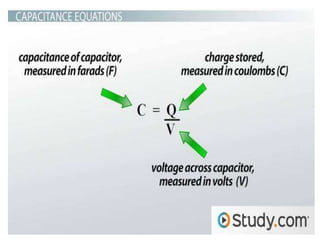
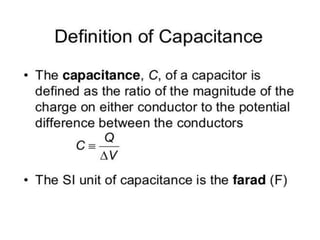
• The symbol for capacitance is
C. Capacitance is expressed as a ratio
of the electrical charge stored to the
voltage across the conductors.
• The SI unit of capacitance is the
farad (symbol: F), named after the
English physicist Michael Faraday.
• Capacitance is the ratio of the
change in electric charge of a
system, to the corresponding
change in its electric potential.
• There are two closely related
notions of capacitance: self
capacitance and mutual
capacitance.
• Any object that can be electrically
charged exhibits self capacitance.
• A material with a large self
capacitance holds more electric
charge at a given voltage than one
with low capacitance.
• The notion of mutual capacitance is
particularly important for
understanding the operations of
the capacitor, one of the three
elementary linear electronic
components (along
with resistors and inductors).
• A 1 farad capacitor, when charged
with 1 coulomb of electrical charge,
has a potential difference of
1 volt between its plates. The
reciprocal of capacitance is
called elastance.
HOW DOES THE CAPACITANCE WORK
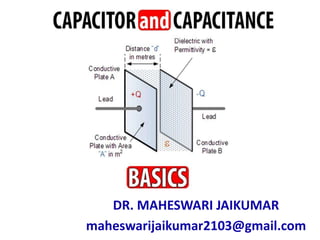
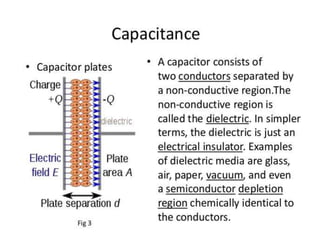
• A capacitor is made up of two
metallic plates. With a dielectric
material in between the plates.
• When we apply a voltage over the
two plates, an electric field is
created “a capacitor works by
storing energy electrostatically in an
electric field”
CREATING CAPACITANCE
• A capacitor is created out of two
metal plates and an insulating
material called a dielectric.
• The metal plates are placed very
close to each other, in parallel, but
the dielectric sits between them to
make sure they don't touch.
FACTORS INFLUEINCING
CAPACITANCE
• The capacitance of a capacitor is
affected by the area of the plates,
the distance between the plates,
and the ability of the dielectric to
support electrostatic forces.
• Larger plates provide greater
capacity to store electric charge.
Therefore, as the area of the plates
increase, capacitance increases
MEASUREMENT OF CAPACITANCE
• Capacitance is measured in units
called farads (abbreviated F).
• The definition of one farad is
deceptively simple. A one-
farad capacitor holds a voltage
across the plates of exactly one volt
when it's charged with exactly one
ampere per second of current.
• A capacitance meter is a piece
of electronic test equipment used to
measure capacitance, mainly of
discrete capacitors.
• For most purposes and in most cases
the capacitor must be disconnected
from circuit.
• Many DVMs (Digital Volt Meters)
have a capacitance-measuring
function.
• DVM operate by charging and
discharging the capacitor under
test with a known current and
measuring the rate of rise of the
resulting voltage; the slower the
rate of rise, the larger the
capacitance
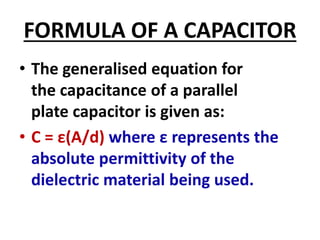
FORMULA OF A CAPACITOR
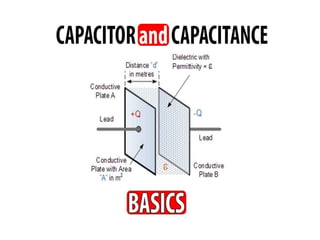
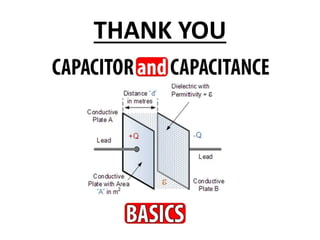
• The generalised equation for
the capacitance of a parallel
plate capacitor is given as:
• C = ε(A/d) where ε represents the
absolute permittivity of the
dielectric material being used.
USE OF CAPACITOR
• A capacitor can store electric energy
when it is connected to its charging
circuit.
• When it is disconnected from its
charging circuit, it can dissipate that
stored energy, so it can be used like a
temporary battery. In car audio
systems, large capacitors store energy
for the amplifier to use on demand.
TYPES OF CAPACITOR
• Film capacitors
• Paper capacitor
• Aluminum electrolytic capacitors
• Tantalum electrolytic capacitors
IMPORTANCE OF CAPACITOR
• Capacitors have
many important applications.
• They are used, for example, in digital
circuits so that information stored in
large computer memories is not lost
during a momentary electric power
failure; the electric energy stored in
such capacitors maintains the
information during the temporary loss
of power.
THANK YOU

CAPACITANCE

  • 1.
  • 2.
    CAPACITANCE • Capacitance simplymeans the ability of a body to store electric charge. A common device to do such task is a capacitor. The SI unit for capacitance is farad.
  • 3.
    • Capacitance isthe ability of a system of electrical conductors and insulators to store electric charge when a potential difference exists between the conductors. • The symbol for capacitance is C. Capacitance is expressed as a ratio of the electrical charge stored to the voltage across the conductors.
  • 5.
    • The SIunit of capacitance is the farad (symbol: F), named after the English physicist Michael Faraday.
  • 7.
    • Capacitance isthe ratio of the change in electric charge of a system, to the corresponding change in its electric potential. • There are two closely related notions of capacitance: self capacitance and mutual capacitance.
  • 8.
    • Any objectthat can be electrically charged exhibits self capacitance. • A material with a large self capacitance holds more electric charge at a given voltage than one with low capacitance.
  • 9.
    • The notionof mutual capacitance is particularly important for understanding the operations of the capacitor, one of the three elementary linear electronic components (along with resistors and inductors).
  • 10.
    • A 1farad capacitor, when charged with 1 coulomb of electrical charge, has a potential difference of 1 volt between its plates. The reciprocal of capacitance is called elastance.
  • 11.
    HOW DOES THECAPACITANCE WORK • A capacitor is made up of two metallic plates. With a dielectric material in between the plates. • When we apply a voltage over the two plates, an electric field is created “a capacitor works by storing energy electrostatically in an electric field”
  • 12.
    CREATING CAPACITANCE • Acapacitor is created out of two metal plates and an insulating material called a dielectric. • The metal plates are placed very close to each other, in parallel, but the dielectric sits between them to make sure they don't touch.
  • 15.
    FACTORS INFLUEINCING CAPACITANCE • Thecapacitance of a capacitor is affected by the area of the plates, the distance between the plates, and the ability of the dielectric to support electrostatic forces.
  • 16.
    • Larger platesprovide greater capacity to store electric charge. Therefore, as the area of the plates increase, capacitance increases
  • 17.
    MEASUREMENT OF CAPACITANCE •Capacitance is measured in units called farads (abbreviated F). • The definition of one farad is deceptively simple. A one- farad capacitor holds a voltage across the plates of exactly one volt when it's charged with exactly one ampere per second of current.
  • 18.
    • A capacitancemeter is a piece of electronic test equipment used to measure capacitance, mainly of discrete capacitors. • For most purposes and in most cases the capacitor must be disconnected from circuit.
  • 19.
    • Many DVMs(Digital Volt Meters) have a capacitance-measuring function. • DVM operate by charging and discharging the capacitor under test with a known current and measuring the rate of rise of the resulting voltage; the slower the rate of rise, the larger the capacitance
  • 20.
    FORMULA OF ACAPACITOR • The generalised equation for the capacitance of a parallel plate capacitor is given as: • C = ε(A/d) where ε represents the absolute permittivity of the dielectric material being used.
  • 21.
    USE OF CAPACITOR •A capacitor can store electric energy when it is connected to its charging circuit. • When it is disconnected from its charging circuit, it can dissipate that stored energy, so it can be used like a temporary battery. In car audio systems, large capacitors store energy for the amplifier to use on demand.
  • 22.
    TYPES OF CAPACITOR •Film capacitors • Paper capacitor • Aluminum electrolytic capacitors • Tantalum electrolytic capacitors
  • 23.
    IMPORTANCE OF CAPACITOR •Capacitors have many important applications. • They are used, for example, in digital circuits so that information stored in large computer memories is not lost during a momentary electric power failure; the electric energy stored in such capacitors maintains the information during the temporary loss of power.
  • 24.