Lecture 21 - Capacitors in circuits Charging a capacitor (semi-qualitative). Charging a capacitor (quantitative). The time constant. Discharging a capacitor. Energy Considerations. The End
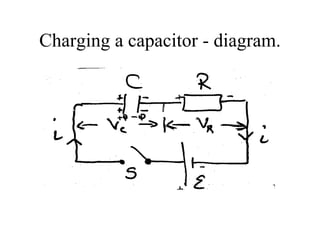
Charging a capacitor - diagram.
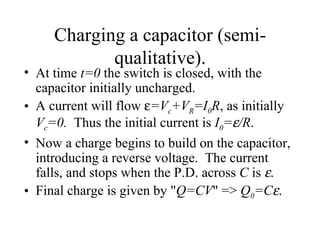
Charging a capacitor (semi-qualitative). At time  t=0  the switch is closed, with the capacitor initially uncharged. A current will flow   =V c +V R =I 0 R , as initially  V c =0.  Thus the initial current is  I 0 =  /R . Now a charge begins to build on the capacitor, introducing a reverse voltage.  The current falls, and stops when the P.D. across  C  is   . Final charge is given by " Q=CV " =>  Q 0 =C  .
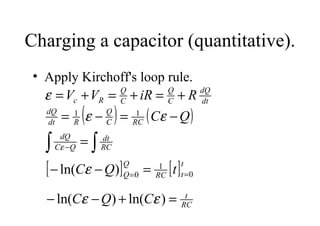
Charging a capacitor (quantitative). Apply Kirchoff's loop rule.
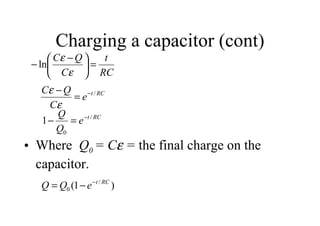
Charging a capacitor (cont) Where  Q 0  = C   =  the final charge on the capacitor.
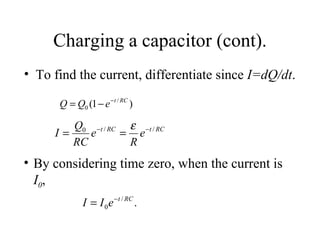
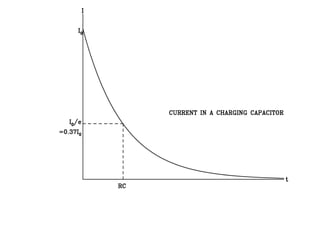
Charging a capacitor (cont). To find the current, differentiate since  I=dQ/dt . By considering time zero, when the current is  I 0 ,
 
 
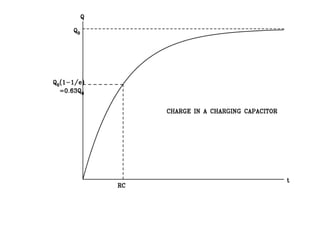
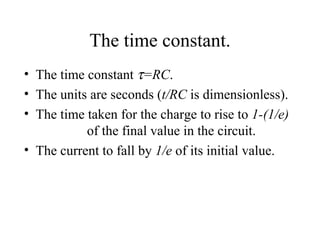
The time constant. The time constant   =RC .  The units are seconds ( t/RC  is dimensionless). The time taken for the charge to rise to  1-(1/e)   of the final value in the circuit. The current to fall by  1/e  of its initial value.
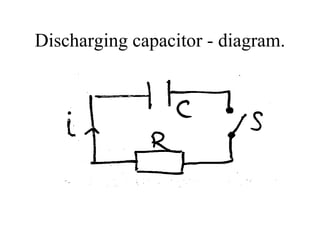
Discharging capacitor - diagram.
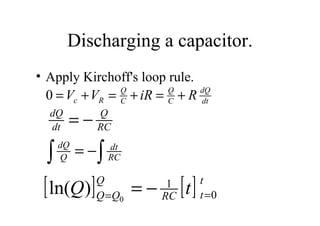
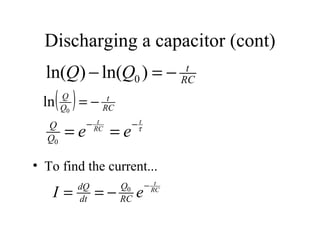
Discharging a capacitor. Apply Kirchoff's loop rule.
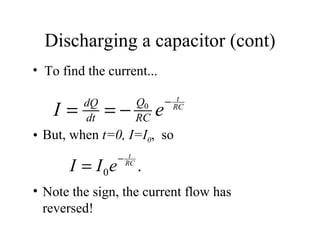
Discharging a capacitor (cont) To find the current...
Discharging a capacitor (cont) To find the current... Note the sign, the current flow has reversed!  But, when  t=0, I=I 0 ,  so
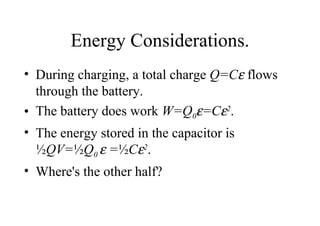
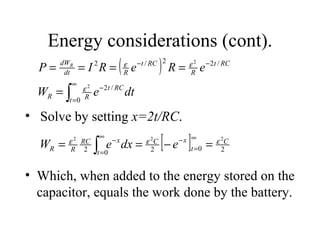
Energy Considerations. During charging, a total charge  Q=C   flows through the battery.  The battery does work  W=Q 0  =C  2 .   The energy stored in the capacitor is ½ QV= ½ Q 0    = ½ C  2 . Where's the other half?
Energy considerations (cont). Solve by setting  x=2t/RC . Which, when added to the energy stored on the capacitor, equals the work done by the battery.
Finally… E-M depends a lot on integrals, vectors etc. shows how useful they are. It is one of the foundations of physics but: it can be rather formal, encouraging the precise thinking that we expect of any academic training; it is rather far removed from the everyday, but that develops the imagination we expect from a physicist.

Charging C

  • 1.
    Lecture 21 -Capacitors in circuits Charging a capacitor (semi-qualitative). Charging a capacitor (quantitative). The time constant. Discharging a capacitor. Energy Considerations. The End
  • 2.
  • 3.
    Charging a capacitor(semi-qualitative). At time t=0 the switch is closed, with the capacitor initially uncharged. A current will flow  =V c +V R =I 0 R , as initially V c =0. Thus the initial current is I 0 =  /R . Now a charge begins to build on the capacitor, introducing a reverse voltage. The current falls, and stops when the P.D. across C is  . Final charge is given by " Q=CV " => Q 0 =C  .
  • 4.
    Charging a capacitor(quantitative). Apply Kirchoff's loop rule.
  • 5.
    Charging a capacitor(cont) Where Q 0 = C  = the final charge on the capacitor.
  • 6.
    Charging a capacitor(cont). To find the current, differentiate since I=dQ/dt . By considering time zero, when the current is I 0 ,
  • 7.
  • 8.
  • 9.
    The time constant.The time constant  =RC . The units are seconds ( t/RC is dimensionless). The time taken for the charge to rise to 1-(1/e) of the final value in the circuit. The current to fall by 1/e of its initial value.
  • 10.
  • 11.
    Discharging a capacitor.Apply Kirchoff's loop rule.
  • 12.
    Discharging a capacitor(cont) To find the current...
  • 13.
    Discharging a capacitor(cont) To find the current... Note the sign, the current flow has reversed! But, when t=0, I=I 0 , so
  • 14.
    Energy Considerations. Duringcharging, a total charge Q=C  flows through the battery. The battery does work W=Q 0  =C  2 . The energy stored in the capacitor is ½ QV= ½ Q 0  = ½ C  2 . Where's the other half?
  • 15.
    Energy considerations (cont).Solve by setting x=2t/RC . Which, when added to the energy stored on the capacitor, equals the work done by the battery.
  • 16.
    Finally… E-M dependsa lot on integrals, vectors etc. shows how useful they are. It is one of the foundations of physics but: it can be rather formal, encouraging the precise thinking that we expect of any academic training; it is rather far removed from the everyday, but that develops the imagination we expect from a physicist.