OPTC Edavanna Page 1
MODULE II : Compass surveying
1. Explain the concept of traverse? What is closed and open traverse?
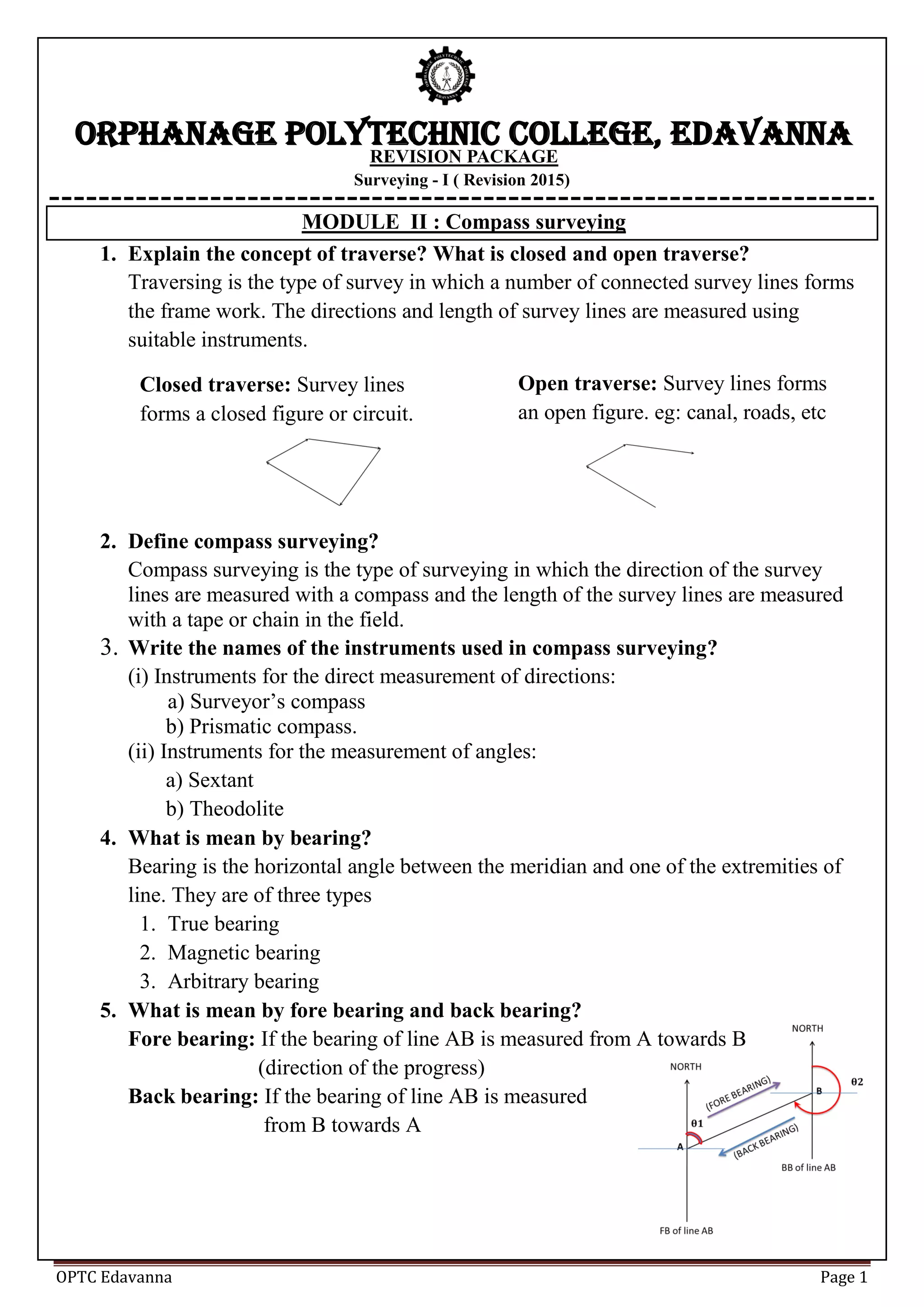
Traversing is the type of survey in which a number of connected survey lines forms
the frame work. The directions and length of survey lines are measured using
suitable instruments.
2. Define compass surveying?
Compass surveying is the type of surveying in which the direction of the survey
lines are measured with a compass and the length of the survey lines are measured
with a tape or chain in the field.
3. Write the names of the instruments used in compass surveying?
(i) Instruments for the direct measurement of directions:
a) Surveyor’s compass
b) Prismatic compass.
(ii) Instruments for the measurement of angles:
a) Sextant
b) Theodolite
4. What is mean by bearing?
Bearing is the horizontal angle between the meridian and one of the extremities of
line. They are of three types
1. True bearing
2. Magnetic bearing
3. Arbitrary bearing
5. What is mean by fore bearing and back bearing?
Fore bearing: If the bearing of line AB is measured from A towards B
(direction of the progress)
Back bearing: If the bearing of line AB is measured
from B towards A
Closed traverse: Survey lines
forms a closed figure or circuit.
Orphanage Polytechnic College, Edavanna
REVISION PACKAGE
Surveying - I ( Revision 2015)
Open traverse: Survey lines forms
an open figure. eg: canal, roads, etc
OPTC Edavanna Page 2
6. What is mean by local attraction? What are its sources?
It is a term used to denote any influence, such as magnetic substances, which
prevents the needle from pointing to the magnetic north in a given locality.
Sources of Local attraction
• Magnetic ore, Wire carrying electric current
• Steel structures. Iron pipes
• keys, High voltage transmission line
• Electric pole etc.
7. Briefly explain how local attraction is detected and eliminated?
Detection : By observing F.B & B.B , and checking whether the
difference 1800
 There is local attraction
We confirm the local attraction only if the difference is not due to
observational or other personal or natural errors. If ( FB - BB ) = 180,
then the bearings measured in that station is free from local attraction. If
detected, that has to be eliminated
Correction: Two methods (1) First method (2) Second method
First method:
 Find the included angles
 Sum of the included angles = (2n-4) x 90 , n – number of lines
 If not, then distribute the total error equally to all interior angles of the
traverse
 Then starting from unaffected line the bearings of all other lines are corrected
using corrected included angles
Second method:
 Find the Unaffected line
 Then, Starting from the unaffected line, the bearing of other affected lines
are corrected by finding the amount of correction at each station.
8. What is mean by closing error in closed traverse? State the methods of
adjusting of closing error?
When a closed traverse is plotted, the finishing and starting points may not coincide.
The distance by which the traverse fails to close is called closing error
• If the closing error exceeds a permissible limit
( 15’√ , NNumber of stations) the field work should be repeated.
• If it is within permissible limits, it can adjusted graphically
by Bowditch’s rule.
OPTC Edavanna Page 3
9. Give in a tabular form, the difference between prismatic compass and
surveyor’s compass.
Prismatic compass Surveyor’s compass
The reading is taken with help of prism No prism for reading
sighting and reading simultaneously not simultaneously
Tripod not sufficient Tripod is sufficient
Object vane: metal vane with vertical
hair
Eye vane: small metal vane with slit
Object vane: metal vane with vertical
hair
Eye vane: small metal vane with a fine
slit
Graduated ring doesn't rotate along with
line of sight
Graduated ring rotate along with line of
sight
Graduations in WCB Graduations in RB
‘Broad type magnetic needle’ doesn’t act
as index
‘Edge bar’ magnetic needle act as index
also
Graduations are marked inverted Graduations are marked erect
10.What do you mean by meridian? Explain each?
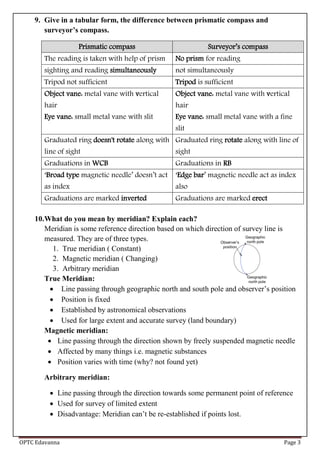
Meridian is some reference direction based on which direction of survey line is
measured. They are of three types.
1. True meridian ( Constant)
2. Magnetic meridian ( Changing)
3. Arbitrary meridian
True Meridian:
 Line passing through geographic north and south pole and observer’s position
 Position is fixed
 Established by astronomical observations
 Used for large extent and accurate survey (land boundary)
Magnetic meridian:
 Line passing through the direction shown by freely suspended magnetic needle
 Affected by many things i.e. magnetic substances
 Position varies with time (why? not found yet)
Arbitrary meridian:
 Line passing through the direction towards some permanent point of reference
 Used for survey of limited extent
 Disadvantage: Meridian can’t be re-established if points lost.
OPTC Edavanna Page 4
11.The following are the bearings taken on a closed traverse. Compute the interior
angles and correct them for observational errors. Assuming the observed
bearing of the line CD to be correct, adjust the bearing of the remaining sides.
Ans:
Theoretically, Sum of the included angles = (2n-4) x 90= 540
Error = -25’  Correction = +25’
Five included angles
Apply +5’ correction for all included angles
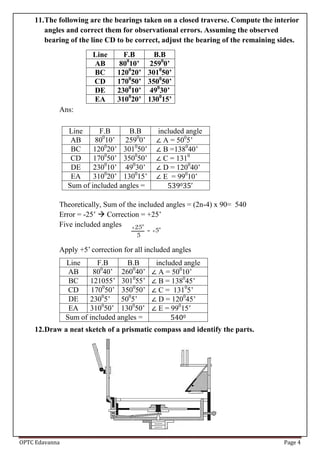
12.Draw a neat sketch of a prismatic compass and identify the parts.
Line F.B B.B
AB 800
10’ 2590
0’
BC 1200
20’ 3010
50’
CD 1700
50’ 3500
50’
DE 2300
10’ 490
30’
EA 3100
20’ 1300
15’
Line F.B B.B included angle
AB 800
10’ 2590
0’ ∠ A = 500
5’
BC 1200
20’ 3010
50’ ∠ B =1380
40’
CD 1700
50’ 3500
50’ ∠ C = 1310
DE 2300
10’ 490
30’ ∠ D = 1200
40’
EA 3100
20’ 1300
15’ ∠ E = 990
10’
Sum of included angles = 539035’
Line F.B B.B included angle
AB 800
40’ 2600
40’ ∠ A = 500
10’
BC 121055’ 3010
55’ ∠ B = 1380
45’
CD 1700
50’ 3500
50’ ∠ C = 1310
5’
DE 2300
5’ 500
5’ ∠ D = 1200
45’
EA 3100
50’ 1300
50’ ∠ E = 990
15’
Sum of included angles = 5400
OPTC Edavanna Page 5
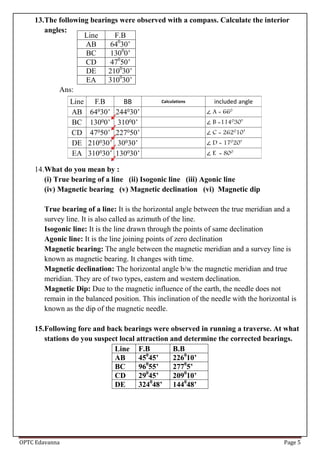
13.The following bearings were observed with a compass. Calculate the interior
angles:
Ans:
14.What do you mean by :
(i) True bearing of a line (ii) Isogonic line (iii) Agonic line
(iv) Magnetic bearing (v) Magnetic declination (vi) Magnetic dip
True bearing of a line: It is the horizontal angle between the true meridian and a
survey line. It is also called as azimuth of the line.
Isogonic line: It is the line drawn through the points of same declination
Agonic line: It is the line joining points of zero declination
Magnetic bearing: The angle between the magnetic meridian and a survey line is
known as magnetic bearing. It changes with time.
Magnetic declination: The horizontal angle b/w the magnetic meridian and true
meridian. They are of two types, eastern and western declination.
Magnetic Dip: Due to the magnetic influence of the earth, the needle does not
remain in the balanced position. This inclination of the needle with the horizontal is
known as the dip of the magnetic needle.
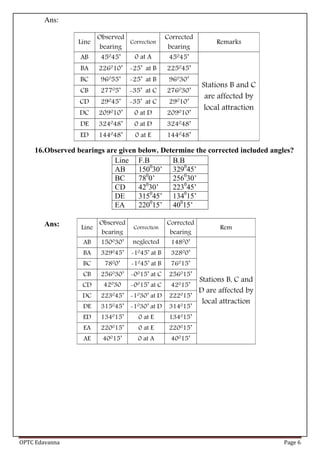
15.Following fore and back bearings were observed in running a traverse. At what
stations do you suspect local attraction and determine the corrected bearings.
Line F.B B.B
AB 450
45’ 2260
10’
BC 960
55’ 2770
5’
CD 290
45’ 2090
10’
DE 3240
48’ 1440
48’
Line F.B
AB 640
30’
BC 1300
0’
CD 470
50’
DE 2100
30’
EA 3100
30’
OPTC Edavanna Page 6
Ans:
16.Observed bearings are given below. Determine the corrected included angles?
Line F.B B.B
AB 1500
30’ 3290
45’
BC 780
0’ 2560
30’
CD 420
30’ 2230
45’
DE 3150
45’ 1340
15’
EA 2200
15’ 400
15’
Ans:
OPTC Edavanna Page 7
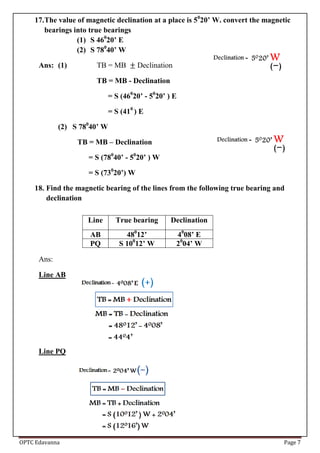
17.The value of magnetic declination at a place is 50
20’ W. convert the magnetic
bearings into true bearings
(1) S 460
20’ E
(2) S 780
40’ W
Ans: (1) TB = MB Declination
TB = MB - Declination
= S (460
20’ - 50
20’ ) E
= S (410
) E
(2) S 780
40’ W
TB = MB – Declination
= S (780
40’ - 50
20’ ) W
= S (730
20’) W
18. Find the magnetic bearing of the lines from the following true bearing and
declination
Ans:
Line AB
Line PQ
Line True bearing Declination
AB 480
12’ 40
08’ E
PQ S 100
12’ W 20
04’ W
OPTC Edavanna Page 8
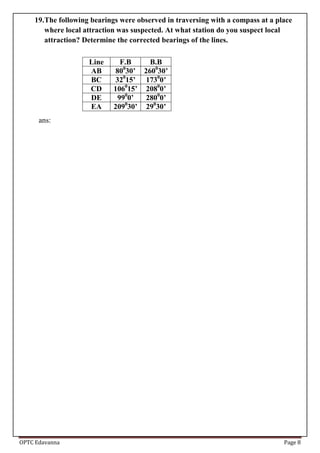
19.The following bearings were observed in traversing with a compass at a place
where local attraction was suspected. At what station do you suspect local
attraction? Determine the corrected bearings of the lines.
ans:
Line F.B B.B
AB 800
30’ 2600
30’
BC 320
15’ 1730
0’
CD 1060
15’ 2080
0’
DE 990
0’ 2800
0’
EA 2090
30’ 290
30’

Surveying - Module II - compass surveying

  • 1.
    OPTC Edavanna Page1 MODULE II : Compass surveying 1. Explain the concept of traverse? What is closed and open traverse? Traversing is the type of survey in which a number of connected survey lines forms the frame work. The directions and length of survey lines are measured using suitable instruments. 2. Define compass surveying? Compass surveying is the type of surveying in which the direction of the survey lines are measured with a compass and the length of the survey lines are measured with a tape or chain in the field. 3. Write the names of the instruments used in compass surveying? (i) Instruments for the direct measurement of directions: a) Surveyor’s compass b) Prismatic compass. (ii) Instruments for the measurement of angles: a) Sextant b) Theodolite 4. What is mean by bearing? Bearing is the horizontal angle between the meridian and one of the extremities of line. They are of three types 1. True bearing 2. Magnetic bearing 3. Arbitrary bearing 5. What is mean by fore bearing and back bearing? Fore bearing: If the bearing of line AB is measured from A towards B (direction of the progress) Back bearing: If the bearing of line AB is measured from B towards A Closed traverse: Survey lines forms a closed figure or circuit. Orphanage Polytechnic College, Edavanna REVISION PACKAGE Surveying - I ( Revision 2015) Open traverse: Survey lines forms an open figure. eg: canal, roads, etc
  • 2.
    OPTC Edavanna Page2 6. What is mean by local attraction? What are its sources? It is a term used to denote any influence, such as magnetic substances, which prevents the needle from pointing to the magnetic north in a given locality. Sources of Local attraction • Magnetic ore, Wire carrying electric current • Steel structures. Iron pipes • keys, High voltage transmission line • Electric pole etc. 7. Briefly explain how local attraction is detected and eliminated? Detection : By observing F.B & B.B , and checking whether the difference 1800  There is local attraction We confirm the local attraction only if the difference is not due to observational or other personal or natural errors. If ( FB - BB ) = 180, then the bearings measured in that station is free from local attraction. If detected, that has to be eliminated Correction: Two methods (1) First method (2) Second method First method:  Find the included angles  Sum of the included angles = (2n-4) x 90 , n – number of lines  If not, then distribute the total error equally to all interior angles of the traverse  Then starting from unaffected line the bearings of all other lines are corrected using corrected included angles Second method:  Find the Unaffected line  Then, Starting from the unaffected line, the bearing of other affected lines are corrected by finding the amount of correction at each station. 8. What is mean by closing error in closed traverse? State the methods of adjusting of closing error? When a closed traverse is plotted, the finishing and starting points may not coincide. The distance by which the traverse fails to close is called closing error • If the closing error exceeds a permissible limit ( 15’√ , NNumber of stations) the field work should be repeated. • If it is within permissible limits, it can adjusted graphically by Bowditch’s rule.
  • 3.
    OPTC Edavanna Page3 9. Give in a tabular form, the difference between prismatic compass and surveyor’s compass. Prismatic compass Surveyor’s compass The reading is taken with help of prism No prism for reading sighting and reading simultaneously not simultaneously Tripod not sufficient Tripod is sufficient Object vane: metal vane with vertical hair Eye vane: small metal vane with slit Object vane: metal vane with vertical hair Eye vane: small metal vane with a fine slit Graduated ring doesn't rotate along with line of sight Graduated ring rotate along with line of sight Graduations in WCB Graduations in RB ‘Broad type magnetic needle’ doesn’t act as index ‘Edge bar’ magnetic needle act as index also Graduations are marked inverted Graduations are marked erect 10.What do you mean by meridian? Explain each? Meridian is some reference direction based on which direction of survey line is measured. They are of three types. 1. True meridian ( Constant) 2. Magnetic meridian ( Changing) 3. Arbitrary meridian True Meridian:  Line passing through geographic north and south pole and observer’s position  Position is fixed  Established by astronomical observations  Used for large extent and accurate survey (land boundary) Magnetic meridian:  Line passing through the direction shown by freely suspended magnetic needle  Affected by many things i.e. magnetic substances  Position varies with time (why? not found yet) Arbitrary meridian:  Line passing through the direction towards some permanent point of reference  Used for survey of limited extent  Disadvantage: Meridian can’t be re-established if points lost.
  • 4.
    OPTC Edavanna Page4 11.The following are the bearings taken on a closed traverse. Compute the interior angles and correct them for observational errors. Assuming the observed bearing of the line CD to be correct, adjust the bearing of the remaining sides. Ans: Theoretically, Sum of the included angles = (2n-4) x 90= 540 Error = -25’  Correction = +25’ Five included angles Apply +5’ correction for all included angles 12.Draw a neat sketch of a prismatic compass and identify the parts. Line F.B B.B AB 800 10’ 2590 0’ BC 1200 20’ 3010 50’ CD 1700 50’ 3500 50’ DE 2300 10’ 490 30’ EA 3100 20’ 1300 15’ Line F.B B.B included angle AB 800 10’ 2590 0’ ∠ A = 500 5’ BC 1200 20’ 3010 50’ ∠ B =1380 40’ CD 1700 50’ 3500 50’ ∠ C = 1310 DE 2300 10’ 490 30’ ∠ D = 1200 40’ EA 3100 20’ 1300 15’ ∠ E = 990 10’ Sum of included angles = 539035’ Line F.B B.B included angle AB 800 40’ 2600 40’ ∠ A = 500 10’ BC 121055’ 3010 55’ ∠ B = 1380 45’ CD 1700 50’ 3500 50’ ∠ C = 1310 5’ DE 2300 5’ 500 5’ ∠ D = 1200 45’ EA 3100 50’ 1300 50’ ∠ E = 990 15’ Sum of included angles = 5400
  • 5.
    OPTC Edavanna Page5 13.The following bearings were observed with a compass. Calculate the interior angles: Ans: 14.What do you mean by : (i) True bearing of a line (ii) Isogonic line (iii) Agonic line (iv) Magnetic bearing (v) Magnetic declination (vi) Magnetic dip True bearing of a line: It is the horizontal angle between the true meridian and a survey line. It is also called as azimuth of the line. Isogonic line: It is the line drawn through the points of same declination Agonic line: It is the line joining points of zero declination Magnetic bearing: The angle between the magnetic meridian and a survey line is known as magnetic bearing. It changes with time. Magnetic declination: The horizontal angle b/w the magnetic meridian and true meridian. They are of two types, eastern and western declination. Magnetic Dip: Due to the magnetic influence of the earth, the needle does not remain in the balanced position. This inclination of the needle with the horizontal is known as the dip of the magnetic needle. 15.Following fore and back bearings were observed in running a traverse. At what stations do you suspect local attraction and determine the corrected bearings. Line F.B B.B AB 450 45’ 2260 10’ BC 960 55’ 2770 5’ CD 290 45’ 2090 10’ DE 3240 48’ 1440 48’ Line F.B AB 640 30’ BC 1300 0’ CD 470 50’ DE 2100 30’ EA 3100 30’
  • 6.
    OPTC Edavanna Page6 Ans: 16.Observed bearings are given below. Determine the corrected included angles? Line F.B B.B AB 1500 30’ 3290 45’ BC 780 0’ 2560 30’ CD 420 30’ 2230 45’ DE 3150 45’ 1340 15’ EA 2200 15’ 400 15’ Ans:
  • 7.
    OPTC Edavanna Page7 17.The value of magnetic declination at a place is 50 20’ W. convert the magnetic bearings into true bearings (1) S 460 20’ E (2) S 780 40’ W Ans: (1) TB = MB Declination TB = MB - Declination = S (460 20’ - 50 20’ ) E = S (410 ) E (2) S 780 40’ W TB = MB – Declination = S (780 40’ - 50 20’ ) W = S (730 20’) W 18. Find the magnetic bearing of the lines from the following true bearing and declination Ans: Line AB Line PQ Line True bearing Declination AB 480 12’ 40 08’ E PQ S 100 12’ W 20 04’ W
  • 8.
    OPTC Edavanna Page8 19.The following bearings were observed in traversing with a compass at a place where local attraction was suspected. At what station do you suspect local attraction? Determine the corrected bearings of the lines. ans: Line F.B B.B AB 800 30’ 2600 30’ BC 320 15’ 1730 0’ CD 1060 15’ 2080 0’ DE 990 0’ 2800 0’ EA 2090 30’ 290 30’