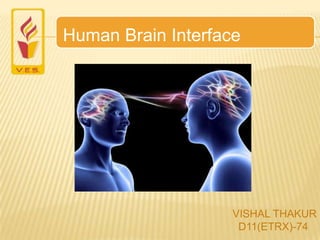
Human Brain Interface
VISHAL THAKUR
D11(ETRX)-74
Brain–computer interface
 DEFINITION
 A brain–computer interface (BCI), sometimes called a
direct neural interface or a brain–machine interface, is
a direct communication pathway between a brain and
an external device.
Human Brain to brain interface
www.youtube.com/watch?v=MXpZSWZ0KRI
Brain to brain interface
How brain computer interface work
ELECTRIC BRAIN
 Our brains are filled with neurons.
 Every time we think, move, feel or remember
something, our neurons are at work.
 That work is carried out by small electric signals
that zip from neuron to neuron as fast as 250
mph.
Classification of BCI
TYPES
 Invasive Brain Computer Interfaces
-implanted directly into the brain and has the
highest quality signals.
-provide functionality to paralyzed people.
 Partially Invasive Brain Computer Interfaces
-implanted inside the skull but outside the brain.
 Non Invasive Brain Computer Interfaces
-Gives a patient the ability to move muscle implants
and restore partial movement.
WORKING
 The technologies used by the researchers for
recording and stimulating the brain are both well-
known. Electroencephalography, or EEG, is routinely
used by clinicians and researchers to record brain
activity noninvasively from the scalp.
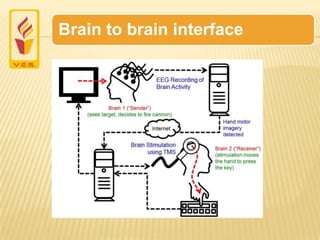
 The first human brain (the sender) is connected to a
computer via an EEG-based BCI. The second human
brain (the receiver) is connected to another computer
via a Magstim transcranial magnetic stimulation
(TMS)
What are electrodes?
 The easiest and least invasive method is a set of
electrodes -- a device known as an
electroencephalograph (EEG) -- attached to the scalp.
 The electrodes can read brain signals.
 The electrodes measure minute differences in the
voltage between neurons. The signal is then amplified
and filtered.
 In current BCI systems, it is then interpreted by a
computer program
ADVANTAGES
 BCIs will help creating a Direct communication
pathway between a human or animal brain and any
external devices like computers.
 BCI has increased the possibility of treatment of
disabilities related to nervous system along with the
old technique of Neuroprosthetics.
 Techniques like EEG, MEG and neurochips have
come into discussions since the BCI application have
started developing.
 This has provided a new work area for scientists and
researchers around the world.
APPLICATIONS
 Criminal investigation.
 Home control appliances.
 Automation airplane control.
 Easy communication between disabilities.
DRAWBACKS
 The brain is incredibly complex.
 The signal is weak and prone to interference.
 The equipment is less than portable.
 HMI's are machine specific.
 Cannot read complex thoughts.
 This technology cannot be used without the consent
of the person.
 There is no way to decide who is better than the
other.
 Man power reduces to great extent.
Future scope
 Brainwaves are low frequency bands which slightly differ
from thought to thought and its these differences that are
detected by an EEG device which works as a transducer.
 We have to think of some device that detects these waves
and based on its artificial intelligence should do the task
based on the thoughts.so it can be used for criminal
investigation
 It could be used by someone on the ground to help a
flight attendant or passenger land an airplane if the
pilot becomes incapacitated.
 Person with disabilities could communicate easily.
Brain to brain interface

Brain to brain interface

  • 1.
    Human Brain Interface VISHALTHAKUR D11(ETRX)-74
  • 2.
    Brain–computer interface  DEFINITION A brain–computer interface (BCI), sometimes called a direct neural interface or a brain–machine interface, is a direct communication pathway between a brain and an external device.
  • 3.
    Human Brain tobrain interface www.youtube.com/watch?v=MXpZSWZ0KRI
  • 4.
    Brain to braininterface
  • 5.
    How brain computerinterface work
  • 6.
    ELECTRIC BRAIN  Ourbrains are filled with neurons.  Every time we think, move, feel or remember something, our neurons are at work.  That work is carried out by small electric signals that zip from neuron to neuron as fast as 250 mph.
  • 7.
  • 8.
    TYPES  Invasive BrainComputer Interfaces -implanted directly into the brain and has the highest quality signals. -provide functionality to paralyzed people.  Partially Invasive Brain Computer Interfaces -implanted inside the skull but outside the brain.  Non Invasive Brain Computer Interfaces -Gives a patient the ability to move muscle implants and restore partial movement.
  • 9.
    WORKING  The technologiesused by the researchers for recording and stimulating the brain are both well- known. Electroencephalography, or EEG, is routinely used by clinicians and researchers to record brain activity noninvasively from the scalp.  The first human brain (the sender) is connected to a computer via an EEG-based BCI. The second human brain (the receiver) is connected to another computer via a Magstim transcranial magnetic stimulation (TMS)
  • 10.
    What are electrodes? The easiest and least invasive method is a set of electrodes -- a device known as an electroencephalograph (EEG) -- attached to the scalp.  The electrodes can read brain signals.  The electrodes measure minute differences in the voltage between neurons. The signal is then amplified and filtered.  In current BCI systems, it is then interpreted by a computer program
  • 11.
    ADVANTAGES  BCIs willhelp creating a Direct communication pathway between a human or animal brain and any external devices like computers.  BCI has increased the possibility of treatment of disabilities related to nervous system along with the old technique of Neuroprosthetics.  Techniques like EEG, MEG and neurochips have come into discussions since the BCI application have started developing.  This has provided a new work area for scientists and researchers around the world.
  • 12.
    APPLICATIONS  Criminal investigation. Home control appliances.  Automation airplane control.  Easy communication between disabilities.
  • 13.
    DRAWBACKS  The brainis incredibly complex.  The signal is weak and prone to interference.  The equipment is less than portable.  HMI's are machine specific.  Cannot read complex thoughts.  This technology cannot be used without the consent of the person.  There is no way to decide who is better than the other.  Man power reduces to great extent.
  • 14.
    Future scope  Brainwavesare low frequency bands which slightly differ from thought to thought and its these differences that are detected by an EEG device which works as a transducer.  We have to think of some device that detects these waves and based on its artificial intelligence should do the task based on the thoughts.so it can be used for criminal investigation  It could be used by someone on the ground to help a flight attendant or passenger land an airplane if the pilot becomes incapacitated.  Person with disabilities could communicate easily.