Structural Analysis - II
Approximate Methods
Dr. Rajesh K. N.
Assistant professor in Civil EngineeringAssistant professor in Civil Engineering
Govt. College of Engineering, Kannur
Dept. of CE, GCE Kannur Dr.RajeshKN
Module IIIModule III
Approximate Methods of Analysis of Multi-storey Frames
• Analysis for vertical loads - Substitute frames-Loading
conditions for maximum positive and negative bending
moments in beams and maximum bending moment in columns
• Analysis for lateral loads - Portal method–Cantilever method–y
Factor method.
Dept. of CE, GCE Kannur Dr.RajeshKN
2
Why approximate analysis?
• Rapid check on computer aided analysis
y pp x y
• Preliminary dimensioning before exact analysis
Advantage? • Fasterg
Disadvantage? • Results are approximateg pp
• Approximate methods are particularly useful for
multi-storey frames taller than 3 storeys.
Dept. of CE, GCE Kannur Dr.RajeshKN
Approximate analysis for Vertical LoadsApproximate analysis for Vertical Loads
SUBSTITUTE FRAME METHOD
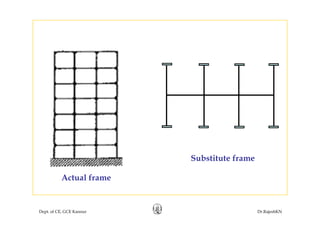
• Analyse only a part of the frame – substitute frame
SUBSTITUTE FRAME METHOD
Analyse only a part of the frame substitute frame
• Carry out a two-cycle moment distribution
Dept. of CE, GCE Kannur Dr.RajeshKN
Substitute frame
Actual frame
Dept. of CE, GCE Kannur Dr.RajeshKN
• Analysis done for:y
• Beam span moments
• Beam support moments
• Column moments
• Liveload positioning for the worst condition
• For the same frame, liveload positions for maximum span
t t t d l tmoments, support moments and column moments may
be different
• For maximum moments at different points, liveload
positions may de different
Dept. of CE, GCE Kannur Dr.RajeshKN
positions may de different
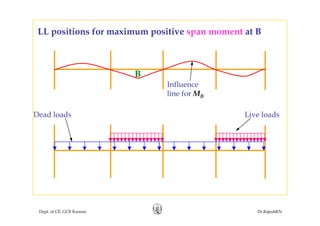
LL positions for maximum positive span moment at Bp p p
B
Influence
D d l d Li l d
line for MB
Dead loads Live loads
Dept. of CE, GCE Kannur Dr.RajeshKN
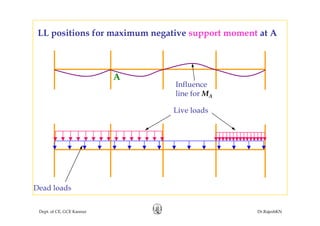
LL positions for maximum negative support moment at Apos t o s o ax u egat e suppo t o e t at
A
Influence
Live loads
line for MA
Dead loads
Dept. of CE, GCE Kannur Dr.RajeshKN
Dead loads
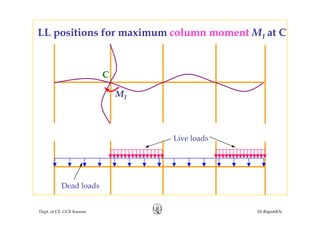
LL positions for maximum column moment M1 at Cpos t o s o ax u co u o e t M1 at C
C
M1
Live loadsLive loads
Dead loads
Dept. of CE, GCE Kannur Dr.RajeshKN
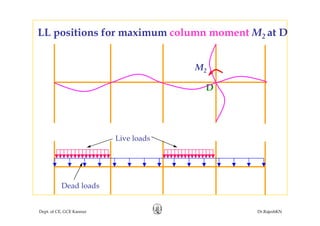
LL positions for maximum column moment M2 at Dpos t o s o ax u co u o e t M2 at
D
M2
D
Live loadsLive loads
Dead loads
Dept. of CE, GCE Kannur Dr.RajeshKN
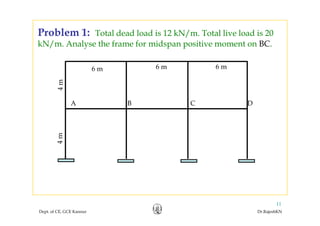
Problem 1: Total dead load is 12 kN/m. Total live load is 20ob e : N/
kN/m. Analyse the frame for midspan positive moment on BC.
4m
6 m 6 m 6 m
B C DA
4m4m
Dept. of CE, GCE Kannur Dr.RajeshKN
11
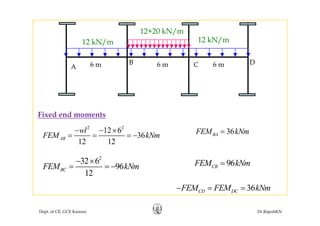
12+20 kN/m
B D
12 kN/m 12 kN/m
B C D
A 6 m 6 m 6 m
Fi d d t
2 2
12 6
36AB
wl
FEM kNm
− − ×
= = = − 36BAFEM kNm=
Fixed end moments
12 12
AB
2
32 6
96FEM kN
− × 96FEM kNm=96
12
BCFEM kNm= = −
36CD DCFEM FEM kNm− = =
96CBFEM kNm=
Dept. of CE, GCE Kannur Dr.RajeshKN
36CD DCFEM FEM kNm
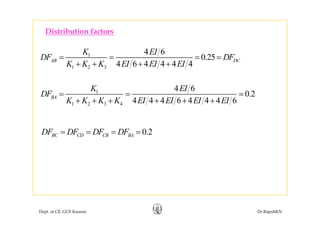
Distribution factors
1 4 6
0.25
4 6 4 4 4 4
AB DC
K EI
DF DF
K K K EI EI EI
= = = =
1 2 3 4 6 4 4 4 4
AB DC
K K K EI EI EI+ + + +
4 6K EI1
1 2 3 4
4 6
0.2
4 4 4 6 4 4 4 6
BA
K EI
DF
K K K K EI EI EI EI
= = =
+ + + + + +
0.2BC CD CB BADF DF DF DF= = = =
Dept. of CE, GCE Kannur Dr.RajeshKN
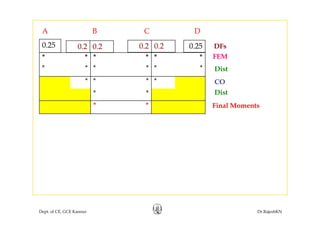
A B C D
0.2 0.2
* * * * * * FEM
0.2 0.20.25 DFs0.25
* * * * * *
* * * * CO
Dist
* *
* * Final Moments
Dist
Dept. of CE, GCE Kannur Dr.RajeshKN
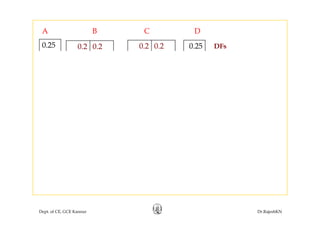
A B C D
0.2 0.2
-36 36 -96 96 -36 36 FEM
0.2 0.20.25 DFs0.25
9 12 12 -12 -12 -9
6 4.5 -6 6 -4.5 -6 CO
Dist
2.25 0.3 0.3 -0.3 -0.3 -2.25
-18.75 52.8 -89.7 89.7 52.8 18.75 Final Moments
Dist
Dept. of CE, GCE Kannur Dr.RajeshKN
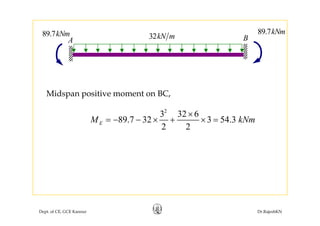
B
89.7kNm 89.7kNm
32kN mA B
89.7kNm 32kN m
2
3 32 6×
Midspan positive moment on BC,
3 32 6
89.7 32 3 54.3
2 2
EM kNm
×
= − − × + × =
Dept. of CE, GCE Kannur Dr.RajeshKN
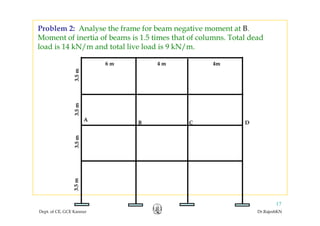
Problem 2: Analyse the frame for beam negative moment at B.
M t f i ti f b i 1 5 ti th t f l T t l d dMoment of inertia of beams is 1.5 times that of columns. Total dead
load is 14 kN/m and total live load is 9 kN/m.
6 m 4m4 m
3.5m.5m
B
A
m3
DC
3.5m3.5m
Dept. of CE, GCE Kannur Dr.RajeshKN
17
3
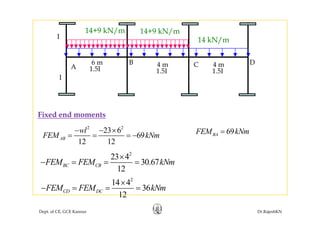
14+9 kN/m 14+9 kN/m
I
B D6 m
14 kN/mI
B C D
A
6 m 4 m 4 m
I
1.5I 1.5I 1.5I
Fi d d t
2 2
23 6
69AB
wl
FEM kNm
− − ×
= = = − 69BAFEM kNm=
Fixed end moments
12 12
AB
2
23 4
30.67BC CBFEM FEM kNm
×
− = = = 30.67
12
BC CBFEM FEM kNm
2
14 4
36CD DCFEM FEM kNm
×
− = = =
Dept. of CE, GCE Kannur Dr.RajeshKN
36
12
CD DCFEM FEM kNm
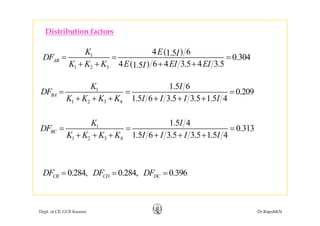
Distribution factors
( )
( )
1 4 61.5
0.304
4 6 4 3 5 4 3 5
AB
K E I
DF
K K K E EI EI
= = =
( )1 2 3 4 6 4 3.5 4 3.51.5
AB
K K K E EI EII+ + + +
1 5 6K I1
1 2 3 4
1.5 6
0.209
1.5 6 3.5 3.5 1.5 4
BA
K I
DF
K K K K I I I I
= = =
+ + + + + +
1
1 2 3 4
1.5 4
0.313
1.5 6 3.5 3.5 1.5 4
BC
K I
DF
K K K K I I I I
= = =
+ + + + + +1 2 3 4
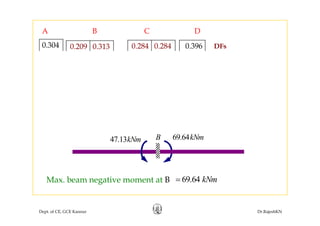
0.284, 0.284, 0.396CB CD DCDF DF DF= = =
Dept. of CE, GCE Kannur Dr.RajeshKN
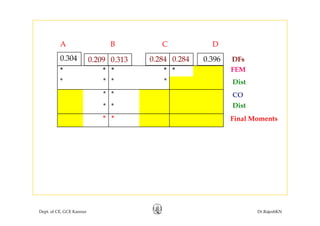
A B C D
0.209 0.313 0.284 0.2840.304 DFs0.3960.209 0.313
* * * * *
* * * *
FEM
Dist
0. 8 0. 8 0.396
* *
* *
CO
Dist
* * Final Moments
Dept. of CE, GCE Kannur Dr.RajeshKN
A B C D
0.209 0.313
-69 69 -30.67 30.67 -18.67 FEM
0.284 0.2840.304 DFs0.396
20.98 -8.01 -12 -3.41
10.49 -1.71 CO
Dist
-1.84 -2.75
69.64 -47.13 Final Moments
Dist
B 69 64kNm47 13kNm B 69.64kNm47.13kNm
Max. beam negative moment at B 69.64 kNm=
Dept. of CE, GCE Kannur Dr.RajeshKN
Approximate analysis for Horizontal LoadsApproximate analysis for Horizontal Loads
1 P t l th d1. Portal method
2. Cantilever method
3. Factor method
Dept. of CE, GCE Kannur Dr.RajeshKN
22
PORTAL METHODPORTAL METHOD
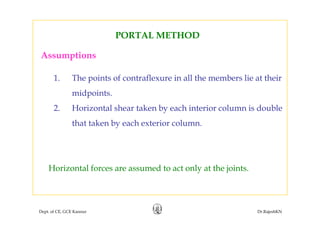
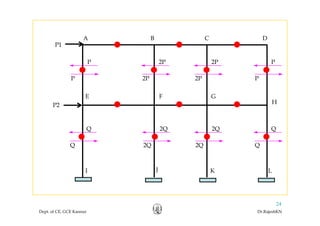
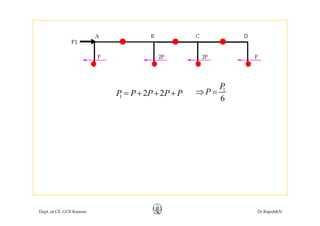
Assumptions
1. The points of contraflexure in all the members lie at their
midpoints.
2. Horizontal shear taken by each interior column is doubley
that taken by each exterior column.
Horizontal forces are assumed to act only at the joints.
Dept. of CE, GCE Kannur Dr.RajeshKN
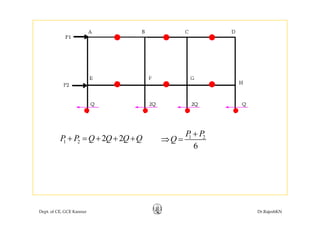
CA B C DA
P1
P 2P 2P PP
P
2P
2P
2P
2P
P
P
FE G
HP2
Q 2Q 2Q Q
Q 2Q 2Q Q
J K LI
Dept. of CE, GCE Kannur Dr.RajeshKN
24
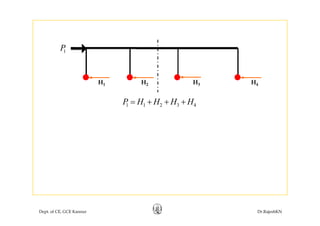
P
1 2 2P P P P P= + + +
1
6
P
P⇒ =
Dept. of CE, GCE Kannur Dr.RajeshKN
2 2P P Q Q Q Q+ = + + + 1 2P P
Q
+
⇒ =1 2 2 2P P Q Q Q Q+ = + + + 1 2
6
Q⇒ =
Dept. of CE, GCE Kannur Dr.RajeshKN
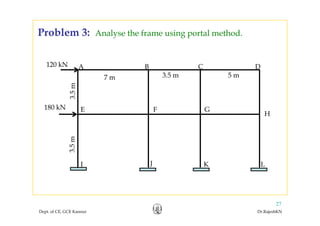
Problem 3: Analyse the frame using portal method.ob e 3: y g p
B C DA
m
120 kN
7 m 3.5 m 5 m
FE G
H
3.5m
180 kN
m
H
3.5m
J K LI J K LI
Dept. of CE, GCE Kannur Dr.RajeshKN
27
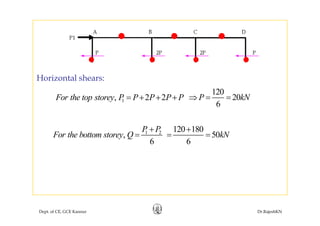
Horizontal shears:
1, 2 2For the top storey P P P P P= + + +
120
20
6
P kN⇒ = =
1 2
,
6
P P
For the bottom storey Q
+
=
120 180
50
6
kN
+
= =,
6
y Q
6
Dept. of CE, GCE Kannur Dr.RajeshKN
120kN 3 5 m
A
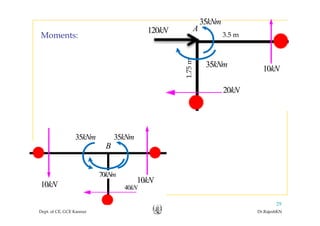
Moments:
35kNm
m
3.5 mMoments:
35kN
20kN
1.75m
35kNm 10kN
20kN
35kNm 35kNm
B
35kNm 35kNm
40kN10kN
70kNm
10kN
Dept. of CE, GCE Kannur Dr.RajeshKN
29
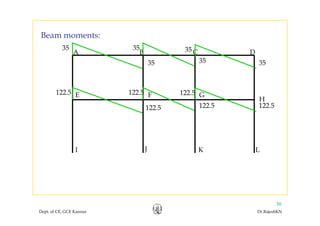
Beam moments:
B C DA
Beam moments:
35
35
35
35
35
3535 35 35
FE G
H
122.5
122.5
122.5 122.5
122.5 122.5
J K LI
Dept. of CE, GCE Kannur Dr.RajeshKN
30
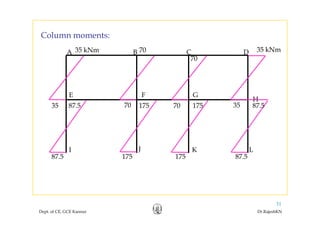
Column moments:
B C DA 7035 kNm
70
35 kNm
Column moments:
FE G
H
35 87.5 87.5175 70 3570 175
J K LI
87.5 87.5175 175
Dept. of CE, GCE Kannur Dr.RajeshKN
31
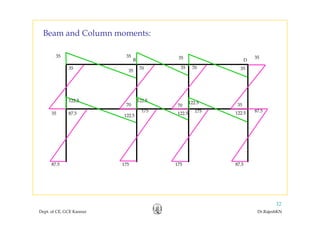
Beam and Column moments:
35
B D
35 35 35
7035 70
35
35 35
35 87 5
87.5175
70 3570
175
122.5 122.5
122 5
122.5
122 535 87.5 122.5 122.5 122.5
87 5 87 5175 17587.5 87.5175 175
Dept. of CE, GCE Kannur Dr.RajeshKN
32
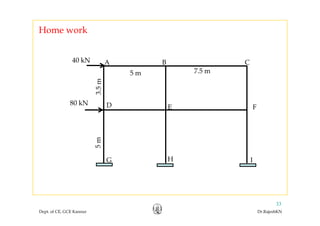
Home work
B CA40 kN B CA
5m
40 kN
5 m 7.5 m
FED
3.5
80 kN
m5m
H IG
Dept. of CE, GCE Kannur Dr.RajeshKN
33
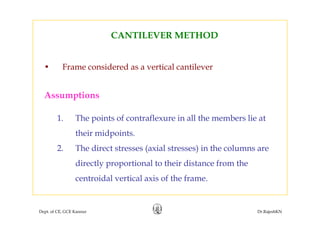
CANTILEVER METHODCANTILEVER METHOD
• Frame considered as a vertical cantilever
Assumptions
1. The points of contraflexure in all the members lie at
their midpoints.
2. The direct stresses (axial stresses) in the columns are
directly proportional to their distance from thedirectly proportional to their distance from the
centroidal vertical axis of the frame.
Dept. of CE, GCE Kannur Dr.RajeshKN
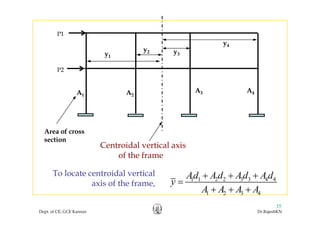
P1
y1
y2 y3
y4
P2
A1 A2
A3 A4
Area of cross
ti
Centroidal vertical axis
of the frame
section
1 1 2 2 3 3 4 4Ad A d Ad A d
y
A A A A
+ + +
=
+ + +
To locate centroidal vertical
axis of the frame,
Dept. of CE, GCE Kannur Dr.RajeshKN
35
1 2 3 4A A A A+ + +
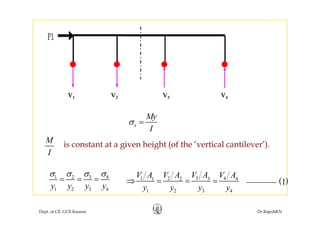
V1 V2 V3 V4
x
My
I
σ =
MM
I
is constant at a given height (of the ‘vertical cantilever’).
1 2 3 4
1 2 3 4y y y y
σ σ σ σ
= = = 31 2 431 2 4
1 2 3 4
V AV A V A V A
y y y y
⇒ = = = ( )1
Dept. of CE, GCE Kannur Dr.RajeshKN
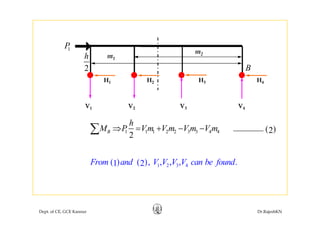
1 2 3 4y y y y 1 2 3 4y y y y
1P
h m1
m2
H1 H2 H3 H4
2 B
V1 V2 V3 V4
1 1 1 2 2 3 3 4 4
2
B
h
M P Vm V m V m V m⇒ = + − −∑ ( )2
( ) ( ) 1 2 3 4, , , , .1 2From and V V V V can be found( ) ( ) 1 2 3 4, , , , .1 2From and V V V V can be found
Dept. of CE, GCE Kannur Dr.RajeshKN
1P
H1 H2 H3 H4
1 1 2 3 4P H H H H= + + +
Dept. of CE, GCE Kannur Dr.RajeshKN
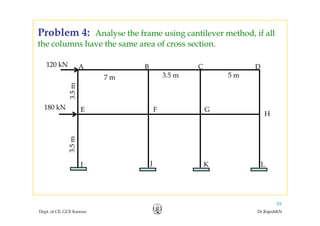
Problem 4: Analyse the frame using cantilever method, if allob e : y g ,
the columns have the same area of cross section.
B C DA
m
120 kN
7 m 3.5 m 5 m
FE G
H
3.5m
180 kN
m
H
3.5m
J K LI J K LI
Dept. of CE, GCE Kannur Dr.RajeshKN
39
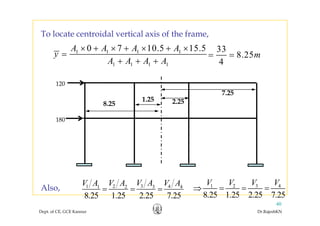
To locate centroidal vertical axis of the frame,
1 1 1 10 7 10.5 15.5A A A A
y
A A A A
× + × + × + ×
=
+ + +
To locate centroidal vertical axis of the frame,
33
8.25
4
m= =
1 1 1 1A A A A+ + + 4
120
8.25
1.25 2.25
7.25
180
Also, 31 2 431 2 4
V AV A V A V A
= = = 1 2 3 4V V V V
⇒ = = =
Dept. of CE, GCE Kannur Dr.RajeshKN
40
Also,
8.25 1.25 2.25 7.25
= = =
8.25 1.25 2.25 7.25
⇒
1 25 2 25 7 25V V V1 1 1
2 3 4
1.25 2.25 7.25
, ,
8.25 8.25 8.25
V V V
V V V= = =
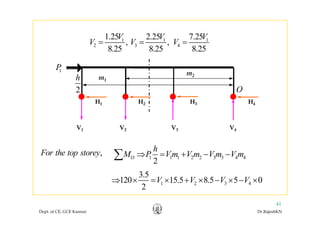
1P
2
h m1
m2
O
H1 H2 H3 H4
2 O
V1 V2 V3 V4
1 1 1 2 2 3 3 4 4
2
O
h
M P Vm V m V m V m⇒ = + − −∑,For the top storey
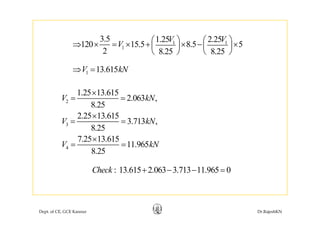
1 2 3 4
3.5
120 15.5 8.5 5 0
2
V V V V⇒ × = × + × − × − ×
Dept. of CE, GCE Kannur Dr.RajeshKN
41
3 5 ⎛ ⎞ ⎛ ⎞1 1
1
3.5 1.25 2.25
120 15.5 8.5 5
2 8.25 8.25
V V
V ⎛ ⎞ ⎛ ⎞⇒ × = × + × − ×⎜ ⎟ ⎜ ⎟
⎝ ⎠ ⎝ ⎠
1 13.615V kN⇒ =
2
1.25 13.615
2.063 ,
8.25
2 25 13 615
V kN
×
= =
3
2.25 13.615
3.713 ,
8.25
7 25 13 615
V kN
×
= =
×
4
7.25 13.615
11.965
8.25
V kN
×
= =
: 13.615 2.063 3.713 11.965 0Check + − − =
Dept. of CE, GCE Kannur Dr.RajeshKN
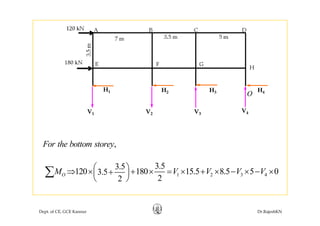
H1 H2 H3 H4
V1 V2 V3
V4
O
V1 V2 V3 4
3 53 5⎛ ⎞
,For the bottom storey
1 2 3 4
3.53.5
120 180 15.5 8.5 5 03.5
22
OM V V V V⎛ ⎞⇒ × + × = × + × − × − ×+⎜ ⎟
⎝ ⎠
∑
Dept. of CE, GCE Kannur Dr.RajeshKN
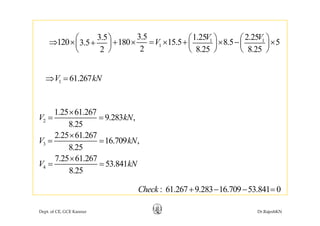
3 5 1 25 2 253 5 V V⎛ ⎞ ⎛ ⎞⎛ ⎞ 1 1
1
3.5 1.25 2.253.5
120 180 15.5 8.5 53.5
2 8.25 8.252
V V
V ⎛ ⎞ ⎛ ⎞⎛ ⎞⇒ × + × = × + × − ×+⎜ ⎟ ⎜ ⎟ ⎜ ⎟
⎝ ⎠ ⎝ ⎠ ⎝ ⎠
1 61.267V kN⇒ =
1 25 61 267×
2
1.25 61.267
9.283 ,
8.25
2.25 61.267
16 709
V kN
V kN
×
= =
×
3 16.709 ,
8.25
7.25 61.267
53 841
V kN
V kN
= =
×
= =4 53.841
8.25
V kN= =
: 61 267 9 283 16 709 53 841 0Check + − − =
Dept. of CE, GCE Kannur Dr.RajeshKN
: 61.267 9.283 16.709 53.841 0Check + − − =
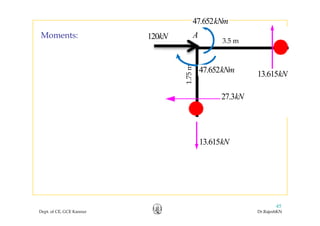
120kNMoments:
47.652kNm
A120kN 3.5 m
Moments: A
1.75m
47.652kNm 13.615kN
27.3kN
k13.615kN
Dept. of CE, GCE Kannur Dr.RajeshKN
45
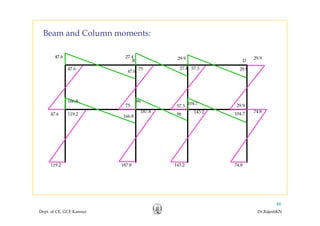
Beam and Column moments:
29.9
B D
47.6 27.4 29.9
7547.6 57.3
B D
47.6
27.4 29.9
47 6 119 2
74.8187.8
57.3 29.975
143.2
166.8 96
96
104.7
104 747.6 119.2
74.8187.8 143.2
166.8 96 104.7
119 2 74 8187 8 143 2119.2 74.8187.8 143.2
Dept. of CE, GCE Kannur Dr.RajeshKN
46
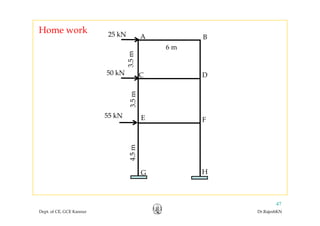
BA25 kN
Home work
BA25 kN
6 m
5m
DC50 kN
3.53.5m
k
FE55 kN
4.5m
HG
Dept. of CE, GCE Kannur Dr.RajeshKN
47
FACTOR METHODFACTOR METHOD
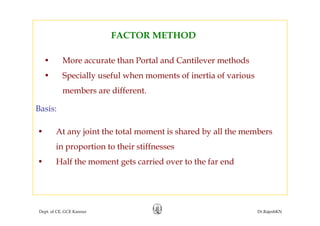
• More accurate than Portal and Cantilever methodsMore accurate than Portal and Cantilever methods
• Specially useful when moments of inertia of various
b d ffmembers are different.
Basis:
• At any joint the total moment is shared by all the members
in proportion to their stiffnesses
• Half the moment gets carried over to the far endHalf the moment gets carried over to the far end
Dept. of CE, GCE Kannur Dr.RajeshKN
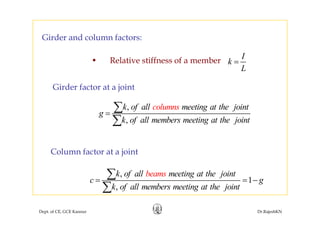
Gi d d l f tGirder and column factors:
• Relative stiffness of a member
I
k =
Girder factor at a joint
Relative stiffness of a member k
L
=
Girder factor at a joint
,k of all meeting at the joint
g
columns
=
∑
,
g
k of all members meeting at the joint
=
∑
Column factor at a joint
,
1
,
k of all meeting at the joint
c g
k of all members meeting at the joint
beams
= = −
∑
∑
Dept. of CE, GCE Kannur Dr.RajeshKN
, f g j∑
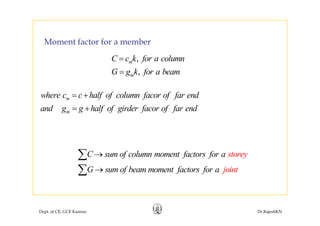
Moment factor for a member
,mC c k for a column= ,
,
m
m
f
G g k for a beam=
m
m
where c c half of column facor of far end
and g g half of girder facor of far end
= +
= +m
storeC sum of column moment factors for a y→∑
G sum of beam moment factors for a joint→∑
Dept. of CE, GCE Kannur Dr.RajeshKN
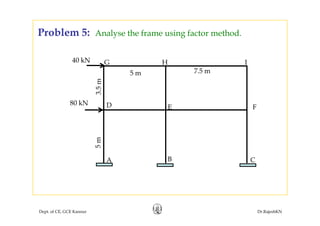
Problem 5: Analyse the frame using factor method.
H IG40 kN
ob e 5: y g
H IG
5m
40 kN
5 m 7.5 m
FED
3.5
80 kN
m5m
B CA
Dept. of CE, GCE Kannur Dr.RajeshKN
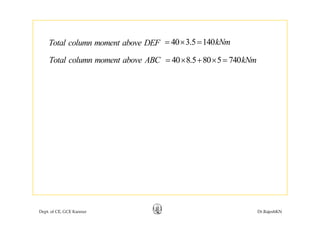
Total column moment above DEF 40 3.5 140kNm= × =
Total column moment above ABC 40 8 5 80 5 740kNm= × + × =Total column moment above ABC 40 8.5 80 5 740kNm× + ×
Dept. of CE, GCE Kannur Dr.RajeshKN
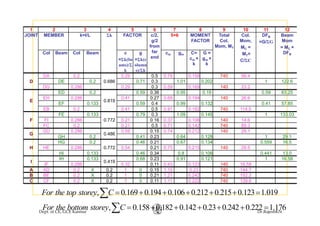
1 2 3 4 5 6 7 8 9 10 11 12
JOINT MEMBER k=I/L Ʃk FACTOR c/2 5+6 MOMENT Total Col DFB BeamJOINT MEMBER k I/L Ʃk FACTOR c/2,
g/2
from
far
end
5+6 MOMENT
FACTOR
Total
Col.
Mom, MT
Col.
Mom,
MC =
MT×
C/ƩC
DFB
=G/ƩG
Beam
Mom
= MC ×
DFBCol Beam Col Beam c
=Ʃk(be
g
=Ʃk(c
cm gm C=
cm ×
G =
gm × C/ƩC(
ams)/Ʃ
k
(
olumn
s)/Ʃk
k k
D
DA 0.2
0.686
0.29 0.5 0.79 0.158 740 99.4
DE 0.2 0.71 0.3 1.01 0.202 1 122.6
DG 0 286 0 29 0 3 0 59 0 169 140 23 2DG 0.286 0.29 0.3 0.59 0.169 140 23.2
E
ED 0.2
0.819
0.59 0.36 0.95 0.19 0.59 83.25
EH 0.286 0.41 0.27 0.68 0.194 140 26.6
EF 0.133 0.59 0.4 0.99 0.132 0.41 57.85
EB 0.2 0.41 0.5 0.91 0.182 740 114.5
FE 0 133 0 79 0 3 1 09 0 145 1 133 03
F
FE 0.133
0.772
0.79 0.3 1.09 0.145 1 133.03
FI 0.286 0.21 0.16 0.37 0.106 140 14.6
FC 0.2 0.21 0.5 0.71 0.142 740 89.3
G
GD 0.286
0.486
0.59 0.15 0.74 0.212 140 29.1
GH 0.2 0.41 0.23 0.64 0.128 1 29.1
H
HG 0.2
0.772
0.46 0.21 0.67 0.134 0.559 16.5
HE 0.286 0.54 0.21 0.75 0.215 140 29.5
HI 0.133 0.46 0.34 0.8 0.106 0.441 13.0
I
IH 0.133
0.419
0.68 0.23 0.91 0.121 1 16.58
IF 0 286 0 32 0 11 0 43 0 123 140 16 58IF 0.286 0.32 0.11 0.43 0.123 140 16.58
A AD 0.2 X 0.2 1 0 0.15 1.15 0.23 740 144.7
B BE 0.2 X 0.2 1 0 0.21 1.21 0.242 740 152.2
C CF 0.2 X 0.2 1 0 0.11 1.11 0.222 740 139.6
0 169 0 194 0 106 0 212 0 215 0 123 1 019F h C∑
Dept. of CE, GCE Kannur Dr.RajeshKN
, 0.169 0.194 0.106 0.212 0.215 0.123 1.019For the top storey C = + + + + + =∑
, 0.158 0.182 0.142 0.23 0.242 0.222 1.176For the bottom storey C = + + + + + =∑
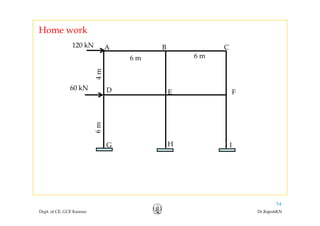
Home work
B CA120 kN
6 m 6 m
4m
60 kN
FED60 kN
6m
H IG
Dept. of CE, GCE Kannur Dr.RajeshKN
54
SummarySummary
Approximate Methods of Analysis of Multi-storey Frames
• Analysis for vertical loads - Substitute frames-Loading
conditions for maximum positive and negative bending
moments in beams and maximum bending moment in columns
• Analysis for lateral loads - Portal method–Cantilever method–y
Factor method.
Dept. of CE, GCE Kannur Dr.RajeshKN

Module3 rajesh sir

  • 1.
    Structural Analysis -II Approximate Methods Dr. Rajesh K. N. Assistant professor in Civil EngineeringAssistant professor in Civil Engineering Govt. College of Engineering, Kannur Dept. of CE, GCE Kannur Dr.RajeshKN
  • 2.
    Module IIIModule III ApproximateMethods of Analysis of Multi-storey Frames • Analysis for vertical loads - Substitute frames-Loading conditions for maximum positive and negative bending moments in beams and maximum bending moment in columns • Analysis for lateral loads - Portal method–Cantilever method–y Factor method. Dept. of CE, GCE Kannur Dr.RajeshKN 2
  • 3.
    Why approximate analysis? •Rapid check on computer aided analysis y pp x y • Preliminary dimensioning before exact analysis Advantage? • Fasterg Disadvantage? • Results are approximateg pp • Approximate methods are particularly useful for multi-storey frames taller than 3 storeys. Dept. of CE, GCE Kannur Dr.RajeshKN
  • 4.
    Approximate analysis forVertical LoadsApproximate analysis for Vertical Loads SUBSTITUTE FRAME METHOD • Analyse only a part of the frame – substitute frame SUBSTITUTE FRAME METHOD Analyse only a part of the frame substitute frame • Carry out a two-cycle moment distribution Dept. of CE, GCE Kannur Dr.RajeshKN
  • 5.
    Substitute frame Actual frame Dept.of CE, GCE Kannur Dr.RajeshKN
  • 6.
    • Analysis donefor:y • Beam span moments • Beam support moments • Column moments • Liveload positioning for the worst condition • For the same frame, liveload positions for maximum span t t t d l tmoments, support moments and column moments may be different • For maximum moments at different points, liveload positions may de different Dept. of CE, GCE Kannur Dr.RajeshKN positions may de different
  • 7.
    LL positions formaximum positive span moment at Bp p p B Influence D d l d Li l d line for MB Dead loads Live loads Dept. of CE, GCE Kannur Dr.RajeshKN
  • 8.
    LL positions formaximum negative support moment at Apos t o s o ax u egat e suppo t o e t at A Influence Live loads line for MA Dead loads Dept. of CE, GCE Kannur Dr.RajeshKN Dead loads
  • 9.
    LL positions formaximum column moment M1 at Cpos t o s o ax u co u o e t M1 at C C M1 Live loadsLive loads Dead loads Dept. of CE, GCE Kannur Dr.RajeshKN
  • 10.
    LL positions formaximum column moment M2 at Dpos t o s o ax u co u o e t M2 at D M2 D Live loadsLive loads Dead loads Dept. of CE, GCE Kannur Dr.RajeshKN
  • 11.
    Problem 1: Totaldead load is 12 kN/m. Total live load is 20ob e : N/ kN/m. Analyse the frame for midspan positive moment on BC. 4m 6 m 6 m 6 m B C DA 4m4m Dept. of CE, GCE Kannur Dr.RajeshKN 11
  • 12.
    12+20 kN/m B D 12kN/m 12 kN/m B C D A 6 m 6 m 6 m Fi d d t 2 2 12 6 36AB wl FEM kNm − − × = = = − 36BAFEM kNm= Fixed end moments 12 12 AB 2 32 6 96FEM kN − × 96FEM kNm=96 12 BCFEM kNm= = − 36CD DCFEM FEM kNm− = = 96CBFEM kNm= Dept. of CE, GCE Kannur Dr.RajeshKN 36CD DCFEM FEM kNm
  • 13.
    Distribution factors 1 46 0.25 4 6 4 4 4 4 AB DC K EI DF DF K K K EI EI EI = = = = 1 2 3 4 6 4 4 4 4 AB DC K K K EI EI EI+ + + + 4 6K EI1 1 2 3 4 4 6 0.2 4 4 4 6 4 4 4 6 BA K EI DF K K K K EI EI EI EI = = = + + + + + + 0.2BC CD CB BADF DF DF DF= = = = Dept. of CE, GCE Kannur Dr.RajeshKN
  • 14.
    A B CD 0.2 0.2 * * * * * * FEM 0.2 0.20.25 DFs0.25 * * * * * * * * * * CO Dist * * * * Final Moments Dist Dept. of CE, GCE Kannur Dr.RajeshKN
  • 15.
    A B CD 0.2 0.2 -36 36 -96 96 -36 36 FEM 0.2 0.20.25 DFs0.25 9 12 12 -12 -12 -9 6 4.5 -6 6 -4.5 -6 CO Dist 2.25 0.3 0.3 -0.3 -0.3 -2.25 -18.75 52.8 -89.7 89.7 52.8 18.75 Final Moments Dist Dept. of CE, GCE Kannur Dr.RajeshKN
  • 16.
    B 89.7kNm 89.7kNm 32kN mAB 89.7kNm 32kN m 2 3 32 6× Midspan positive moment on BC, 3 32 6 89.7 32 3 54.3 2 2 EM kNm × = − − × + × = Dept. of CE, GCE Kannur Dr.RajeshKN
  • 17.
    Problem 2: Analysethe frame for beam negative moment at B. M t f i ti f b i 1 5 ti th t f l T t l d dMoment of inertia of beams is 1.5 times that of columns. Total dead load is 14 kN/m and total live load is 9 kN/m. 6 m 4m4 m 3.5m.5m B A m3 DC 3.5m3.5m Dept. of CE, GCE Kannur Dr.RajeshKN 17 3
  • 18.
    14+9 kN/m 14+9kN/m I B D6 m 14 kN/mI B C D A 6 m 4 m 4 m I 1.5I 1.5I 1.5I Fi d d t 2 2 23 6 69AB wl FEM kNm − − × = = = − 69BAFEM kNm= Fixed end moments 12 12 AB 2 23 4 30.67BC CBFEM FEM kNm × − = = = 30.67 12 BC CBFEM FEM kNm 2 14 4 36CD DCFEM FEM kNm × − = = = Dept. of CE, GCE Kannur Dr.RajeshKN 36 12 CD DCFEM FEM kNm
  • 19.
    Distribution factors ( ) () 1 4 61.5 0.304 4 6 4 3 5 4 3 5 AB K E I DF K K K E EI EI = = = ( )1 2 3 4 6 4 3.5 4 3.51.5 AB K K K E EI EII+ + + + 1 5 6K I1 1 2 3 4 1.5 6 0.209 1.5 6 3.5 3.5 1.5 4 BA K I DF K K K K I I I I = = = + + + + + + 1 1 2 3 4 1.5 4 0.313 1.5 6 3.5 3.5 1.5 4 BC K I DF K K K K I I I I = = = + + + + + +1 2 3 4 0.284, 0.284, 0.396CB CD DCDF DF DF= = = Dept. of CE, GCE Kannur Dr.RajeshKN
  • 20.
    A B CD 0.209 0.313 0.284 0.2840.304 DFs0.3960.209 0.313 * * * * * * * * * FEM Dist 0. 8 0. 8 0.396 * * * * CO Dist * * Final Moments Dept. of CE, GCE Kannur Dr.RajeshKN
  • 21.
    A B CD 0.209 0.313 -69 69 -30.67 30.67 -18.67 FEM 0.284 0.2840.304 DFs0.396 20.98 -8.01 -12 -3.41 10.49 -1.71 CO Dist -1.84 -2.75 69.64 -47.13 Final Moments Dist B 69 64kNm47 13kNm B 69.64kNm47.13kNm Max. beam negative moment at B 69.64 kNm= Dept. of CE, GCE Kannur Dr.RajeshKN
  • 22.
    Approximate analysis forHorizontal LoadsApproximate analysis for Horizontal Loads 1 P t l th d1. Portal method 2. Cantilever method 3. Factor method Dept. of CE, GCE Kannur Dr.RajeshKN 22
  • 23.
    PORTAL METHODPORTAL METHOD Assumptions 1.The points of contraflexure in all the members lie at their midpoints. 2. Horizontal shear taken by each interior column is doubley that taken by each exterior column. Horizontal forces are assumed to act only at the joints. Dept. of CE, GCE Kannur Dr.RajeshKN
  • 24.
    CA B CDA P1 P 2P 2P PP P 2P 2P 2P 2P P P FE G HP2 Q 2Q 2Q Q Q 2Q 2Q Q J K LI Dept. of CE, GCE Kannur Dr.RajeshKN 24
  • 25.
    P 1 2 2PP P P P= + + + 1 6 P P⇒ = Dept. of CE, GCE Kannur Dr.RajeshKN
  • 26.
    2 2P PQ Q Q Q+ = + + + 1 2P P Q + ⇒ =1 2 2 2P P Q Q Q Q+ = + + + 1 2 6 Q⇒ = Dept. of CE, GCE Kannur Dr.RajeshKN
  • 27.
    Problem 3: Analysethe frame using portal method.ob e 3: y g p B C DA m 120 kN 7 m 3.5 m 5 m FE G H 3.5m 180 kN m H 3.5m J K LI J K LI Dept. of CE, GCE Kannur Dr.RajeshKN 27
  • 28.
    Horizontal shears: 1, 22For the top storey P P P P P= + + + 120 20 6 P kN⇒ = = 1 2 , 6 P P For the bottom storey Q + = 120 180 50 6 kN + = =, 6 y Q 6 Dept. of CE, GCE Kannur Dr.RajeshKN
  • 29.
    120kN 3 5m A Moments: 35kNm m 3.5 mMoments: 35kN 20kN 1.75m 35kNm 10kN 20kN 35kNm 35kNm B 35kNm 35kNm 40kN10kN 70kNm 10kN Dept. of CE, GCE Kannur Dr.RajeshKN 29
  • 30.
    Beam moments: B CDA Beam moments: 35 35 35 35 35 3535 35 35 FE G H 122.5 122.5 122.5 122.5 122.5 122.5 J K LI Dept. of CE, GCE Kannur Dr.RajeshKN 30
  • 31.
    Column moments: B CDA 7035 kNm 70 35 kNm Column moments: FE G H 35 87.5 87.5175 70 3570 175 J K LI 87.5 87.5175 175 Dept. of CE, GCE Kannur Dr.RajeshKN 31
  • 32.
    Beam and Columnmoments: 35 B D 35 35 35 7035 70 35 35 35 35 87 5 87.5175 70 3570 175 122.5 122.5 122 5 122.5 122 535 87.5 122.5 122.5 122.5 87 5 87 5175 17587.5 87.5175 175 Dept. of CE, GCE Kannur Dr.RajeshKN 32
  • 33.
    Home work B CA40kN B CA 5m 40 kN 5 m 7.5 m FED 3.5 80 kN m5m H IG Dept. of CE, GCE Kannur Dr.RajeshKN 33
  • 34.
    CANTILEVER METHODCANTILEVER METHOD •Frame considered as a vertical cantilever Assumptions 1. The points of contraflexure in all the members lie at their midpoints. 2. The direct stresses (axial stresses) in the columns are directly proportional to their distance from thedirectly proportional to their distance from the centroidal vertical axis of the frame. Dept. of CE, GCE Kannur Dr.RajeshKN
  • 35.
    P1 y1 y2 y3 y4 P2 A1 A2 A3A4 Area of cross ti Centroidal vertical axis of the frame section 1 1 2 2 3 3 4 4Ad A d Ad A d y A A A A + + + = + + + To locate centroidal vertical axis of the frame, Dept. of CE, GCE Kannur Dr.RajeshKN 35 1 2 3 4A A A A+ + +
  • 36.
    V1 V2 V3V4 x My I σ = MM I is constant at a given height (of the ‘vertical cantilever’). 1 2 3 4 1 2 3 4y y y y σ σ σ σ = = = 31 2 431 2 4 1 2 3 4 V AV A V A V A y y y y ⇒ = = = ( )1 Dept. of CE, GCE Kannur Dr.RajeshKN 1 2 3 4y y y y 1 2 3 4y y y y
  • 37.
    1P h m1 m2 H1 H2H3 H4 2 B V1 V2 V3 V4 1 1 1 2 2 3 3 4 4 2 B h M P Vm V m V m V m⇒ = + − −∑ ( )2 ( ) ( ) 1 2 3 4, , , , .1 2From and V V V V can be found( ) ( ) 1 2 3 4, , , , .1 2From and V V V V can be found Dept. of CE, GCE Kannur Dr.RajeshKN
  • 38.
    1P H1 H2 H3H4 1 1 2 3 4P H H H H= + + + Dept. of CE, GCE Kannur Dr.RajeshKN
  • 39.
    Problem 4: Analysethe frame using cantilever method, if allob e : y g , the columns have the same area of cross section. B C DA m 120 kN 7 m 3.5 m 5 m FE G H 3.5m 180 kN m H 3.5m J K LI J K LI Dept. of CE, GCE Kannur Dr.RajeshKN 39
  • 40.
    To locate centroidalvertical axis of the frame, 1 1 1 10 7 10.5 15.5A A A A y A A A A × + × + × + × = + + + To locate centroidal vertical axis of the frame, 33 8.25 4 m= = 1 1 1 1A A A A+ + + 4 120 8.25 1.25 2.25 7.25 180 Also, 31 2 431 2 4 V AV A V A V A = = = 1 2 3 4V V V V ⇒ = = = Dept. of CE, GCE Kannur Dr.RajeshKN 40 Also, 8.25 1.25 2.25 7.25 = = = 8.25 1.25 2.25 7.25 ⇒
  • 41.
    1 25 225 7 25V V V1 1 1 2 3 4 1.25 2.25 7.25 , , 8.25 8.25 8.25 V V V V V V= = = 1P 2 h m1 m2 O H1 H2 H3 H4 2 O V1 V2 V3 V4 1 1 1 2 2 3 3 4 4 2 O h M P Vm V m V m V m⇒ = + − −∑,For the top storey 1 2 3 4 3.5 120 15.5 8.5 5 0 2 V V V V⇒ × = × + × − × − × Dept. of CE, GCE Kannur Dr.RajeshKN 41
  • 42.
    3 5 ⎛⎞ ⎛ ⎞1 1 1 3.5 1.25 2.25 120 15.5 8.5 5 2 8.25 8.25 V V V ⎛ ⎞ ⎛ ⎞⇒ × = × + × − ×⎜ ⎟ ⎜ ⎟ ⎝ ⎠ ⎝ ⎠ 1 13.615V kN⇒ = 2 1.25 13.615 2.063 , 8.25 2 25 13 615 V kN × = = 3 2.25 13.615 3.713 , 8.25 7 25 13 615 V kN × = = × 4 7.25 13.615 11.965 8.25 V kN × = = : 13.615 2.063 3.713 11.965 0Check + − − = Dept. of CE, GCE Kannur Dr.RajeshKN
  • 43.
    H1 H2 H3H4 V1 V2 V3 V4 O V1 V2 V3 4 3 53 5⎛ ⎞ ,For the bottom storey 1 2 3 4 3.53.5 120 180 15.5 8.5 5 03.5 22 OM V V V V⎛ ⎞⇒ × + × = × + × − × − ×+⎜ ⎟ ⎝ ⎠ ∑ Dept. of CE, GCE Kannur Dr.RajeshKN
  • 44.
    3 5 125 2 253 5 V V⎛ ⎞ ⎛ ⎞⎛ ⎞ 1 1 1 3.5 1.25 2.253.5 120 180 15.5 8.5 53.5 2 8.25 8.252 V V V ⎛ ⎞ ⎛ ⎞⎛ ⎞⇒ × + × = × + × − ×+⎜ ⎟ ⎜ ⎟ ⎜ ⎟ ⎝ ⎠ ⎝ ⎠ ⎝ ⎠ 1 61.267V kN⇒ = 1 25 61 267× 2 1.25 61.267 9.283 , 8.25 2.25 61.267 16 709 V kN V kN × = = × 3 16.709 , 8.25 7.25 61.267 53 841 V kN V kN = = × = =4 53.841 8.25 V kN= = : 61 267 9 283 16 709 53 841 0Check + − − = Dept. of CE, GCE Kannur Dr.RajeshKN : 61.267 9.283 16.709 53.841 0Check + − − =
  • 45.
    120kNMoments: 47.652kNm A120kN 3.5 m Moments:A 1.75m 47.652kNm 13.615kN 27.3kN k13.615kN Dept. of CE, GCE Kannur Dr.RajeshKN 45
  • 46.
    Beam and Columnmoments: 29.9 B D 47.6 27.4 29.9 7547.6 57.3 B D 47.6 27.4 29.9 47 6 119 2 74.8187.8 57.3 29.975 143.2 166.8 96 96 104.7 104 747.6 119.2 74.8187.8 143.2 166.8 96 104.7 119 2 74 8187 8 143 2119.2 74.8187.8 143.2 Dept. of CE, GCE Kannur Dr.RajeshKN 46
  • 47.
    BA25 kN Home work BA25kN 6 m 5m DC50 kN 3.53.5m k FE55 kN 4.5m HG Dept. of CE, GCE Kannur Dr.RajeshKN 47
  • 48.
    FACTOR METHODFACTOR METHOD •More accurate than Portal and Cantilever methodsMore accurate than Portal and Cantilever methods • Specially useful when moments of inertia of various b d ffmembers are different. Basis: • At any joint the total moment is shared by all the members in proportion to their stiffnesses • Half the moment gets carried over to the far endHalf the moment gets carried over to the far end Dept. of CE, GCE Kannur Dr.RajeshKN
  • 49.
    Gi d dl f tGirder and column factors: • Relative stiffness of a member I k = Girder factor at a joint Relative stiffness of a member k L = Girder factor at a joint ,k of all meeting at the joint g columns = ∑ , g k of all members meeting at the joint = ∑ Column factor at a joint , 1 , k of all meeting at the joint c g k of all members meeting at the joint beams = = − ∑ ∑ Dept. of CE, GCE Kannur Dr.RajeshKN , f g j∑
  • 50.
    Moment factor fora member ,mC c k for a column= , , m m f G g k for a beam= m m where c c half of column facor of far end and g g half of girder facor of far end = + = +m storeC sum of column moment factors for a y→∑ G sum of beam moment factors for a joint→∑ Dept. of CE, GCE Kannur Dr.RajeshKN
  • 51.
    Problem 5: Analysethe frame using factor method. H IG40 kN ob e 5: y g H IG 5m 40 kN 5 m 7.5 m FED 3.5 80 kN m5m B CA Dept. of CE, GCE Kannur Dr.RajeshKN
  • 52.
    Total column momentabove DEF 40 3.5 140kNm= × = Total column moment above ABC 40 8 5 80 5 740kNm= × + × =Total column moment above ABC 40 8.5 80 5 740kNm× + × Dept. of CE, GCE Kannur Dr.RajeshKN
  • 53.
    1 2 34 5 6 7 8 9 10 11 12 JOINT MEMBER k=I/L Ʃk FACTOR c/2 5+6 MOMENT Total Col DFB BeamJOINT MEMBER k I/L Ʃk FACTOR c/2, g/2 from far end 5+6 MOMENT FACTOR Total Col. Mom, MT Col. Mom, MC = MT× C/ƩC DFB =G/ƩG Beam Mom = MC × DFBCol Beam Col Beam c =Ʃk(be g =Ʃk(c cm gm C= cm × G = gm × C/ƩC( ams)/Ʃ k ( olumn s)/Ʃk k k D DA 0.2 0.686 0.29 0.5 0.79 0.158 740 99.4 DE 0.2 0.71 0.3 1.01 0.202 1 122.6 DG 0 286 0 29 0 3 0 59 0 169 140 23 2DG 0.286 0.29 0.3 0.59 0.169 140 23.2 E ED 0.2 0.819 0.59 0.36 0.95 0.19 0.59 83.25 EH 0.286 0.41 0.27 0.68 0.194 140 26.6 EF 0.133 0.59 0.4 0.99 0.132 0.41 57.85 EB 0.2 0.41 0.5 0.91 0.182 740 114.5 FE 0 133 0 79 0 3 1 09 0 145 1 133 03 F FE 0.133 0.772 0.79 0.3 1.09 0.145 1 133.03 FI 0.286 0.21 0.16 0.37 0.106 140 14.6 FC 0.2 0.21 0.5 0.71 0.142 740 89.3 G GD 0.286 0.486 0.59 0.15 0.74 0.212 140 29.1 GH 0.2 0.41 0.23 0.64 0.128 1 29.1 H HG 0.2 0.772 0.46 0.21 0.67 0.134 0.559 16.5 HE 0.286 0.54 0.21 0.75 0.215 140 29.5 HI 0.133 0.46 0.34 0.8 0.106 0.441 13.0 I IH 0.133 0.419 0.68 0.23 0.91 0.121 1 16.58 IF 0 286 0 32 0 11 0 43 0 123 140 16 58IF 0.286 0.32 0.11 0.43 0.123 140 16.58 A AD 0.2 X 0.2 1 0 0.15 1.15 0.23 740 144.7 B BE 0.2 X 0.2 1 0 0.21 1.21 0.242 740 152.2 C CF 0.2 X 0.2 1 0 0.11 1.11 0.222 740 139.6 0 169 0 194 0 106 0 212 0 215 0 123 1 019F h C∑ Dept. of CE, GCE Kannur Dr.RajeshKN , 0.169 0.194 0.106 0.212 0.215 0.123 1.019For the top storey C = + + + + + =∑ , 0.158 0.182 0.142 0.23 0.242 0.222 1.176For the bottom storey C = + + + + + =∑
  • 54.
    Home work B CA120kN 6 m 6 m 4m 60 kN FED60 kN 6m H IG Dept. of CE, GCE Kannur Dr.RajeshKN 54
  • 55.
    SummarySummary Approximate Methods ofAnalysis of Multi-storey Frames • Analysis for vertical loads - Substitute frames-Loading conditions for maximum positive and negative bending moments in beams and maximum bending moment in columns • Analysis for lateral loads - Portal method–Cantilever method–y Factor method. Dept. of CE, GCE Kannur Dr.RajeshKN