BRAIN GATE SYSTEM

Submitted by
Brati Sundar Nanda
1011016238
ECE-E
CONTENTS:












Introduction
History
Principle behind BCI
Types of BCI
Implementation
Applications
Limitations
Future Concerns
Conclusion
References
INTRODUCTION
Brain

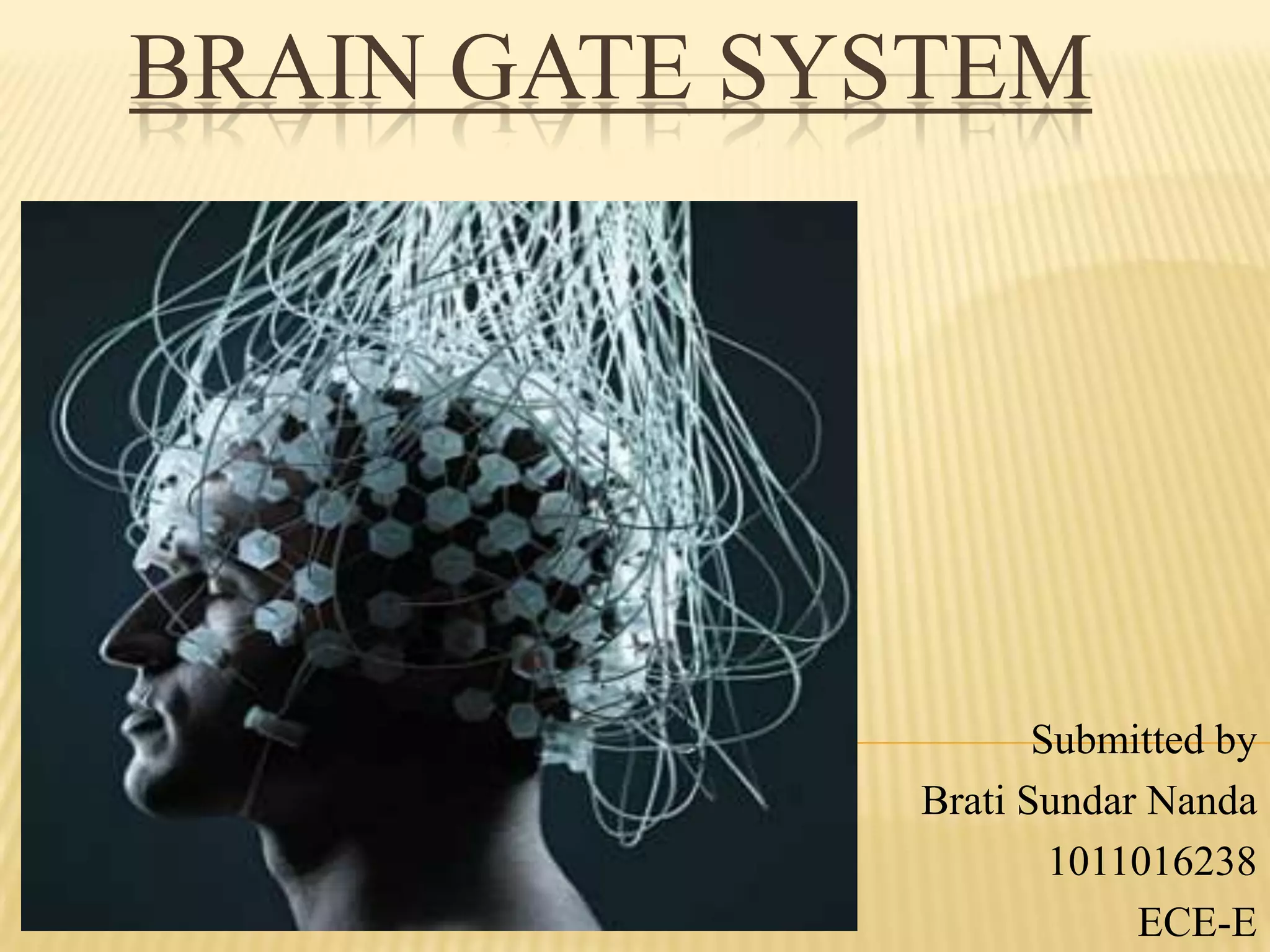
Gate is a brain implant system built by Cyberkinetics which
implements the technology Brain-computer interface (BCI).
Brain-computer

interface (BCI) is a fast-growing emergent
technology, in which researchers aim to build a direct channel between
the human brain and the computer.
A

Brain Computer Interface (BCI) is a collaboration in which a brain
accepts and controls a mechanical device as a natural part of its
representation of the body.
BCI

is often called a mind-machine interface (MMI), or sometimes
called a direct neural interface(DNI) or a brain–machine interface (BMI)
HISTORY






Research on BCIs has been going on for more than 20
years, but from the mid-1990s there has been a
dramatic increase in working experimental implants.
Brain Gate system was commercially developed by
the bio-tech company Cyberkinetics in 2003 in
conjunction with the Department of Neuroscience at
Brown University.
First of all it was implemented on rats then monkeys
and after no complication on human beings
BCI RESEARCH ON
ANIMALS
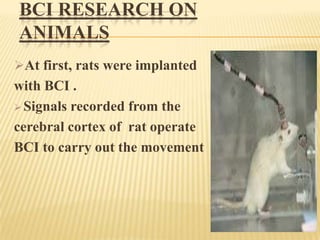
At first, rats were implanted

with BCI .
 Signals recorded from the
cerebral cortex of rat operate
BCI to carry out the movement
CONTINUED……


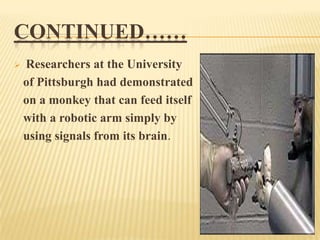
Researchers at the University
of Pittsburgh had demonstrated
on a monkey that can feed itself
with a robotic arm simply by
using signals from its brain.
PRINCIPLE BEHIND BCI






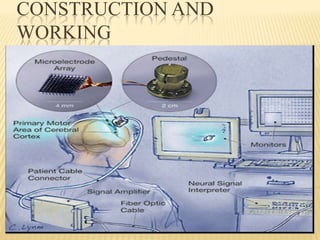
This
technology
is
based
on
to
sense, transmit, analyze the language of neurons
and translate it in to computer commands .
It consist of a sensor that is implanted in the
motor cortex of the brain and a device that
analyses brain signals. The signals generated by
brain are interpreted and translated into
computer commands.
It consists of a silicon array about the size of an
Aspirin tablet that contains about 100 electrodes
each thinner than a human hair.
BLOCK DIAGRAM
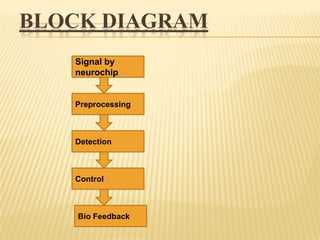
Signal by
neurochip

Preprocessing

Detection

Control

Bio Feedback
CONSTRUCTION AND
WORKING
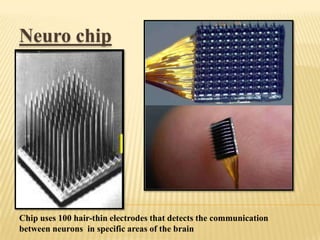
Neuro chip

NEURO CHIP
Chip uses 100 hair-thin electrodes that detects the communication
between neurons in specific areas of the brain
INVASIVE AND SEMI INVASIN BCI










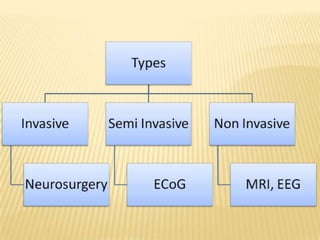
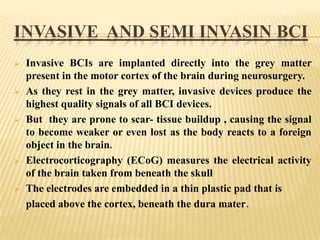
Invasive BCIs are implanted directly into the grey matter
present in the motor cortex of the brain during neurosurgery.
As they rest in the grey matter, invasive devices produce the
highest quality signals of all BCI devices.
But they are prone to scar- tissue buildup , causing the signal
to become weaker or even lost as the body reacts to a foreign
object in the brain.
Electrocorticography (ECoG) measures the electrical activity
of the brain taken from beneath the skull
The electrodes are embedded in a thin plastic pad that is
placed above the cortex, beneath the dura mater.
NON INVASIVE












Electroencephalography (EEG), the recording is obtained by
placing electrodes on the scalp with a conductive gel or paste.
Usually recording is done after preparing the scalp area by light
abrasion to reduce impedance due to dead skin cells
Functional Magnetic Resonance Imaging (fMRI) exploits the
changes in the magnetic properties of hemoglobin which contains
oxygen.
Activation of a part of the brain increases oxygen levels there
increasing the ratio of oxyhemoglobin to deoxyhemoglobin.
Magnetoencephalography (MEG) detects the tiny magnetic fields
created as individual neurons "fire" within the brain.
It can pinpoint the active region with a millimeter, and can follow
the movement of brain activity .
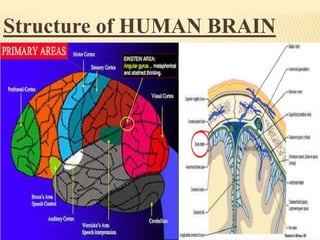
Structure of HUMAN BRAIN
HOW BCI IMPLEMENTS?


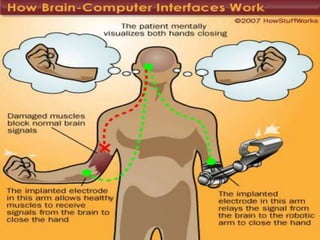
A more difficult task is interpreting the brain signals for movement in
someone who can't physically move his own arm. With a task like
that, the subject must "train" to use the device.



With an implant in place, the subject would visualize closing his or
her disabled hand. After many trials, the software can learn to
recognize the signals associated with the thought of hand-closing.



Software connected to a robotic hand is programmed to receive the
"close hand" signal and interpret it to mean that the robotic hand
should close. At that point, when the subject thinks about closing the
hand, the signals are sent and the robotic hand closes.
BCI ON HUMAN




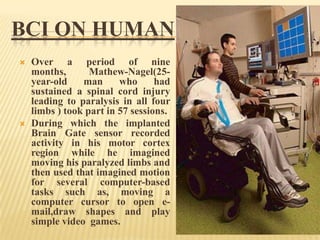
Over a period of nine
months,
Mathew-Nagel(25year-old
man
who
had
sustained a spinal cord injury
leading to paralysis in all four
limbs ) took part in 57 sessions.
During which the implanted
Brain Gate sensor recorded
activity in his motor cortex
region while he imagined
moving his paralyzed limbs and
then used that imagined motion
for several computer-based
tasks such as, moving a
computer cursor to open email,draw shapes and play
simple video games.
APPLICATIONS








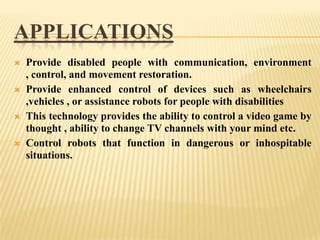
Provide disabled people with communication, environment
, control, and movement restoration.
Provide enhanced control of devices such as wheelchairs
,vehicles , or assistance robots for people with disabilities
This technology provides the ability to control a video game by
thought , ability to change TV channels with your mind etc.
Control robots that function in dangerous or inhospitable
situations.
LIMITATIONS







At present the biggest obstacle of BCI technology is
the lack of sensor mode that provides safe, accurate,
and strong access to brain signals.
It is very expensive.
Processing and Information transformation of data is
very time taking.
Difficulty in adaptation and learning
FUTURE
IMPLEMENTATION
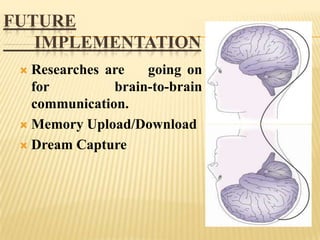
Researches are
going on
for
brain-to-brain
communication.
 Memory Upload/Download
 Dream Capture

CONCLUSION
The results of BCI are spectacular and almost
unbelievable.
 BCI can help paralyzed people to move by
controlling their own electric wheelchairs, to
communicate by using e-mail and Internet-based
phone systems, and to be independent by
controlling items such as televisions and electrical
appliances.
 Conclusively, BCI has proved to be a boon for
paralyzed patients and all human being in future.

REFERENCES








Dias, N.S. ; Jacinto, L.R. ; Mendes, P.M. ; Correia, J.H. “Visual gate for brain
computer interface” Engineering in Medicine and Biology Society, EMBC 2009.
Annual International Conference of the IEEE year 2009
Levine, S.P. ; Huggins, J.E. ; BeMent, S.L. ; Kushwaha, R.K. ; Schuh, L.A. ; Rohde,
M.M. ; Passaro, E.A. Ross, D.A. ; Elisevich, K.V. ; Smith, B.J. “A direct brain
interface based on event-related potentials” Rehabilitation Engineering, IEEE
Transactions on Volume:8 , Issue: 2 Publication Year: 2000
Huang, D. Kai Qian ; Oxenham, S. ; Ding-Yu Fei ; Ou Bai “Event-related
desynchronization/ synchronization-based brain-computer interface towards
volitional cursor control in a 2D center-out paradigm” Computational Intelligence,
Cognitive Algorithms, Mind, and Brain (CCMB), 2011 IEEE Symposium 11-15
April 2011
Dietmar Dietrich, Roland Lang, Dietmar Bruckner, Georg Fodor, and Brit Muller,
"Limitations, Possibilities and Implications of Brain-Computer Interfaces“
Institute of Computer Technology, Vienna University of Technology, Austria, May
13-15, 2010
THANK
YOU……..

Brain gate

  • 1.
    BRAIN GATE SYSTEM Submittedby Brati Sundar Nanda 1011016238 ECE-E
  • 2.
    CONTENTS:           Introduction History Principle behind BCI Typesof BCI Implementation Applications Limitations Future Concerns Conclusion References
  • 3.
    INTRODUCTION Brain Gate is abrain implant system built by Cyberkinetics which implements the technology Brain-computer interface (BCI). Brain-computer interface (BCI) is a fast-growing emergent technology, in which researchers aim to build a direct channel between the human brain and the computer. A Brain Computer Interface (BCI) is a collaboration in which a brain accepts and controls a mechanical device as a natural part of its representation of the body. BCI is often called a mind-machine interface (MMI), or sometimes called a direct neural interface(DNI) or a brain–machine interface (BMI)
  • 4.
    HISTORY    Research on BCIshas been going on for more than 20 years, but from the mid-1990s there has been a dramatic increase in working experimental implants. Brain Gate system was commercially developed by the bio-tech company Cyberkinetics in 2003 in conjunction with the Department of Neuroscience at Brown University. First of all it was implemented on rats then monkeys and after no complication on human beings
  • 5.
    BCI RESEARCH ON ANIMALS Atfirst, rats were implanted with BCI .  Signals recorded from the cerebral cortex of rat operate BCI to carry out the movement
  • 6.
    CONTINUED……  Researchers at theUniversity of Pittsburgh had demonstrated on a monkey that can feed itself with a robotic arm simply by using signals from its brain.
  • 7.
    PRINCIPLE BEHIND BCI    This technology is based on to sense,transmit, analyze the language of neurons and translate it in to computer commands . It consist of a sensor that is implanted in the motor cortex of the brain and a device that analyses brain signals. The signals generated by brain are interpreted and translated into computer commands. It consists of a silicon array about the size of an Aspirin tablet that contains about 100 electrodes each thinner than a human hair.
  • 8.
  • 9.
  • 10.
    Neuro chip NEURO CHIP Chipuses 100 hair-thin electrodes that detects the communication between neurons in specific areas of the brain
  • 12.
    INVASIVE AND SEMIINVASIN BCI      Invasive BCIs are implanted directly into the grey matter present in the motor cortex of the brain during neurosurgery. As they rest in the grey matter, invasive devices produce the highest quality signals of all BCI devices. But they are prone to scar- tissue buildup , causing the signal to become weaker or even lost as the body reacts to a foreign object in the brain. Electrocorticography (ECoG) measures the electrical activity of the brain taken from beneath the skull The electrodes are embedded in a thin plastic pad that is placed above the cortex, beneath the dura mater.
  • 13.
    NON INVASIVE       Electroencephalography (EEG),the recording is obtained by placing electrodes on the scalp with a conductive gel or paste. Usually recording is done after preparing the scalp area by light abrasion to reduce impedance due to dead skin cells Functional Magnetic Resonance Imaging (fMRI) exploits the changes in the magnetic properties of hemoglobin which contains oxygen. Activation of a part of the brain increases oxygen levels there increasing the ratio of oxyhemoglobin to deoxyhemoglobin. Magnetoencephalography (MEG) detects the tiny magnetic fields created as individual neurons "fire" within the brain. It can pinpoint the active region with a millimeter, and can follow the movement of brain activity .
  • 14.
  • 15.
    HOW BCI IMPLEMENTS?  Amore difficult task is interpreting the brain signals for movement in someone who can't physically move his own arm. With a task like that, the subject must "train" to use the device.  With an implant in place, the subject would visualize closing his or her disabled hand. After many trials, the software can learn to recognize the signals associated with the thought of hand-closing.  Software connected to a robotic hand is programmed to receive the "close hand" signal and interpret it to mean that the robotic hand should close. At that point, when the subject thinks about closing the hand, the signals are sent and the robotic hand closes.
  • 17.
    BCI ON HUMAN   Overa period of nine months, Mathew-Nagel(25year-old man who had sustained a spinal cord injury leading to paralysis in all four limbs ) took part in 57 sessions. During which the implanted Brain Gate sensor recorded activity in his motor cortex region while he imagined moving his paralyzed limbs and then used that imagined motion for several computer-based tasks such as, moving a computer cursor to open email,draw shapes and play simple video games.
  • 18.
    APPLICATIONS     Provide disabled peoplewith communication, environment , control, and movement restoration. Provide enhanced control of devices such as wheelchairs ,vehicles , or assistance robots for people with disabilities This technology provides the ability to control a video game by thought , ability to change TV channels with your mind etc. Control robots that function in dangerous or inhospitable situations.
  • 19.
    LIMITATIONS     At present thebiggest obstacle of BCI technology is the lack of sensor mode that provides safe, accurate, and strong access to brain signals. It is very expensive. Processing and Information transformation of data is very time taking. Difficulty in adaptation and learning
  • 20.
  • 21.
    CONCLUSION The results ofBCI are spectacular and almost unbelievable.  BCI can help paralyzed people to move by controlling their own electric wheelchairs, to communicate by using e-mail and Internet-based phone systems, and to be independent by controlling items such as televisions and electrical appliances.  Conclusively, BCI has proved to be a boon for paralyzed patients and all human being in future. 
  • 22.
    REFERENCES     Dias, N.S. ;Jacinto, L.R. ; Mendes, P.M. ; Correia, J.H. “Visual gate for brain computer interface” Engineering in Medicine and Biology Society, EMBC 2009. Annual International Conference of the IEEE year 2009 Levine, S.P. ; Huggins, J.E. ; BeMent, S.L. ; Kushwaha, R.K. ; Schuh, L.A. ; Rohde, M.M. ; Passaro, E.A. Ross, D.A. ; Elisevich, K.V. ; Smith, B.J. “A direct brain interface based on event-related potentials” Rehabilitation Engineering, IEEE Transactions on Volume:8 , Issue: 2 Publication Year: 2000 Huang, D. Kai Qian ; Oxenham, S. ; Ding-Yu Fei ; Ou Bai “Event-related desynchronization/ synchronization-based brain-computer interface towards volitional cursor control in a 2D center-out paradigm” Computational Intelligence, Cognitive Algorithms, Mind, and Brain (CCMB), 2011 IEEE Symposium 11-15 April 2011 Dietmar Dietrich, Roland Lang, Dietmar Bruckner, Georg Fodor, and Brit Muller, "Limitations, Possibilities and Implications of Brain-Computer Interfaces“ Institute of Computer Technology, Vienna University of Technology, Austria, May 13-15, 2010
  • 23.