S
1) INTRODUCTION
2) BCI MODEL
3) PRINCIPAL OF BCI
4) HISTORY
5) HOW DOES IT WORK?
6) WHAT IS AN EEG?
7) BCI RESEARCHES
8) BCI APPROACHES
9) APPLICATIONS
10) ADVANTAGES
11) DISADVANTAGES
12) PROJECTS& FUTURE
13) CONCLUSION
14) REFERENCES
It is the study of brain functions.
A collaboration in which a brain accepts and controls a
mechanical device.
Direct communication pathway between a brain and an
external device.
Thus BCI extracts electro-physical signals from suitable
components of the brain and process them to generate
control signals for computers, robotic machines or
communication devices.
BCI MODEL
(a) In healthy subjects, primary motor area
sends movement commands to muscles via
spinal cord.
(b) But in paralyzed people this pathway is
interrupted.
(c) A Computer based decoder is used, which
translates this activity into commands for muscle control.
HANS BERGER was the one, completely
involved in this Brain-Computer Interface(BCI),
also called as Mind-Machine Interface’s(MMI)
invention
In 1924, he was the first to record human brain
activity by means of EEG
11MCA007 7
EEG IS MEASUREMENT OF
ELECTRICAL ACTIVITY
PRODUCED BY BRAIN AS
RECORDED FROM
ELECTRODES PLACED ON THE
SCALP.
EEG?
Invasive Brain Computer Interfaces
-implanted directly into the brain and has the highest
quality signals.
-provide functionality to paralyzed people.
Partially Invasive Brain Computer Interfaces
-implanted inside the skull but outside the brain.
Non Invasive Brain Computer Interfaces
-gives a patient the ability to move muscle
implants and restore partial movement.
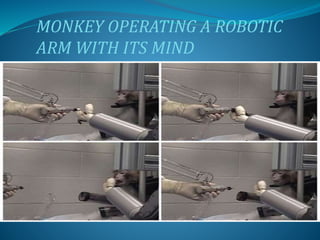
MONKEY OPERATING A ROBOTIC
ARM WITH ITS MIND
RESEARCH…..
1)MENTAL TYPEWRITER
2)BCI offers
paralyzed
patients improved
quality of life.
3)MILITARY and CIVIL
RESEARCH.
4)Allow patients to
control a computer
by conscious
changes of brain
activity.
IN MOVIES ….
STAR
WARS
AVTAR
1. DIRECT
COMMUNICATION
between human brain
and computers.
2. Better LIVING, more
FEATURES, more
ADVANCEMENT in
technologies etc.
3. New work area for
scientists and researches
around the world.
4. LOW BANDWIDTH.
1. Virus attacks may
occur to brain
causing ill effects.
2. Requires extensive
training.
3. BCI techniques are
costly.
4. Slow speed.
FUTURE
WORKS
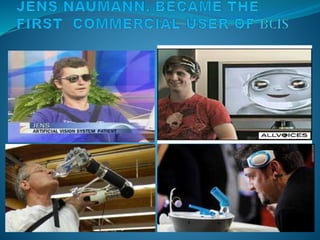
o BRAIN GATE
o HONDA ASIMO
CONTROL
o GAMING CONTROL
o BIONIC EYE
o Improving physical
methods for gathering
EEGs.
o Improving
generalization.
o Improving knowledge of
how to interpret waves.
T he sensor, which is implanted into
the brain, monitors brain activity in the
patient and converts the intention of the
user into computer commands.
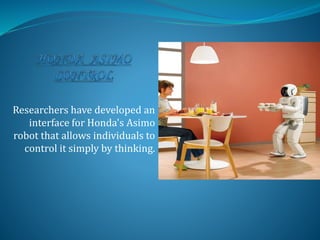
Researchers have developed an
interface for Honda's Asimo
robot that allows individuals to
control it simply by thinking.
Gaming control using a wearable and wireless EEG-based
brain-computer interface device with novel dry foam-
based sensors.
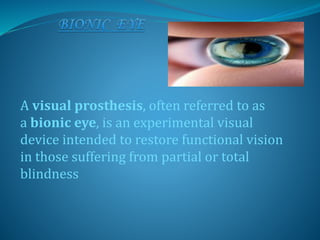
A visual prosthesis, often referred to as
a bionic eye, is an experimental visual
device intended to restore functional vision
in those suffering from partial or total
blindness
FUTURE
Newly purchased computers will one day
arrive with biological signal sensors and
thought-recognition software built in, just
as keyboard and mouse are commonly
found on today's units.
o www.elecdesign.com
o www.brainlab.org
www.en.wikipedia.com/brainc
omputerinterface
Ravi Kumar
CS(3rd Year)

BRAIN COMPUTER INTERFACE......

  • 1.
  • 2.
    1) INTRODUCTION 2) BCIMODEL 3) PRINCIPAL OF BCI 4) HISTORY 5) HOW DOES IT WORK? 6) WHAT IS AN EEG? 7) BCI RESEARCHES 8) BCI APPROACHES 9) APPLICATIONS 10) ADVANTAGES 11) DISADVANTAGES 12) PROJECTS& FUTURE 13) CONCLUSION 14) REFERENCES
  • 3.
    It is thestudy of brain functions. A collaboration in which a brain accepts and controls a mechanical device. Direct communication pathway between a brain and an external device. Thus BCI extracts electro-physical signals from suitable components of the brain and process them to generate control signals for computers, robotic machines or communication devices.
  • 5.
  • 6.
    (a) In healthysubjects, primary motor area sends movement commands to muscles via spinal cord. (b) But in paralyzed people this pathway is interrupted. (c) A Computer based decoder is used, which translates this activity into commands for muscle control.
  • 7.
    HANS BERGER wasthe one, completely involved in this Brain-Computer Interface(BCI), also called as Mind-Machine Interface’s(MMI) invention In 1924, he was the first to record human brain activity by means of EEG 11MCA007 7
  • 9.
    EEG IS MEASUREMENTOF ELECTRICAL ACTIVITY PRODUCED BY BRAIN AS RECORDED FROM ELECTRODES PLACED ON THE SCALP. EEG?
  • 11.
    Invasive Brain ComputerInterfaces -implanted directly into the brain and has the highest quality signals. -provide functionality to paralyzed people. Partially Invasive Brain Computer Interfaces -implanted inside the skull but outside the brain. Non Invasive Brain Computer Interfaces -gives a patient the ability to move muscle implants and restore partial movement.
  • 15.
    MONKEY OPERATING AROBOTIC ARM WITH ITS MIND
  • 16.
  • 18.
    1)MENTAL TYPEWRITER 2)BCI offers paralyzed patientsimproved quality of life. 3)MILITARY and CIVIL RESEARCH. 4)Allow patients to control a computer by conscious changes of brain activity.
  • 19.
  • 20.
  • 22.
    1. DIRECT COMMUNICATION between humanbrain and computers. 2. Better LIVING, more FEATURES, more ADVANCEMENT in technologies etc. 3. New work area for scientists and researches around the world. 4. LOW BANDWIDTH.
  • 23.
    1. Virus attacksmay occur to brain causing ill effects. 2. Requires extensive training. 3. BCI techniques are costly. 4. Slow speed.
  • 24.
    FUTURE WORKS o BRAIN GATE oHONDA ASIMO CONTROL o GAMING CONTROL o BIONIC EYE o Improving physical methods for gathering EEGs. o Improving generalization. o Improving knowledge of how to interpret waves.
  • 25.
    T he sensor,which is implanted into the brain, monitors brain activity in the patient and converts the intention of the user into computer commands.
  • 26.
    Researchers have developedan interface for Honda's Asimo robot that allows individuals to control it simply by thinking.
  • 27.
    Gaming control usinga wearable and wireless EEG-based brain-computer interface device with novel dry foam- based sensors.
  • 28.
    A visual prosthesis,often referred to as a bionic eye, is an experimental visual device intended to restore functional vision in those suffering from partial or total blindness
  • 29.
  • 30.
    Newly purchased computerswill one day arrive with biological signal sensors and thought-recognition software built in, just as keyboard and mouse are commonly found on today's units.
  • 31.
  • 33.