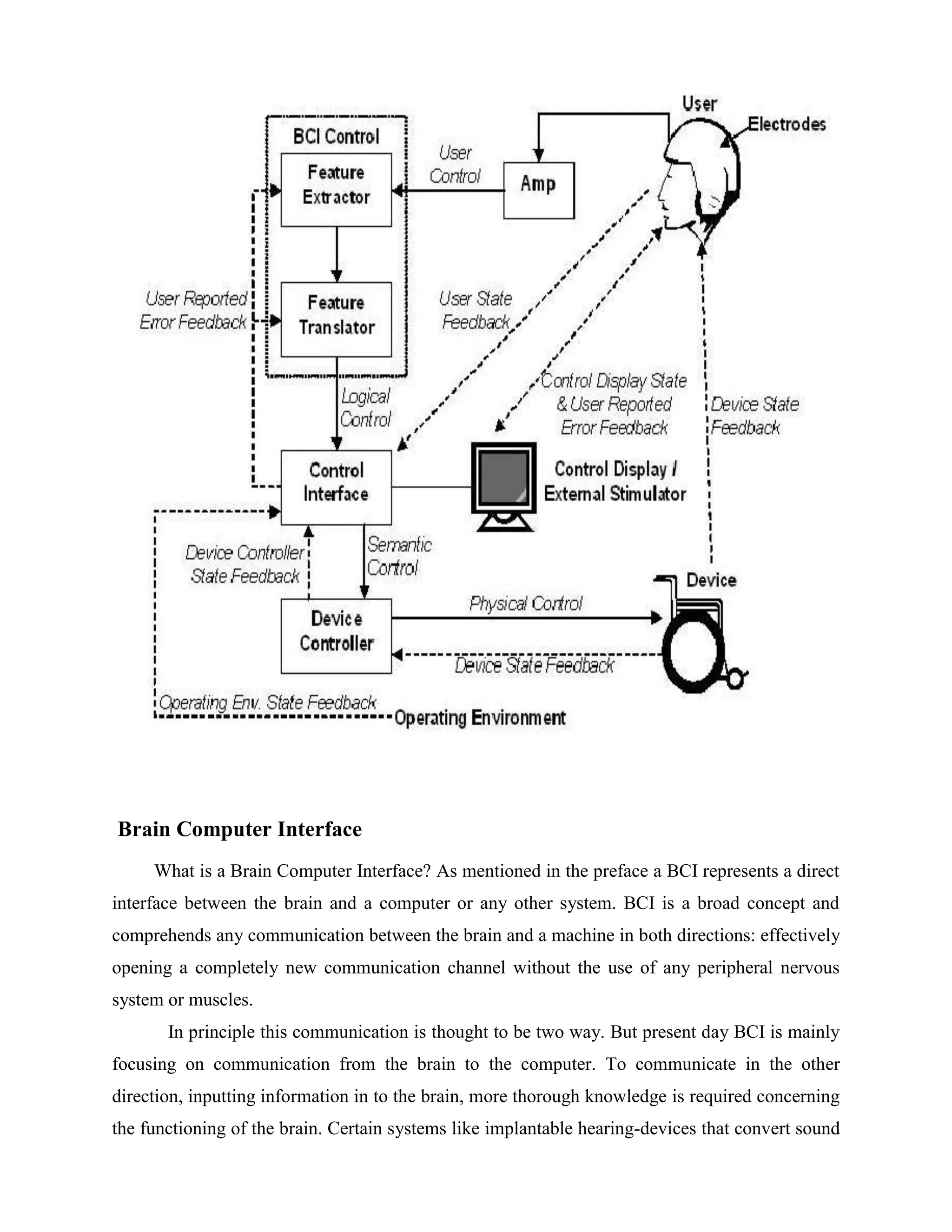
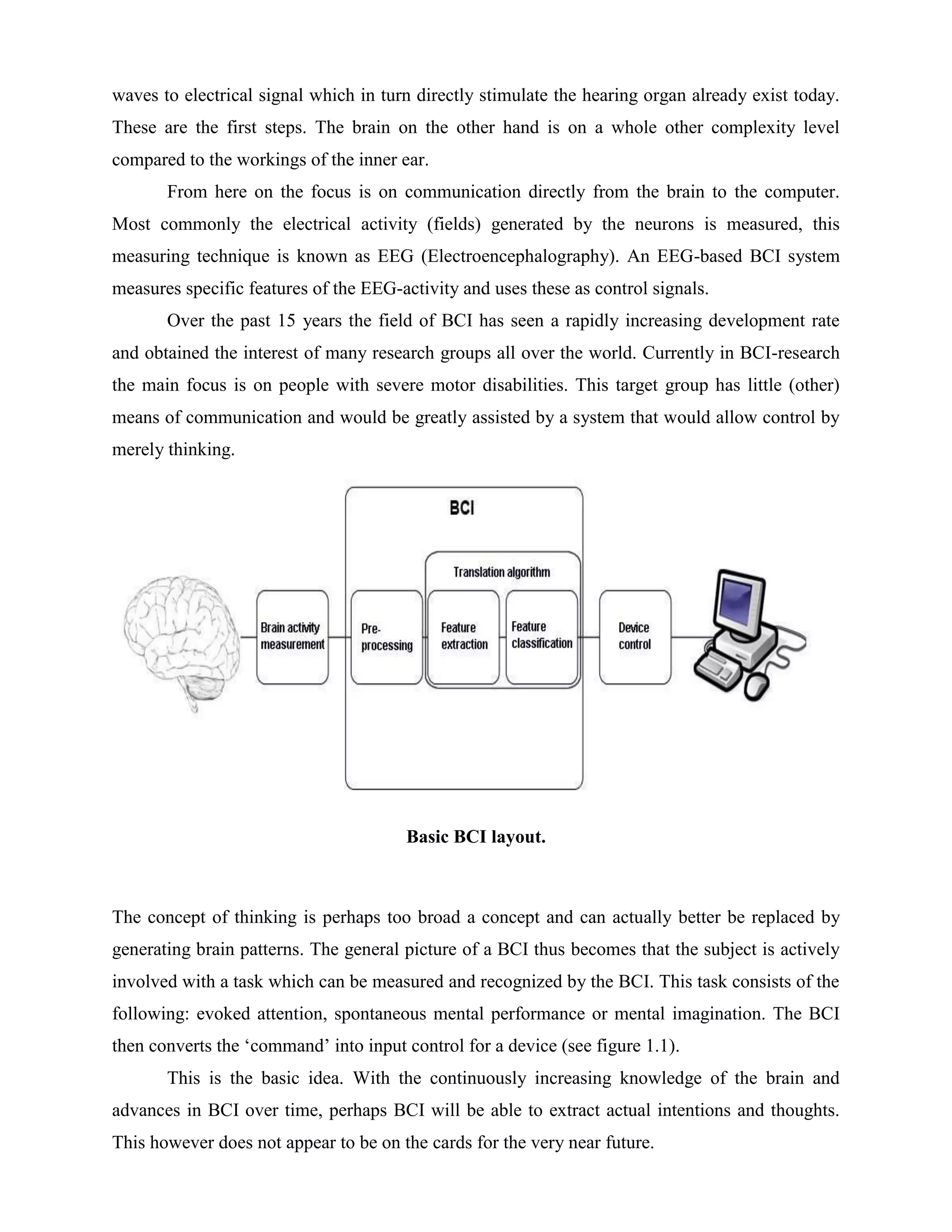
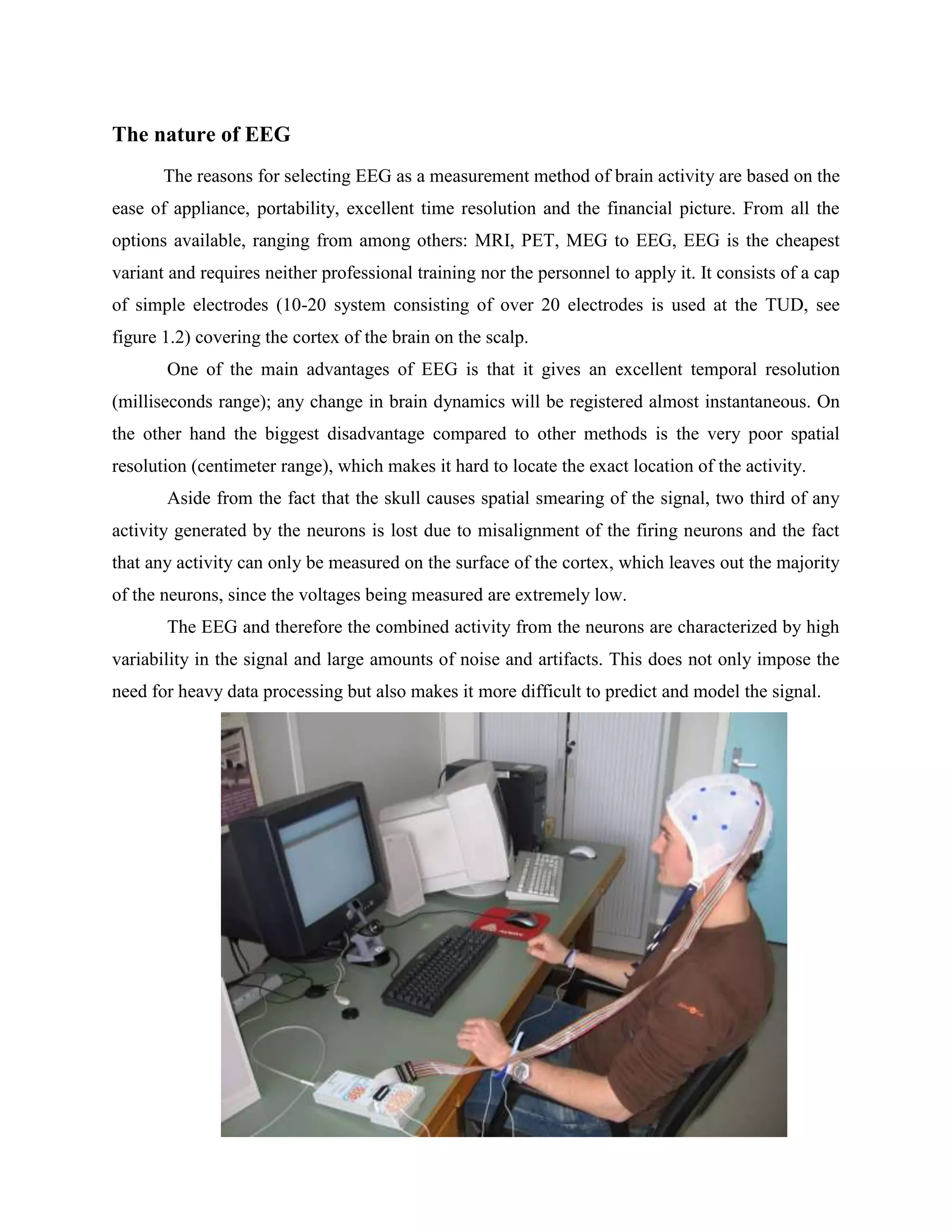
This document discusses brain-computer interfaces (BCIs). It begins by explaining that BCIs allow users to control devices through brain activity measured by electroencephalography (EEG) or single-neuron recordings, but both methods have disadvantages. The document then demonstrates that electrocorticography (ECoG) recorded from the brain's surface can enable rapid and accurate one-dimensional cursor control. Over brief training periods, patients achieved high success rates in a binary task, suggesting ECoG-BCIs could provide an effective communication option for those with severe motor disabilities. Open-loop experiments also found ECoG signals encoded substantial information about two-dimensional joystick movements.
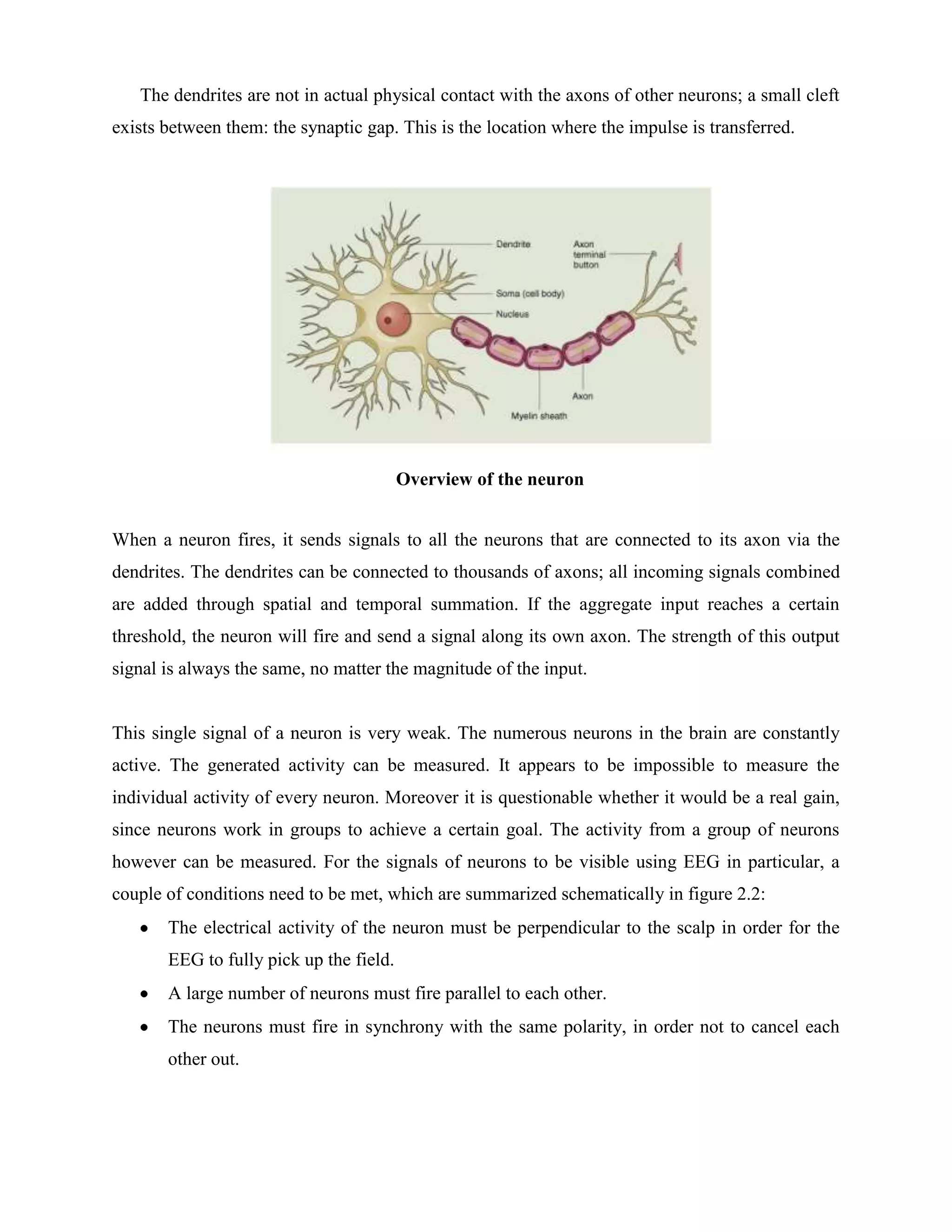
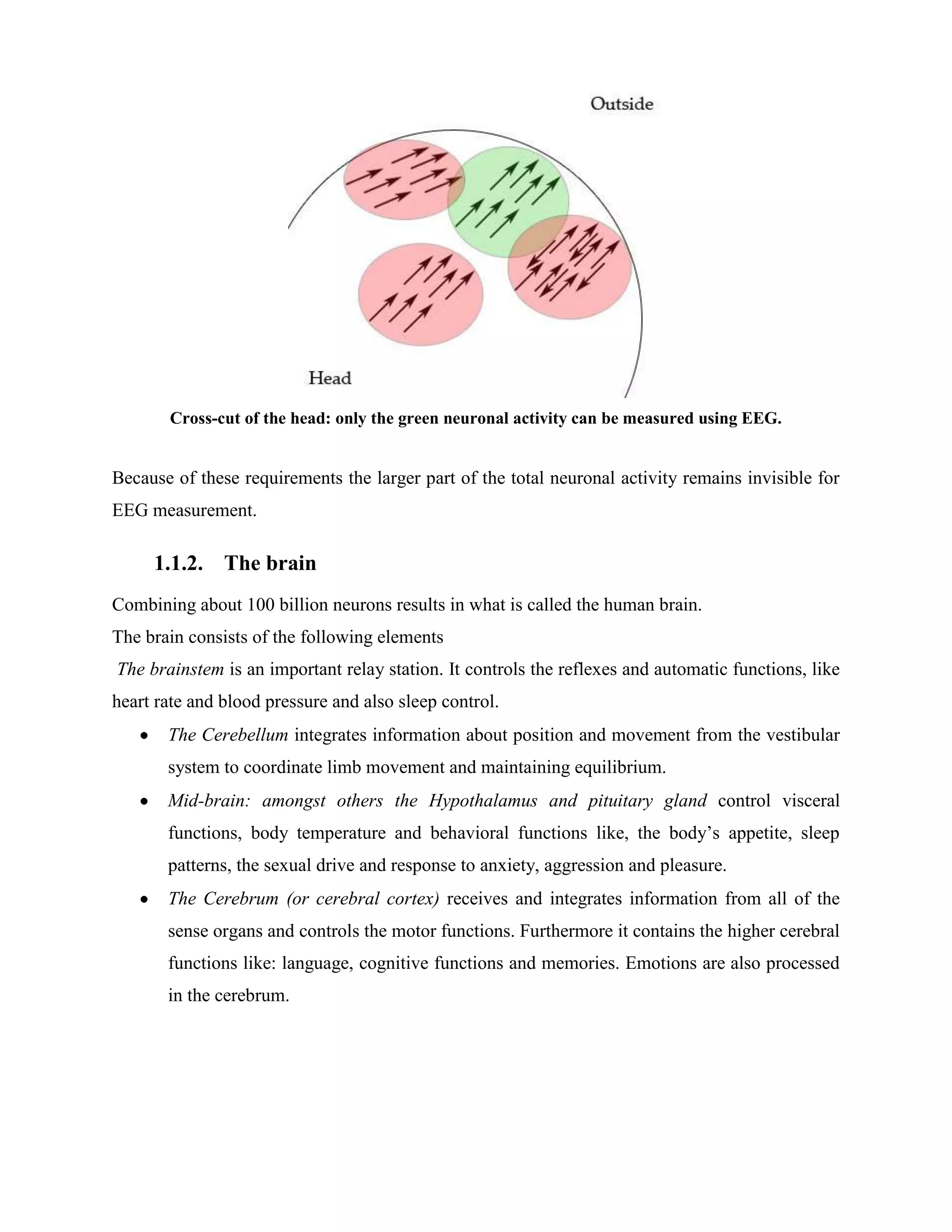
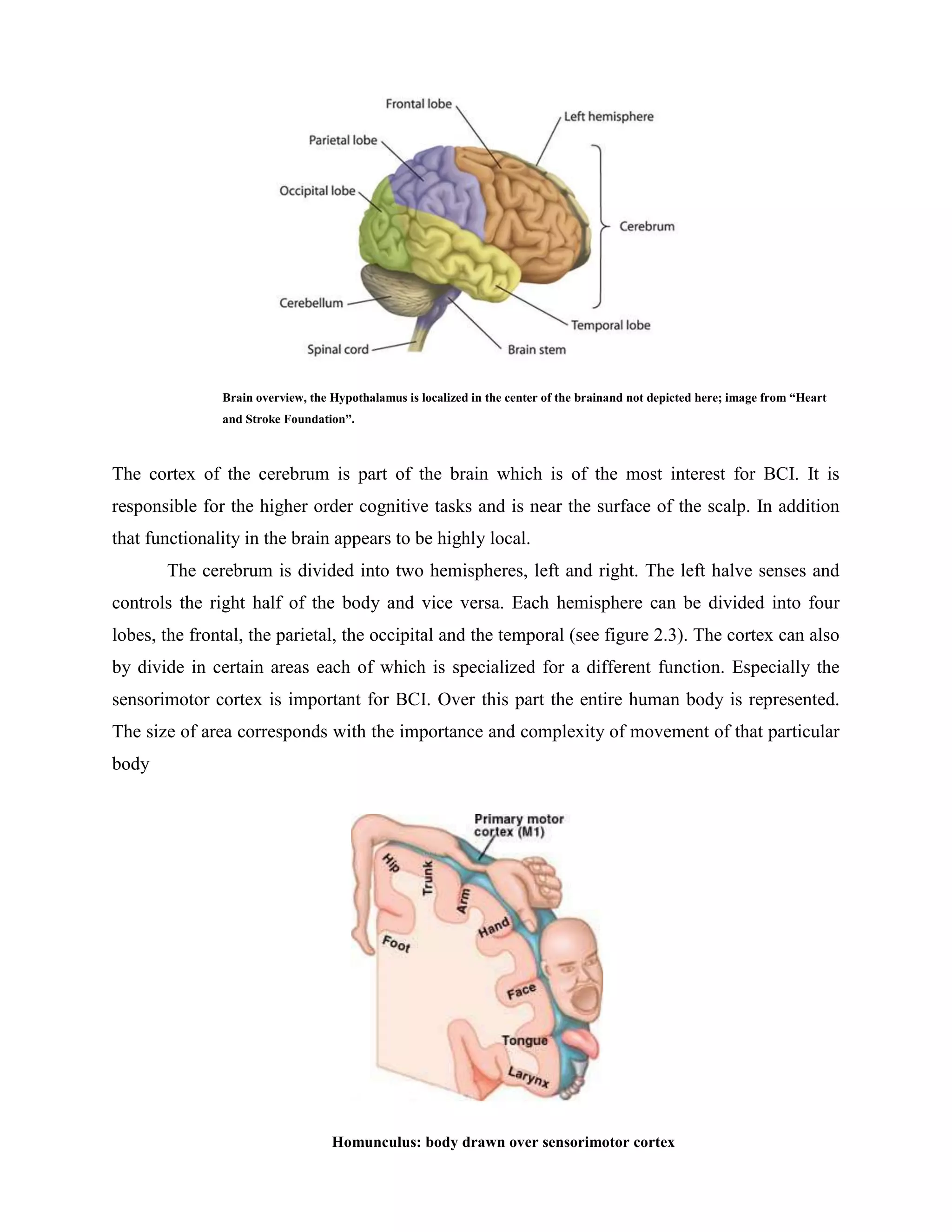
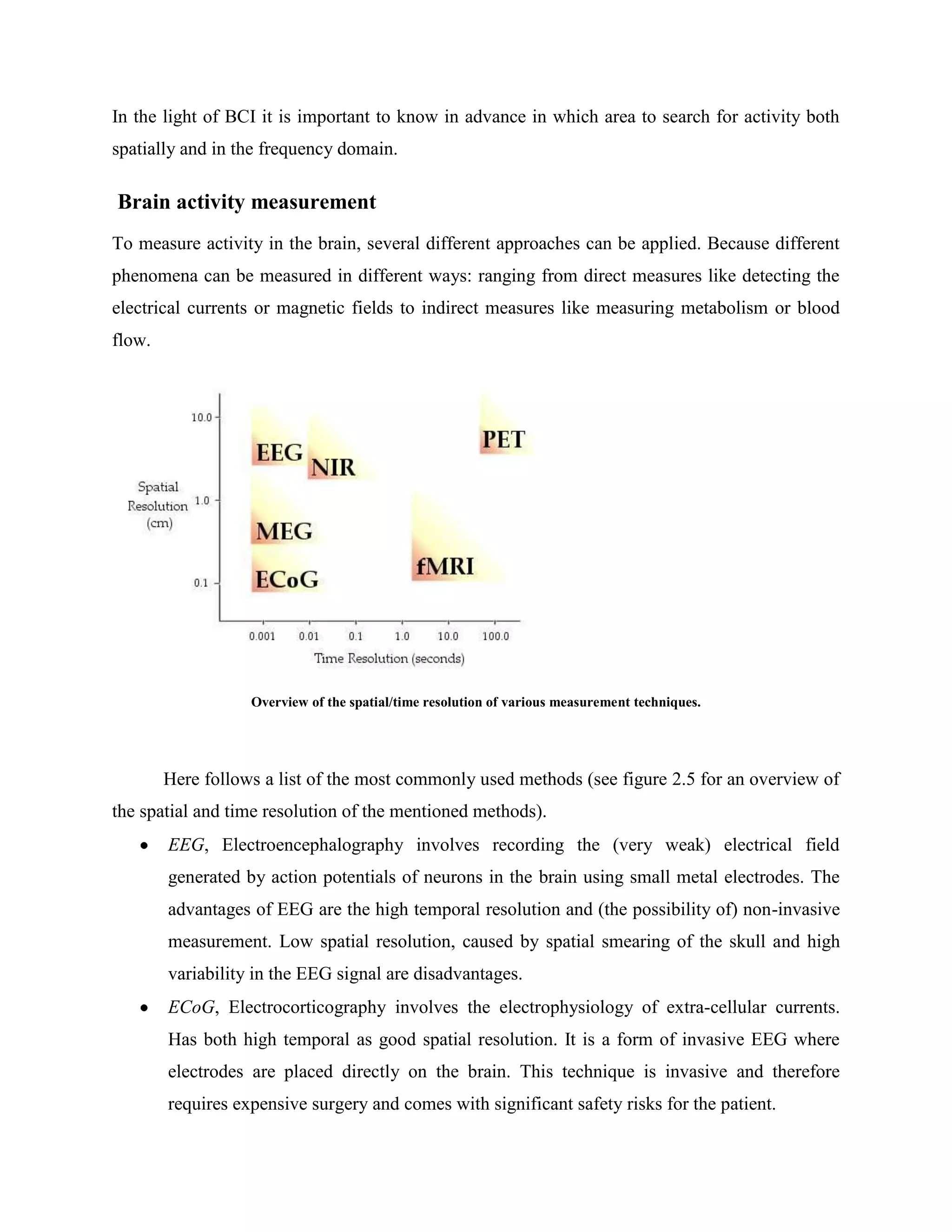
![PET, Positron Emission Tomography indirectly measures metabolism on a cellular level
by tracking injected radioactive isotopes. It is based on the principle that in areas of
increased activity the metabolism is on a higher level and more isotopes are supplied by
the blood flow. This knowledge can be used to determine which areas are generating
activity. Good spatial resolution is an advantage of PET. The really bad temporal
resolution (about 2 minutes) is a distinct disadvantage. This is due to the fact that
metabolism is a relatively slow process. Moreover ionizing radiation makes this method
harmful for the human body and thus unusable for applications like BCI.
MEG, magneto encephalography directly measures the cortical magnetic fields produced
by electrical currents. This method is non-invasive and has good spatial and temporal
resolution. However the equipment is extremely expensive and due to the very weak
magnetic fields requires a very impractical isolation/shielding room (cage of Faraday).
The real-time properties for analysis are poor.
fMRI, functional Magnetic Resonance Imaging provides information on brain metabolism
using BOLD (Blood Oxygen Level Dependent). fMRI uses strong fluctuating magnetic
field to measure the whereabouts of dipoles [25]. The advantages are good spatial
resolution and the non-invasiveness. But the temporal resolution is poor (about one
second) and this method requires very expensive equipment and procedures.
NIR, Near-infrared light penetrates the human head to sufficient depths to allow
functional mapping of the cerebral cortex. Changes in tissue oxygenation cause
modulation of absorption and scattering of photons, which can be measured [12]. NIR
can measure two responses.
o The slow response corresponds with the attenuation changes due to cerebral
heamodynamics.
o The fast response could be used for BCI and is due to changes in scattering
properties. This response has a good temporal resolution, but is not yet feasible.
To date the only experimental setup that has been used uses the slow response, which has
a poor temporal resolution. Advantages of optical techniques: no interference, user is
electrically isolated, non-invasive, non-ionizing and no gel is required. Overall this looks
like a promising technique.](https://image.slidesharecdn.com/45891026-brain-computer-interface-seminar-report-121129005534-phpapp02/75/45891026-brain-computer-interface-seminar-report-11-2048.jpg)
![direct connection. The [Brain Gate] is going to be right there and you won't have to think about
it."
DARPA
The Brown University group was partially funded by the Defense Advanced Research Projects
Agency (DARPA), the central research and development organization for the US Department of
Defense (DoD). DARPA has been interested in Brain-Machine- Interfaces (BMI) for a number
of years for military applications like wiring fighter pilots directly to their planes to allow
autonomous flight from the safety of the ground. Future developments are also envisaged in
which humans could 'download' memory implants for skill enhancement, allowing actions to be
performed that have not been learned directly.
BCI APPLICATIONS:
After we go through the various techniques of BCI the first question that comes to our mind is,
what does BCI do to us and what are its applications. So BCI in today’s time turns useful to us in
many ways. Whether it is in any medical field or in a field leading to enhancement of human
environment. Some of the BCI applications are discussed below.
1) Adaptive BCI for Augmented Cognition and Action
2) BCI offers paralyzed patients improved quality of life
3) The Mental Typewriter
Corresponding real-time adaptive interfaces with sub-second latency are being designed to
evaluate this concept of an adaptive brain-computer interface in three specific applications
1) Error and conflict perception
2) Working memory encoding.
3) Rapid visual recognition](https://image.slidesharecdn.com/45891026-brain-computer-interface-seminar-report-121129005534-phpapp02/75/45891026-brain-computer-interface-seminar-report-15-2048.jpg)