BRAIN COMPUTER INTERFACE
Ā 
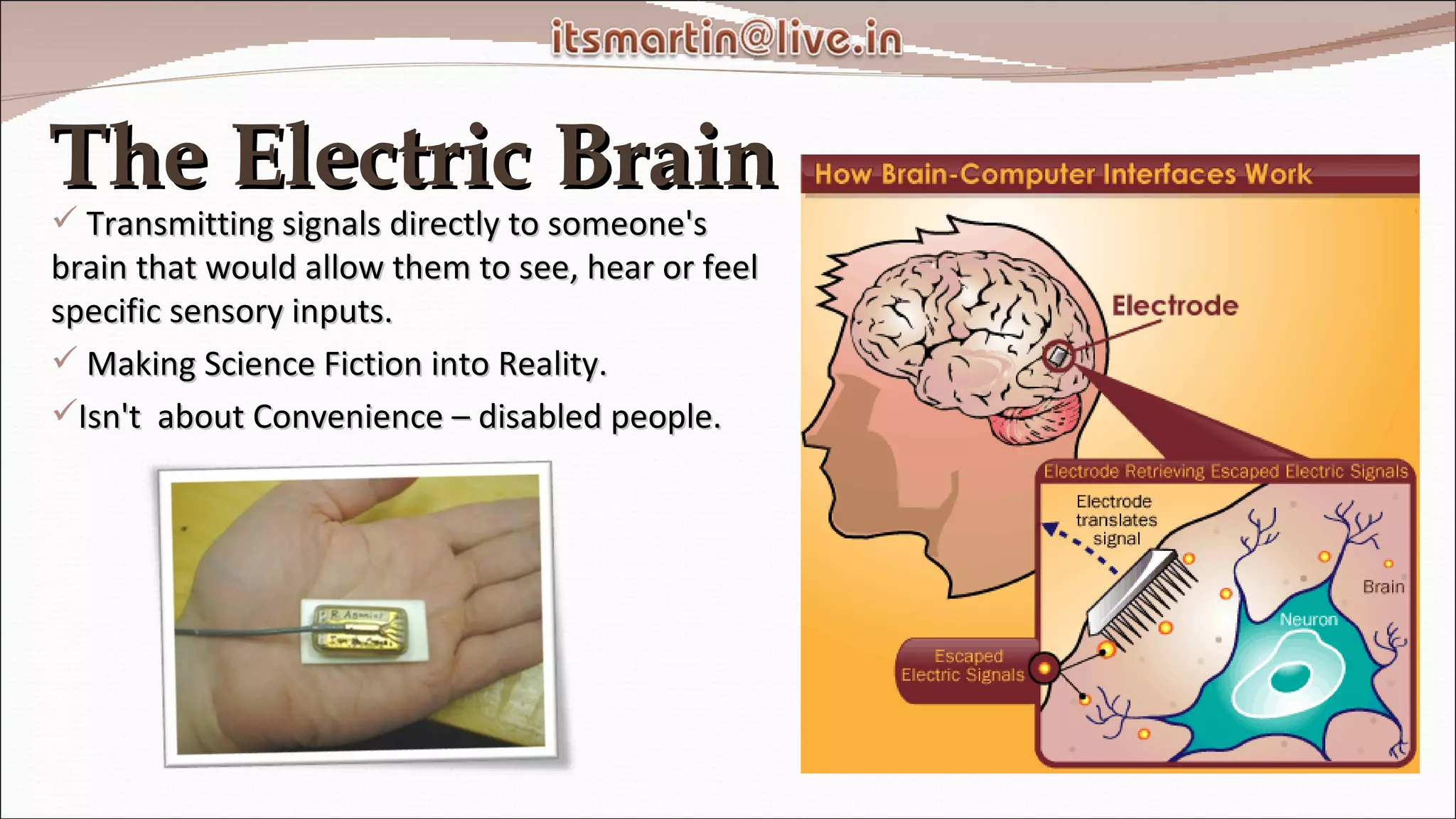
The Electric Brain Transmitting signals directly to someone's brain that would allow them to see, hear or feel specific sensory inputs. Making Science Fiction into Reality. Isn't  about Convenience – disabled people.
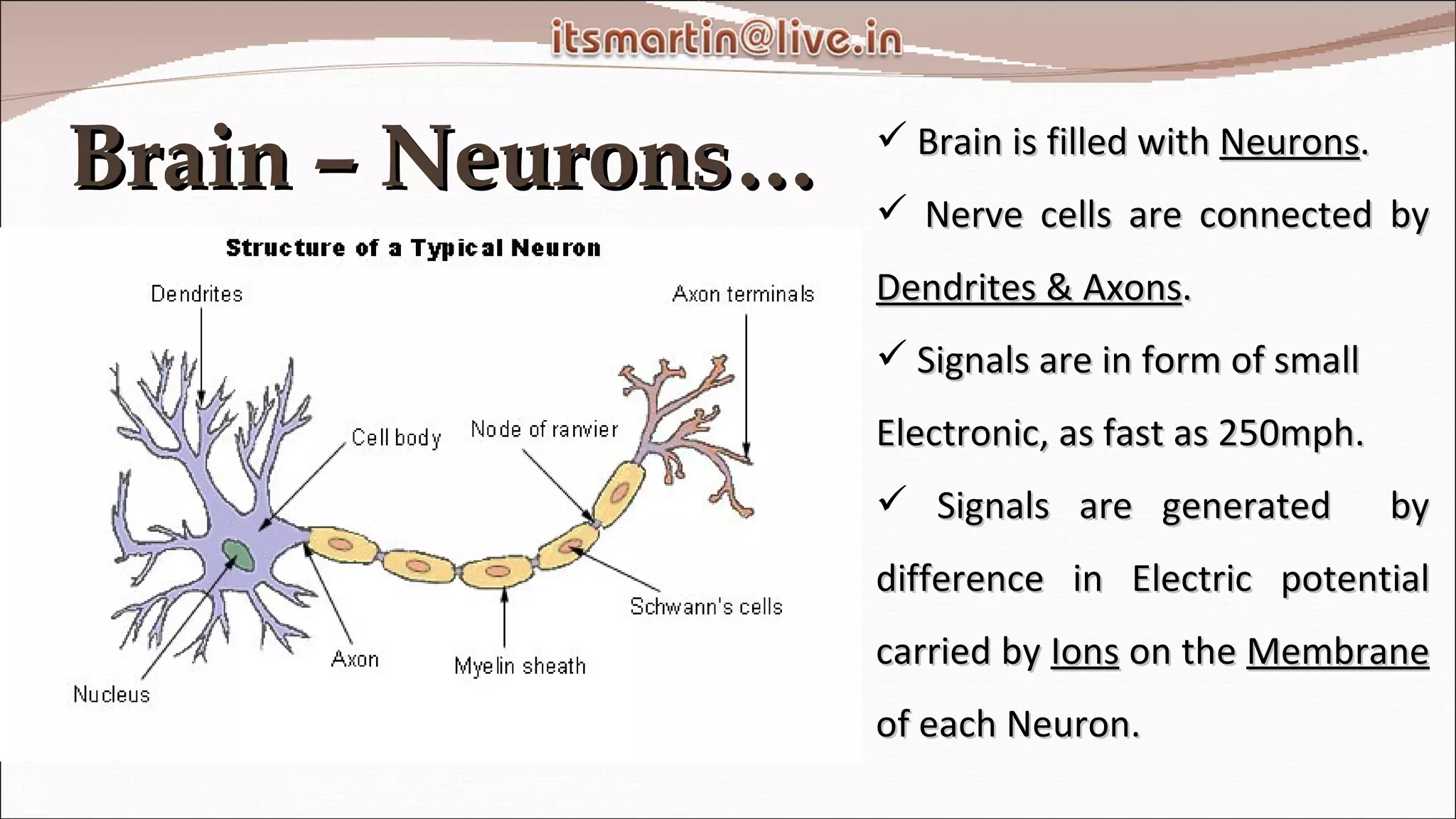
Brain – Neurons… Brain is filled with  Neurons . Nerve cells are connected by  Dendrites & Axons . Signals are in form of small  Electronic, as fast as 250mph. Signals are generated  by difference in Electric potential carried by  Ions  on the  Membrane  of each Neuron.
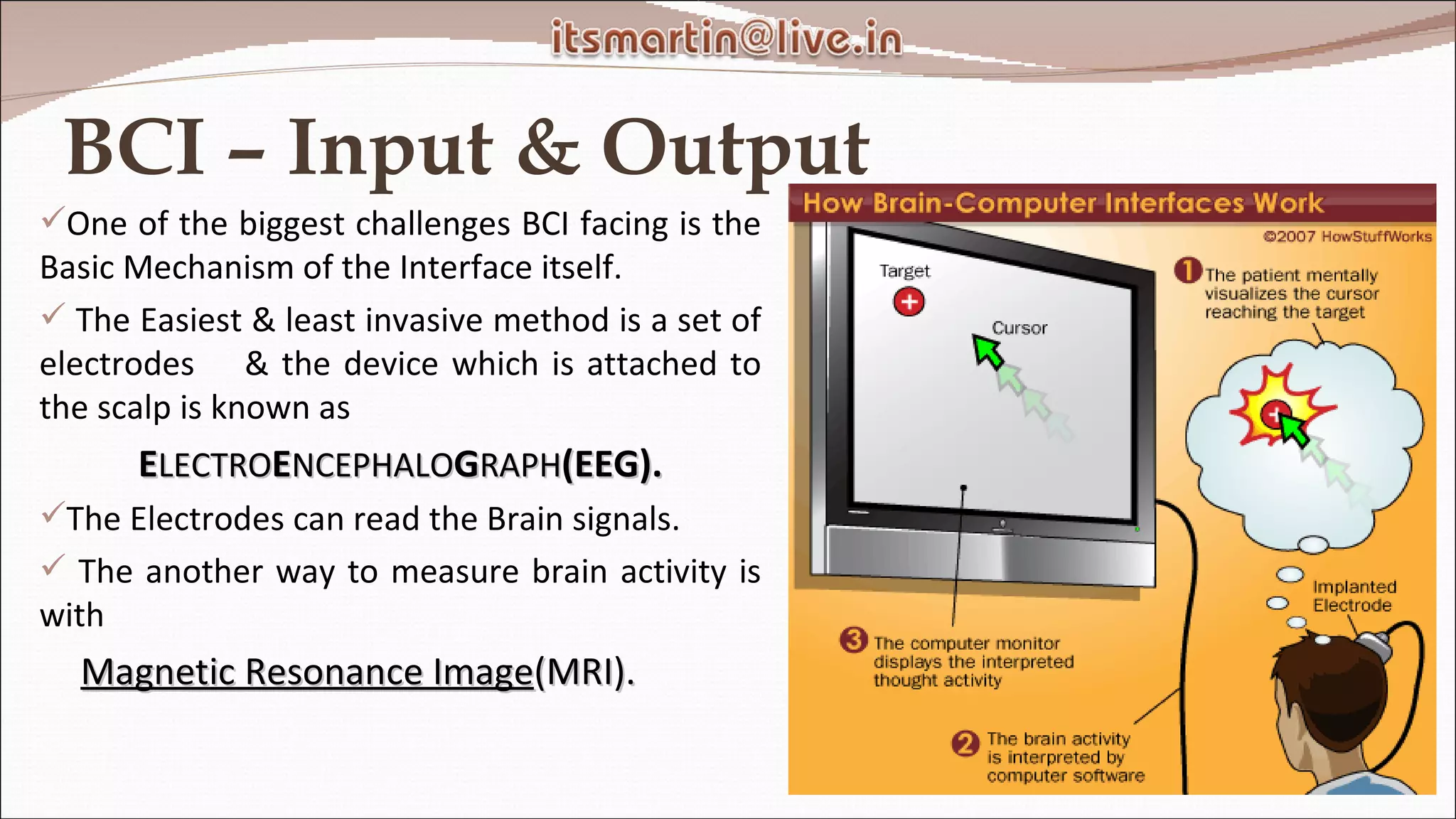
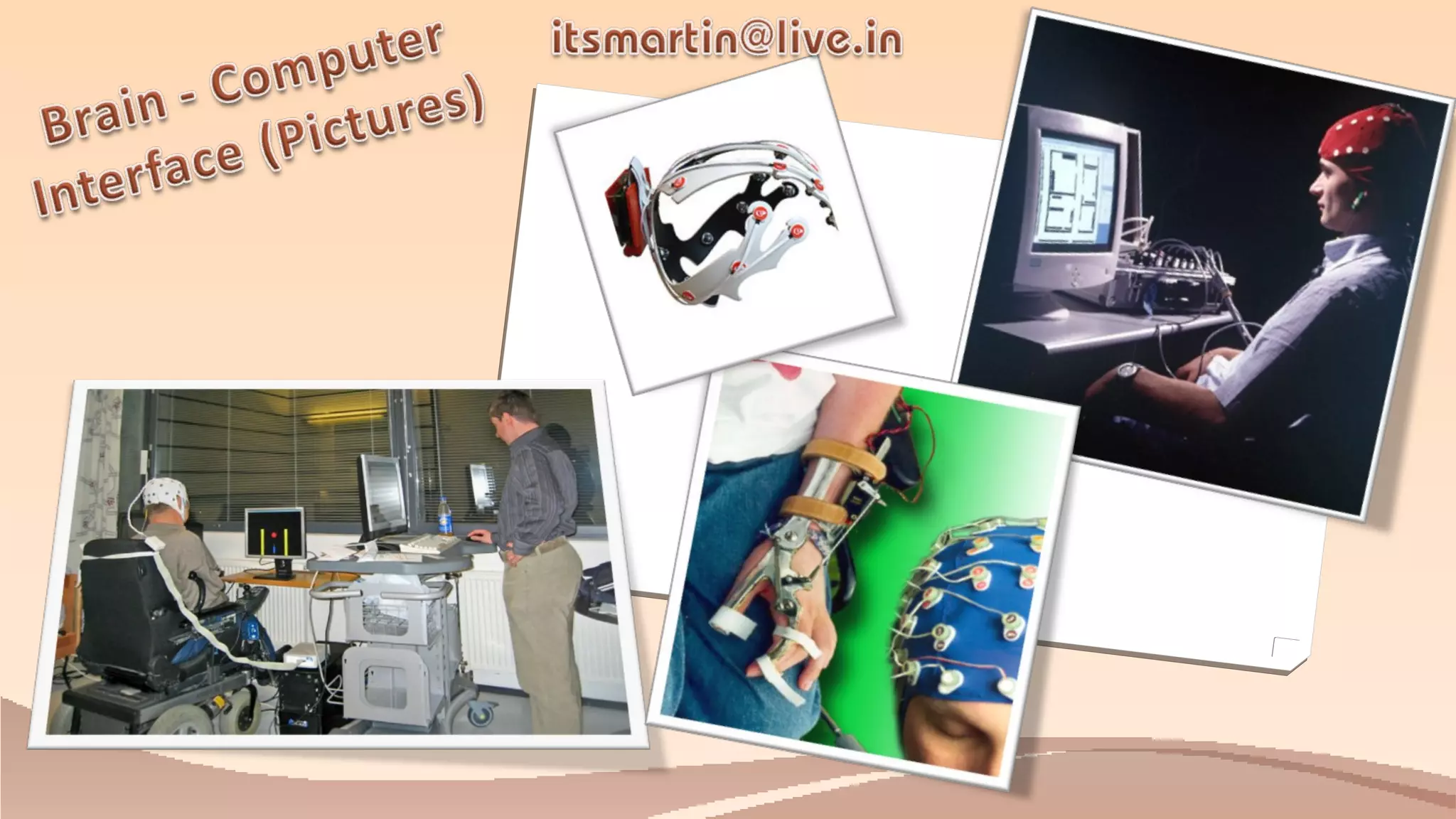
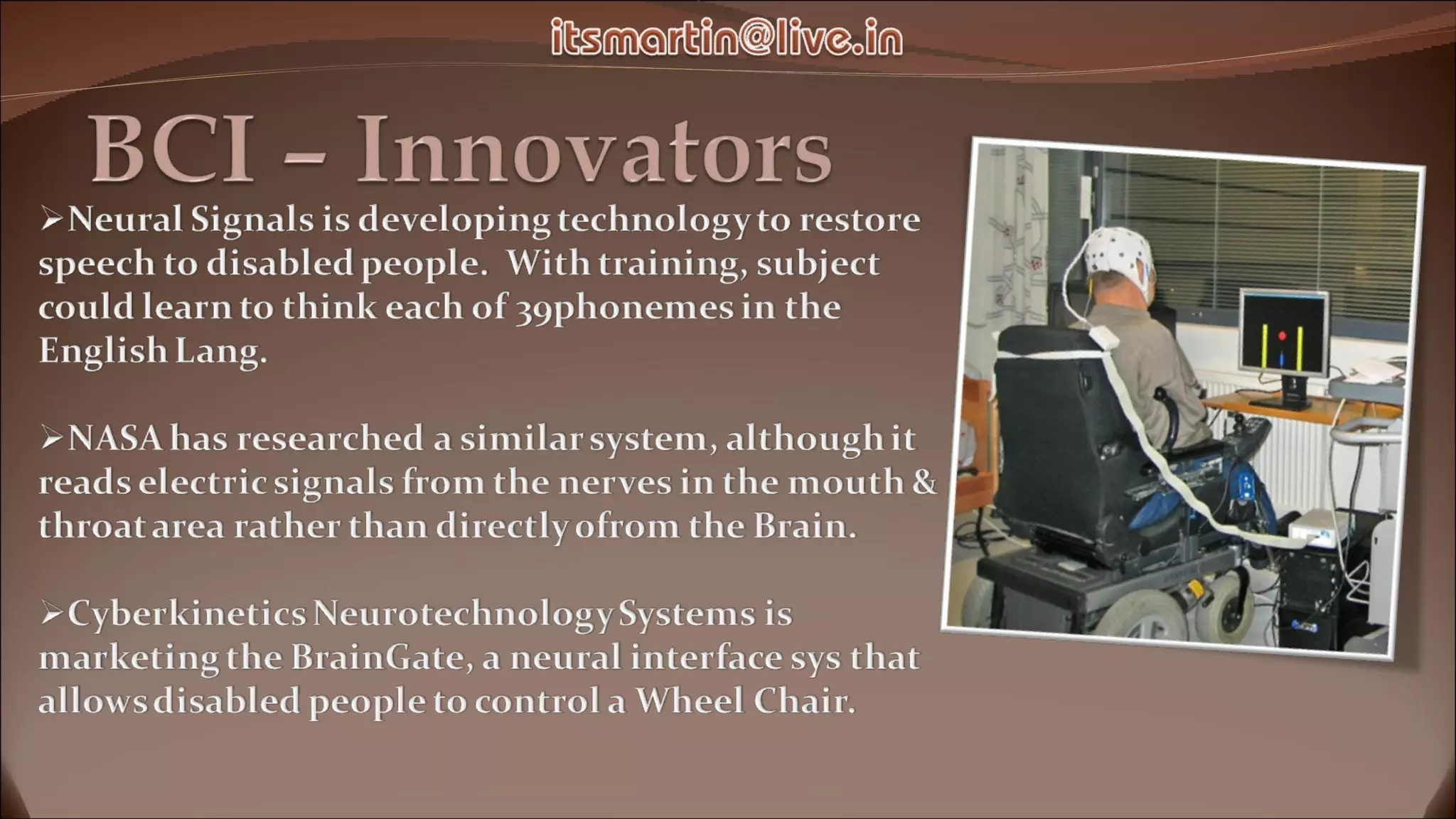
BCI – Input & Output One of the biggest challenges BCI facing is the Basic Mechanism of the Interface itself. The Easiest & least invasive method is a set of electrodes  & the device which is attached to the scalp is known as E LECTRO E NCEPHALO G RAPH (EEG). The Electrodes can read the Brain signals. The another way to measure brain activity is with  Magnetic Resonance Image (MRI).
Ā 
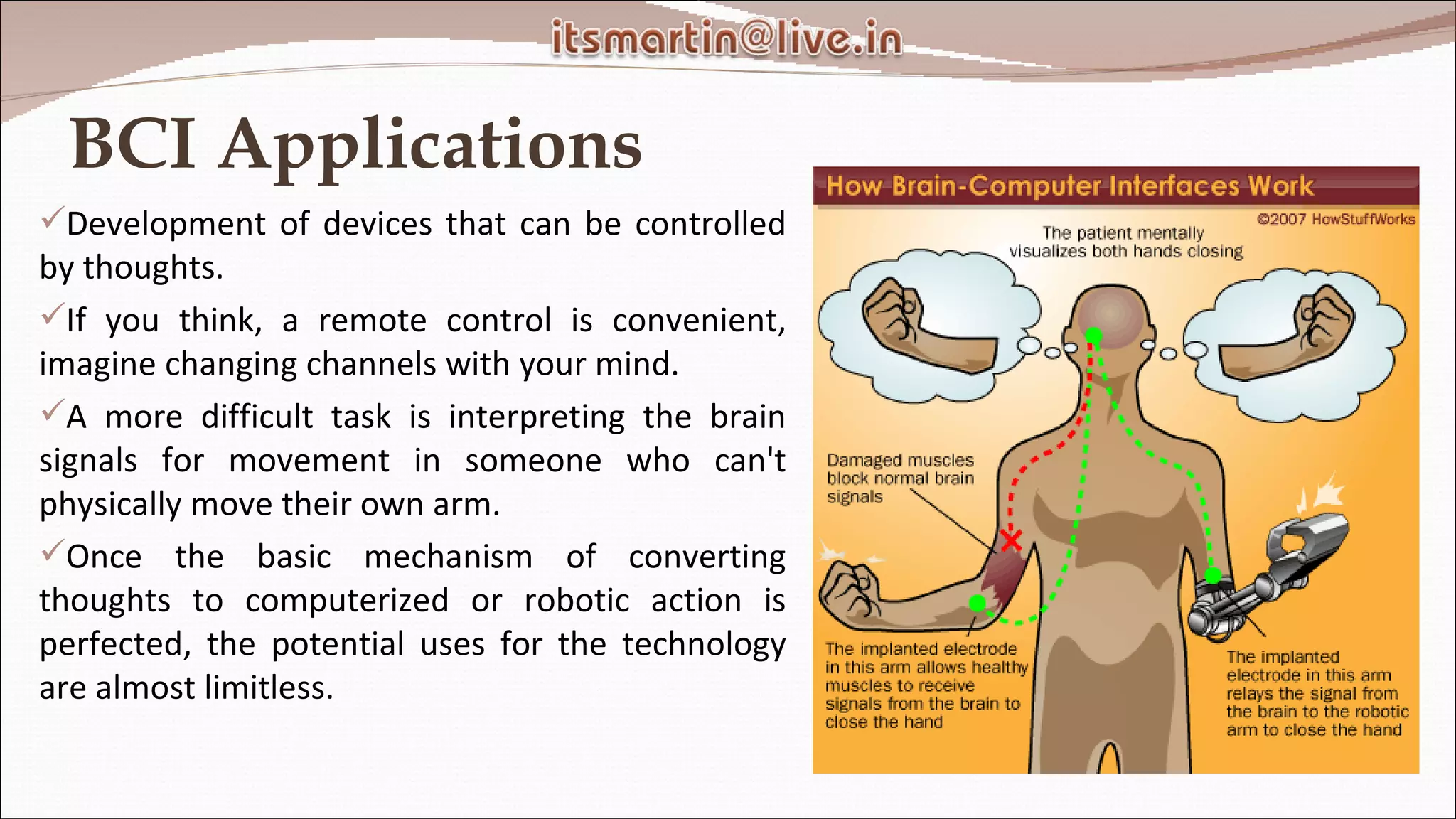
BCI Applications Development of devices that can be controlled by thoughts. If you think, a remote control is convenient, imagine changing channels with your mind. A more difficult task is interpreting the brain signals for movement in someone who can't physically move their own arm.  Once the basic mechanism of converting thoughts to computerized or robotic action is perfected, the potential uses for the technology are almost limitless.
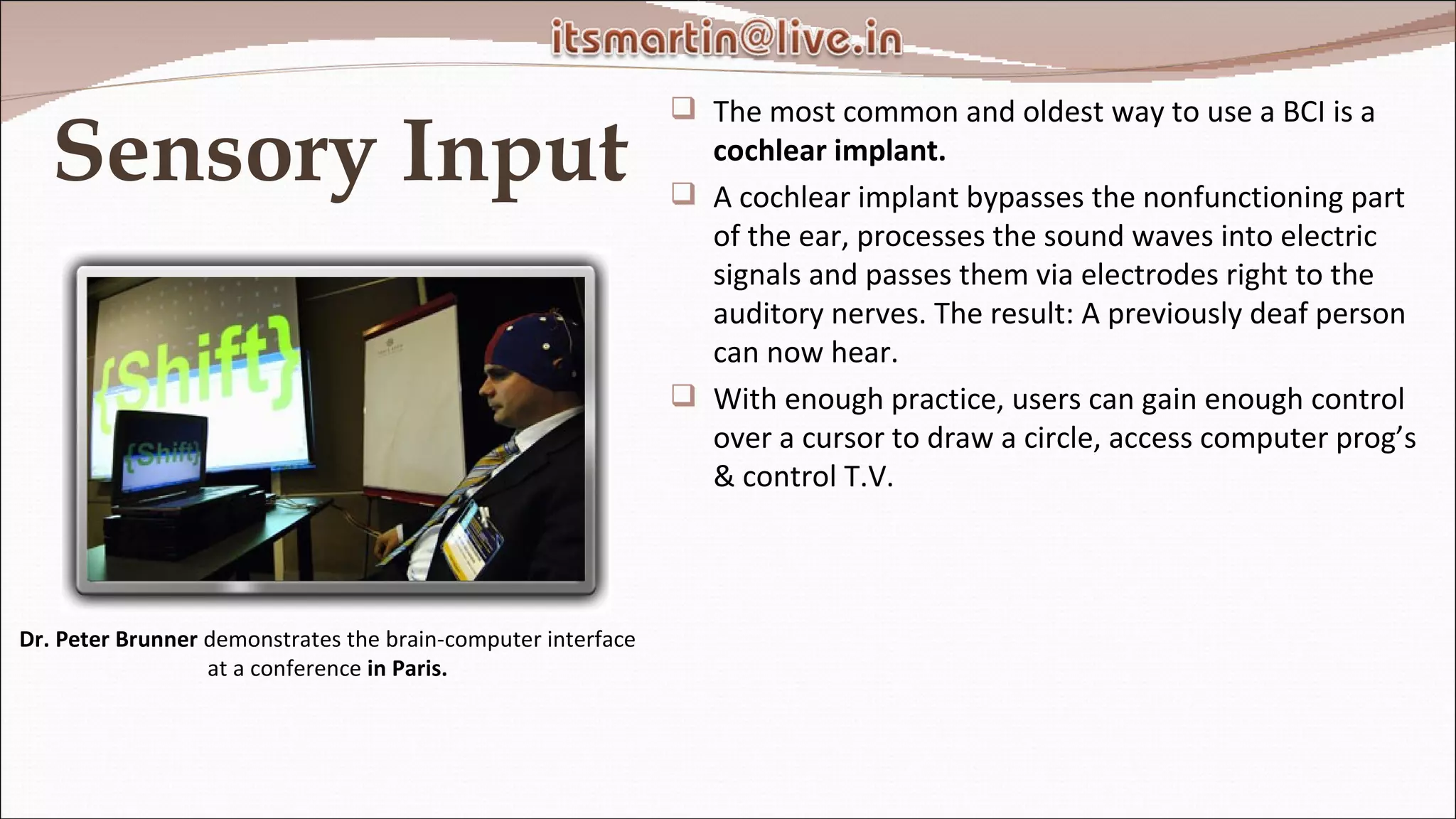
Sensory Input The most common and oldest way to use a BCI is a  cochlear implant. A cochlear implant bypasses the nonfunctioning part of the ear, processes the sound waves into electric signals and passes them via electrodes right to the auditory nerves. The result: A previously deaf person can now hear. With enough practice, users can gain enough control over a cursor to draw a circle, access computer prog’s & control T.V. Dr. Peter Brunner  demonstrates the brain-computer interface at a conference  in Paris.
Ā 
Ā 
Ā 
Ā 

Martin's Seminar on Brain Control Interface(BCI)

  • 1.
  • 2.
  • 3.
    The Electric BrainTransmitting signals directly to someone's brain that would allow them to see, hear or feel specific sensory inputs. Making Science Fiction into Reality. Isn't about Convenience – disabled people.
  • 4.
    Brain – Neurons…Brain is filled with Neurons . Nerve cells are connected by Dendrites & Axons . Signals are in form of small Electronic, as fast as 250mph. Signals are generated by difference in Electric potential carried by Ions on the Membrane of each Neuron.
  • 5.
    BCI – Input& Output One of the biggest challenges BCI facing is the Basic Mechanism of the Interface itself. The Easiest & least invasive method is a set of electrodes & the device which is attached to the scalp is known as E LECTRO E NCEPHALO G RAPH (EEG). The Electrodes can read the Brain signals. The another way to measure brain activity is with Magnetic Resonance Image (MRI).
  • 6.
  • 7.
    BCI Applications Developmentof devices that can be controlled by thoughts. If you think, a remote control is convenient, imagine changing channels with your mind. A more difficult task is interpreting the brain signals for movement in someone who can't physically move their own arm. Once the basic mechanism of converting thoughts to computerized or robotic action is perfected, the potential uses for the technology are almost limitless.
  • 8.
    Sensory Input Themost common and oldest way to use a BCI is a cochlear implant. A cochlear implant bypasses the nonfunctioning part of the ear, processes the sound waves into electric signals and passes them via electrodes right to the auditory nerves. The result: A previously deaf person can now hear. With enough practice, users can gain enough control over a cursor to draw a circle, access computer prog’s & control T.V. Dr. Peter Brunner demonstrates the brain-computer interface at a conference in Paris.
  • 9.
  • 10.
  • 11.
  • 12.