fNIRS and Brain Computer
Interface for Communication
Dr. Ujwal Chaudhary and Dr. Bettina Sorger present groundbreaking
research in the field of fNIRS-based BCI for communication with
healthy subjects and patients in completely locked-in states
InsideScientific is an online educational environment
designed for life science researchers. Our goal is to aid
in the sharing and distribution of scientific information
regarding innovative technologies, protocols, research
tools and laboratory services.
JOIN FOR FREE AT WWW.INSIDESCIENTIFIC.COM
Bettina Sorger, PhD
Assistant Professor
Leader of Hemodynamic BCI group
Cognitive Neuroscience Department
Faculty of Psychology and Neuroscience
Maastricht University
Functional Near-Infrared Spectroscopy (fNIRS):
A promising BCI technique
ψ
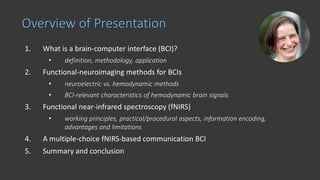
1. What is a brain-computer interface (BCI)?
• definition, methodology, application
2. Functional-neuroimaging methods for BCIs
• neuroelectric vs. hemodynamic methods
• BCI-relevant characteristics of hemodynamic brain signals
3. Functional near-infrared spectroscopy (fNIRS)
• working principles, practical/procedural aspects, information encoding,
advantages and limitations
4. A multiple-choice fNIRS-based communication BCI
5. Summary and conclusion
Overview of Presentation
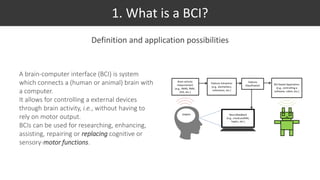
1. What is a brain-computer interface (BCI)?
1. What is a BCI?
Definition and application possibilities
A brain-computer interface (BCI) is system
which connects a (human or animal) brain with
a computer.
It allows for controlling a external devices
through brain activity, i.e., without having to
rely on motor output.
BCIs can be used for researching, enhancing,
assisting, repairing or replacing cognitive or
sensory-motor functions.
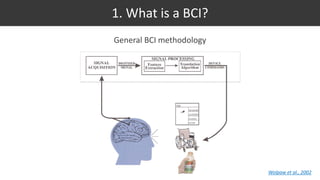
1. What is a BCI?
General BCI methodology
Wolpaw et al., 2002
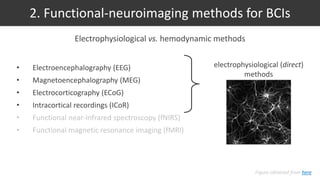
2. Functional-neuroimaging methods for BCIs
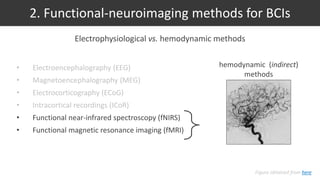
Electrophysiological vs. hemodynamic methods
electrophysiological (direct)
methods
• Electroencephalography (EEG)
• Magnetoencephalography (MEG)
• Electrocorticography (ECoG)
• Intracortical recordings (ICoR)
• Functional near-infrared spectroscopy (fNIRS)
• Functional magnetic resonance imaging (fMRI)
Figure obtained from here
• Electroencephalography (EEG)
• Magnetoencephalography (MEG)
• Electrocorticography (ECoG)
• Intracortical recordings (ICoR)
• Functional near-infrared spectroscopy (fNIRS)
• Functional magnetic resonance imaging (fMRI)
Figure obtained from here
2. Functional-neuroimaging methods for BCIs
Electrophysiological vs. hemodynamic methods
hemodynamic (indirect)
methods
2. Functional-neuroimaging methods for BCIs
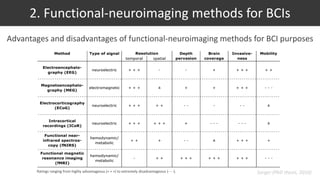
Ratings ranging from highly advantageous (+ + +) to extremely disadvantageous (- - -). Sorger (PhD thesis, 2010)
2. Functional-neuroimaging methods for BCIs
Advantages and disadvantages of functional-neuroimaging methods for BCI purposes
0 3 10 time [s]
neuroelectric response hemodynamic response
2. Functional-neuroimaging methods for BCIs
100ms
BCI-relevant characteristics of hemodynamic signals (1): delay
BCI-relevant characteristics of hemodynamic signals (2): high single-trial reliability
Resting periods (20s)
Motor-imagery periods (10s)
fMRIresponse
fMRIresponse
Time
0 10 Time [s]
2. Functional-neuroimaging methods for BCIs
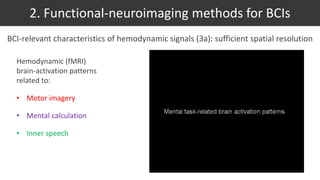
BCI-relevant characteristics of hemodynamic signals (3a): sufficient spatial resolution
Hemodynamic (fMRI)
brain-activation patterns
related to:
• Motor imagery
• Mental calculation
• Inner speech
2. Functional-neuroimaging methods for BCIs
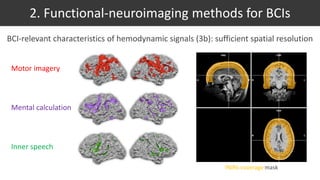
BCI-relevant characteristics of hemodynamic signals (3b): sufficient spatial resolution
Motor imagery
Mental calculation
Inner speech
fNIRS-coverage mask
2. Functional-neuroimaging methods for BCIs
3. Functional near-infrared spectroscopy (fNIRS)
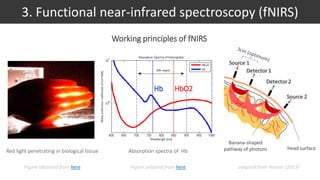
Working principles of fNIRS
Red light penetrating in biological tissue
Figure obtained from here adapted from Naseer (2013)
Head surface
Banana-shaped
pathway of photonsAbsorption spectra of Hb
Figure adapted from here
Hb HbO2
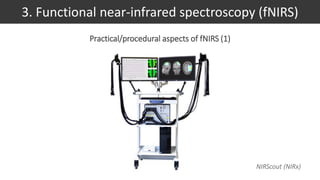
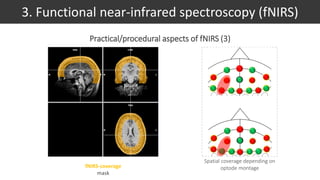
Practical/procedural aspects of fNIRS (1)
3. Functional near-infrared spectroscopy (fNIRS)
NIRScout (NIRx)
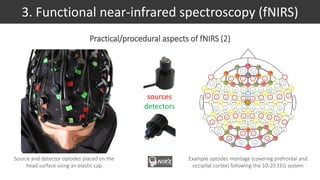
Practical/procedural aspects of fNIRS (2)
Source and detector optodes placed on the
head surface using an elastic cap
Example optodes montage (covering prefrontal and
occipital cortex) following the 10-20 EEG system
CZ
3. Functional near-infrared spectroscopy (fNIRS)
sources
detectors
Spatial coverage depending on
optode montagefNIRS-coverage
mask
3. Functional near-infrared spectroscopy (fNIRS)
Practical/procedural aspects of fNIRS (3)
Information encoding in fNIRS-BCIs
3. Functional near-infrared spectroscopy (fNIRS)
How can we enable patients to encode different
information or intentions into differentiable fNIRS
signal?
3. Functional near-infrared spectroscopy (fNIRS)
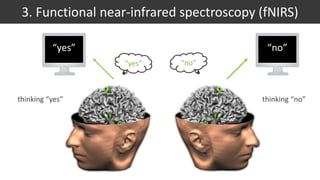
“yes” “no”
“yes” “no”
thinking “yes” thinking “no”
3. Functional near-infrared spectroscopy (fNIRS)
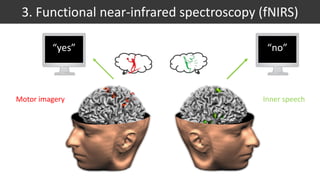
“yes” “no”
Inner speechMotor imagery
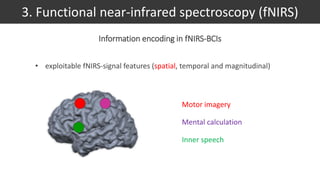
• exploitable fNIRS-signal features (spatial, temporal and magnitudinal)
3. Functional near-infrared spectroscopy (fNIRS)
Motor imagery
Mental calculation
Inner speech
Information encoding in fNIRS-BCIs
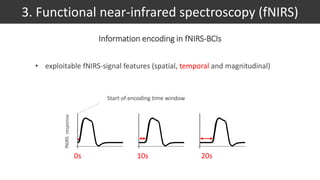
• exploitable fNIRS-signal features (spatial, temporal and magnitudinal)
3. Functional near-infrared spectroscopy (fNIRS)
20s10s0s
fNIRSresponse
Information encoding in fNIRS-BCIs
Start of encoding time window
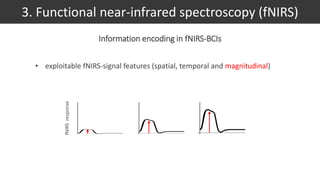
• exploitable fNIRS-signal features (spatial, temporal and magnitudinal)
3. Functional near-infrared spectroscopy (fNIRS)
fNIRSresponse
Information encoding in fNIRS-BCIs
• exploitable fNIRS-signal features (spatial, temporal and magnitudinal)
• two general forms information-encoding strategies:
- intentionally controlled mental activities
1. higher-order cognitive tasks (e.g., mental calculation)
2. covert language-related tasks (e.g., mental speech, mental singing)
3. mental-imagery tasks (motor, visual, auditory, tactile and emotion imagery)
4. selective-attention tasks (visual, auditory, and tactile attention)
- automatic cognitive processing
3. Functional near-infrared spectroscopy (fNIRS)
Information encoding in fNIRS-BCIs
• relatively low purchase/operating costs [fMRI]
• medium temporal resolution (sample rate: up to 20Hz, but cave hemodynamic delay) [fMRI]
• sufficient spatial resolution (1cm³ range)
• no vulnerability to electromagnetic environment [EEG, fMRI]
• relatively low sensitivity to head motion artifacts [EEG, fMRI]
• no inverse problem [EEG]
• ease of application [EEG, fMRI]
• portability/mobility [fMRI]
• harmlessness, non-invasiveness
• noiselessness [fMRI]
• compatibility with paramagnetic (medical) equipment [fMRI]
• measuring both oxygenated and deoxygenated Hb changes ( two dependent variables) [EEG, fMRI]
• compatibility with EEG, fMRI, TMS/tCS ( simultaneous measurements possible)
3. Functional near-infrared spectroscopy (fNIRS)
Advantages of fNIRS as BCI technique
3. Functional near-infrared spectroscopy (fNIRS)
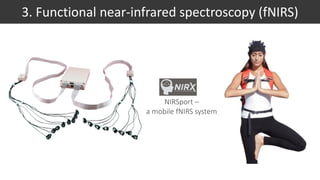
NIRSport –
a mobile fNIRS system
• relatively low purchase/operating costs [fMRI]
• medium temporal resolution (sample rate: up to 20Hz, but cave hemodynamic delay) [fMRI]
• sufficient spatial resolution (1cm³ range)
• no vulnerability to electromagnetic environment [EEG, fMRI]
• relatively low sensitivity to head motion artifacts [EEG, fMRI]
• no inverse problem [EEG]
• ease of application [EEG, fMRI]
• portability/mobility [fMRI]
• harmlessness, non-invasiveness
• noiselessness [fMRI]
• compatibility with paramagnetic (medical) equipment [fMRI]
• measuring both oxygenated and deoxygenated Hb changes ( two dependent variables) [EEG, fMRI]
• compatibility with EEG, fMRI, TMS/tCS ( simultaneous measurements possible)
3. Functional near-infrared spectroscopy (fNIRS)
Advantages of fNIRS as BCI technique
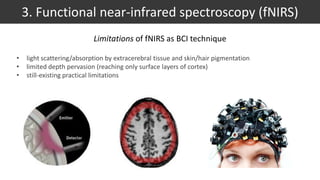
Limitations of fNIRS as BCI technique
• light scattering/absorption by extracerebral tissue and skin/hair pigmentation
• limited depth pervasion (reaching only surface layers of cortex)
• still-existing practical limitations
3. Functional near-infrared spectroscopy (fNIRS)
Figure adapted from here
4. A multiple-choice fNIRS-based communication BCI
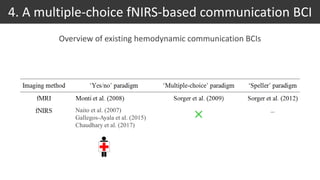
Overview of existing hemodynamic communication BCIs
×
4. A multiple-choice fNIRS-based communication BCI
Naito et al. (2007)
Gallegos-Ayala et al. (2015)
Chaudhary et al. (2017)
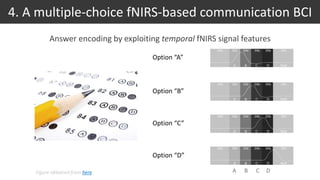
Option “D”
Option “C”
Option “B”
Option “A”
Answer encoding by exploiting temporal fNIRS signal features
4. A multiple-choice fNIRS-based communication BCI
Figure obtained from here A B C D
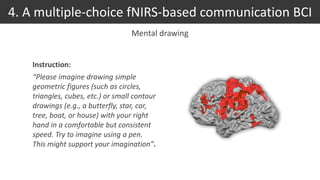
Instruction:
“Please imagine drawing simple
geometric figures (such as circles,
triangles, cubes, etc.) or small contour
drawings (e.g., a butterfly, star, car,
tree, boat, or house) with your right
hand in a comfortable but consistent
speed. Try to imagine using a pen.
This might support your imagination”.
4. A multiple-choice fNIRS-based communication BCI
Mental drawing
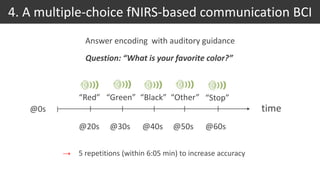
Answer encoding with auditory guidance
Question: “What is your favorite color?”
4. A multiple-choice fNIRS-based communication BCI
time
@20s
“Red” “Green”
@30s
“Black”
@40s
“Other”
@50s
“Stop”
@60s
@0s
→ 5 repetitions (within 6:05 min) to increase accuracy
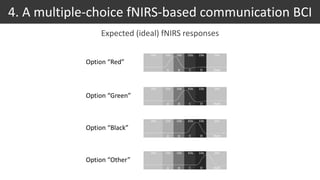
Option “Other”
Option “Black”
Option “Green”
Option “Red”
4. A multiple-choice fNIRS-based communication BCI
Expected (ideal) fNIRS responses
4. A multiple-choice fNIRS-based communication BCI
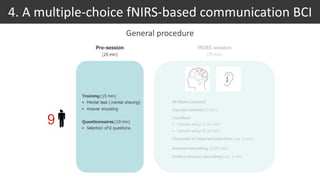
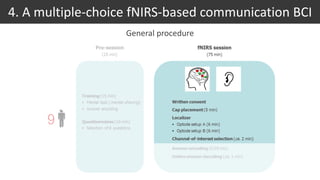
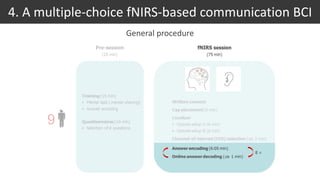
General procedure
General procedure
4. A multiple-choice fNIRS-based communication BCI
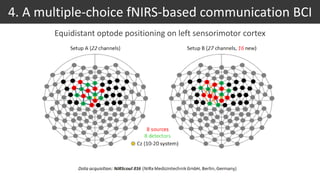
Equidistant optode positioning on left sensorimotor cortex
4. A multiple-choice fNIRS-based communication BCI
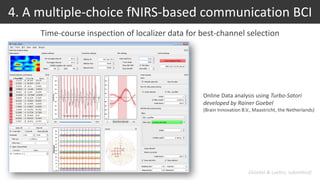
Online Data analysis using Turbo-Satori
developed by Rainer Goebel
(Brain Innovation B.V., Maastricht, the Netherlands)
4. A multiple-choice fNIRS-based communication BCI
Time-course inspection of localizer data for best-channel selection
(Goebel & Luehrs, submitted)
4. A multiple-choice fNIRS-based communication BCI
*
Best-channel selection based on general linear model (GLM) analysis
(channel with maximal mean of oxy- and deoxy-Hb t-values)
GLMoutput[y-value]
Channel
General procedure
4. A multiple-choice fNIRS-based communication BCI
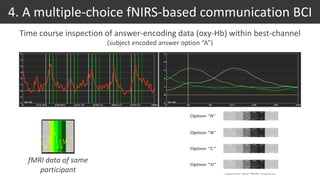
fMRI data of same
participant
4. A multiple-choice fNIRS-based communication BCI
Time course inspection of answer-encoding data (oxy-Hb) within best-channel
(subject encoded answer option “A”)
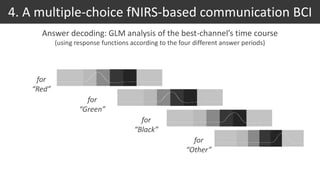
for
“Red”
for
“Green”
for
“Black”
for
“Other”
4. A multiple-choice fNIRS-based communication BCI
Answer decoding: GLM analysis of the best-channel’s time course
(using response functions according to the four different answer periods)
4. A multiple-choice fNIRS-based communication BCI
Answer decoding: Plotting GLM results and deriving encoded answer
(based on maximal mean of oxy- and deoxy-Hb t-values within selected channel)
Example question: “What is your favorite color?”
*
GLMoutput[y-value]
Answer option
S8-D8
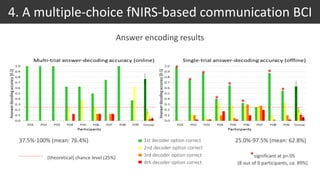
Answer encoding results
25.0%-97.5% (mean: 62.8%)
*
*
*
*
*
*
*
*
*significant at p<.05
(8 out of 9 participants, ca. 89%)
(theoretical) chance level (25%)
37.5%-100% (mean: 76.4%)
4. A multiple-choice fNIRS-based communication BCI
1st decoder option correct
4th decoder option correct
3rd decoder option correct
2nd decoder option correct
5. Summary and conclusion
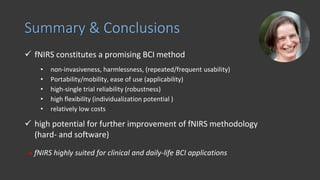
✓ fNIRS constitutes a promising BCI method
• non-invasiveness, harmlessness, (repeated/frequent usability)
• Portability/mobility, ease of use (applicability)
• high-single trial reliability (robustness)
• high flexibility (individualization potential )
• relatively low costs
✓ high potential for further improvement of fNIRS methodology
(hard- and software)
 fNIRS highly suited for clinical and daily-life BCI applications
Summary & Conclusions
Acknowledgements
Colleagues
Rainer Goebel
Rico Möckel
Lars Riecke
PhD students
Amaia Benitez-Andonegui
Hannah Boeijkens
Michael Luehrs
Laurien Nagels-Coune
Internship students
Denizhan Kurban
Louisa Gossé
Dedicated Near-Infrared
Spectroscopy
LEARN MORE
Thank you to our event sponsor
Dr. Ujwal Chaudhary
Research Group Leader,
Institute of Medical Psychology,
University of Tübingen
Research Fellow
WYSS Center for Bio and
Neuroengineering, Genèva
fNIRS and Brain Computer
Interface for Communication
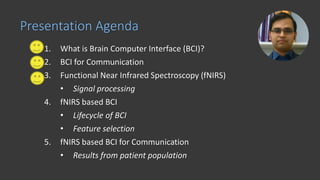
1. What is Brain Computer Interface (BCI)?
2. BCI for Communication
3. Functional Near Infrared Spectroscopy (fNIRS)
• Signal processing
4. fNIRS based BCI
• Lifecycle of BCI
• Feature selection
5. fNIRS based BCI for Communication
• Results from patient population
Presentation Agenda
The human being lives according to its communication capacity: loosing the
capacity for communication means loosing life.
Der Mensch lebt in dem Maße, wie er kommunikationsfähig ist: ist die
Kommunikationsfähigkeit vorbei, so ist auch das Leben vorbei.
L’uomo vive in base alla sua capacita di communicazione, quando la
communicazione e finita finisce anche la vita
Ludwig Hohl
Communication
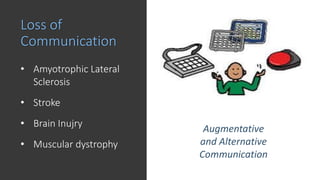
• Amyotrophic Lateral
Sclerosis
• Stroke
• Brain Inujry
• Muscular dystrophy
Loss of
Communication
Augmentative
and Alternative
Communication
What is Brain Computer Interface?
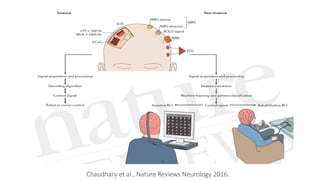
Revolves around the idea to convert thoughts
directly into movement without the detour via
the motor system
Coined for the first time by French
neurophysiologist Jacques Vidal in 1973
Chaudhary et al., Nature Reviews Neurology 2016.
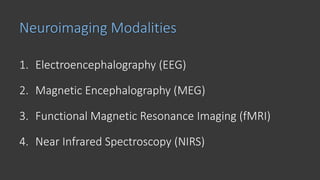
Neuroimaging Modalities
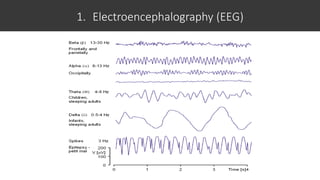
1. Electroencephalography (EEG)
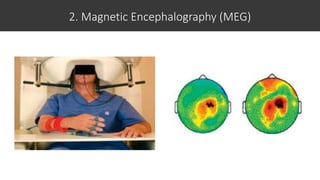
2. Magnetic Encephalography (MEG)
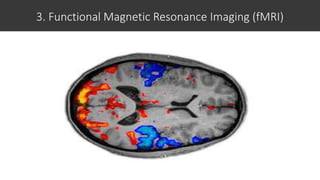
3. Functional Magnetic Resonance Imaging (fMRI)
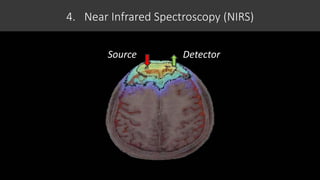
4. Near Infrared Spectroscopy (NIRS)
1. Electroencephalography (EEG)
2. Magnetic Encephalography (MEG)
3. Functional Magnetic Resonance Imaging (fMRI)
Neuroimaging Modalities
1. Electroencephalography (EEG)
2. Magnetic Encephalography (MEG)
3. Functional Magnetic Resonance Imaging (fMRI)
4. Near Infrared Spectroscopy (NIRS)
Source Detector
BCI for Communication
1. EEG-BCI
• Slow Cortical Potential (SCP)- BCI
• Sensorimotor rhythm (SMR)-BCI
• P300-BCI
2. fNIRS-BCI
Rockstroh et al., 1989; Birbaumer, 1997
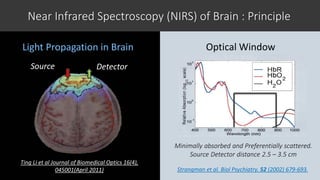
Near Infrared Spectroscopy (NIRS) of Brain : Principle
Minimally absorbed and Preferentially scattered.
Source Detector distance 2.5 – 3.5 cm
Optical WindowLight Propagation in Brain
Strangman et al. Biol Psychiatry. 52 (2002) 679-693.
Source Detector
Ting Li et al Journal of Biomedical Optics 16(4),
045001(April 2011)
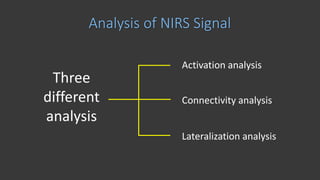
Three
different
analysis
Analysis of NIRS Signal
Activation analysis
Connectivity analysis
Lateralization analysis
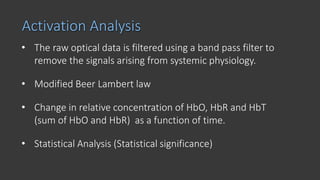
Activation Analysis
• The raw optical data is filtered using a band pass filter to
remove the signals arising from systemic physiology.
• Modified Beer Lambert law
• Change in relative concentration of HbO, HbR and HbT
(sum of HbO and HbR) as a function of time.
• Statistical Analysis (Statistical significance)
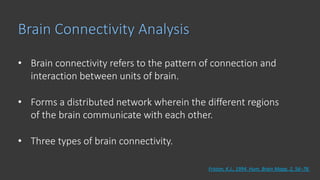
Brain Connectivity Analysis
• Brain connectivity refers to the pattern of connection and
interaction between units of brain.
• Forms a distributed network wherein the different regions
of the brain communicate with each other.
• Three types of brain connectivity.
Friston, K.J., 1994. Hum. Brain Mapp. 2, 56–78.
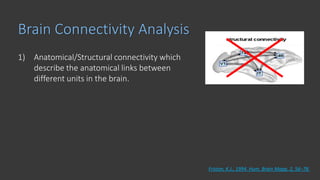
Brain Connectivity Analysis
Friston, K.J., 1994. Hum. Brain Mapp. 2, 56–78.
1) Anatomical/Structural connectivity which
describe the anatomical links between
different units in the brain.
Brain Connectivity Analysis
1) Anatomical/Structural connectivity which
describe the anatomical links between
different units in the brain.
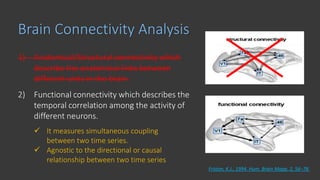
2) Functional connectivity which describes the
temporal correlation among the activity of
different neurons.
✓ It measures simultaneous coupling
between two time series.
✓ Agnostic to the directional or causal
relationship between two time series
Friston, K.J., 1994. Hum. Brain Mapp. 2, 56–78.
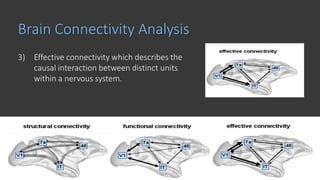
Brain Connectivity Analysis
Friston, K.J., 1994. Hum. Brain Mapp. 2, 56–78.
3) Effective connectivity which describes the
causal interaction between distinct units
within a nervous system.
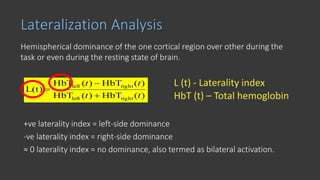
Lateralization Analysis
Hemispherical dominance of the one cortical region over other during the
task or even during the resting state of brain.
+ve laterality index = left-side dominance
-ve laterality index = right-side dominance
≈ 0 laterality index = no dominance, also termed as bilateral activation.
)(HbT)(HbT
)(HbT)(HbT
L(t)
rightleft
rightleft
tt
tt



L (t) - Laterality index
HbT (t) – Total hemoglobin
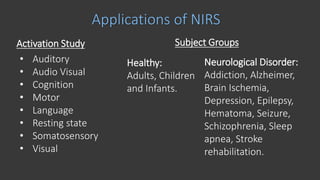
Applications of NIRS
Activation Study
• Auditory
• Audio Visual
• Cognition
• Motor
• Language
• Resting state
• Somatosensory
• Visual
Healthy:
Adults, Children
and Infants.
Neurological Disorder:
Addiction, Alzheimer,
Brain Ischemia,
Depression, Epilepsy,
Hematoma, Seizure,
Schizophrenia, Sleep
apnea, Stroke
rehabilitation.
Subject Groups
1. What is Brain Computer Interface (BCI)?
2. BCI for Communication
3. Functional Near Infrared Spectroscopy (fNIRS)
• Signal processing
4. fNIRS based BCI
• Lifecycle of BCI
• Feature selection
5. fNIRS based BCI for Communication
• Results from patient population
Presentation Agenda
BCI for Communication in
Locked-in State Patient
If we are left alone everything becomes unbearable.
Wenn wir allein gelassen werden, ist alles zu viel.
Si nos dejan solos, todo esta de mas.
Antonio Porchia
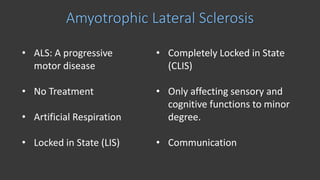
Amyotrophic Lateral Sclerosis
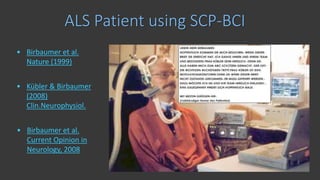
• ALS: A progressive
motor disease
• No Treatment
• Artificial Respiration
• Locked in State (LIS)
• Completely Locked in State
(CLIS)
• Only affecting sensory and
cognitive functions to minor
degree.
• Communication
• Birbaumer et al.
Nature (1999)
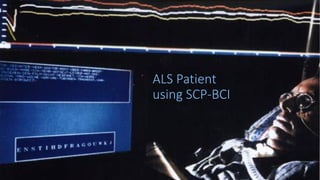
ALS Patient using SCP-BCI
• Kübler & Birbaumer
(2008)
Clin.Neurophysiol.
• Birbaumer et al.
Current Opinion in
Neurology, 2008
ALS Patient
using SCP-BCI
• Several techniques for communication in LIS.
• Previously trained patient did not transition.
• No motor channels left for communication.
• Patient in CLIS without previous BCI training
• No techniques work.
• Extinction of goal directed thinking proposed.
• Circadian rhythm disrupted.
Transition from LIS to CLIS
BCI for Communication in
Completely Locked-in State Patient
We conclude that we would remain in a state of anesthesia
(numbness) if our perception would not have a particular
preference for this or that.
Man sieht daraus, dass wir stets in einem Zustande der Betäubung
verharren würden, wenn unsere Perception nicht sozusagen eine
hervorstechende Eigentümlichkeit und eine bestimmte Vorliebe für
dieses oder jenes besässen.
Gottfried Wilhelm Leibniz (1646-1716)
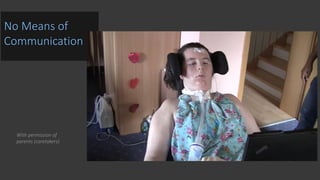
No Means of
Communication
With permission of
parents (caretakers)
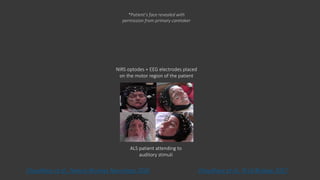
ALS patient attending to
auditory stimuli
NIRS optodes + EEG electrodes placed
on the motor region of the patient
*Patient’s face revealed with
permission from primary caretaker
Chaudhary et al., PLoS Biology 2017.Chaudhary et al., Nature Reviews Neurology 2016
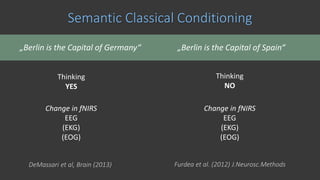
Semantic Classical Conditioning
Thinking
YES
„Berlin is the Capital of Germany“
Change in fNIRS
EEG
(EKG)
(EOG)
Thinking
NO
„Berlin is the Capital of Spain“
Change in fNIRS
EEG
(EKG)
(EOG)
Furdea et al. (2012) J.Neurosc.MethodsDeMassari et al, Brain (2013)
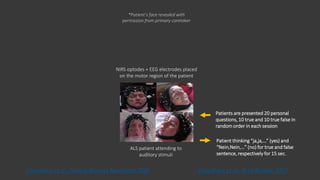
ALS patient attending to
auditory stimuli
NIRS optodes + EEG electrodes placed
on the motor region of the patient
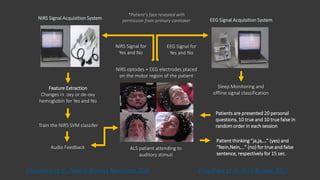
Patients are presented 20 personal
questions, 10 true and 10 true false in
random order in each session
Patient thinking “ja,ja,…” (yes) and
“Nein,Nein,…” (no) for true and false
sentence, respectively for 15 sec.
*Patient’s face revealed with
permission from primary caretaker
Chaudhary et al., PLoS Biology 2017.Chaudhary et al., Nature Reviews Neurology 2016
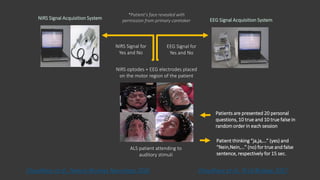
NIRS Signal for
Yes and No
EEG Signal for
Yes and No
NIRS Signal Acquisition System EEG Signal Acquisition System
ALS patient attending to
auditory stimuli
NIRS optodes + EEG electrodes placed
on the motor region of the patient
Patients are presented 20 personal
questions, 10 true and 10 true false in
random order in each session
Patient thinking “ja,ja,…” (yes) and
“Nein,Nein,…” (no) for true and false
sentence, respectively for 15 sec.
*Patient’s face revealed with
permission from primary caretaker
Chaudhary et al., PLoS Biology 2017.Chaudhary et al., Nature Reviews Neurology 2016
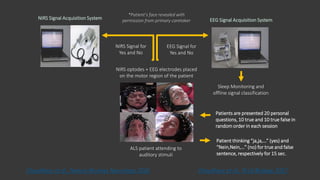
NIRS Signal for
Yes and No
EEG Signal for
Yes and No
NIRS Signal Acquisition System EEG Signal Acquisition System
ALS patient attending to
auditory stimuli
NIRS optodes + EEG electrodes placed
on the motor region of the patient
Patients are presented 20 personal
questions, 10 true and 10 true false in
random order in each session
Patient thinking “ja,ja,…” (yes) and
“Nein,Nein,…” (no) for true and false
sentence, respectively for 15 sec.
Sleep Monitoring and
offline signal classification
*Patient’s face revealed with
permission from primary caretaker
Chaudhary et al., PLoS Biology 2017.Chaudhary et al., Nature Reviews Neurology 2016
NIRS Signal for
Yes and No
EEG Signal for
Yes and No
NIRS Signal Acquisition System EEG Signal Acquisition System
Audio Feedback ALS patient attending to
auditory stimuli
NIRS optodes + EEG electrodes placed
on the motor region of the patient
Feature Extraction
Changes in oxy or de-oxy
hemoglobin for Yes and No
Train the NIRS SVM classifer
Patients are presented 20 personal
questions, 10 true and 10 true false in
random order in each session
Patient thinking “ja,ja,…” (yes) and
“Nein,Nein,…” (no) for true and false
sentence, respectively for 15 sec.
Sleep Monitoring and
offline signal classification
*Patient’s face revealed with
permission from primary caretaker
Chaudhary et al., PLoS Biology 2017.Chaudhary et al., Nature Reviews Neurology 2016
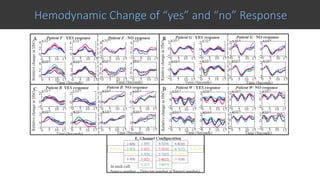
Hemodynamic Change of “yes” and “no” Response
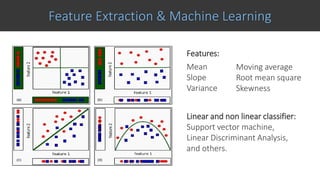
Feature Extraction & Machine Learning
Linear and non linear classifier:
Support vector machine,
Linear Discriminant Analysis,
and others.
Features:
Mean
Slope
Variance
Moving average
Root mean square
Skewness
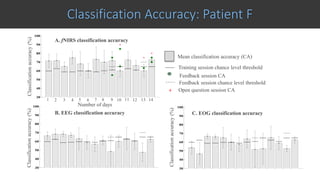
Classification Accuracy: Patient F
30
40
50
60
70
80
90
100
1 2 3 4 5 6 7 8 9 10 11 12 13 14
30
40
50
60
70
80
90
100
Mean classification accuracy (CA)
Training session chance level threshold
Feedback session CA
Open question session CA
Feedback session chance level threshold
+
Classificationaccuracy(%)
30
40
50
60
70
80
90
100
Classificationaccuracy(%)
B. EEG classification accuracy
Number of days
A. fNIRS classification accuracy
1 2 3 4 5 6 7 8 9 10 11 12 13 14
C. EOG classification accuracy
Classificationaccuracy(%)
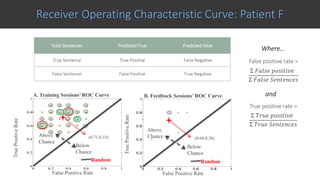
0 0.2 0.4 0.6 0.8 1
0
0.2
0.4
0.6
0.8
1
0 0.2 0.4 0.6 0.8 1
0
0.2
0.4
0.6
0.8
1
A. Training Sessions’ ROC Curve
False Positive Rate
TruePositiveRate
TruePositiveRate
Random
Above
Chance
Random
Below
Chance
Above
Chance
Below
Chance
B. Feedback Sessions’ ROC Curve
(0.71,0.33) (0.68,0.28)
False Positive Rate
Receiver Operating Characteristic Curve: Patient F
Total Sentences Predicted True Predicted False
True Sentence True Positive False Negative
False Sentence False Positive True Negative
True positive rate =
Ʃ 𝑇𝑟𝑢𝑒 𝑝𝑜𝑠𝑖𝑡𝑖𝑣𝑒
Ʃ 𝑇𝑟𝑢𝑒 𝑆𝑒𝑛𝑡𝑒𝑛𝑐𝑒𝑠
False positive rate =
Ʃ 𝐹𝑎𝑙𝑠𝑒 𝑝𝑜𝑠𝑖𝑡𝑖𝑣𝑒
Ʃ 𝐹𝑎𝑙𝑠𝑒 𝑆𝑒𝑛𝑡𝑒𝑛𝑐𝑒𝑠
Where…
and
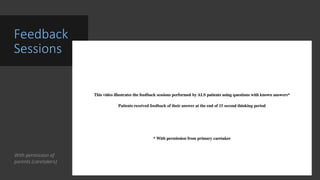
Feedback
Sessions
With permission of
parents (caretakers)
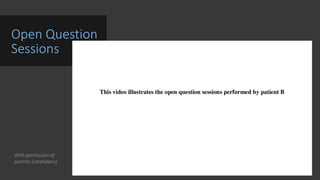
With permission of
parents (caretakers)
Open Question
Sessions
• Numerous studies on able bodied individual
• Limited controlled, systemic clinical trial on patient population.
• fNIRS based BCI for Communication in CLIS
• BCI for rehabilitation in stroke
• Controlled clinical study in patient population
• BCI for motor control in stroke, tetraplegia and Spinal cord Injury.
Conclusion
Niels Birbaumer
Aygul Rakihmkulova
Azim Maleksahi
Alessandro Tonin
Alberto Lucas
Stefano Silvoni
WYSS Center
John Donoghue
Ali Zaidi
Thank you!
Thank You
Dr. Bettina Sorger,
Assistant Professor,
Dept. of Cognitive Neuroscience
Maastricht University
b.sorger@maastrichtuniversity.nl
Dr. Ujwal Chaudhary,
Research Group Leader,
Institute of Medical Psychology,
University of Tübingen
uchau001@fiu.edu
For additional information on the products and applications
presented during this webinar please visit www.nirx.net

fNIRS and Brain Computer Interface for Communication

  • 1.
    fNIRS and BrainComputer Interface for Communication Dr. Ujwal Chaudhary and Dr. Bettina Sorger present groundbreaking research in the field of fNIRS-based BCI for communication with healthy subjects and patients in completely locked-in states
  • 2.
    InsideScientific is anonline educational environment designed for life science researchers. Our goal is to aid in the sharing and distribution of scientific information regarding innovative technologies, protocols, research tools and laboratory services. JOIN FOR FREE AT WWW.INSIDESCIENTIFIC.COM
  • 3.
    Bettina Sorger, PhD AssistantProfessor Leader of Hemodynamic BCI group Cognitive Neuroscience Department Faculty of Psychology and Neuroscience Maastricht University Functional Near-Infrared Spectroscopy (fNIRS): A promising BCI technique ψ
  • 4.
    1. What isa brain-computer interface (BCI)? • definition, methodology, application 2. Functional-neuroimaging methods for BCIs • neuroelectric vs. hemodynamic methods • BCI-relevant characteristics of hemodynamic brain signals 3. Functional near-infrared spectroscopy (fNIRS) • working principles, practical/procedural aspects, information encoding, advantages and limitations 4. A multiple-choice fNIRS-based communication BCI 5. Summary and conclusion Overview of Presentation
  • 5.
    1. What isa brain-computer interface (BCI)?
  • 6.
    1. What isa BCI? Definition and application possibilities A brain-computer interface (BCI) is system which connects a (human or animal) brain with a computer. It allows for controlling a external devices through brain activity, i.e., without having to rely on motor output. BCIs can be used for researching, enhancing, assisting, repairing or replacing cognitive or sensory-motor functions.
  • 7.
    1. What isa BCI? General BCI methodology Wolpaw et al., 2002
  • 8.
  • 9.
    2. Functional-neuroimaging methodsfor BCIs Electrophysiological vs. hemodynamic methods electrophysiological (direct) methods • Electroencephalography (EEG) • Magnetoencephalography (MEG) • Electrocorticography (ECoG) • Intracortical recordings (ICoR) • Functional near-infrared spectroscopy (fNIRS) • Functional magnetic resonance imaging (fMRI) Figure obtained from here
  • 10.
    • Electroencephalography (EEG) •Magnetoencephalography (MEG) • Electrocorticography (ECoG) • Intracortical recordings (ICoR) • Functional near-infrared spectroscopy (fNIRS) • Functional magnetic resonance imaging (fMRI) Figure obtained from here 2. Functional-neuroimaging methods for BCIs Electrophysiological vs. hemodynamic methods hemodynamic (indirect) methods
  • 11.
    2. Functional-neuroimaging methodsfor BCIs Ratings ranging from highly advantageous (+ + +) to extremely disadvantageous (- - -). Sorger (PhD thesis, 2010) 2. Functional-neuroimaging methods for BCIs Advantages and disadvantages of functional-neuroimaging methods for BCI purposes
  • 12.
    0 3 10time [s] neuroelectric response hemodynamic response 2. Functional-neuroimaging methods for BCIs 100ms BCI-relevant characteristics of hemodynamic signals (1): delay
  • 13.
    BCI-relevant characteristics ofhemodynamic signals (2): high single-trial reliability Resting periods (20s) Motor-imagery periods (10s) fMRIresponse fMRIresponse Time 0 10 Time [s] 2. Functional-neuroimaging methods for BCIs
  • 14.
    BCI-relevant characteristics ofhemodynamic signals (3a): sufficient spatial resolution Hemodynamic (fMRI) brain-activation patterns related to: • Motor imagery • Mental calculation • Inner speech 2. Functional-neuroimaging methods for BCIs
  • 15.
    BCI-relevant characteristics ofhemodynamic signals (3b): sufficient spatial resolution Motor imagery Mental calculation Inner speech fNIRS-coverage mask 2. Functional-neuroimaging methods for BCIs
  • 16.
    3. Functional near-infraredspectroscopy (fNIRS)
  • 17.
    3. Functional near-infraredspectroscopy (fNIRS) Working principles of fNIRS Red light penetrating in biological tissue Figure obtained from here adapted from Naseer (2013) Head surface Banana-shaped pathway of photonsAbsorption spectra of Hb Figure adapted from here Hb HbO2
  • 18.
    Practical/procedural aspects offNIRS (1) 3. Functional near-infrared spectroscopy (fNIRS) NIRScout (NIRx)
  • 19.
    Practical/procedural aspects offNIRS (2) Source and detector optodes placed on the head surface using an elastic cap Example optodes montage (covering prefrontal and occipital cortex) following the 10-20 EEG system CZ 3. Functional near-infrared spectroscopy (fNIRS) sources detectors
  • 20.
    Spatial coverage dependingon optode montagefNIRS-coverage mask 3. Functional near-infrared spectroscopy (fNIRS) Practical/procedural aspects of fNIRS (3)
  • 21.
    Information encoding infNIRS-BCIs 3. Functional near-infrared spectroscopy (fNIRS) How can we enable patients to encode different information or intentions into differentiable fNIRS signal?
  • 22.
    3. Functional near-infraredspectroscopy (fNIRS) “yes” “no” “yes” “no” thinking “yes” thinking “no”
  • 23.
    3. Functional near-infraredspectroscopy (fNIRS) “yes” “no” Inner speechMotor imagery
  • 24.
    • exploitable fNIRS-signalfeatures (spatial, temporal and magnitudinal) 3. Functional near-infrared spectroscopy (fNIRS) Motor imagery Mental calculation Inner speech Information encoding in fNIRS-BCIs
  • 25.
    • exploitable fNIRS-signalfeatures (spatial, temporal and magnitudinal) 3. Functional near-infrared spectroscopy (fNIRS) 20s10s0s fNIRSresponse Information encoding in fNIRS-BCIs Start of encoding time window
  • 26.
    • exploitable fNIRS-signalfeatures (spatial, temporal and magnitudinal) 3. Functional near-infrared spectroscopy (fNIRS) fNIRSresponse Information encoding in fNIRS-BCIs
  • 27.
    • exploitable fNIRS-signalfeatures (spatial, temporal and magnitudinal) • two general forms information-encoding strategies: - intentionally controlled mental activities 1. higher-order cognitive tasks (e.g., mental calculation) 2. covert language-related tasks (e.g., mental speech, mental singing) 3. mental-imagery tasks (motor, visual, auditory, tactile and emotion imagery) 4. selective-attention tasks (visual, auditory, and tactile attention) - automatic cognitive processing 3. Functional near-infrared spectroscopy (fNIRS) Information encoding in fNIRS-BCIs
  • 28.
    • relatively lowpurchase/operating costs [fMRI] • medium temporal resolution (sample rate: up to 20Hz, but cave hemodynamic delay) [fMRI] • sufficient spatial resolution (1cm³ range) • no vulnerability to electromagnetic environment [EEG, fMRI] • relatively low sensitivity to head motion artifacts [EEG, fMRI] • no inverse problem [EEG] • ease of application [EEG, fMRI] • portability/mobility [fMRI] • harmlessness, non-invasiveness • noiselessness [fMRI] • compatibility with paramagnetic (medical) equipment [fMRI] • measuring both oxygenated and deoxygenated Hb changes ( two dependent variables) [EEG, fMRI] • compatibility with EEG, fMRI, TMS/tCS ( simultaneous measurements possible) 3. Functional near-infrared spectroscopy (fNIRS) Advantages of fNIRS as BCI technique
  • 29.
    3. Functional near-infraredspectroscopy (fNIRS) NIRSport – a mobile fNIRS system
  • 30.
    • relatively lowpurchase/operating costs [fMRI] • medium temporal resolution (sample rate: up to 20Hz, but cave hemodynamic delay) [fMRI] • sufficient spatial resolution (1cm³ range) • no vulnerability to electromagnetic environment [EEG, fMRI] • relatively low sensitivity to head motion artifacts [EEG, fMRI] • no inverse problem [EEG] • ease of application [EEG, fMRI] • portability/mobility [fMRI] • harmlessness, non-invasiveness • noiselessness [fMRI] • compatibility with paramagnetic (medical) equipment [fMRI] • measuring both oxygenated and deoxygenated Hb changes ( two dependent variables) [EEG, fMRI] • compatibility with EEG, fMRI, TMS/tCS ( simultaneous measurements possible) 3. Functional near-infrared spectroscopy (fNIRS) Advantages of fNIRS as BCI technique
  • 31.
    Limitations of fNIRSas BCI technique • light scattering/absorption by extracerebral tissue and skin/hair pigmentation • limited depth pervasion (reaching only surface layers of cortex) • still-existing practical limitations 3. Functional near-infrared spectroscopy (fNIRS) Figure adapted from here
  • 32.
    4. A multiple-choicefNIRS-based communication BCI
  • 33.
    Overview of existinghemodynamic communication BCIs × 4. A multiple-choice fNIRS-based communication BCI Naito et al. (2007) Gallegos-Ayala et al. (2015) Chaudhary et al. (2017)
  • 34.
    Option “D” Option “C” Option“B” Option “A” Answer encoding by exploiting temporal fNIRS signal features 4. A multiple-choice fNIRS-based communication BCI Figure obtained from here A B C D
  • 35.
    Instruction: “Please imagine drawingsimple geometric figures (such as circles, triangles, cubes, etc.) or small contour drawings (e.g., a butterfly, star, car, tree, boat, or house) with your right hand in a comfortable but consistent speed. Try to imagine using a pen. This might support your imagination”. 4. A multiple-choice fNIRS-based communication BCI Mental drawing
  • 36.
    Answer encoding withauditory guidance Question: “What is your favorite color?” 4. A multiple-choice fNIRS-based communication BCI time @20s “Red” “Green” @30s “Black” @40s “Other” @50s “Stop” @60s @0s → 5 repetitions (within 6:05 min) to increase accuracy
  • 37.
    Option “Other” Option “Black” Option“Green” Option “Red” 4. A multiple-choice fNIRS-based communication BCI Expected (ideal) fNIRS responses
  • 38.
    4. A multiple-choicefNIRS-based communication BCI General procedure
  • 39.
    General procedure 4. Amultiple-choice fNIRS-based communication BCI
  • 40.
    Equidistant optode positioningon left sensorimotor cortex 4. A multiple-choice fNIRS-based communication BCI
  • 41.
    Online Data analysisusing Turbo-Satori developed by Rainer Goebel (Brain Innovation B.V., Maastricht, the Netherlands) 4. A multiple-choice fNIRS-based communication BCI Time-course inspection of localizer data for best-channel selection (Goebel & Luehrs, submitted)
  • 42.
    4. A multiple-choicefNIRS-based communication BCI * Best-channel selection based on general linear model (GLM) analysis (channel with maximal mean of oxy- and deoxy-Hb t-values) GLMoutput[y-value] Channel
  • 43.
    General procedure 4. Amultiple-choice fNIRS-based communication BCI
  • 44.
    fMRI data ofsame participant 4. A multiple-choice fNIRS-based communication BCI Time course inspection of answer-encoding data (oxy-Hb) within best-channel (subject encoded answer option “A”)
  • 45.
    for “Red” for “Green” for “Black” for “Other” 4. A multiple-choicefNIRS-based communication BCI Answer decoding: GLM analysis of the best-channel’s time course (using response functions according to the four different answer periods)
  • 46.
    4. A multiple-choicefNIRS-based communication BCI Answer decoding: Plotting GLM results and deriving encoded answer (based on maximal mean of oxy- and deoxy-Hb t-values within selected channel) Example question: “What is your favorite color?” * GLMoutput[y-value] Answer option S8-D8
  • 47.
    Answer encoding results 25.0%-97.5%(mean: 62.8%) * * * * * * * * *significant at p<.05 (8 out of 9 participants, ca. 89%) (theoretical) chance level (25%) 37.5%-100% (mean: 76.4%) 4. A multiple-choice fNIRS-based communication BCI 1st decoder option correct 4th decoder option correct 3rd decoder option correct 2nd decoder option correct
  • 48.
    5. Summary andconclusion
  • 49.
    ✓ fNIRS constitutesa promising BCI method • non-invasiveness, harmlessness, (repeated/frequent usability) • Portability/mobility, ease of use (applicability) • high-single trial reliability (robustness) • high flexibility (individualization potential ) • relatively low costs ✓ high potential for further improvement of fNIRS methodology (hard- and software)  fNIRS highly suited for clinical and daily-life BCI applications Summary & Conclusions
  • 50.
    Acknowledgements Colleagues Rainer Goebel Rico Möckel LarsRiecke PhD students Amaia Benitez-Andonegui Hannah Boeijkens Michael Luehrs Laurien Nagels-Coune Internship students Denizhan Kurban Louisa Gossé
  • 51.
  • 52.
    Dr. Ujwal Chaudhary ResearchGroup Leader, Institute of Medical Psychology, University of Tübingen Research Fellow WYSS Center for Bio and Neuroengineering, Genèva fNIRS and Brain Computer Interface for Communication
  • 53.
    1. What isBrain Computer Interface (BCI)? 2. BCI for Communication 3. Functional Near Infrared Spectroscopy (fNIRS) • Signal processing 4. fNIRS based BCI • Lifecycle of BCI • Feature selection 5. fNIRS based BCI for Communication • Results from patient population Presentation Agenda
  • 54.
    The human beinglives according to its communication capacity: loosing the capacity for communication means loosing life. Der Mensch lebt in dem Maße, wie er kommunikationsfähig ist: ist die Kommunikationsfähigkeit vorbei, so ist auch das Leben vorbei. L’uomo vive in base alla sua capacita di communicazione, quando la communicazione e finita finisce anche la vita Ludwig Hohl Communication
  • 55.
    • Amyotrophic Lateral Sclerosis •Stroke • Brain Inujry • Muscular dystrophy Loss of Communication Augmentative and Alternative Communication
  • 56.
    What is BrainComputer Interface? Revolves around the idea to convert thoughts directly into movement without the detour via the motor system Coined for the first time by French neurophysiologist Jacques Vidal in 1973
  • 58.
    Chaudhary et al.,Nature Reviews Neurology 2016.
  • 59.
    Neuroimaging Modalities 1. Electroencephalography(EEG) 2. Magnetic Encephalography (MEG) 3. Functional Magnetic Resonance Imaging (fMRI) 4. Near Infrared Spectroscopy (NIRS)
  • 60.
  • 61.
  • 62.
    3. Functional MagneticResonance Imaging (fMRI)
  • 63.
    Neuroimaging Modalities 1. Electroencephalography(EEG) 2. Magnetic Encephalography (MEG) 3. Functional Magnetic Resonance Imaging (fMRI) 4. Near Infrared Spectroscopy (NIRS)
  • 64.
    4. Near InfraredSpectroscopy (NIRS) Source Detector
  • 65.
    BCI for Communication 1.EEG-BCI • Slow Cortical Potential (SCP)- BCI • Sensorimotor rhythm (SMR)-BCI • P300-BCI 2. fNIRS-BCI Rockstroh et al., 1989; Birbaumer, 1997
  • 66.
    Near Infrared Spectroscopy(NIRS) of Brain : Principle Minimally absorbed and Preferentially scattered. Source Detector distance 2.5 – 3.5 cm Optical WindowLight Propagation in Brain Strangman et al. Biol Psychiatry. 52 (2002) 679-693. Source Detector Ting Li et al Journal of Biomedical Optics 16(4), 045001(April 2011)
  • 67.
    Three different analysis Analysis of NIRSSignal Activation analysis Connectivity analysis Lateralization analysis
  • 68.
    Activation Analysis • Theraw optical data is filtered using a band pass filter to remove the signals arising from systemic physiology. • Modified Beer Lambert law • Change in relative concentration of HbO, HbR and HbT (sum of HbO and HbR) as a function of time. • Statistical Analysis (Statistical significance)
  • 69.
    Brain Connectivity Analysis •Brain connectivity refers to the pattern of connection and interaction between units of brain. • Forms a distributed network wherein the different regions of the brain communicate with each other. • Three types of brain connectivity. Friston, K.J., 1994. Hum. Brain Mapp. 2, 56–78.
  • 70.
    Brain Connectivity Analysis Friston,K.J., 1994. Hum. Brain Mapp. 2, 56–78. 1) Anatomical/Structural connectivity which describe the anatomical links between different units in the brain.
  • 71.
    Brain Connectivity Analysis 1)Anatomical/Structural connectivity which describe the anatomical links between different units in the brain. 2) Functional connectivity which describes the temporal correlation among the activity of different neurons. ✓ It measures simultaneous coupling between two time series. ✓ Agnostic to the directional or causal relationship between two time series Friston, K.J., 1994. Hum. Brain Mapp. 2, 56–78.
  • 72.
    Brain Connectivity Analysis Friston,K.J., 1994. Hum. Brain Mapp. 2, 56–78. 3) Effective connectivity which describes the causal interaction between distinct units within a nervous system.
  • 73.
    Lateralization Analysis Hemispherical dominanceof the one cortical region over other during the task or even during the resting state of brain. +ve laterality index = left-side dominance -ve laterality index = right-side dominance ≈ 0 laterality index = no dominance, also termed as bilateral activation. )(HbT)(HbT )(HbT)(HbT L(t) rightleft rightleft tt tt    L (t) - Laterality index HbT (t) – Total hemoglobin
  • 74.
    Applications of NIRS ActivationStudy • Auditory • Audio Visual • Cognition • Motor • Language • Resting state • Somatosensory • Visual Healthy: Adults, Children and Infants. Neurological Disorder: Addiction, Alzheimer, Brain Ischemia, Depression, Epilepsy, Hematoma, Seizure, Schizophrenia, Sleep apnea, Stroke rehabilitation. Subject Groups
  • 75.
    1. What isBrain Computer Interface (BCI)? 2. BCI for Communication 3. Functional Near Infrared Spectroscopy (fNIRS) • Signal processing 4. fNIRS based BCI • Lifecycle of BCI • Feature selection 5. fNIRS based BCI for Communication • Results from patient population Presentation Agenda
  • 76.
    BCI for Communicationin Locked-in State Patient If we are left alone everything becomes unbearable. Wenn wir allein gelassen werden, ist alles zu viel. Si nos dejan solos, todo esta de mas. Antonio Porchia
  • 77.
    Amyotrophic Lateral Sclerosis •ALS: A progressive motor disease • No Treatment • Artificial Respiration • Locked in State (LIS) • Completely Locked in State (CLIS) • Only affecting sensory and cognitive functions to minor degree. • Communication
  • 78.
    • Birbaumer etal. Nature (1999) ALS Patient using SCP-BCI • Kübler & Birbaumer (2008) Clin.Neurophysiol. • Birbaumer et al. Current Opinion in Neurology, 2008
  • 79.
  • 80.
    • Several techniquesfor communication in LIS. • Previously trained patient did not transition. • No motor channels left for communication. • Patient in CLIS without previous BCI training • No techniques work. • Extinction of goal directed thinking proposed. • Circadian rhythm disrupted. Transition from LIS to CLIS
  • 81.
    BCI for Communicationin Completely Locked-in State Patient We conclude that we would remain in a state of anesthesia (numbness) if our perception would not have a particular preference for this or that. Man sieht daraus, dass wir stets in einem Zustande der Betäubung verharren würden, wenn unsere Perception nicht sozusagen eine hervorstechende Eigentümlichkeit und eine bestimmte Vorliebe für dieses oder jenes besässen. Gottfried Wilhelm Leibniz (1646-1716)
  • 82.
    No Means of Communication Withpermission of parents (caretakers)
  • 83.
    ALS patient attendingto auditory stimuli NIRS optodes + EEG electrodes placed on the motor region of the patient *Patient’s face revealed with permission from primary caretaker Chaudhary et al., PLoS Biology 2017.Chaudhary et al., Nature Reviews Neurology 2016
  • 84.
    Semantic Classical Conditioning Thinking YES „Berlinis the Capital of Germany“ Change in fNIRS EEG (EKG) (EOG) Thinking NO „Berlin is the Capital of Spain“ Change in fNIRS EEG (EKG) (EOG) Furdea et al. (2012) J.Neurosc.MethodsDeMassari et al, Brain (2013)
  • 85.
    ALS patient attendingto auditory stimuli NIRS optodes + EEG electrodes placed on the motor region of the patient Patients are presented 20 personal questions, 10 true and 10 true false in random order in each session Patient thinking “ja,ja,…” (yes) and “Nein,Nein,…” (no) for true and false sentence, respectively for 15 sec. *Patient’s face revealed with permission from primary caretaker Chaudhary et al., PLoS Biology 2017.Chaudhary et al., Nature Reviews Neurology 2016
  • 86.
    NIRS Signal for Yesand No EEG Signal for Yes and No NIRS Signal Acquisition System EEG Signal Acquisition System ALS patient attending to auditory stimuli NIRS optodes + EEG electrodes placed on the motor region of the patient Patients are presented 20 personal questions, 10 true and 10 true false in random order in each session Patient thinking “ja,ja,…” (yes) and “Nein,Nein,…” (no) for true and false sentence, respectively for 15 sec. *Patient’s face revealed with permission from primary caretaker Chaudhary et al., PLoS Biology 2017.Chaudhary et al., Nature Reviews Neurology 2016
  • 87.
    NIRS Signal for Yesand No EEG Signal for Yes and No NIRS Signal Acquisition System EEG Signal Acquisition System ALS patient attending to auditory stimuli NIRS optodes + EEG electrodes placed on the motor region of the patient Patients are presented 20 personal questions, 10 true and 10 true false in random order in each session Patient thinking “ja,ja,…” (yes) and “Nein,Nein,…” (no) for true and false sentence, respectively for 15 sec. Sleep Monitoring and offline signal classification *Patient’s face revealed with permission from primary caretaker Chaudhary et al., PLoS Biology 2017.Chaudhary et al., Nature Reviews Neurology 2016
  • 88.
    NIRS Signal for Yesand No EEG Signal for Yes and No NIRS Signal Acquisition System EEG Signal Acquisition System Audio Feedback ALS patient attending to auditory stimuli NIRS optodes + EEG electrodes placed on the motor region of the patient Feature Extraction Changes in oxy or de-oxy hemoglobin for Yes and No Train the NIRS SVM classifer Patients are presented 20 personal questions, 10 true and 10 true false in random order in each session Patient thinking “ja,ja,…” (yes) and “Nein,Nein,…” (no) for true and false sentence, respectively for 15 sec. Sleep Monitoring and offline signal classification *Patient’s face revealed with permission from primary caretaker Chaudhary et al., PLoS Biology 2017.Chaudhary et al., Nature Reviews Neurology 2016
  • 89.
    Hemodynamic Change of“yes” and “no” Response
  • 90.
    Feature Extraction &Machine Learning Linear and non linear classifier: Support vector machine, Linear Discriminant Analysis, and others. Features: Mean Slope Variance Moving average Root mean square Skewness
  • 91.
    Classification Accuracy: PatientF 30 40 50 60 70 80 90 100 1 2 3 4 5 6 7 8 9 10 11 12 13 14 30 40 50 60 70 80 90 100 Mean classification accuracy (CA) Training session chance level threshold Feedback session CA Open question session CA Feedback session chance level threshold + Classificationaccuracy(%) 30 40 50 60 70 80 90 100 Classificationaccuracy(%) B. EEG classification accuracy Number of days A. fNIRS classification accuracy 1 2 3 4 5 6 7 8 9 10 11 12 13 14 C. EOG classification accuracy Classificationaccuracy(%)
  • 92.
    0 0.2 0.40.6 0.8 1 0 0.2 0.4 0.6 0.8 1 0 0.2 0.4 0.6 0.8 1 0 0.2 0.4 0.6 0.8 1 A. Training Sessions’ ROC Curve False Positive Rate TruePositiveRate TruePositiveRate Random Above Chance Random Below Chance Above Chance Below Chance B. Feedback Sessions’ ROC Curve (0.71,0.33) (0.68,0.28) False Positive Rate Receiver Operating Characteristic Curve: Patient F Total Sentences Predicted True Predicted False True Sentence True Positive False Negative False Sentence False Positive True Negative True positive rate = Ʃ 𝑇𝑟𝑢𝑒 𝑝𝑜𝑠𝑖𝑡𝑖𝑣𝑒 Ʃ 𝑇𝑟𝑢𝑒 𝑆𝑒𝑛𝑡𝑒𝑛𝑐𝑒𝑠 False positive rate = Ʃ 𝐹𝑎𝑙𝑠𝑒 𝑝𝑜𝑠𝑖𝑡𝑖𝑣𝑒 Ʃ 𝐹𝑎𝑙𝑠𝑒 𝑆𝑒𝑛𝑡𝑒𝑛𝑐𝑒𝑠 Where… and
  • 93.
  • 94.
    With permission of parents(caretakers) Open Question Sessions
  • 95.
    • Numerous studieson able bodied individual • Limited controlled, systemic clinical trial on patient population. • fNIRS based BCI for Communication in CLIS • BCI for rehabilitation in stroke • Controlled clinical study in patient population • BCI for motor control in stroke, tetraplegia and Spinal cord Injury. Conclusion
  • 96.
    Niels Birbaumer Aygul Rakihmkulova AzimMaleksahi Alessandro Tonin Alberto Lucas Stefano Silvoni WYSS Center John Donoghue Ali Zaidi Thank you!
  • 97.
    Thank You Dr. BettinaSorger, Assistant Professor, Dept. of Cognitive Neuroscience Maastricht University b.sorger@maastrichtuniversity.nl Dr. Ujwal Chaudhary, Research Group Leader, Institute of Medical Psychology, University of Tübingen uchau001@fiu.edu For additional information on the products and applications presented during this webinar please visit www.nirx.net