

BCI Implementation For Blind
Subjects using Signal Processing
BY-Sanchita Singha
Contents
 What is BCI?
 How human brain works
 How BCI works
 Uses of BCI
 Implementation
 Constraints
 Conclusion

11/23/2013

BCI Implementation

2
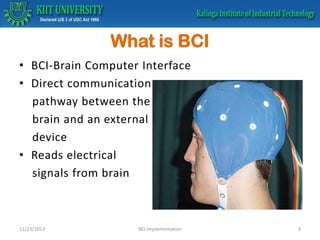
What is BCI
• BCI-Brain Computer Interface
• Direct communication
pathway between the
brain and an external
device
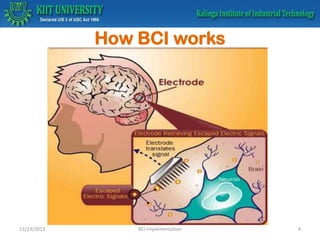
• Reads electrical
signals from brain

11/23/2013

BCI Implementation

3
How BCI works

11/23/2013

BCI Implementation

4
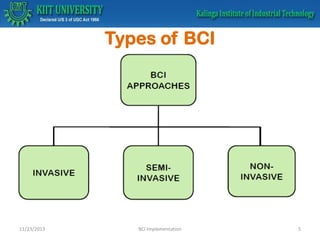
Types of BCI

11/23/2013

BCI Implementation

5
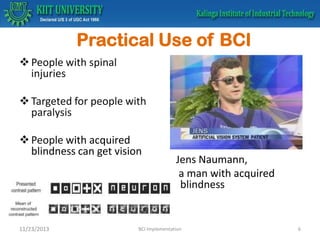
Practical Use of BCI
 People with spinal
injuries
 Targeted for people with
paralysis

 People with acquired
blindness can get vision

11/23/2013

Jens Naumann,
a man with acquired
blindness

BCI Implementation

6
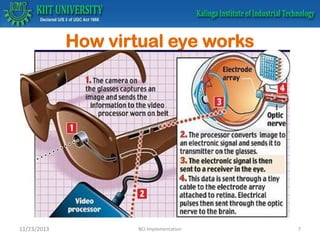
How virtual eye works

11/23/2013

BCI Implementation

7
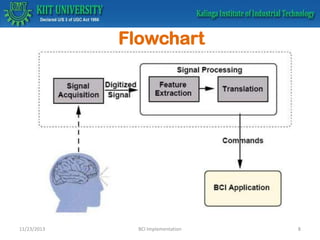
Flowchart

11/23/2013

BCI Implementation

8
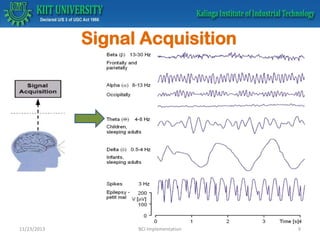
Signal Acquisition

11/23/2013

BCI Implementation

9
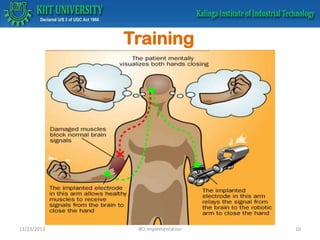
Training

11/23/2013

BCI Implementation

10
Feature Extraction

11/23/2013

BCI Implementation

11
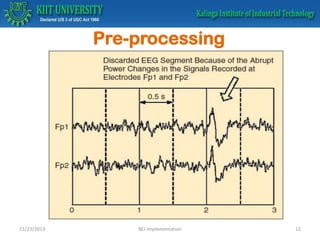
Pre-processing

11/23/2013

BCI Implementation

12
Constraints
• EEGs measure tiny voltage potentials. The signal is
weak and prone to interference.
• Each neuron is constantly sending and receiving
signals through a complex web of connections. There
are chemical processes involved as well, which EEGs
can't pick up on.
• The equipment heavy & hence not portable.

11/23/2013

BCI Implementation

13
Conclusion
• Enables people to communicate and control
appliances with use of brain signals
• Open gates for disabled people.
• Numerous future applications

11/23/2013

BCI Implementation

14
•
•
•
•
•
•
•
•
•
•
•
•
•
•
•
•
•

•

References

[1] C. Guger, A. Schlögl, C. Neuper, D. Walterspacher, T. Strein, and G. Pfurtscheller, “Rapid
prototyping of an EEG-based brain-computer
interface (BCI),” IEEE Trans. Neural Syst. Rehab. Eng., vol. 9, no. 1, pp. 49–58, 2001.
[2] G. Pfurtscheller, R. Leeb, C. Keinrath, D. Friedman, C. Neuper, C. Guger, and M. Slater, “Walking from thought,” Brain Res., vol. 1071, no. 1, pp.
145–152, 2006.
[3] N.J. Hill, T.N. Lal, M. Schroder, T. Hinterberger, B. Wilhelm, F. Nijboer, U. Mochty, G. Widman, C. Elger, B. Scholkopf, A. Kubler, and N.
Birbaumer, “Classifying EEG and ECoG signals without subject training for fast BCI implementation: Comparison of nonparalyzed and completely
paralyzed subjects,” IEEE Trans. Neural Syst. Rehab. Eng., vol. 14, pp. 183–186, June 2006.
[4] N. Weiskopf, K. Mathiak, S.W. Bock, F. Scharnowski, R. Veit, W. Grodd, R. Goebel, and N. Birbaumer, “Principles of a brain-computer interface
(BCI) based on real-time functional magnetic resonance imaging (fMRI),” IEEE Trans. Biomed. Eng., vol. 51, pp. 966–970, June 2004.
[5] S.-S. Yoo, T. Fairneny, N.-K. Chen, S.-E. Choo, L.P. Panych, H. Park, S.-Y. Lee, and F.A. Jolesz, “Brain-computer interface using fMRI: Spatial
navigation by thoughts,” Neuroreport, vol. 15, no. 10, pp. 1591–1595, 2004.
[6] M. A. L. Nicolelis, “Actions from Thoughts,” Nature, vol. 409, pp.403-407, 2001
[7] X. Gao, X. Dignfeng, M. Cheng and S. Gao, “A BCI-based Environmental Controller for the Motion-Disabled,” IEEE Transactions on Neural
Systems and Rehabilitation Engineering, vol. 11, pp. 137-140, 2003
[8] J. R. Mill´an, P. W. Ferrez and A. Buttfield, “Non Invasive Brain Machine Interfaces - Final report,” IDIAP Research Institute - ESA, 2005
[9] J. D. Bayliss, “Use of the Evoked Potential P3 Component for Control in a Virtual Environment,” IEEE Transactions on Neural Systems and
Rehabilitation Engineering, vol. 11, pp. 113-116, 2003
[10] J. L. Sirvent, J. M. Azor´ın, E. Ia´n˜ez, E., A. U´ beda and E. Ferna´ndez, “P300-based Brain-Computer Interface for Internet Browsing,” IEEE
International Conference on Practical Applications of Agents and Multi-Agent Systems (PAAMS), pp. 615-622, 2010
[11] E. Ia´n˜ez, J. M. Azor´ın, A. U´ beda, J. M. Ferra´ndez and E. Ferna´ndez, “Mental Tasks-Based Brain–Robot Interface,” Robotics and
Autonomous Systems, vol. 58(12), pp. 1238-1245, 2010
[12] G. Pfurtscheller and C. Neuper, “Motor Imagery and Direct Brain Computer Communication,” Proceedings of the IEEE, vol. 89, pp. 1123-1134,
2001
[13] F. Lotte, M. Congedo, A. L´ecuyer, F. Lamarche and B. Arnaldi, “A Review of Classification Algorithms for EEG-based Brain-Computer
Interfaces,” Journal of Neural Engineering, vol. 4, pp. 1-13, 2007
[14] F. Cincotti et al., “High-resolution EEG Techniques for Brain Computer Interface Applications,” Journal of Neuroscience Methods, vol. 167(1),
pp. 31-42, 2008
[15] R. T. Lauer, P. H. Peckham, K. L. Kilgore, andW. J. Heetderks, “Applications of cortical signals to neuroprosthetic control: A critical review,”
IEEE Trans. Rehab. Eng., vol. 8, pp. 205–208, June 2000.
[16] G. Garcia, T. Ebrahimi, and J.-M. Vesin, “Classification of EEG signals in the ambiguity domain for brain-computer interface applications,” in
IEEE Int. Conf. Digit. Sig. Proc., Santorini, Greece, vol. 1, 1-3 July 2002, pp. 301-305.
[17] H. Ramoser, J. Muller-Gerking, and G. Pfurtscheller, “Optimal spatial filtering of single trial EEG during imagined hand movement,” IEEE
Trans. Rehab. Eng., vol. 8, pp. 441–446, Dec. 2000.
[18] B. Kotchoubey, D. Schneider, H. Schleichert, U. Strehl, C. Uhlmann, V. Blankenhorn, W. Froscher, and N. Birbaumer, “Self-regulation of slow
cortical potentials in epilepsy: A retrial with analysis of influencing factors,” Epilepsy Res., vol. 25, no. 3, pp. 269–276, Nov. 1996.

11/23/2013

BCI Implementation

15
~Thank You~
For your attention

11/23/2013

BCI Implementation

16
Any Queries??

11/23/2013

BCI Implementation

17

Brain computer interface

  • 1.
    BCI Implementation ForBlind Subjects using Signal Processing BY-Sanchita Singha
  • 2.
    Contents  What isBCI?  How human brain works  How BCI works  Uses of BCI  Implementation  Constraints  Conclusion 11/23/2013 BCI Implementation 2
  • 3.
    What is BCI •BCI-Brain Computer Interface • Direct communication pathway between the brain and an external device • Reads electrical signals from brain 11/23/2013 BCI Implementation 3
  • 4.
  • 5.
  • 6.
    Practical Use ofBCI  People with spinal injuries  Targeted for people with paralysis  People with acquired blindness can get vision 11/23/2013 Jens Naumann, a man with acquired blindness BCI Implementation 6
  • 7.
    How virtual eyeworks 11/23/2013 BCI Implementation 7
  • 8.
  • 9.
  • 10.
  • 11.
  • 12.
  • 13.
    Constraints • EEGs measuretiny voltage potentials. The signal is weak and prone to interference. • Each neuron is constantly sending and receiving signals through a complex web of connections. There are chemical processes involved as well, which EEGs can't pick up on. • The equipment heavy & hence not portable. 11/23/2013 BCI Implementation 13
  • 14.
    Conclusion • Enables peopleto communicate and control appliances with use of brain signals • Open gates for disabled people. • Numerous future applications 11/23/2013 BCI Implementation 14
  • 15.
    • • • • • • • • • • • • • • • • • • References [1] C. Guger,A. Schlögl, C. Neuper, D. Walterspacher, T. Strein, and G. Pfurtscheller, “Rapid prototyping of an EEG-based brain-computer interface (BCI),” IEEE Trans. Neural Syst. Rehab. Eng., vol. 9, no. 1, pp. 49–58, 2001. [2] G. Pfurtscheller, R. Leeb, C. Keinrath, D. Friedman, C. Neuper, C. Guger, and M. Slater, “Walking from thought,” Brain Res., vol. 1071, no. 1, pp. 145–152, 2006. [3] N.J. Hill, T.N. Lal, M. Schroder, T. Hinterberger, B. Wilhelm, F. Nijboer, U. Mochty, G. Widman, C. Elger, B. Scholkopf, A. Kubler, and N. Birbaumer, “Classifying EEG and ECoG signals without subject training for fast BCI implementation: Comparison of nonparalyzed and completely paralyzed subjects,” IEEE Trans. Neural Syst. Rehab. Eng., vol. 14, pp. 183–186, June 2006. [4] N. Weiskopf, K. Mathiak, S.W. Bock, F. Scharnowski, R. Veit, W. Grodd, R. Goebel, and N. Birbaumer, “Principles of a brain-computer interface (BCI) based on real-time functional magnetic resonance imaging (fMRI),” IEEE Trans. Biomed. Eng., vol. 51, pp. 966–970, June 2004. [5] S.-S. Yoo, T. Fairneny, N.-K. Chen, S.-E. Choo, L.P. Panych, H. Park, S.-Y. Lee, and F.A. Jolesz, “Brain-computer interface using fMRI: Spatial navigation by thoughts,” Neuroreport, vol. 15, no. 10, pp. 1591–1595, 2004. [6] M. A. L. Nicolelis, “Actions from Thoughts,” Nature, vol. 409, pp.403-407, 2001 [7] X. Gao, X. Dignfeng, M. Cheng and S. Gao, “A BCI-based Environmental Controller for the Motion-Disabled,” IEEE Transactions on Neural Systems and Rehabilitation Engineering, vol. 11, pp. 137-140, 2003 [8] J. R. Mill´an, P. W. Ferrez and A. Buttfield, “Non Invasive Brain Machine Interfaces - Final report,” IDIAP Research Institute - ESA, 2005 [9] J. D. Bayliss, “Use of the Evoked Potential P3 Component for Control in a Virtual Environment,” IEEE Transactions on Neural Systems and Rehabilitation Engineering, vol. 11, pp. 113-116, 2003 [10] J. L. Sirvent, J. M. Azor´ın, E. Ia´n˜ez, E., A. U´ beda and E. Ferna´ndez, “P300-based Brain-Computer Interface for Internet Browsing,” IEEE International Conference on Practical Applications of Agents and Multi-Agent Systems (PAAMS), pp. 615-622, 2010 [11] E. Ia´n˜ez, J. M. Azor´ın, A. U´ beda, J. M. Ferra´ndez and E. Ferna´ndez, “Mental Tasks-Based Brain–Robot Interface,” Robotics and Autonomous Systems, vol. 58(12), pp. 1238-1245, 2010 [12] G. Pfurtscheller and C. Neuper, “Motor Imagery and Direct Brain Computer Communication,” Proceedings of the IEEE, vol. 89, pp. 1123-1134, 2001 [13] F. Lotte, M. Congedo, A. L´ecuyer, F. Lamarche and B. Arnaldi, “A Review of Classification Algorithms for EEG-based Brain-Computer Interfaces,” Journal of Neural Engineering, vol. 4, pp. 1-13, 2007 [14] F. Cincotti et al., “High-resolution EEG Techniques for Brain Computer Interface Applications,” Journal of Neuroscience Methods, vol. 167(1), pp. 31-42, 2008 [15] R. T. Lauer, P. H. Peckham, K. L. Kilgore, andW. J. Heetderks, “Applications of cortical signals to neuroprosthetic control: A critical review,” IEEE Trans. Rehab. Eng., vol. 8, pp. 205–208, June 2000. [16] G. Garcia, T. Ebrahimi, and J.-M. Vesin, “Classification of EEG signals in the ambiguity domain for brain-computer interface applications,” in IEEE Int. Conf. Digit. Sig. Proc., Santorini, Greece, vol. 1, 1-3 July 2002, pp. 301-305. [17] H. Ramoser, J. Muller-Gerking, and G. Pfurtscheller, “Optimal spatial filtering of single trial EEG during imagined hand movement,” IEEE Trans. Rehab. Eng., vol. 8, pp. 441–446, Dec. 2000. [18] B. Kotchoubey, D. Schneider, H. Schleichert, U. Strehl, C. Uhlmann, V. Blankenhorn, W. Froscher, and N. Birbaumer, “Self-regulation of slow cortical potentials in epilepsy: A retrial with analysis of influencing factors,” Epilepsy Res., vol. 25, no. 3, pp. 269–276, Nov. 1996. 11/23/2013 BCI Implementation 15
  • 16.
    ~Thank You~ For yourattention 11/23/2013 BCI Implementation 16
  • 17.