
BRAIN-COMPUTER INTERFACE
OVERVIEW
What is Brain-Computer Interface?
Principle behind BCI
Objective of BCI
Types of BCIs
Implementation
Applications
Limitations
Future Concerns
Conclusion
References
What is Brain-Computer Interface?
Brain Computer Interface is a direct technological interface
between a brain & a computer system and provides a new
Communication Channel.
It is also known as Direct Neural Interface (DNI), Mind-
machine interface (MMI) & Brain-Machine Interface (BMI).
It is the study of brain functions. BCI are system that provide
translation of the electrical activity of the human brain into
command which can control device in real time.
Principle Behind BCI
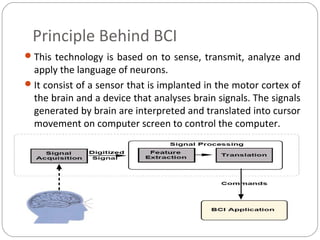
This technology is based on to sense, transmit, analyze and
apply the language of neurons.
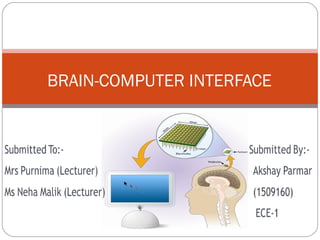
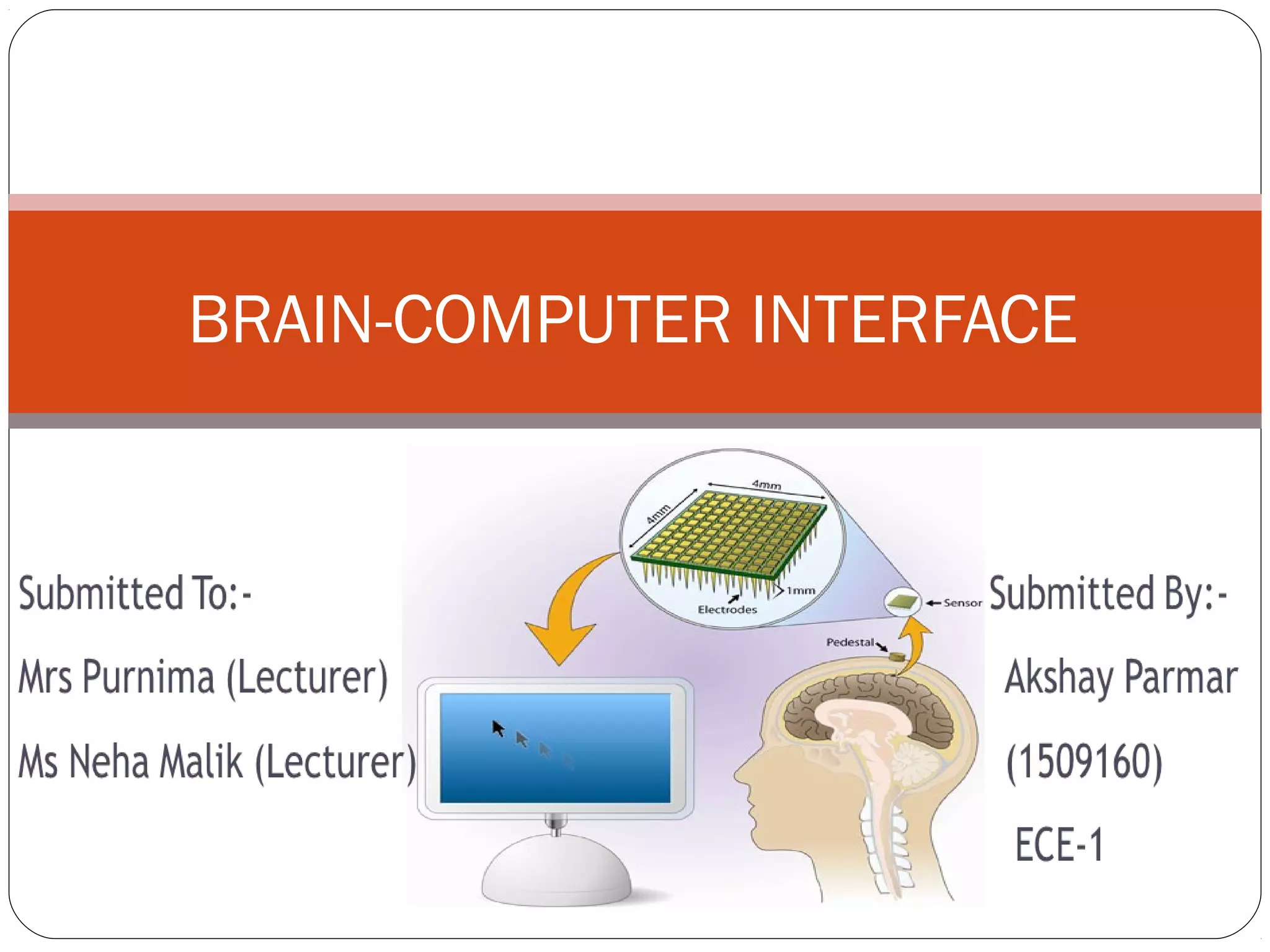
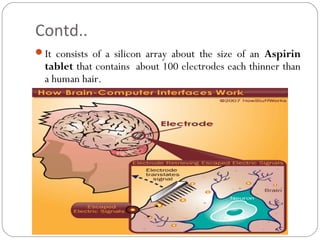
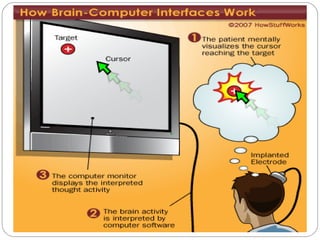
It consist of a sensor that is implanted in the motor cortex of
the brain and a device that analyses brain signals. The signals
generated by brain are interpreted and translated into cursor
movement on computer screen to control the computer.
Contd..
It consists of a silicon array about the size of an Aspirin
tablet that contains about 100 electrodes each thinner than
a human hair.
BCI vs. Neuroprosthetics
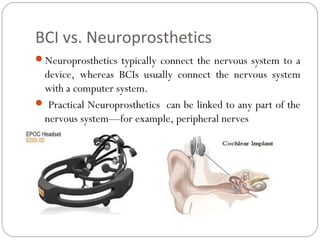
Neuroprosthetics typically connect the nervous system to a
device, whereas BCIs usually connect the nervous system
with a computer system.
 Practical Neuroprosthetics can be linked to any part of the
nervous system—for example, peripheral nerves
Objective of BCI
The goal of the Brain-Computer Interface is to develop a fast
and reliable connection between the brain of a severely
disabled person and a personal computer .
The ‘Brain Gate’ device can provide paralysed or motor-
impaired patients a mode of communication through the
translation of thought into direct computer
control.
Types of BCIs
Invasive BCI
Invasive BCIs are implanted directly into the grey matter of the brain
during neurosurgery. Retrieves information quickly and clearly.
 Non-Invasive BCI
Non-Invasive BCIs do not involve neurosurgery. They are just like
wearable virtual reality devices. Less dangerous and risky, Slight delay
(300-600 ms ).
Partially Invasive BCI
Partially invasive BCI devices are implanted inside the skull but rest
outside the brain rather than within the grey matter.
IMPLEMENTATIONS
BCI Research On Animals:
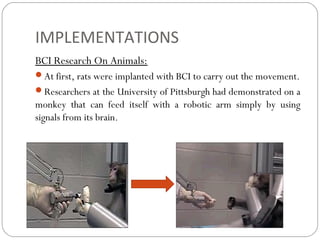
At first, rats were implanted with BCI to carry out the movement.
Researchers at the University of Pittsburgh had demonstrated on a
monkey that can feed itself with a robotic arm simply by using
signals from its brain.
Contd..
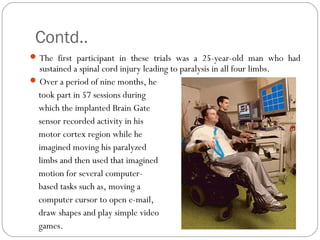
The first participant in these trials was a 25-year-old man who had
sustained a spinal cord injury leading to paralysis in all four limbs.
Over a period of nine months, he
took part in 57 sessions during
which the implanted Brain Gate
sensor recorded activity in his
motor cortex region while he
imagined moving his paralyzed
limbs and then used that imagined
motion for several computer-
based tasks such as, moving a
computer cursor to open e-mail,
draw shapes and play simple video
games.
How BCI Works?
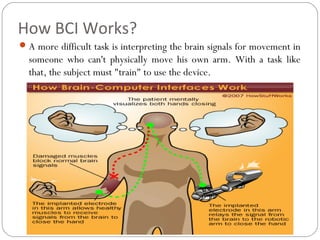
A more difficult task is interpreting the brain signals for movement in
someone who can't physically move his own arm. With a task like
that, the subject must "train" to use the device.
Contd..
With an implant in place, the subject would visualize closing his
or her disabled hand. After many trials, the software can learn to
recognize the signals associated with the thought of hand-closing.
Software connected to a robotic hand is programmed to receive
the "close hand" signal and interpret it to mean that the robotic
hand should close. At that point, when the subject thinks about
closing the hand, the signals are sent and the robotic hand closes.
This could even be accomplished without the "robotic" part of
the device. Signals could be sent to the appropriate motor
control nerves in the hands, bypassing a damaged section of
the spinal cord and allowing actual movement of the subject's
own hands.
Applications
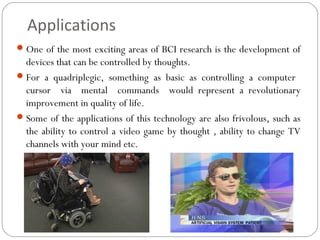
One of the most exciting areas of BCI research is the development of
devices that can be controlled by thoughts.
For a quadriplegic, something as basic as controlling a computer
cursor via mental commands would represent a revolutionary
improvement in quality of life.
Some of the applications of this technology are also frivolous, such as
the ability to control a video game by thought , ability to change TV
channels with your mind etc.
Limitations
 At present ,the biggest impediment of BCI technology is the
lack of sensor modality that provides safe, accurate, and
robust access to brain signals.
 It is very expensive.
Information transformation rate is limited to 20 bits/min.
 Difficulty in adaptation and learning.
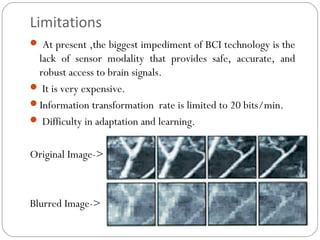
Original Image->
Blurred Image->
Conclusion
The results of BCI are spectacular and almost unbelievable.
Conclusively, BCI has proved to be a boon for paralyzed patients .
BCI can help paralyzed people to move by controlling their own
electric wheelchairs, to communicate by using e-mail and
Internet-based phone systems, and to be independent by
controlling items such as televisions and electrical appliances.
References
http://interaxon.ca/blog/2010/11/what-is-a-brain-wave/
http://www.slideshare.net/itsmartin/martins-seminar-on-
brain-control-interfacebci
http://en.wikipedia.org/wiki/Brain
%E2%80%93computer_interface
http://computer.howstuffworks.com/brain-computer-
interface.htm
Brain computer interface by akshay parmar

Brain computer interface by akshay parmar

  • 1.
  • 2.
    OVERVIEW What is Brain-ComputerInterface? Principle behind BCI Objective of BCI Types of BCIs Implementation Applications Limitations Future Concerns Conclusion References
  • 3.
    What is Brain-ComputerInterface? Brain Computer Interface is a direct technological interface between a brain & a computer system and provides a new Communication Channel. It is also known as Direct Neural Interface (DNI), Mind- machine interface (MMI) & Brain-Machine Interface (BMI). It is the study of brain functions. BCI are system that provide translation of the electrical activity of the human brain into command which can control device in real time.
  • 4.
    Principle Behind BCI Thistechnology is based on to sense, transmit, analyze and apply the language of neurons. It consist of a sensor that is implanted in the motor cortex of the brain and a device that analyses brain signals. The signals generated by brain are interpreted and translated into cursor movement on computer screen to control the computer.
  • 5.
    Contd.. It consists ofa silicon array about the size of an Aspirin tablet that contains about 100 electrodes each thinner than a human hair.
  • 7.
    BCI vs. Neuroprosthetics Neuroprostheticstypically connect the nervous system to a device, whereas BCIs usually connect the nervous system with a computer system.  Practical Neuroprosthetics can be linked to any part of the nervous system—for example, peripheral nerves
  • 8.
    Objective of BCI Thegoal of the Brain-Computer Interface is to develop a fast and reliable connection between the brain of a severely disabled person and a personal computer . The ‘Brain Gate’ device can provide paralysed or motor- impaired patients a mode of communication through the translation of thought into direct computer control.
  • 9.
    Types of BCIs InvasiveBCI Invasive BCIs are implanted directly into the grey matter of the brain during neurosurgery. Retrieves information quickly and clearly.  Non-Invasive BCI Non-Invasive BCIs do not involve neurosurgery. They are just like wearable virtual reality devices. Less dangerous and risky, Slight delay (300-600 ms ). Partially Invasive BCI Partially invasive BCI devices are implanted inside the skull but rest outside the brain rather than within the grey matter.
  • 10.
    IMPLEMENTATIONS BCI Research OnAnimals: At first, rats were implanted with BCI to carry out the movement. Researchers at the University of Pittsburgh had demonstrated on a monkey that can feed itself with a robotic arm simply by using signals from its brain.
  • 11.
    Contd.. The first participantin these trials was a 25-year-old man who had sustained a spinal cord injury leading to paralysis in all four limbs. Over a period of nine months, he took part in 57 sessions during which the implanted Brain Gate sensor recorded activity in his motor cortex region while he imagined moving his paralyzed limbs and then used that imagined motion for several computer- based tasks such as, moving a computer cursor to open e-mail, draw shapes and play simple video games.
  • 12.
    How BCI Works? Amore difficult task is interpreting the brain signals for movement in someone who can't physically move his own arm. With a task like that, the subject must "train" to use the device.
  • 13.
    Contd.. With an implantin place, the subject would visualize closing his or her disabled hand. After many trials, the software can learn to recognize the signals associated with the thought of hand-closing. Software connected to a robotic hand is programmed to receive the "close hand" signal and interpret it to mean that the robotic hand should close. At that point, when the subject thinks about closing the hand, the signals are sent and the robotic hand closes. This could even be accomplished without the "robotic" part of the device. Signals could be sent to the appropriate motor control nerves in the hands, bypassing a damaged section of the spinal cord and allowing actual movement of the subject's own hands.
  • 14.
    Applications One of themost exciting areas of BCI research is the development of devices that can be controlled by thoughts. For a quadriplegic, something as basic as controlling a computer cursor via mental commands would represent a revolutionary improvement in quality of life. Some of the applications of this technology are also frivolous, such as the ability to control a video game by thought , ability to change TV channels with your mind etc.
  • 15.
    Limitations  At present,the biggest impediment of BCI technology is the lack of sensor modality that provides safe, accurate, and robust access to brain signals.  It is very expensive. Information transformation rate is limited to 20 bits/min.  Difficulty in adaptation and learning. Original Image-> Blurred Image->
  • 16.
    Conclusion The results ofBCI are spectacular and almost unbelievable. Conclusively, BCI has proved to be a boon for paralyzed patients . BCI can help paralyzed people to move by controlling their own electric wheelchairs, to communicate by using e-mail and Internet-based phone systems, and to be independent by controlling items such as televisions and electrical appliances.
  • 17.