Angle Modulation


         BY
Muhammad Uzair Rasheed
     2009-CPE-03
 UCE&T BZU MULTAN
Contents


 Properties of Angle (exponential) Modulation
 Types
   Phase Modulation

   Frequency Modulation
Properties


 Angle Modulation: A non-linear process:-
  – Modulated wave does not look like message wave
  – Amplitude of an exponentially modulated wave is constant
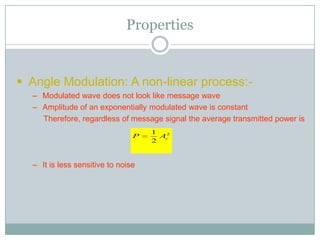
    Therefore, regardless of message signal the average transmitted power is
                                    1  2
                                P     Ac
                                    2


  – It is less sensitive to noise
Basic Concept

 First introduced in 1931

A sinusoidal carrier signal is defined as:                c(t )   Ac cos [    c   t   c   (t )]

For un-modulated carrier signal the total instantaneous angle is:


                                  c (t )     ct       c (t )

Thus one can express c(t) as:                     c(t )     Ac cos   c (t )       Ac Re [e j      c (t )
                                                                                                           ]

 Thus:
     • Varying the frequency fc            Frequency modulation
     • Varying the phase c                 Phase modulation
Basic Concept - Cont’d.

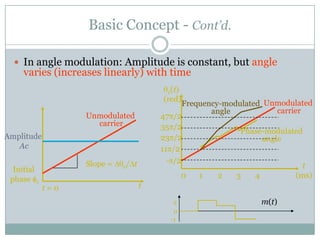
   In angle modulation: Amplitude is constant, but angle
    varies (increases linearly) with time
                                           c(t)
                                         (red)
                                                  Frequency-modulated Unmodulated
                                                         angle          carrier
                  Unmodulated            47 /2
                    carrier              35 /2
                                                               Phase-modulated
Amplitude                                23 /2                      angle
   Ac                                    11 /2
                  Slope =                  - /2
                            c/   t                                              t
  Initial
 phase c                                          0   1   2    3   4          (ms)
            t=0                      t

                                             2                         m(t)
                                             0
                                            -1
Phase Modulation (PM)

PM is defined If                        c (t ) K p m(t )               K p 1800

Thus                      c(t ) PM   Ac cos [   c   t   K p m(t )]
Where Kp is known as the phase modulation index


                                         Instantaneous phase i (t )                K p m(t )
                              i(t
Ac                        )
                                          Instantaneous frequency
                   c(t)
                              c(t)
                                                                        d c (t )
            c(t)                                              i (t )                 c    c (t )
                                                                          dt
     Rotating Phasor diagram
Frequency Modulation (FM)

The instantaneous frequency is;                                  i (t )        c   K f m(t )

Where Kf is known as the frequency modulation index.


                                                                       Instantaneous phase
Note that
                  c (t )       K f m (t )
                                                                                   t
Integrating
                           i (t )    c      c (t )          c (t )        ct   K f m(t ) dt 0
                                                                                   0
                                                                                           t
Substituting   c(t)   in c(t) results in:            c(t ) FM        Ac cos[ ct K f m(t ) dt ]
                                                                                          0
Bandwidth of Angle modulation

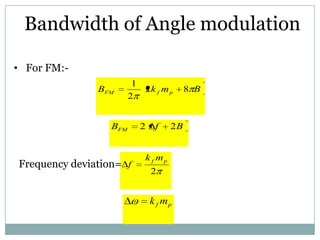
• For FM:-
                         1
               BFM         2k f m p       8 B
                        2


                  BFM     2    f     2B


                            k f mp
Frequency deviation= f
                              2


                              k f mp
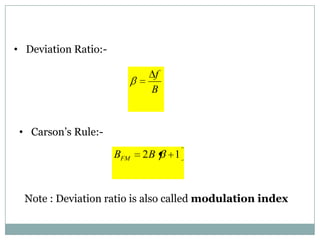
• Deviation Ratio:-

                              f
                             B


 • Carson’s Rule:-

                      BFM   2B    1


  Note : Deviation ratio is also called modulation index
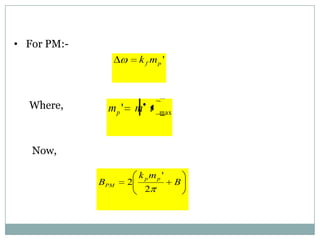
• For PM:-
                       k f mp '


  Where,      mp ' m t       max


   Now,

                       k pmp '
             BPM   2               B
                        2
THANKS

Angle modulation

  • 1.
    Angle Modulation BY Muhammad Uzair Rasheed 2009-CPE-03 UCE&T BZU MULTAN
  • 2.
    Contents  Properties ofAngle (exponential) Modulation  Types  Phase Modulation  Frequency Modulation
  • 3.
    Properties  Angle Modulation:A non-linear process:- – Modulated wave does not look like message wave – Amplitude of an exponentially modulated wave is constant Therefore, regardless of message signal the average transmitted power is 1 2 P Ac 2 – It is less sensitive to noise
  • 4.
    Basic Concept  Firstintroduced in 1931 A sinusoidal carrier signal is defined as: c(t ) Ac cos [ c t c (t )] For un-modulated carrier signal the total instantaneous angle is: c (t ) ct c (t ) Thus one can express c(t) as: c(t ) Ac cos c (t ) Ac Re [e j c (t ) ] Thus: • Varying the frequency fc Frequency modulation • Varying the phase c Phase modulation
  • 5.
    Basic Concept -Cont’d.  In angle modulation: Amplitude is constant, but angle varies (increases linearly) with time c(t) (red) Frequency-modulated Unmodulated angle carrier Unmodulated 47 /2 carrier 35 /2 Phase-modulated Amplitude 23 /2 angle Ac 11 /2 Slope = - /2 c/ t t Initial phase c 0 1 2 3 4 (ms) t=0 t 2 m(t) 0 -1
  • 6.
    Phase Modulation (PM) PMis defined If c (t ) K p m(t ) K p 1800 Thus c(t ) PM Ac cos [ c t K p m(t )] Where Kp is known as the phase modulation index Instantaneous phase i (t ) K p m(t ) i(t Ac ) Instantaneous frequency c(t) c(t) d c (t ) c(t) i (t ) c c (t ) dt Rotating Phasor diagram
  • 7.
    Frequency Modulation (FM) Theinstantaneous frequency is; i (t ) c K f m(t ) Where Kf is known as the frequency modulation index. Instantaneous phase Note that c (t ) K f m (t ) t Integrating i (t ) c c (t ) c (t ) ct K f m(t ) dt 0 0 t Substituting c(t) in c(t) results in: c(t ) FM Ac cos[ ct K f m(t ) dt ] 0
  • 8.
    Bandwidth of Anglemodulation • For FM:- 1 BFM 2k f m p 8 B 2 BFM 2 f 2B k f mp Frequency deviation= f 2 k f mp
  • 9.
    • Deviation Ratio:- f B • Carson’s Rule:- BFM 2B 1 Note : Deviation ratio is also called modulation index
  • 10.
    • For PM:- k f mp ' Where, mp ' m t max Now, k pmp ' BPM 2 B 2
  • 11.