ANGLE MODULATION
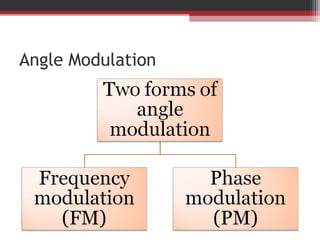
Angle Modulation
• Difference between FM and PM lies in whether 
frequency or phase is directly varied by the info 
signal 
• FM and PM occur concurrently in angle 
modulation 
• Direct FM is indirect PM. Direct PM is indirect FM 
• Direct FM  vary frequency of constant-amplitude 
carrier proportional to info signal 
amplitude, at a rate equal to the info signal frequency 
• Direct PM  vary phase of constant-amplitude 
carrier proportional to info signal amplitude, at a rate 
equal to the info signal frequency
• FM and PM waveforms are identical except 
for the time relationship 
• It is impossible to distinguish between FM and 
PM waveforms unless dynamic characteristic of 
information signal is known 
• For FM – max frequency deviation (max change 
in carrier frequency) occurs during the maximum 
positive and negative peaks of information signal 
• For PM – max frequency deviation (max change 
in carrier frequency) occurs during the zero 
crossings of information signal
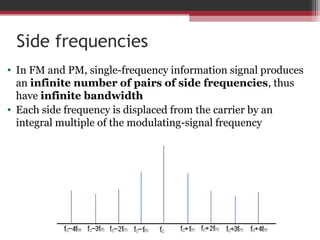
Side frequencies 
• In FM and PM, single-frequency information signal produces 
an infinite number of pairs of side frequencies, thus 
have infinite bandwidth 
• Each side frequency is displaced from the carrier by an 
integral multiple of the modulating-signal frequency
Advantages of Angle Modulation 
• Noise immunity 
▫ Most noise cause amplitude variations in modulated 
wave 
▫ In FM and PM, limiters are used to remove amplitude 
variations (hence noise also removed) 
• Noise performance and signal-to-noise improvement 
▫ Noise reduction by limiters improve SNR ratio 
• Capture effect 
▫ If two signals are received with the same frequency, the 
receiver will capture the stronger signal and the weaker 
signal is eliminated 
▫ However, if strengths of the signals are nearly the same, 
capture effect may cause signal to alternate in their 
dominance of the frequency
Disadvantages of Angle Modulation 
• Bandwidth: FM takes up more spectrum space 
compared to AM 
• Modulation and demodulation circuits required 
for FM and PM are usually far more complex 
than those of AM
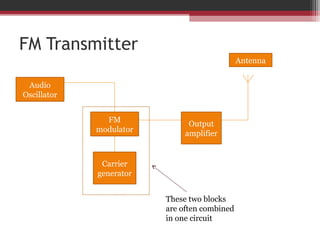
FM Transmitter 
Audio 
Oscillator 
FM 
modulator 
Carrier 
generator 
Output 
amplifier 
Antenna 
These two blocks 
are often combined 
in one circuit
• Difference from AM transmitter: FM modulator 
is used in place of AM modulator 
• FM modulator: 
▫ Changes carrier frequency according to info signal 
▫ Usually uses a varactor or voltage-variable 
capacitor (VVC)
FM Receiver 
• For FM receiver, the superheterodyne 
receiver can be used, like the AM receiver, 
except that FM demodulator is used in place 
of AM demodulator
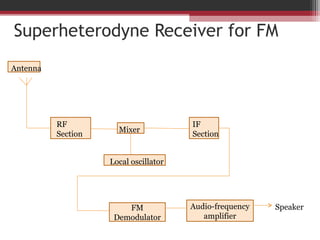
Superheterodyne Receiver for FM 
Local oscillator 
FM 
Demodulator 
RF 
Section 
Antenna 
Audio-frequency 
amplifier 
Mixer 
IF 
Section 
Speaker
FM Demodulator 
• Two types of FM demodulator: 
▫ Quadrature detector 
▫ Phase-locked loop detector
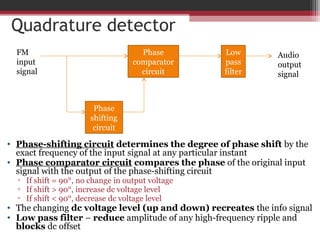
Quadrature detector 
Phase 
comparator 
circuit 
Phase 
shifting 
circuit 
Low 
pass 
filter 
FM 
input 
signal 
Audio 
output 
signal 
• Phase-shifting circuit determines the degree of phase shift by the 
exact frequency of the input signal at any particular instant 
• Phase comparator circuit compares the phase of the original input 
signal with the output of the phase-shifting circuit 
▫ If shift = 90°, no change in output voltage 
▫ If shift > 90°, increase dc voltage level 
▫ If shift < 90°, decrease dc voltage level 
• The changing dc voltage level (up and down) recreates the info signal 
• Low pass filter – reduce amplitude of any high-frequency ripple and 
blocks dc offset
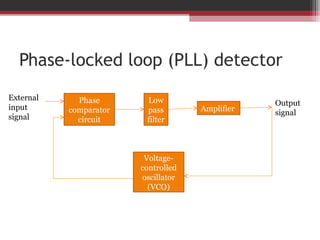
Phase-locked loop (PLL) detector 
Phase 
comparator 
circuit 
Low 
pass 
filter 
Amplifier 
Voltage-controlled 
oscillator 
(VCO) 
External 
input 
signal 
Output 
signal
Phase-locked loop (PLL) detector 
• PLL has 3 operating states: 
▫ Free running 
 VCO oscillates at its natural frequency 
▫ Capture 
 External input signal is present and feedback loop is 
complete 
 PLL is in the process of acquiring frequency lock 
▫ Lock 
 VCO frequency is locked onto (equal to) the frequency of 
external input signal 
 VCO frequency tracks (follows) changes in the frequency 
of the external input signal, whether increase or decrease

311 angle modulation

  • 1.
  • 2.
  • 3.
    • Difference betweenFM and PM lies in whether frequency or phase is directly varied by the info signal • FM and PM occur concurrently in angle modulation • Direct FM is indirect PM. Direct PM is indirect FM • Direct FM  vary frequency of constant-amplitude carrier proportional to info signal amplitude, at a rate equal to the info signal frequency • Direct PM  vary phase of constant-amplitude carrier proportional to info signal amplitude, at a rate equal to the info signal frequency
  • 4.
    • FM andPM waveforms are identical except for the time relationship • It is impossible to distinguish between FM and PM waveforms unless dynamic characteristic of information signal is known • For FM – max frequency deviation (max change in carrier frequency) occurs during the maximum positive and negative peaks of information signal • For PM – max frequency deviation (max change in carrier frequency) occurs during the zero crossings of information signal
  • 5.
    Side frequencies •In FM and PM, single-frequency information signal produces an infinite number of pairs of side frequencies, thus have infinite bandwidth • Each side frequency is displaced from the carrier by an integral multiple of the modulating-signal frequency
  • 6.
    Advantages of AngleModulation • Noise immunity ▫ Most noise cause amplitude variations in modulated wave ▫ In FM and PM, limiters are used to remove amplitude variations (hence noise also removed) • Noise performance and signal-to-noise improvement ▫ Noise reduction by limiters improve SNR ratio • Capture effect ▫ If two signals are received with the same frequency, the receiver will capture the stronger signal and the weaker signal is eliminated ▫ However, if strengths of the signals are nearly the same, capture effect may cause signal to alternate in their dominance of the frequency
  • 7.
    Disadvantages of AngleModulation • Bandwidth: FM takes up more spectrum space compared to AM • Modulation and demodulation circuits required for FM and PM are usually far more complex than those of AM
  • 8.
    FM Transmitter Audio Oscillator FM modulator Carrier generator Output amplifier Antenna These two blocks are often combined in one circuit
  • 9.
    • Difference fromAM transmitter: FM modulator is used in place of AM modulator • FM modulator: ▫ Changes carrier frequency according to info signal ▫ Usually uses a varactor or voltage-variable capacitor (VVC)
  • 10.
    FM Receiver •For FM receiver, the superheterodyne receiver can be used, like the AM receiver, except that FM demodulator is used in place of AM demodulator
  • 11.
    Superheterodyne Receiver forFM Local oscillator FM Demodulator RF Section Antenna Audio-frequency amplifier Mixer IF Section Speaker
  • 12.
    FM Demodulator •Two types of FM demodulator: ▫ Quadrature detector ▫ Phase-locked loop detector
  • 13.
    Quadrature detector Phase comparator circuit Phase shifting circuit Low pass filter FM input signal Audio output signal • Phase-shifting circuit determines the degree of phase shift by the exact frequency of the input signal at any particular instant • Phase comparator circuit compares the phase of the original input signal with the output of the phase-shifting circuit ▫ If shift = 90°, no change in output voltage ▫ If shift > 90°, increase dc voltage level ▫ If shift < 90°, decrease dc voltage level • The changing dc voltage level (up and down) recreates the info signal • Low pass filter – reduce amplitude of any high-frequency ripple and blocks dc offset
  • 14.
    Phase-locked loop (PLL)detector Phase comparator circuit Low pass filter Amplifier Voltage-controlled oscillator (VCO) External input signal Output signal
  • 15.
    Phase-locked loop (PLL)detector • PLL has 3 operating states: ▫ Free running  VCO oscillates at its natural frequency ▫ Capture  External input signal is present and feedback loop is complete  PLL is in the process of acquiring frequency lock ▫ Lock  VCO frequency is locked onto (equal to) the frequency of external input signal  VCO frequency tracks (follows) changes in the frequency of the external input signal, whether increase or decrease