MODULATION


       BY- SANJAY KUMAR
           0900321088
             EN-2(A)
INTrODUcTION

 Modulation is the process by which some
 characteristics of a carrier is varied in accordance with a
 modulation wave .

 Modulation is the process of putting information onto
  a high frequency carrier for transmission (frequency
  translation).


 such a modification is achieved by mean of a process
 called modulation .
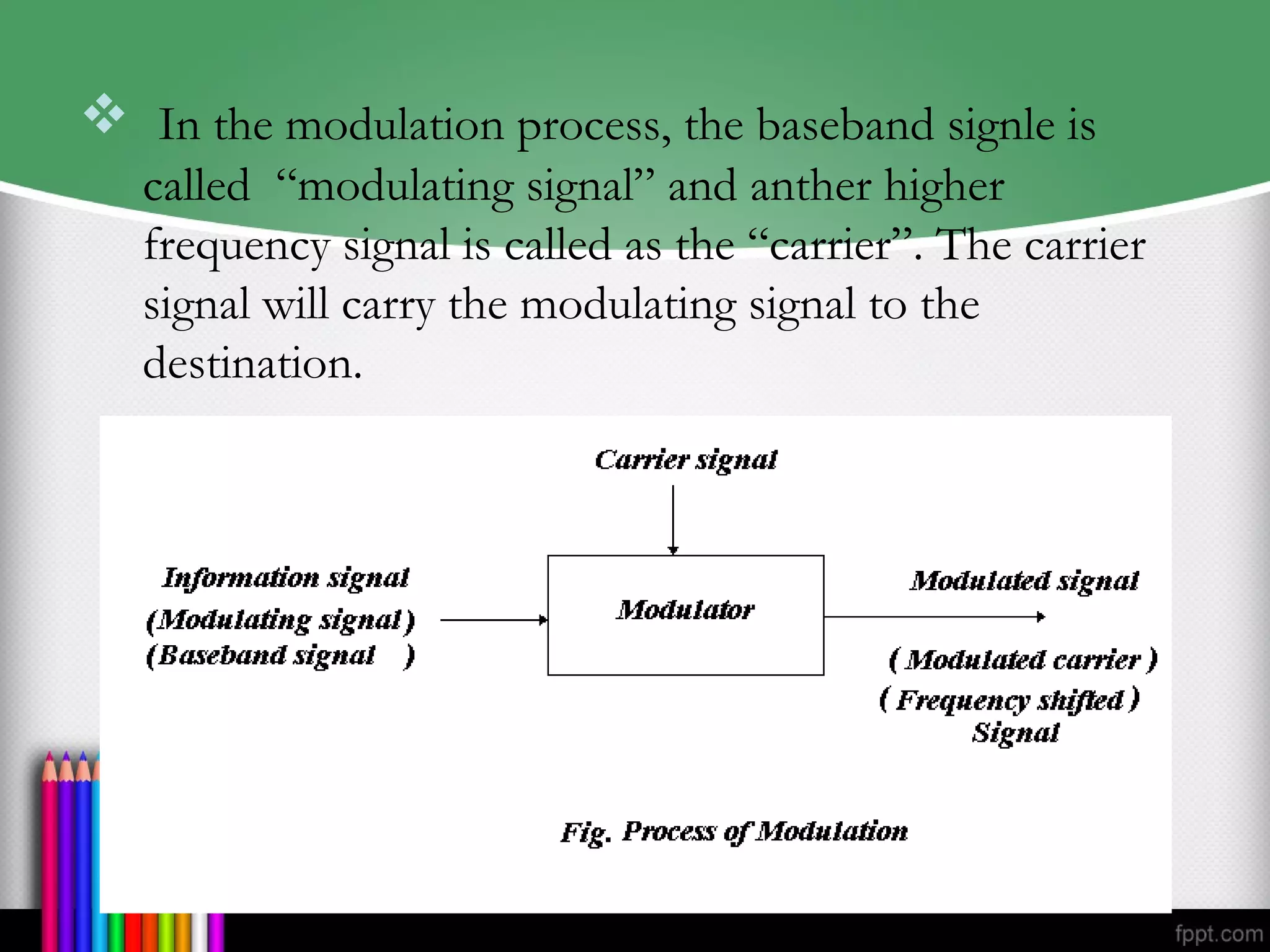
 In the modulation process, the baseband signle is
   called “modulating signal” and anther higher
   frequency signal is called as the “carrier”. The carrier
   signal will carry the modulating signal to the
   destination.
DIffereNT Of MODULATION
         MeThOD

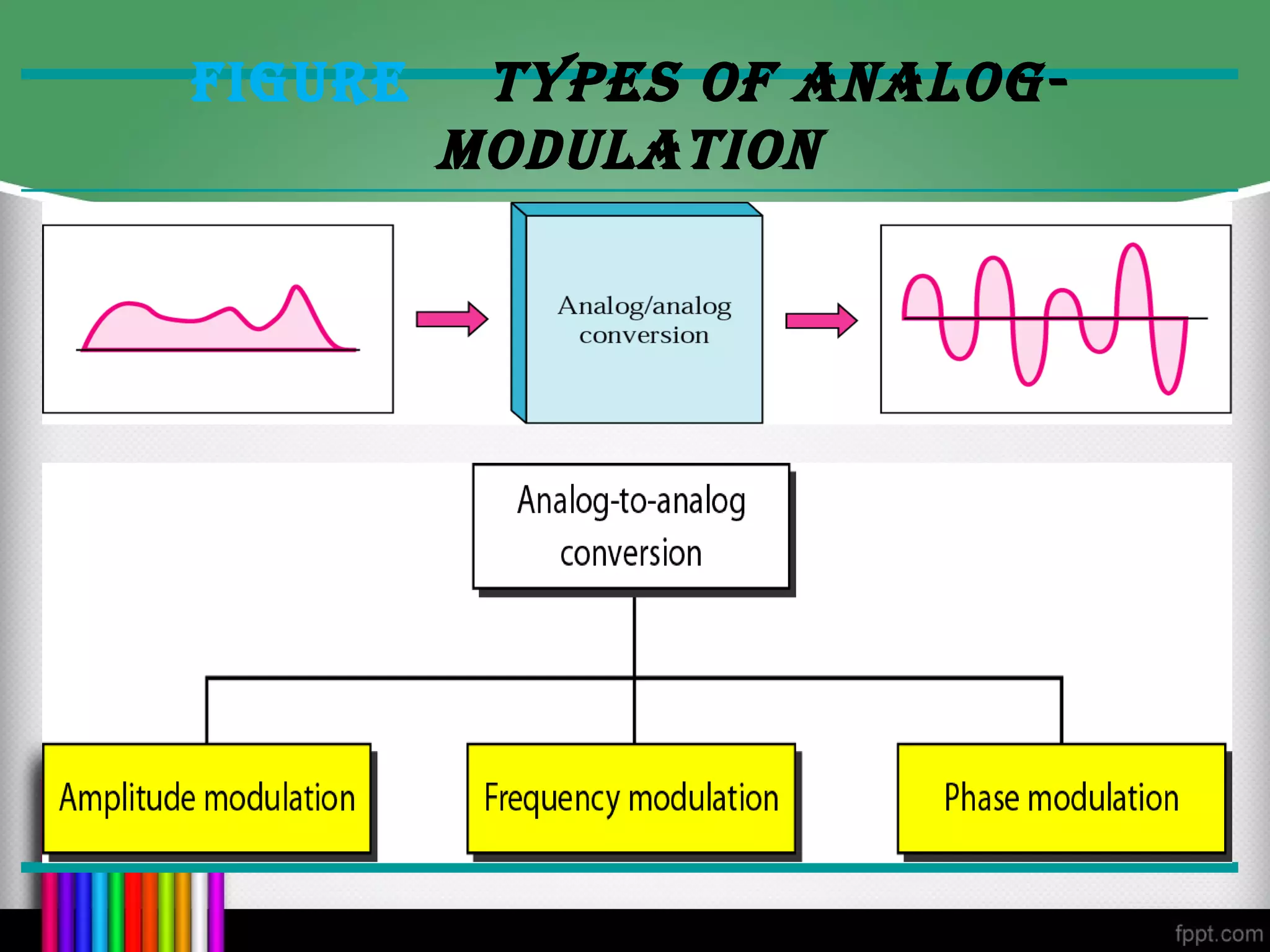
 Analog modulation - The modulating signal and
 carrier both are analogue signal.

                        TYPES :
                 Amplitude modulation (AM),
                 Frequency modulation (FM),
                   Phase modulation (PM)
fIgUre    Types Of ANALOg-
         MODULATION
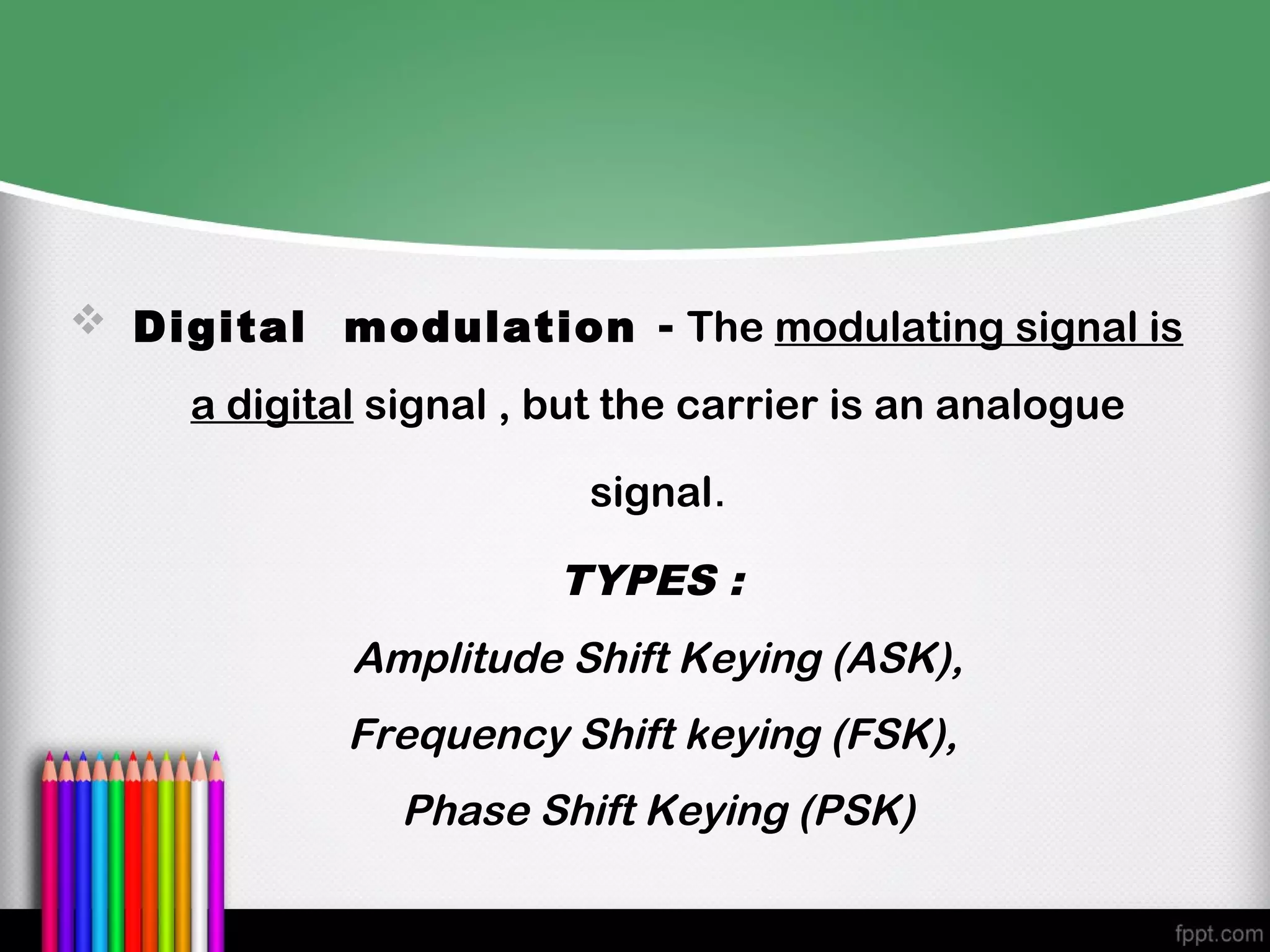
 Digital modulation - The modulating signal is

     a digital signal , but the carrier is an analogue

                         signal.

                        TYPES :
             Amplitude Shift Keying (ASK),
             Frequency Shift keying (FSK),
                Phase Shift Keying (PSK)
AMpLITUDe MODULATION

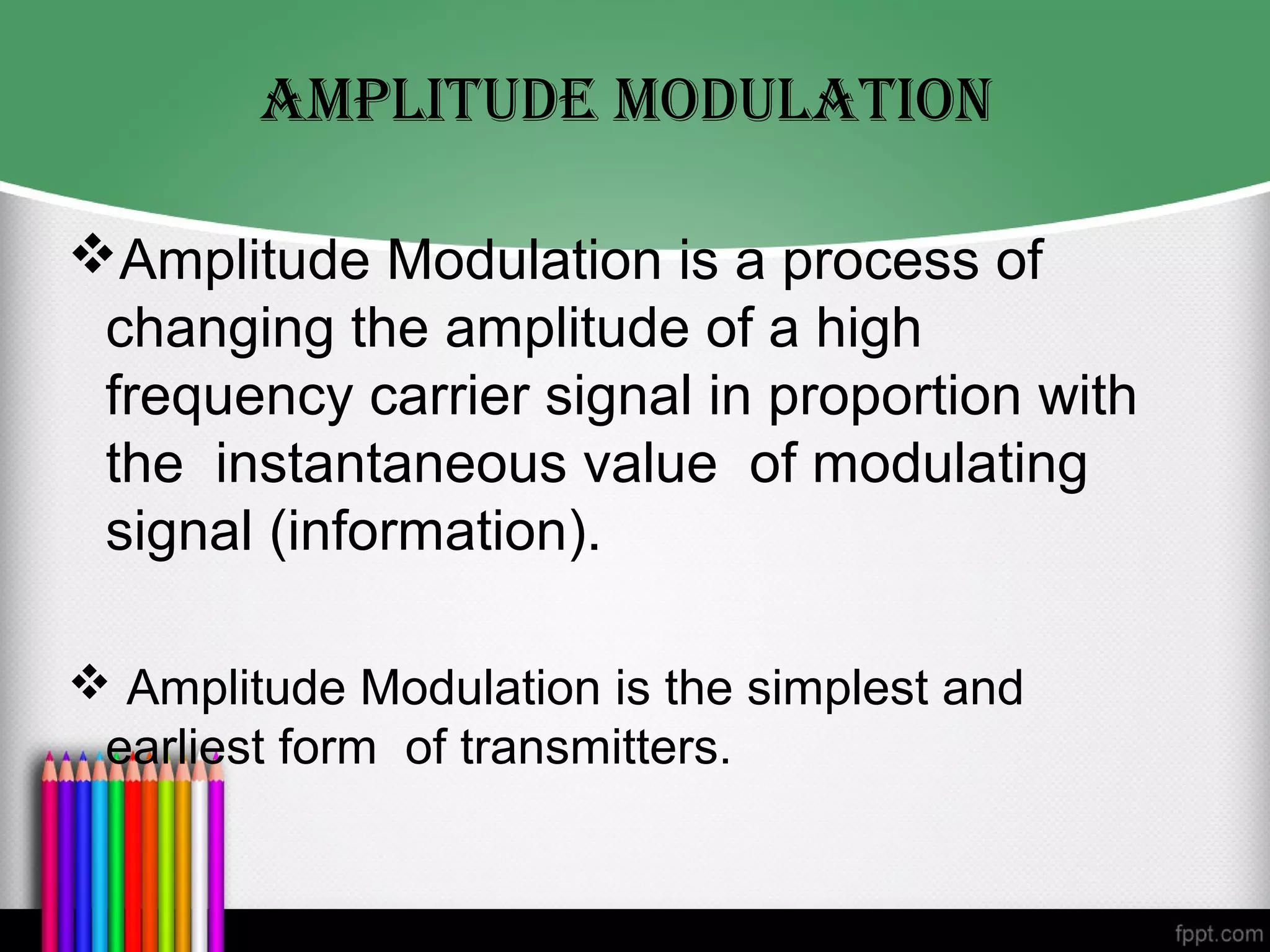
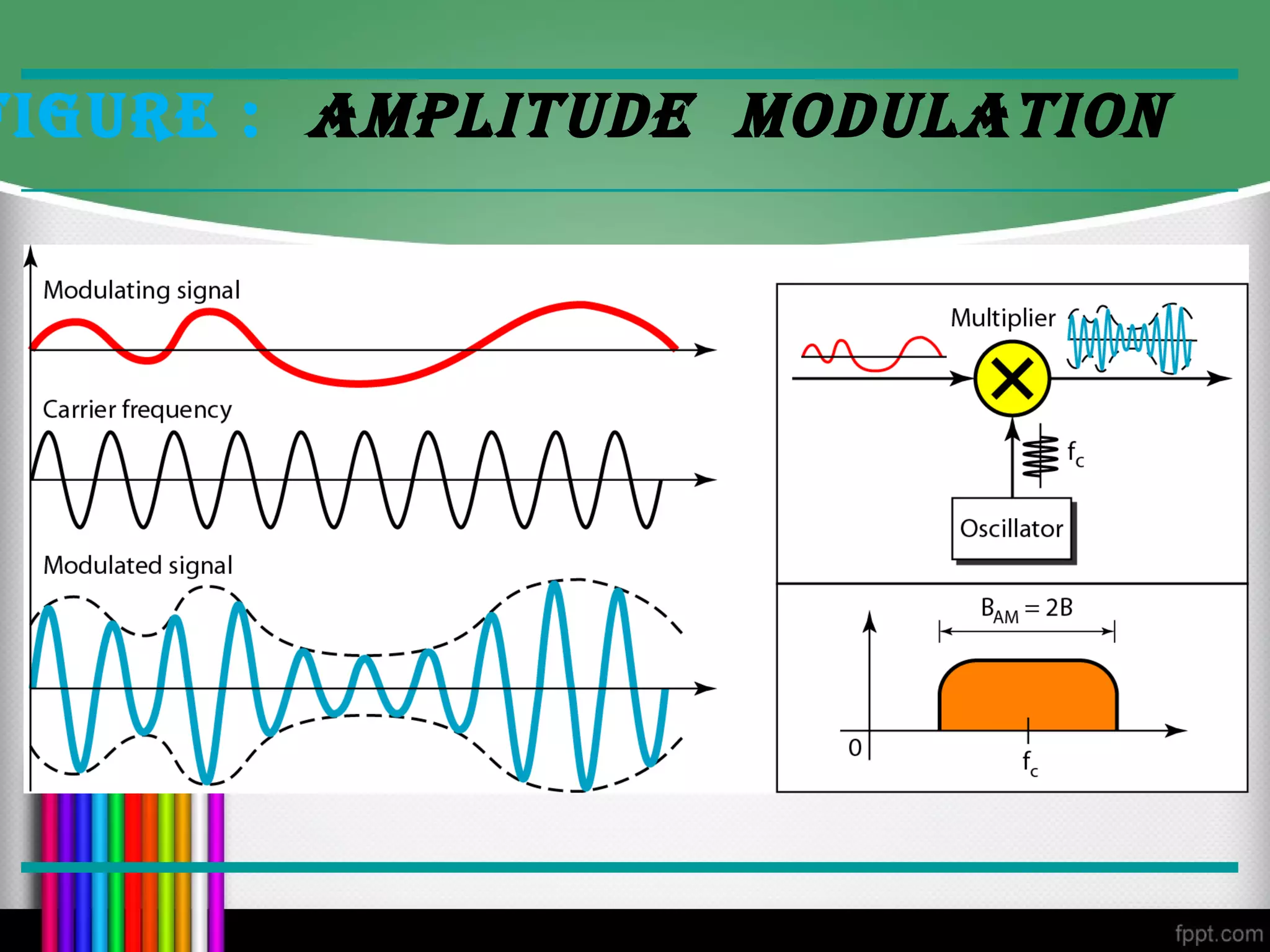
Amplitude Modulation is a process of
 changing the amplitude of a high
 frequency carrier signal in proportion with
 the instantaneous value of modulating
 signal (information).

 Amplitude Modulation is the simplest and
 earliest form of transmitters.
fIgUre : AMpLITUDe MODULATION
AM – BAsIc DefINITIONs
                                            5
The AM signal:

  s ( t ) = Ac [1 + k • m( t ) ] cos ωc t
                                            0


                                            -5
                                                 0   0 .0 1 0 .0 2 0 .0 3 0 .0 4 0 .0 5 0 .0 6 0 .0 7 0 .0 8 0 .0 9   0 .1

The modulating signal:                      1


m( t ) = Am cos ωct
                                            0


                                            -1
The Carrier Signal:                              0   0 .0 1 0 .0 2 0 .0 3 0 .0 4 0 .0 5 0 .0 6 0 .0 7 0 .0 8 0 .0 9   0 .1
                                            1

c( t ) = Ac cos ωc t                        0


                                            -1
                                                 0   0 .0 1 0 .0 2 0 .0 3 0 .0 4 0 .0 5 0 .0 6 0 .0 7 0 .0 8 0 .0 9   0 .1
AM chArAcTerIsTIcs
 AM is a nonlinear process

 Sum and difference frequencies are created that
 carry the information
MODULATION INDex


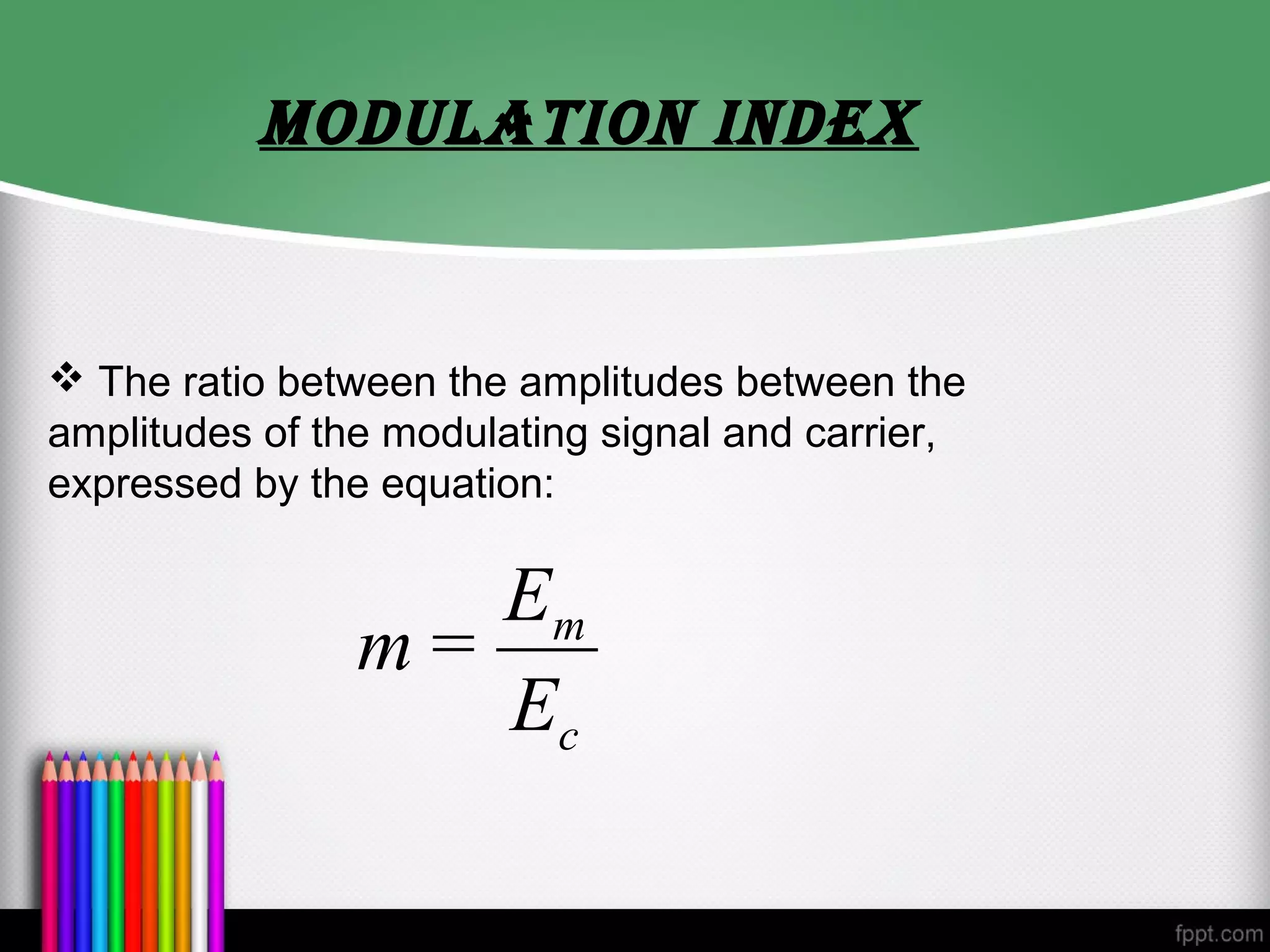
 The ratio between the amplitudes between the
amplitudes of the modulating signal and carrier,
expressed by the equation:

                   Em
                m=
                   Ec
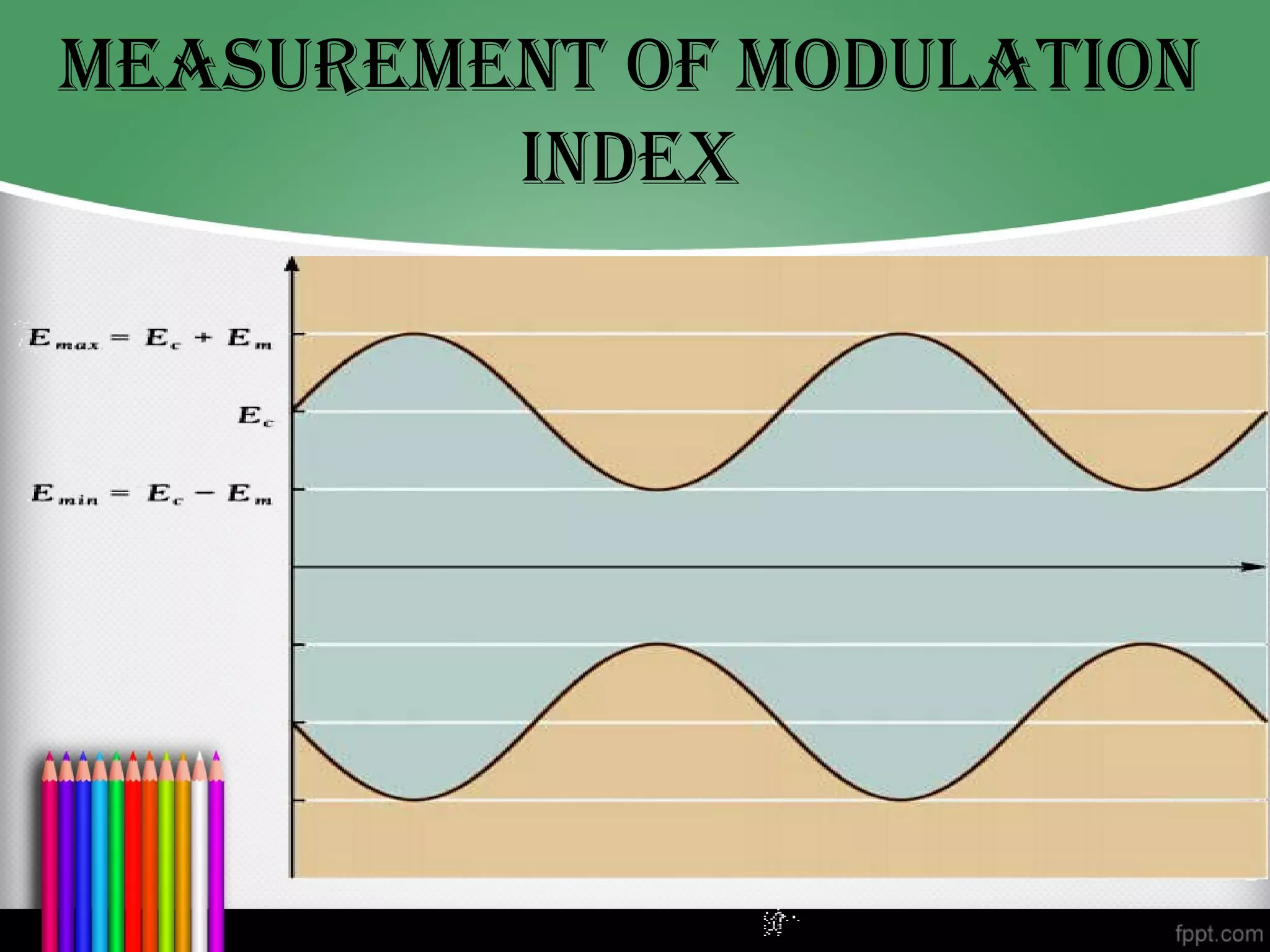
MeAsUreMeNT Of MODULATION
         INDex
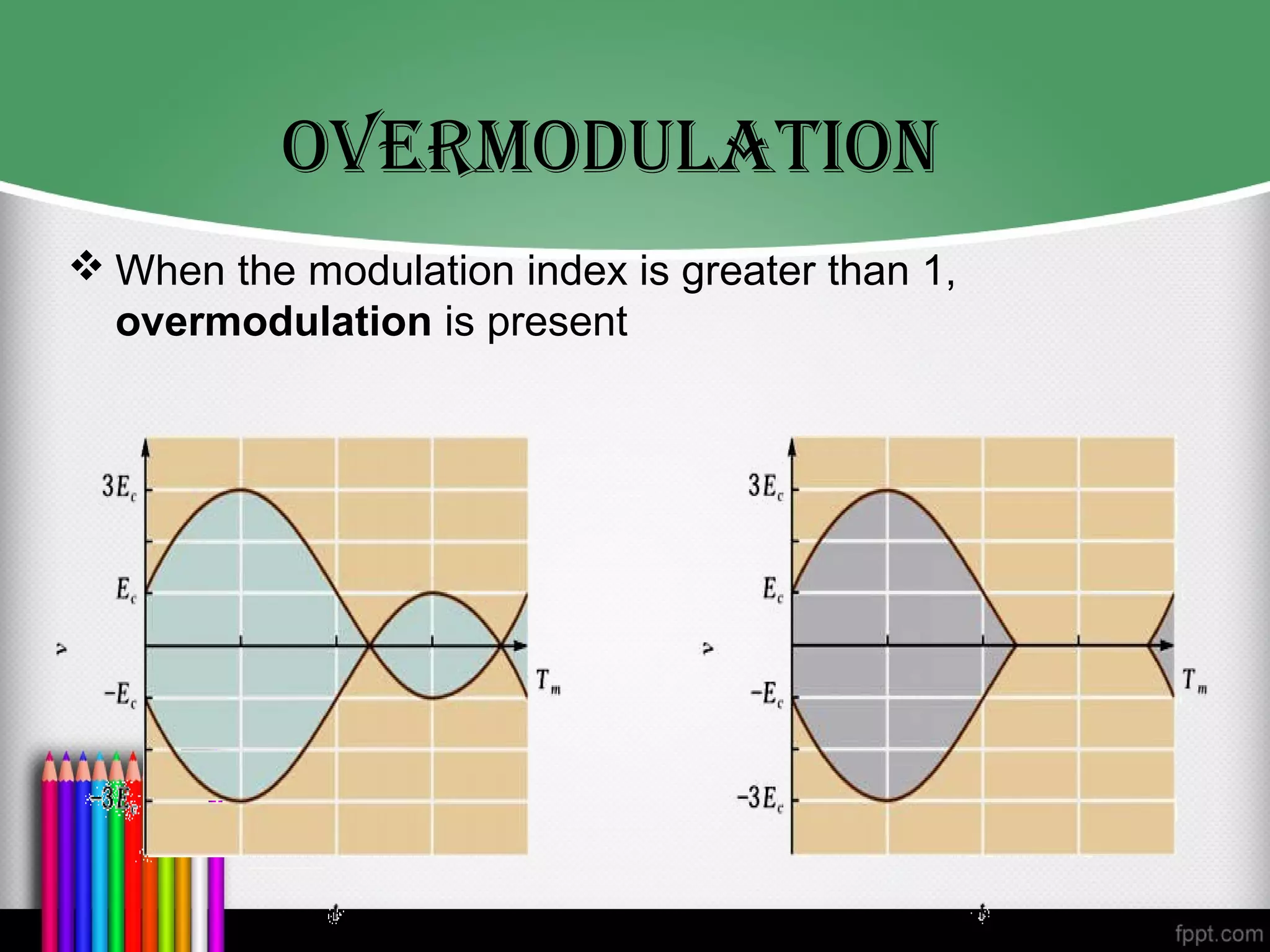
OverMODULATION
 When the modulation index is greater than 1,
  overmodulation is present
MODULATION INDex fOr MULTIpLe
  MODULATINg freqUeNcIes
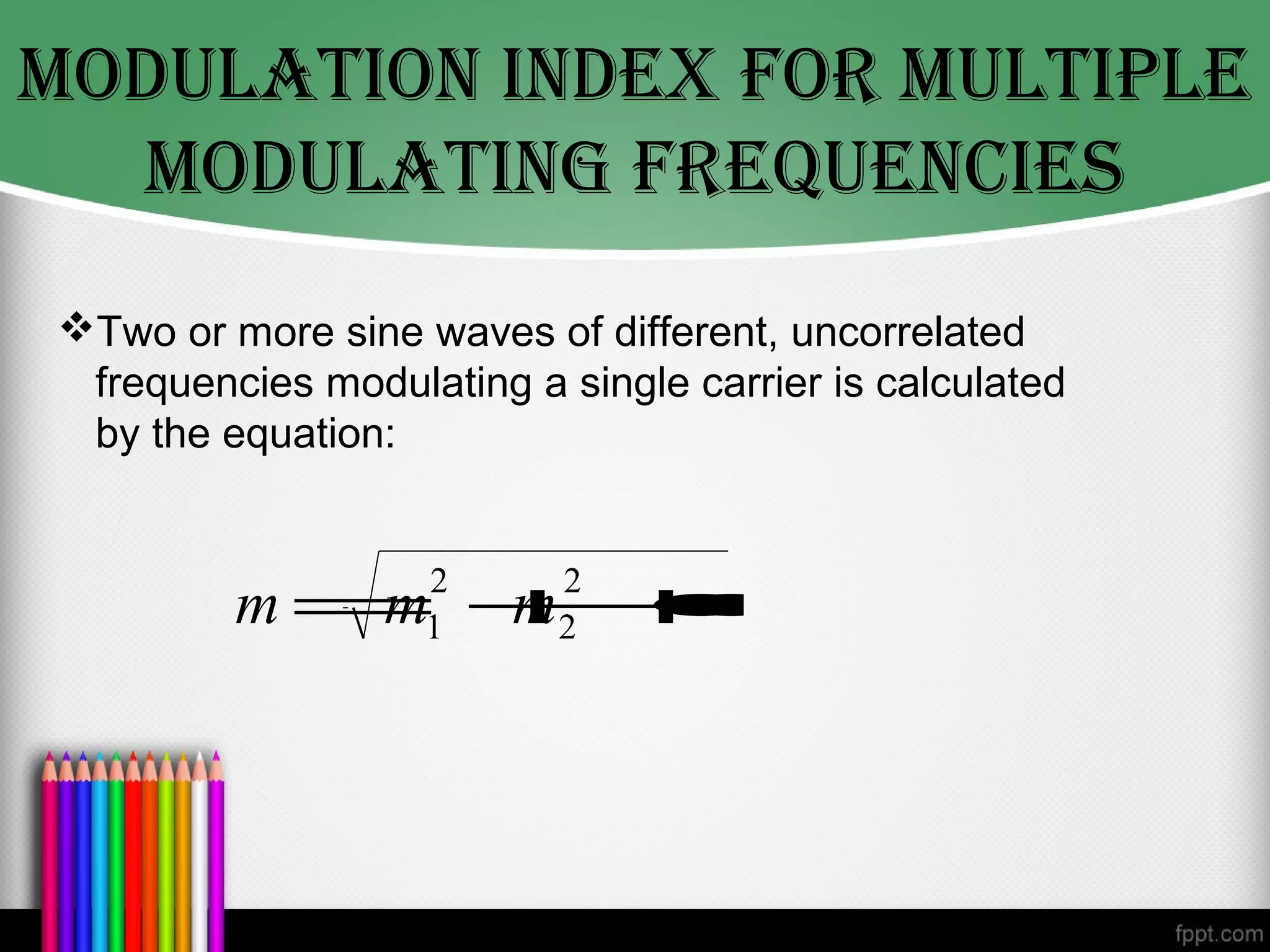
Two or more sine waves of different, uncorrelated
 frequencies modulating a single carrier is calculated
 by the equation:


                   2      2
         m= + •
           m m +•
                •  1      2
fULL-cArrIer AM: freqUeNcy
          DOMAIN
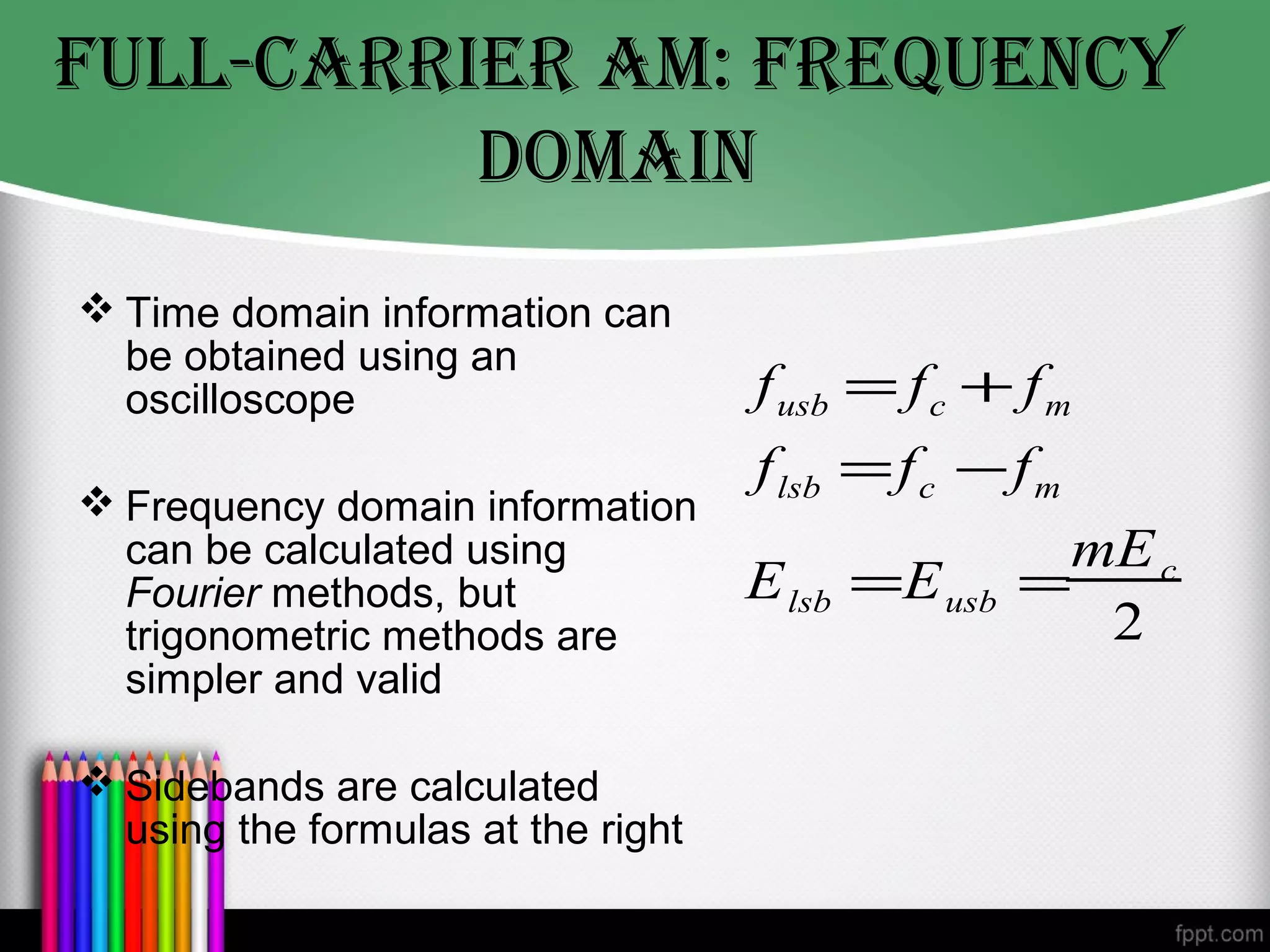
 Time domain information can
  be obtained using an
  oscilloscope                      f usb = f c + f m
                                    f lsb = f c − f m
 Frequency domain information
  can be calculated using                            mE c
  Fourier methods, but              E lsb =E usb   =
  trigonometric methods are                           2
  simpler and valid

 Sidebands are calculated
  using the formulas at the right
BANDwIDTh

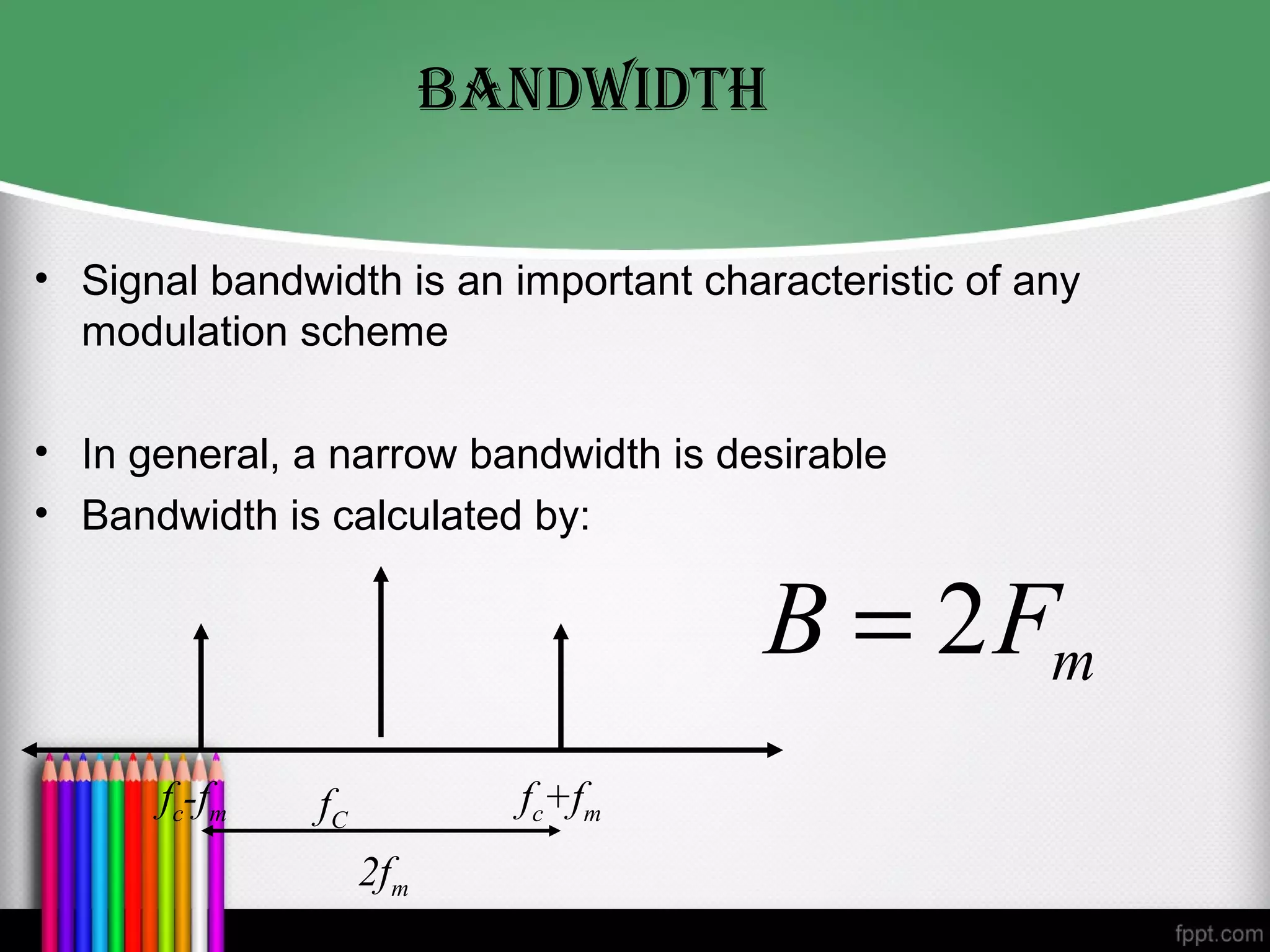
• Signal bandwidth is an important characteristic of any
  modulation scheme

• In general, a narrow bandwidth is desirable
• Bandwidth is calculated by:

                                       B = 2 Fm
      fc-fm    fC           fc+fm
                    2fm
AppLIcATIONs AMpLITUDe
      MODULATION

 AM applications include broadcasting in
  medium- and high-frequency applications,

  CB radio , and

  aircraft communications
ThANK yOU

Modulation by sanjay

  • 1.
    MODULATION BY- SANJAY KUMAR 0900321088 EN-2(A)
  • 2.
    INTrODUcTION  Modulation isthe process by which some characteristics of a carrier is varied in accordance with a modulation wave .  Modulation is the process of putting information onto a high frequency carrier for transmission (frequency translation).  such a modification is achieved by mean of a process called modulation .
  • 3.
     In themodulation process, the baseband signle is called “modulating signal” and anther higher frequency signal is called as the “carrier”. The carrier signal will carry the modulating signal to the destination.
  • 4.
    DIffereNT Of MODULATION MeThOD  Analog modulation - The modulating signal and carrier both are analogue signal. TYPES : Amplitude modulation (AM), Frequency modulation (FM), Phase modulation (PM)
  • 5.
    fIgUre Types Of ANALOg- MODULATION
  • 6.
     Digital modulation- The modulating signal is a digital signal , but the carrier is an analogue signal. TYPES : Amplitude Shift Keying (ASK), Frequency Shift keying (FSK), Phase Shift Keying (PSK)
  • 7.
    AMpLITUDe MODULATION Amplitude Modulationis a process of changing the amplitude of a high frequency carrier signal in proportion with the instantaneous value of modulating signal (information).  Amplitude Modulation is the simplest and earliest form of transmitters.
  • 8.
  • 9.
    AM – BAsIcDefINITIONs 5 The AM signal: s ( t ) = Ac [1 + k • m( t ) ] cos ωc t 0 -5 0 0 .0 1 0 .0 2 0 .0 3 0 .0 4 0 .0 5 0 .0 6 0 .0 7 0 .0 8 0 .0 9 0 .1 The modulating signal: 1 m( t ) = Am cos ωct 0 -1 The Carrier Signal: 0 0 .0 1 0 .0 2 0 .0 3 0 .0 4 0 .0 5 0 .0 6 0 .0 7 0 .0 8 0 .0 9 0 .1 1 c( t ) = Ac cos ωc t 0 -1 0 0 .0 1 0 .0 2 0 .0 3 0 .0 4 0 .0 5 0 .0 6 0 .0 7 0 .0 8 0 .0 9 0 .1
  • 10.
    AM chArAcTerIsTIcs  AMis a nonlinear process  Sum and difference frequencies are created that carry the information
  • 11.
    MODULATION INDex  Theratio between the amplitudes between the amplitudes of the modulating signal and carrier, expressed by the equation: Em m= Ec
  • 12.
  • 13.
    OverMODULATION  When themodulation index is greater than 1, overmodulation is present
  • 14.
    MODULATION INDex fOrMULTIpLe MODULATINg freqUeNcIes Two or more sine waves of different, uncorrelated frequencies modulating a single carrier is calculated by the equation: 2 2 m= + • m m +• • 1 2
  • 15.
    fULL-cArrIer AM: freqUeNcy DOMAIN  Time domain information can be obtained using an oscilloscope f usb = f c + f m f lsb = f c − f m  Frequency domain information can be calculated using mE c Fourier methods, but E lsb =E usb = trigonometric methods are 2 simpler and valid  Sidebands are calculated using the formulas at the right
  • 16.
    BANDwIDTh • Signal bandwidthis an important characteristic of any modulation scheme • In general, a narrow bandwidth is desirable • Bandwidth is calculated by: B = 2 Fm fc-fm fC fc+fm 2fm
  • 17.
    AppLIcATIONs AMpLITUDe MODULATION AM applications include broadcasting in medium- and high-frequency applications,  CB radio , and  aircraft communications
  • 18.