FM- TRANSMITTERS AND
RECEIVERS
By-
Yogesh bhargawa
M.Sc. 3rd sem.
BBAU
INTRODUCTION
The FM transmitters and receivers are those
devices which is used for sending and receiving
FM signal.
The transmitters are those devices which is used
to send frequency modulated wave through a
band and
the receivers are the devices which received
modulated signal then after demodulation it gives
us the original signal.
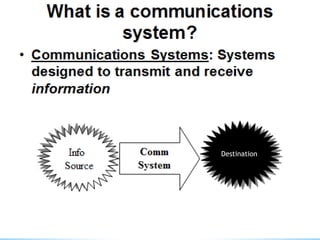
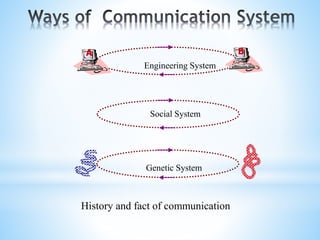
Destination
A B
Engineering System
Genetic System
Social System
History and fact of communication
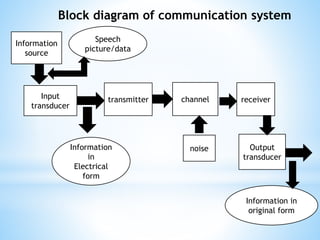
Input
transducer
transmitter channel receiver
Output
transducer
noise
Speech
picture/data
Information
in
Electrical
form
Information in
original form
Information
source
Block diagram of communication system
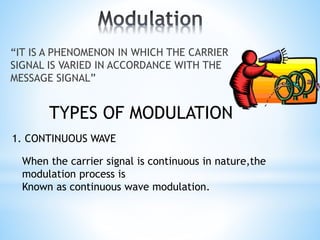
“IT IS A PHENOMENON IN WHICH THE CARRIER
SIGNAL IS VARIED IN ACCORDANCE WITH THE
MESSAGE SIGNAL”
TYPES OF MODULATION
1. CONTINUOUS WAVE
When the carrier signal is continuous in nature,the
modulation process is
Known as continuous wave modulation.
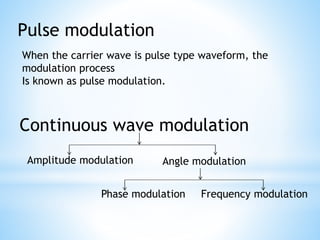
Pulse modulation
When the carrier wave is pulse type waveform, the
modulation process
Is known as pulse modulation.
Continuous wave modulation
Amplitude modulation Angle modulation
Phase modulation Frequency modulation
Unmodulated carrier, full power
at all times
Waveform of modulating signal
Modulated carrier with frequency
deviation and constant amplitude
DIFFERENT TYPES OF FM.
1. NARROW BAND F.M.
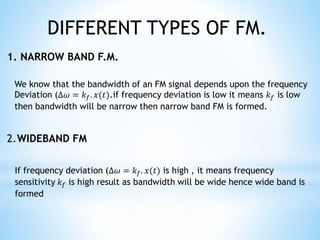
We know that the bandwidth of an FM signal depends upon the frequency
Deviation (∆𝜔 = 𝑘 𝑓. 𝑥(𝑡).if frequency deviation is low it means 𝑘 𝑓 is low
then bandwidth will be narrow then narrow band FM is formed.
WIDEBAND FM
If frequency deviation (∆𝜔 = 𝑘 𝑓. 𝑥(𝑡) is high , it means frequency
sensitivity 𝑘 𝑓 is high result as bandwidth will be wide hence wide band is
formed
2.
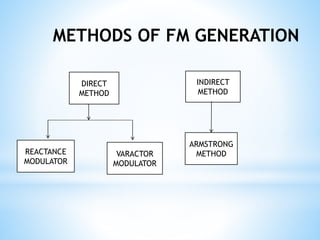
METHODS OF FM GENERATION
DIRECT
METHOD
REACTANCE
MODULATOR
INDIRECT
METHOD
ARMSTRONG
METHODVARACTOR
MODULATOR
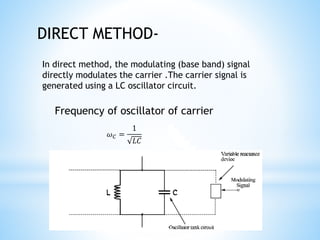
DIRECT METHOD-
Frequency of oscillator of carrier
𝜔 𝐶 =
1
𝐿𝐶
In direct method, the modulating (base band) signal
directly modulates the carrier .The carrier signal is
generated using a LC oscillator circuit.
Crystal
oscillator
phase
modulator
frequency
multiplier Power amplifier
Audio
source
FM Transmitters
NBFM WBFM ANTENNA
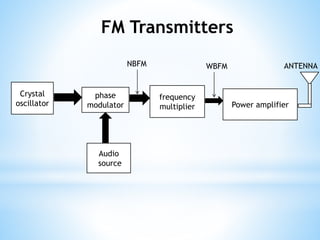
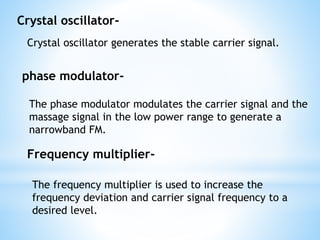
Crystal oscillator-
Crystal oscillator generates the stable carrier signal.
The phase modulator modulates the carrier signal and the
massage signal in the low power range to generate a
narrowband FM.
phase modulator-
Frequency multiplier-
The frequency multiplier is used to increase the
frequency deviation and carrier signal frequency to a
desired level.
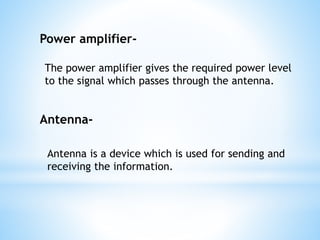
The power amplifier gives the required power level
to the signal which passes through the antenna.
Power amplifier-
Antenna-
Antenna is a device which is used for sending and
receiving the information.
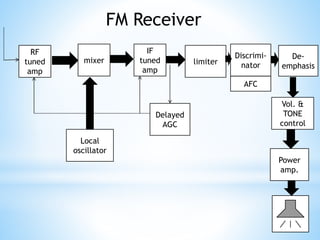
FM Receiver
RF
tuned
amp
mixer
IF
tuned
amp
limiter
Discrimi-
nator
Local
oscillator
Delayed
AGC
AFC
Vol. &
TONE
control
De-
emphasis
Power
amp.
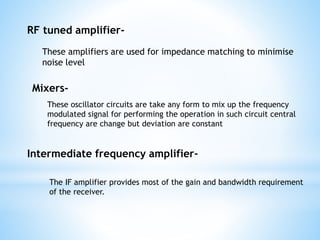
RF tuned amplifier-
Mixers-
These amplifiers are used for impedance matching to minimise
noise level
These oscillator circuits are take any form to mix up the frequency
modulated signal for performing the operation in such circuit central
frequency are change but deviation are constant
Intermediate frequency amplifier-
The IF amplifier provides most of the gain and bandwidth requirement
of the receiver.
Limiters-
Limiters are those circuit which allows the certain frequency
range to pass out and block the other signals
Discriminator-
The discriminator change FM into AM. A simple diode detection
then recover the intelligence contained in the envelop of the AM
waveform.
De-emphasis-
The artificial boosting given to the higher modulating
frequencies in the process of pre-emphasis is nullified or
compensated at the receiver by the process of De-
emphasis
Vol & tone controller-
In this circuit it control the efficiency of audio signal. The signal
whose efficiency is more then audible range are neglected in
this circuit.
Power amplifier-
The power amplifier gives the required power level to the signal
which passes through the loudspeaker.
PERFORMANCE COMPARISION B/W FM & AM SYSTEM
FM SYSTEM AM SYSTEM
Amplitude is constant & independent of
modulation index & hence the
transmitted power remains constant
Amplitude will change with modulating
voltage& transmitted power is
dependent on the modulating index
Transmitted power is useful Carrier power and one sideband power
are useless
Immune to noise Not Immune to noise
Bandwidth is large hence wide channel is
required 2(∆𝜔 + 𝑓𝑚)
Bandwidth is less then FM 2𝑓𝑚
FM transmission & reception equipment
are more complex
AM transmission & reception equipment
are more complex
ADVANTAGES OF FM OVER AM
• Noise reduction
• Improved system fidelity
• More efficient use of power
DISADVANTAGES OF FM OVER AM
• Increased band width
• Use of more complex circuit
APPLICATIONS-
• Radio broadcasting
• Two way mobile radio
• Microwave communication
• TV sound transmission
• Cellular radio communication
• Satellite communication
THANK YOU

Fm transmitter and receivers

  • 1.
    FM- TRANSMITTERS AND RECEIVERS By- Yogeshbhargawa M.Sc. 3rd sem. BBAU
  • 2.
    INTRODUCTION The FM transmittersand receivers are those devices which is used for sending and receiving FM signal. The transmitters are those devices which is used to send frequency modulated wave through a band and the receivers are the devices which received modulated signal then after demodulation it gives us the original signal.
  • 3.
  • 4.
    A B Engineering System GeneticSystem Social System History and fact of communication
  • 5.
  • 6.
    “IT IS APHENOMENON IN WHICH THE CARRIER SIGNAL IS VARIED IN ACCORDANCE WITH THE MESSAGE SIGNAL” TYPES OF MODULATION 1. CONTINUOUS WAVE When the carrier signal is continuous in nature,the modulation process is Known as continuous wave modulation.
  • 7.
    Pulse modulation When thecarrier wave is pulse type waveform, the modulation process Is known as pulse modulation. Continuous wave modulation Amplitude modulation Angle modulation Phase modulation Frequency modulation
  • 8.
    Unmodulated carrier, fullpower at all times Waveform of modulating signal Modulated carrier with frequency deviation and constant amplitude
  • 9.
    DIFFERENT TYPES OFFM. 1. NARROW BAND F.M. We know that the bandwidth of an FM signal depends upon the frequency Deviation (∆𝜔 = 𝑘 𝑓. 𝑥(𝑡).if frequency deviation is low it means 𝑘 𝑓 is low then bandwidth will be narrow then narrow band FM is formed. WIDEBAND FM If frequency deviation (∆𝜔 = 𝑘 𝑓. 𝑥(𝑡) is high , it means frequency sensitivity 𝑘 𝑓 is high result as bandwidth will be wide hence wide band is formed 2.
  • 10.
    METHODS OF FMGENERATION DIRECT METHOD REACTANCE MODULATOR INDIRECT METHOD ARMSTRONG METHODVARACTOR MODULATOR
  • 11.
    DIRECT METHOD- Frequency ofoscillator of carrier 𝜔 𝐶 = 1 𝐿𝐶 In direct method, the modulating (base band) signal directly modulates the carrier .The carrier signal is generated using a LC oscillator circuit.
  • 12.
  • 13.
    Crystal oscillator- Crystal oscillatorgenerates the stable carrier signal. The phase modulator modulates the carrier signal and the massage signal in the low power range to generate a narrowband FM. phase modulator- Frequency multiplier- The frequency multiplier is used to increase the frequency deviation and carrier signal frequency to a desired level.
  • 14.
    The power amplifiergives the required power level to the signal which passes through the antenna. Power amplifier- Antenna- Antenna is a device which is used for sending and receiving the information.
  • 15.
  • 16.
    RF tuned amplifier- Mixers- Theseamplifiers are used for impedance matching to minimise noise level These oscillator circuits are take any form to mix up the frequency modulated signal for performing the operation in such circuit central frequency are change but deviation are constant Intermediate frequency amplifier- The IF amplifier provides most of the gain and bandwidth requirement of the receiver.
  • 17.
    Limiters- Limiters are thosecircuit which allows the certain frequency range to pass out and block the other signals Discriminator- The discriminator change FM into AM. A simple diode detection then recover the intelligence contained in the envelop of the AM waveform. De-emphasis- The artificial boosting given to the higher modulating frequencies in the process of pre-emphasis is nullified or compensated at the receiver by the process of De- emphasis
  • 18.
    Vol & tonecontroller- In this circuit it control the efficiency of audio signal. The signal whose efficiency is more then audible range are neglected in this circuit. Power amplifier- The power amplifier gives the required power level to the signal which passes through the loudspeaker.
  • 19.
    PERFORMANCE COMPARISION B/WFM & AM SYSTEM FM SYSTEM AM SYSTEM Amplitude is constant & independent of modulation index & hence the transmitted power remains constant Amplitude will change with modulating voltage& transmitted power is dependent on the modulating index Transmitted power is useful Carrier power and one sideband power are useless Immune to noise Not Immune to noise Bandwidth is large hence wide channel is required 2(∆𝜔 + 𝑓𝑚) Bandwidth is less then FM 2𝑓𝑚 FM transmission & reception equipment are more complex AM transmission & reception equipment are more complex
  • 20.
    ADVANTAGES OF FMOVER AM • Noise reduction • Improved system fidelity • More efficient use of power DISADVANTAGES OF FM OVER AM • Increased band width • Use of more complex circuit
  • 21.
    APPLICATIONS- • Radio broadcasting •Two way mobile radio • Microwave communication • TV sound transmission • Cellular radio communication • Satellite communication
  • 22.