Analog Communication
Semester V[ETC/ECE 5.6]
Analog Communication
Unit 2:
Angle modulation: FM and PM signals, Relationship between frequency and phase
modulation. Tone modulated FM. Arbitrary modulated FM. Spectrum of FM and PM,
Implementation of angle modulators and demodulators: Direct method using FET,
Armstrong method of generation. Slope detector, Foster-Seelay Discriminator, Ratio
detector. FM broadcasting, FM stereo broadcasting.
Analog Communication
Theory of Angle Modulation
Frequency Modulation:
Frequency modulation is a system in which the amplitude of the modulated carrier is
kept constant, while its frequency and rate of change are varied by the modulating
signal.
Let's assume for the moment that the carrier of the transmitter is at its resting frequency
(no modulation) of 100 MHz and we apply a modulating signal. The amplitude of the
modulating signal will cause the carrier to deviate (shift) from this resting frequency by
a certain amount. If we increase the amplitude (loudness) of this signal we will increase
the deviation to a maximum of 75kHz as specified by the FCC. If we remove the
modulation, the carrier frequency shifts back to its resting frequency· (100 MHz).
The deviation of the carrier is proportional to the amplitude of the modulating voltage.
The shift in the carrier frequency from its resting point compared to the amplitude of
the modulating voltage is called the deviation ratio (a deviation ratio of 5 is the
maximum allowed in commercially broadcast FM).
The rate at which the carrier shifts from its resting point to a nonresting point is
determined by the frequency of the modulating signal.
Analog Communication
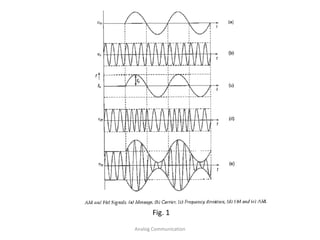
Fig. 1
Analog Communication
Description of Systems
The general equation of an unmodulated wave, or carrier, may be written as
x =Asin(ωt + ϕ) (1)
where x = instantaneous value ( of voltage or current)
A = (maximum) amplitude
ω = angular velocity, radians per second (rad/s)
ϕ, = phase angle, rad
Note that ωt represents an angle in radians.
If any one of these three parameters is varied in accordance with another signal,
normally of a lower frequency, then the second signal is called the modulation, and the
first is said to be modulated by the second.
By the definition of frequency modulation, the amount by which the carrier frequency
is varied from its unmodulated value, called the deviation, is made proportional to the
instantaneous amplitude of the modulating voltage. The rate at which this frequency
variation changes or takes place is equal to the modulating frequency.
The amplitude of the frequency modulated wave remains constant at all times.
This is the greatest single advantage of FM.
Analog Communication
Mathematical Representation of FM:
From Fig.1.c , it is seen that the instantaneous frequency of the frequency modulated wave is
given by
f = fc( 1+ k f Vmcos ωm t ) (2)
where fc is unmodulated (or average) carrier frequency,
k f is proportionality constant expressed in Hz/volt
Vmcosωm t is instantaneous modulating voltage.
The maximum deviation for this signal will occur when the cosine term, has its maximum
value, ± 1. Under these conditions, the instantaneous frequency will be
f = fc (1 ± k f Vm) , (3)
so that the maximum deviation 𝛿f will be given by
𝛿f = k f Vm fc (4)
The instantaneous amplitude of the FM signal will be given by a formula of the form
vFM=Asin[f(ωc ,ωm )] =Asinθ (5)
where f(ωc , ωm ) is some function of the carrier and modulating frequencies. This function
represents an angle and will be called θ for convenience.
Analog Communication
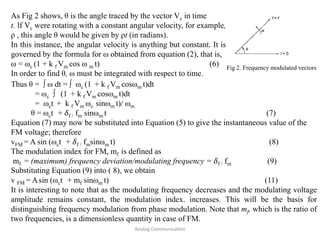
Fig 2. Frequency modulated vectors
As Fig 2 shows, θ is the angle traced by the vector Vc in time
t. lf Vc were rotating with a constant angular velocity, for example,
ρ , this angle θ would be given by ρt (in radians).
In this instance, the angular velocity is anything but constant. It is
governed by the formula for ω obtained from equation (2), that is,
ω = ωc (1 + k f Vm cos ω m t) (6)
In order to find θ, ω must be integrated with respect to time.
Thus θ = ∫ ω dt = ∫ ωc (1 + k f Vm cosωm t)dt
= ωc ∫ (1 + k f Vm cosωm t)dt
= ωct + k f Vm ωc sinωm t)/ ωm
θ = ωct + 𝛿f / fm sinωm t (7)
Equation (7) may now be substituted into Equation (5) to give the instantaneous value of the
FM voltage; therefore
vFM = A sin (ωct + 𝛿f / fmsinωm t) (8)
The modulation index for FM, mf is defined as
mf = (maximum) frequency deviation/modulating frequency = 𝛿f / fm (9)
Substituting Equation (9) into ( 8), we obtain
v FM = Asin (ωct + mf sinωm t) (11)
It is interesting to note that as the modulating frequency decreases and the modulating voltage
amplitude remains constant, the modulation index. increases. This will be the basis for
distinguishing frequency modulation from phase modulation. Note that mf, which is the ratio of
two frequencies, is a dimensionless quantity in case of FM.
Analog Communication
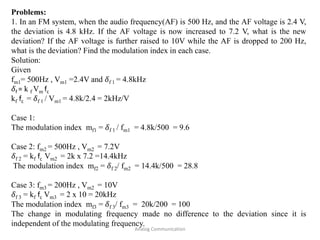
Problems:
1. In an FM system, when the audio frequency(AF) is 500 Hz, and the AF voltage is 2.4 V,
the deviation is 4.8 kHz. If the AF voltage is now increased to 7.2 V, what is the new
deviation? If the AF voltage is further raised to 10V while the AF is dropped to 200 Hz,
what is the deviation? Find the modulation index in each case.
Solution:
Given
fm1= 500Hz , Vm1 =2.4V and 𝛿f 1 = 4.8kHz
𝛿f = k f Vm fc
kf fc = 𝛿f 1 / Vm1 = 4.8k/2.4 = 2kHz/V
Case 1:
The modulation index mf1 = 𝛿f 1 / fm1 = 4.8k/500 = 9.6
Case 2: fm2 = 500Hz , Vm2 = 7.2V
𝛿f 2 = kf fc Vm2 = 2k x 7.2 =14.4kHz
The modulation index mf2 = 𝛿f 2/ fm2 = 14.4k/500 = 28.8
Case 3: fm3 = 200Hz , Vm2 = 10V
𝛿f 3 = kf fc Vm3 = 2 x 10 = 20kHz
The modulation index mf3 = 𝛿f 3/ fm3 = 20k/200 = 100
The change in modulating frequency made no difference to the deviation since it is
independent of the modulating frequency.
Analog Communication
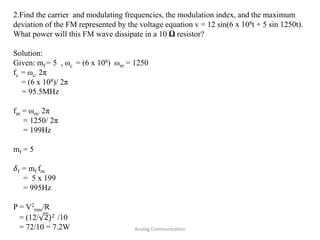
2.Find the carrier and modulating frequencies, the modulation index, and the maximum
deviation of the FM represented by the voltage equation v = 12 sin(6 x 10⁸t + 5 sin 1250t).
What power will this FM wave dissipate in a 10 Ω resistor?
Solution:
Given: mf = 5 , ωc = (6 x 10⁸) ωm = 1250
fc = ωc/ 2π
= (6 x 10⁸)/ 2π
= 95.5MHz
fm = ωm/ 2π
= 1250/ 2π
= 199Hz
mf = 5
𝛿f = mf fm
= 5 x 199
= 995Hz
P = V2
rms/R
= (12/ 2)2 /10
= 72/10 = 7.2W
Analog Communication
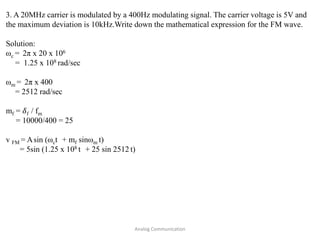
3. A 20MHz carrier is modulated by a 400Hz modulating signal. The carrier voltage is 5V and
the maximum deviation is 10kHz.Write down the mathematical expression for the FM wave.
Solution:
ωc = 2π x 20 x 106
= 1.25 x 10⁸ rad/sec
ωm = 2π x 400
= 2512 rad/sec
mf = 𝛿f / fm
= 10000/400 = 25
v FM = Asin (ωct + mf sinωm t)
= 5sin (1.25 x 10⁸ t + 25 sin 2512 t)
Analog Communication
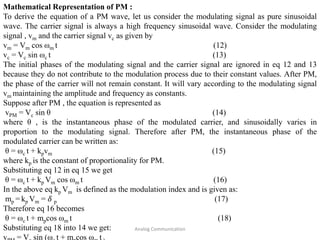
Phase Modulation:
Phase modulation is a system in which the amplitude of the modulated carrier is kept constant,
while its phase and rate of phase change are varied by the modulating signal. By the definition
of phase modulation, the amount by which the carrier phase is varied from its unmodulated
value, called the phase deviation, is made proportional to the instantaneous amplitude of the
modulating voltage. The rate at which this phase variation changes is equal to the modulating
frequency. Fig 3.
Analog Communication
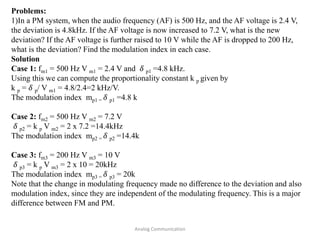
Mathematical Representation of PM :
To derive the equation of a PM wave, let us consider the modulating signal as pure sinusoidal
wave. The carrier signal is always a high frequency sinusoidal wave. Consider the modulating
signal , vm and the carrier signal vc as given by
vm = Vm cos ωm t (12)
vc = Vc sin ωc t (13)
The initial phases of the modulating signal and the carrier signal are ignored in eq 12 and 13
because they do not contribute to the modulation process due to their constant values. After PM,
the phase of the carrier will not remain constant. It will vary according to the modulating signal
vm maintaining the amplitude and frequency as constants.
Suppose after PM , the equation is represented as
vPM = Vc sin θ (14)
where θ , is the instantaneous phase of the modulated carrier, and sinusoidally varies in
proportion to the modulating signal. Therefore after PM, the instantaneous phase of the
modulated carrier can be written as:
θ = ωc t + kpvm (15)
where kp is the constant of proportionality for PM.
Substituting eq 12 in eq 15 we get
θ = ωc t + kp Vm cos ωm t (16)
In the above eq kp Vm is defined as the modulation index and is given as:
mp = kp Vm = 𝛿 p (17)
Therefore eq 16 becomes
θ = ωc t + mpcos ωm t (18)
Substituting eq 18 into 14 we get:
v = V sin (ω t + m cos ω t
Analog Communication
Problems:
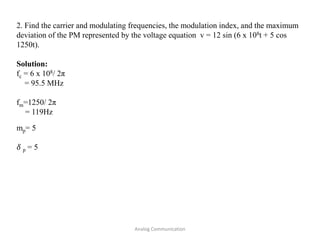
1)In a PM system, when the audio frequency (AF) is 500 Hz, and the AF voltage is 2.4 V,
the deviation is 4.8kHz. If the AF voltage is now increased to 7.2 V, what is the new
deviation? If the AF voltage is further raised to 10 V while the AF is dropped to 200 Hz,
what is the deviation? Find the modulation index in each case.
Solution
Case 1: fm1 = 500 Hz V m1 = 2.4 V and 𝛿 p1 =4.8 kHz.
Using this we can compute the proportionality constant k p given by
k p = 𝛿 p/ V m1 = 4.8/2.4=2 kHz/V.
The modulation index mp1 = 𝛿 p1 =4.8 k
Case 2: fm2 = 500 Hz V m2 = 7.2 V
𝛿 p2 = k p V m2 = 2 x 7.2 =14.4kHz
The modulation index mp2 = 𝛿 p2 =14.4k
Case 3: fm3 = 200 Hz V m3 = 10 V
𝛿 p3 = k p V m3 = 2 x 10 = 20kHz
The modulation index mp3 = 𝛿 p3 = 20k
Note that the change in modulating frequency made no difference to the deviation and also
modulation index, since they are independent of the modulating frequency. This is a major
difference between FM and PM.
Analog Communication
2. Find the carrier and modulating frequencies, the modulation index, and the maximum
deviation of the PM represented by the voltage equation v = 12 sin (6 x 10⁸t + 5 cos
1250t).
Solution:
fc = 6 x 10⁸/ 2π
= 95.5 MHz
fm=1250/ 2π
= 119Hz
mp= 5
𝛿 p = 5
Analog Communication
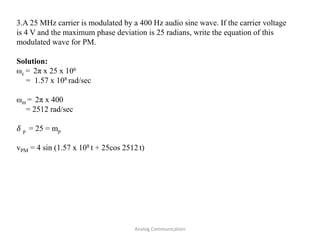
3.A 25 MHz carrier is modulated by a 400 Hz audio sine wave. If the carrier voltage
is 4 V and the maximum phase deviation is 25 radians, write the equation of this
modulated wave for PM.
Solution:
ωc = 2π x 25 x 106
= 1.57 x 10⁸ rad/sec
ωm = 2π x 400
= 2512 rad/sec
𝛿 p = 25 = mp
vPM = 4 sin (1.57 x 10⁸ t + 25cos 2512 t)
Analog Communication
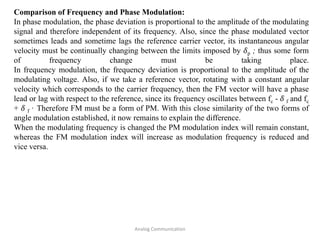
Comparison of Frequency and Phase Modulation:
In phase modulation, the phase deviation is proportional to the amplitude of the modulating
signal and therefore independent of its frequency. Also, since the phase modulated vector
sometimes leads and sometime lags the reference carrier vector, its instantaneous angular
velocity must be continually changing between the limits imposed by 𝛿p ; thus some form
of frequency change must be taking place.
In frequency modulation, the frequency deviation is proportional to the amplitude of the
modulating voltage. Also, if we take a reference vector, rotating with a constant angular
velocity which corresponds to the carrier frequency, then the FM vector will have a phase
lead or lag with respect to the reference, since its frequency oscillates between fc - 𝛿 f and fc
+ 𝛿 f · Therefore FM must be a form of PM. With this close similarity of the two forms of
angle modulation established, it now remains to explain the difference.
When the modulating frequency is changed the PM modulation index will remain constant,
whereas the FM modulation index will increase as modulation frequency is reduced and
vice versa.
Analog Communication
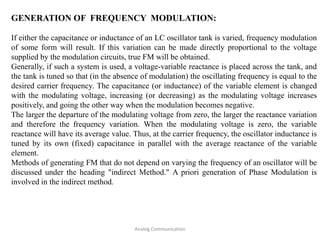
GENERATION OF FREQUENCY MODULATION:
If either the capacitance or inductance of an LC oscillator tank is varied, frequency modulation
of some form will result. If this variation can be made directly proportional to the voltage
supplied by the modulation circuits, true FM will be obtained.
Generally, if such a system is used, a voltage-variable reactance is placed across the tank, and
the tank is tuned so that (in the absence of modulation) the oscillating frequency is equal to the
desired carrier frequency. The capacitance (or inductance) of the variable element is changed
with the modulating voltage, increasing (or decreasing) as the modulating voltage increases
positively, and going the other way when the modulation becomes negative.
The larger the departure of the modulating voltage from zero, the larger the reactance variation
and therefore the frequency variation. When the modulating voltage is zero, the variable
reactance will have its average value. Thus, at the carrier frequency, the oscillator inductance is
tuned by its own (fixed) capacitance in parallel with the average reactance of the variable
element.
Methods of generating FM that do not depend on varying the frequency of an oscillator will be
discussed under the heading "indirect Method." A priori generation of Phase Modulation is
involved in the indirect method.
Analog Communication
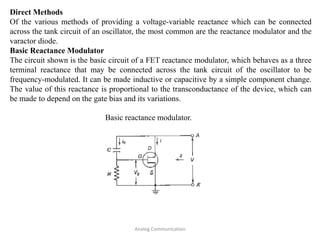
Direct Methods
Of the various methods of providing a voltage-variable reactance which can be connected
across the tank circuit of an oscillator, the most common are the reactance modulator and the
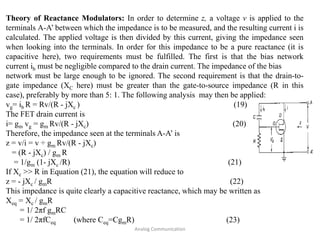
varactor diode.
Basic Reactance Modulator
The circuit shown is the basic circuit of a FET reactance modulator, which behaves as a three
terminal reactance that may be connected across the tank circuit of the oscillator to be
frequency-modulated. It can be made inductive or capacitive by a simple component change.
The value of this reactance is proportional to the transconductance of the device, which can
be made to depend on the gate bias and its variations.
Basic reactance modulator.
Analog Communication
Theory of Reactance Modulators: In order to determine z, a voltage v is applied to the
terminals A-A’ between which the impedance is to be measured, and the resulting current i is
calculated. The applied voltage is then divided by this current, giving the impedance seen
when looking into the terminals. In order for this impedance to be a pure reactance (it is
capacitive here), two requirements must be fulfilled. The first is that the bias network
current ib must be negligible compared to the drain current. The impedance of the bias
network must be large enough to be ignored. The second requirement is that the drain-to-
gate impedance (XC here) must be greater than the gate-to-source impedance (R in this
case), preferably by more than 5: 1. The following analysis may then be applied:
vg= ib R = Rv/(R - jXc ) (19)
The FET drain current is
i= gm vg = gm Rv/(R - jXc) (20)
Therefore, the impedance seen at the terminals A-A’ is
z = v/i = v ÷ gm Rv/(R - jXc)
= (R - jXc) / gm R
= 1/gm (1- jXc /R) (21)
If Xc >> R in Equation (21), the equation will reduce to
z = - jXc / gmR (22)
This impedance is quite clearly a capacitive reactance, which may be written as
Xeq = Xc / gmR
= 1/ 2πf gmRC
= 1/ 2πfCeq (where Ceq=CgmR) (23)
Analog Communication
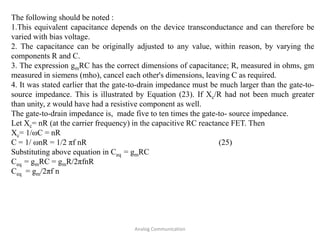
The following should be noted :
1.This equivalent capacitance depends on the device transconductance and can therefore be
varied with bias voltage.
2. The capacitance can be originally adjusted to any value, within reason, by varying the
components R and C.
3. The expression gmRC has the correct dimensions of capacitance; R, measured in ohms, gm
measured in siemens (mho), cancel each other's dimensions, leaving C as required.
4. It was stated earlier that the gate-to-drain impedance must be much larger than the gate-to-
source impedance. This is illustrated by Equation (23). If Xc/R had not been much greater
than unity, z would have had a resistive component as well.
The gate-to-drain impedance is, made five to ten times the gate-to- source impedance.
Let Xc= nR (at the carrier frequency) in the capacitive RC reactance FET. Then
Xc= 1/ωC = nR
C = 1/ ωnR = 1/2 πf nR (25)
Substituting above equation in Ceq = gmRC
Ceq = gmRC = gmR/2πfnR
Ceq = gm/2πf n
Analog Communication
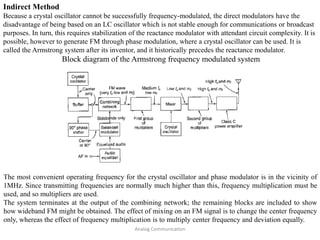
Indirect Method
Because a crystal oscillator cannot be successfully frequency-modulated, the direct modulators have the
disadvantage of being based on an LC oscillator which is not stable enough for communications or broadcast
purposes. In turn, this requires stabilization of the reactance modulator with attendant circuit complexity. It is
possible, however to generate FM through phase modulation, where a crystal oscillator can be used. It is
called the Armstrong system after its inventor, and it historically precedes the reactance modulator.
Block diagram of the Armstrong frequency modulated system
The most convenient operating frequency for the crystal oscillator and phase modulator is in the vicinity of
1MHz. Since transmitting frequencies are normally much higher than this, frequency multiplication must be
used, and so multipliers are used.
The system terminates at the output of the combining network; the remaining blocks are included to show
how wideband FM might be obtained. The effect of mixing on an FM signal is to change the center frequency
only, whereas the effect of frequency multiplication is to multiply center frequency and deviation equally.
Analog Communication
Basic FM Demodulators
The function of a frequency-to-amplitude changer, or FM demodulator, is to change the
frequency deviation of the incoming carrier into an AF amplitude variation (identical to the one
that originally caused the frequency variation). This conversion should be done efficiently and
linearly. In addition, the detection circuit should (if at all possible) be insensitive to amplitude
changes and should not be too critical in its adjustment and operation.
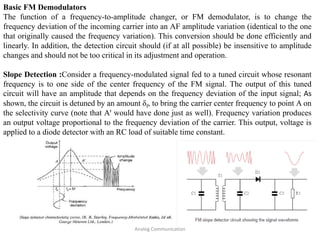
Slope Detection :Consider a frequency-modulated signal fed to a tuned circuit whose resonant
frequency is to one side of the center frequency of the FM signal. The output of this tuned
circuit will have an amplitude that depends on the frequency deviation of the input signal; As
shown, the circuit is detuned by an amount ẟf, to bring the carrier center frequency to point A on
the selectivity curve (note that A' would have done just as well). Frequency variation produces
an output voltage proportional to the frequency deviation of the carrier. This output, voltage is
applied to a diode detector with an RC load of suitable time constant.
Analog Communication
Disadvantages:
• It is inefficient and it is linear only along a very limited frequency range
• It reacts to all amplitude changes.
• It is relatively difficult to adjust, since the primary and secondary windings of the
transformer must be tuned to slightly differing frequencies.
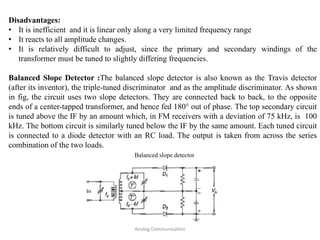
Balanced Slope Detector :The balanced slope detector is also known as the Travis detector
(after its inventor), the triple-tuned discriminator and as the amplitude discriminator. As shown
in fig, the circuit uses two slope detectors. They are connected back to back, to the opposite
ends of a center-tapped transformer, and hence fed 180° out of phase. The top secondary circuit
is tuned above the IF by an amount which, in FM receivers with a deviation of 75 kHz, is 100
kHz. The bottom circuit is similarly tuned below the IF by the same amount. Each tuned circuit
is connected to a diode detector with an RC load. The output is taken from across the series
combination of the two loads.
Balanced slope detector
Analog Communication
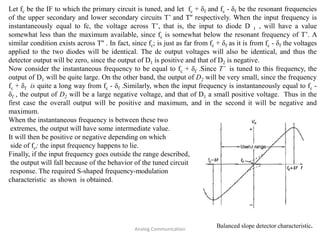
Let fc be the IF to which the primary circuit is tuned, and let fc + ẟf and fc - ẟf be the resonant frequencies
of the upper secondary and lower secondary circuits T’ and T'' respectively. When the input frequency is
instantaneously equal to fc, the voltage across T’, that is, the input to diode D 1 , will have a value
somewhat less than the maximum available, since fc is somewhat below the resonant frequency of T’. A
similar condition exists across T'' . In fact, since fc; is just as far from fc + ẟf as it is from fc - ẟf the voltages
applied to the two diodes will be identical. The dc output voltages will also be identical, and thus the
detector output will be zero, since the output of D1 is positive and that of D2 is negative.
Now consider the instantaneous frequency to be equal to fc + ẟf .Since T’ is tuned to this frequency, the
output of D1 will be quite large. On the other band, the output of D2 will be very small, since the frequency
fc + ẟf is quite a long way from fc - ẟf .Similarly, when the input frequency is instantaneously equal to fc -
ẟf , the output of D2 will be a large negative voltage, and that of D1 a small positive voltage. Thus in the
first case the overall output will be positive and maximum, and in the second it will be negative and
maximum.
When the instantaneous frequency is between these two
extremes, the output will have some intermediate value.
It will then be positive or negative depending on which
side of fc; the input frequency happens to lie.
Finally, if the input frequency goes outside the range described,
the output will fall because of the behavior of the tuned circuit
response. The required S-shaped frequency-modulation
characteristic as shown is obtained.
Balanced slope detector characteristic.
Analog Communication
Disadvantages:
• Although this detector is considerably more efficient than the previous one, it is even
trickier to align, because there are now three different frequencies to which the various
tuned circuits of the transformer must be adjusted.
• Amplitude limiting is still not provided, and the linearity, although better than that of the
single slope detector, is still not good enough.
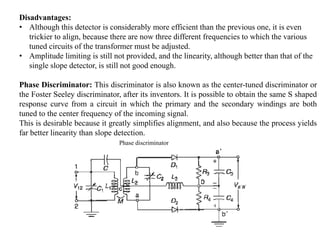
Phase Discriminator: This discriminator is also known as the center-tuned discriminator or
the Foster Seeley discriminator, after its inventors. It is possible to obtain the same S shaped
response curve from a circuit in which the primary and the secondary windings are both
tuned to the center frequency of the incoming signal.
This is desirable because it greatly simplifies alignment, and also because the process yields
far better linearity than slope detection.
Phase discriminator
Analog Communication
It will also be shown that the primary and secondary voltages are:
l. Exactly 90° out of phase when the input frequency is fc
2. Less than 90° out of phase when fin is higher than fc
3. More than 90° out of phase when fin is below fc
Thus, although the individual component voltages will be the same at the diode inputs at all
frequencies, the vector sums will differ with the phase difference between primary and
secondary windings. The result will be that the individual output voltages will be equal only
at fc. At all other frequencies the output of one diode will be greater than that of the other.
Which diode has the larger output will depend entirely on whether fin is above or below fc.
As for the output arrangements, it will be noted that they are the same as in the balanced
slope detector. Accordingly, the overall output will be positive or negative according to the
input frequency. As required the magnitude of the output will depend on the deviation of
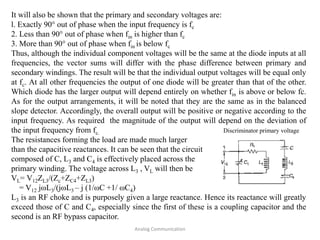
the input frequency from fc. Discriminator primary voltage
The resistances forming the load are made much larger
than the capacitive reactances. It can be seen that the circuit
composed of C, L3 and C4 is effectively placed across the
primary winding. The voltage across L3 , VL will then be
VL= V12ZL3/(Zc+ZC4+ZL3)
= V12 jωL3/(jωL3 – j (1/ωC +1/ ωC4)
L3 is an RF choke and is purposely given a large reactance. Hence its reactance will greatly
exceed those of C and C4, especially since the first of these is a coupling capacitor and the
second is an RF bypass capacitor.
Analog Communication
Therefore the above equation will reduce to
VL= V12
The voltage across the RF choke is equal to the applied primary voltage.
The mutually coupled, double-tuned circuit has high primary and secondary Q and a low
mutual inductance.
When evaluating the primary current, one may, therefore, neglect the impedance (coupled in
from the secondary) and the primary resistance. Then IP is given simply by
IP= V12/ jωL1
From basic transformer circuit theory, a voltage is induced in series in the secondary as a result
of the current in the primary. This voltage can be expressed as follows:
Vs = ± jωM IP
where the sign depends on the direction of winding.
It is simpler here to take the connection giving negative mutual inductance.
We have
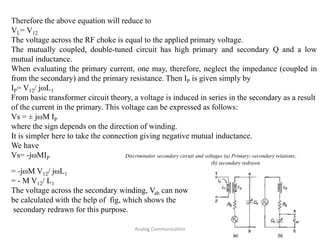
Vs= -jωMIP Discriminator secondary circuit and voltages (a) Primary;-secondary relations;
(b) secondary redrawn
= -jωM V12/ jωL1
= - M V12/ L1
The voltage across the secondary winding, Vab can now
be calculated with the help of fig, which shows the
secondary redrawn for this purpose.
Analog Communication
Then
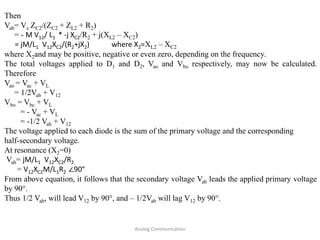
Vab= Vs ZC2/(ZC2 + ZL2 + R2)
= - M V12/ L1 * -j XC2/R2 + j(XL2 – XC2)
= jM/L1 V12XC2/(R2+jX2) where X2=XL2 – XC2
where X2and may be positive, negative or even zero, depending on the frequency.
The total voltages applied to D1 and D2, Vao and Vbo respectively, may now be calculated.
Therefore
Vao = Vac + VL
= 1/2Vab + V12
Vbo = Vbc + VL
= - Vac + VL
= -1/2 Vab + V12
The voltage applied to each diode is the sum of the primary voltage and the corresponding
half-secondary voltage.
At resonance (X2=0)
Vab= jM/L1 V12XC2/R2
= V12XC2M/L1R2 ∠90°
From above equation, it follows that the secondary voltage Vab leads the applied primary voltage
by 90°.
Thus 1/2 Vab, will lead V12 by 90°, and – 1/2Vab will lag V12 by 90°.
Analog Communication
Now consider the case when fin=fc ie. At resonance the equation for
Vab = V12XC2M/L1R2 ∠90° since XL2 =XC2
X2=0
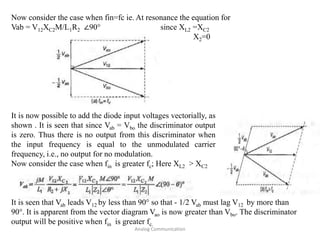
It is now possible to add the diode input voltages vectorially, as
shown . It is seen that since Vab = Vbo the discriminator output
is zero. Thus there is no output from this discriminator when
the input frequency is equal to the unmodulated carrier
frequency, i.e., no output for no modulation.
Now consider the case when fin is greater fc; Here XL2 > XC2
It is seen that Vab leads V12 by less than 90° so that - 1/2 Vab must lag V12 by more than
90°. It is apparent from the vector diagram Vao is now greater than Vbo. The discriminator
output will be positive when fin is greater fc.
Analog Communication
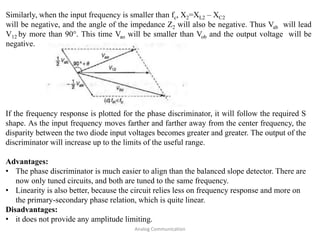
Similarly, when the input frequency is smaller than fc, X2=XL2 – XC2
will be negative, and the angle of the impedance Z2 will also be negative. Thus Vab will lead
V12 by more than 90°. This time Vao will be smaller than Vob and the output voltage will be
negative.
If the frequency response is plotted for the phase discriminator, it will follow the required S
shape. As the input frequency moves farther and farther away from the center frequency, the
disparity between the two diode input voltages becomes greater and greater. The output of the
discriminator will increase up to the limits of the useful range.
Advantages:
• The phase discriminator is much easier to align than the balanced slope detector. There are
now only tuned circuits, and both are tuned to the same frequency.
• Linearity is also better, because the circuit relies less on frequency response and more on
the primary-secondary phase relation, which is quite linear.
Disadvantages:
• it does not provide any amplitude limiting.
Analog Communication
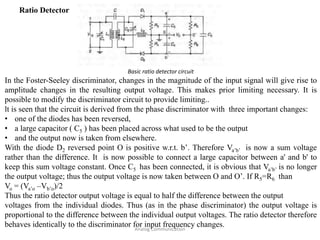
Ratio Detector
Basic ratio detector circuit
In the Foster-Seeley discriminator, changes in the magnitude of the input signal will give rise to
amplitude changes in the resulting output voltage. This makes prior limiting necessary. It is
possible to modify the discriminator circuit to provide limiting..
lt is seen that the circuit is derived from the phase discriminator with three important changes:
• one of the diodes has been reversed,
• a large capacitor ( C5 ) has been placed across what used to be the output
• and the output now is taken from elsewhere.
With the diode D2 reversed point O is positive w.r.t. b’. Therefore Va’b’ is now a sum voltage
rather than the difference. It is now possible to connect a large capacitor between a' and b' to
keep this sum voltage constant. Once C5 has been connected, it is obvious that Va’b’ is no longer
the output voltage; thus the output voltage is now taken between O and O’. If R5=R6 than
Vo = (Va’o –Vb’o)/2
Thus the ratio detector output voltage is equal to half the difference between the output
voltages from the individual diodes. Thus (as in the phase discriminator) the output voltage is
proportional to the difference between the individual output voltages. The ratio detector therefore
behaves identically to the discriminator for input frequency changes.
Analog Communication
If the input voltage V12 is constant and has been so for some time, C5 has been able to charge
up to the potential existing between a' and b'. Since this is a dc voltage if V12 is constant, there
will be no current either flowing in to charge the capacitor or flowing out to discharge it.
If V12 tries to increase, C5 will tend to oppose any rise in Vo. As soon as the input voltage tries
to rise, extra diode current flows, but this excess current flows into the capacitor C5, charging
it. The voltage Va’b’ remains constant at first because it is not possible for the voltage across a
capacitor to change instantaneously. The situation now is that the current in the diodes load has
risen, but the voltage across the load has not changed. The conclusion is that the load
impedance has decreased. The secondary of the ratio detector transfonner is more heavily
damped, the Q falls, and so does the gain of the amplifier driving the ratio detector. This
neatly counteracts the initial rise in input voltage.
Should the input voltage fall, the diode current will fall, but the load voltage will not, at first,
because of ·the presence of the capacitor. The effect is that of an increased diode load
impedance; the diode current has fallen, but the load voltage has remained constant.
Accordingly, damping is reduced, and the gain of the driving amplifier rises, this time
counteracting an initial fall in the input voltage. The ratio detector provides what is known as
diode variable damping. We have here a system of varying the gain of an amplifier by
changing the damping of its tuned circuit. This maintains a constant output voltage despite
changes in the amplitude of the input.

Angle Modulation -Frequency Modulation and Phase Modulation.pptx

  • 1.
    Analog Communication Semester V[ETC/ECE5.6] Analog Communication
  • 2.
    Unit 2: Angle modulation:FM and PM signals, Relationship between frequency and phase modulation. Tone modulated FM. Arbitrary modulated FM. Spectrum of FM and PM, Implementation of angle modulators and demodulators: Direct method using FET, Armstrong method of generation. Slope detector, Foster-Seelay Discriminator, Ratio detector. FM broadcasting, FM stereo broadcasting. Analog Communication
  • 3.
    Theory of AngleModulation Frequency Modulation: Frequency modulation is a system in which the amplitude of the modulated carrier is kept constant, while its frequency and rate of change are varied by the modulating signal. Let's assume for the moment that the carrier of the transmitter is at its resting frequency (no modulation) of 100 MHz and we apply a modulating signal. The amplitude of the modulating signal will cause the carrier to deviate (shift) from this resting frequency by a certain amount. If we increase the amplitude (loudness) of this signal we will increase the deviation to a maximum of 75kHz as specified by the FCC. If we remove the modulation, the carrier frequency shifts back to its resting frequency· (100 MHz). The deviation of the carrier is proportional to the amplitude of the modulating voltage. The shift in the carrier frequency from its resting point compared to the amplitude of the modulating voltage is called the deviation ratio (a deviation ratio of 5 is the maximum allowed in commercially broadcast FM). The rate at which the carrier shifts from its resting point to a nonresting point is determined by the frequency of the modulating signal. Analog Communication
  • 4.
  • 5.
    Analog Communication Description ofSystems The general equation of an unmodulated wave, or carrier, may be written as x =Asin(ωt + ϕ) (1) where x = instantaneous value ( of voltage or current) A = (maximum) amplitude ω = angular velocity, radians per second (rad/s) ϕ, = phase angle, rad Note that ωt represents an angle in radians. If any one of these three parameters is varied in accordance with another signal, normally of a lower frequency, then the second signal is called the modulation, and the first is said to be modulated by the second. By the definition of frequency modulation, the amount by which the carrier frequency is varied from its unmodulated value, called the deviation, is made proportional to the instantaneous amplitude of the modulating voltage. The rate at which this frequency variation changes or takes place is equal to the modulating frequency. The amplitude of the frequency modulated wave remains constant at all times. This is the greatest single advantage of FM.
  • 6.
    Analog Communication Mathematical Representationof FM: From Fig.1.c , it is seen that the instantaneous frequency of the frequency modulated wave is given by f = fc( 1+ k f Vmcos ωm t ) (2) where fc is unmodulated (or average) carrier frequency, k f is proportionality constant expressed in Hz/volt Vmcosωm t is instantaneous modulating voltage. The maximum deviation for this signal will occur when the cosine term, has its maximum value, ± 1. Under these conditions, the instantaneous frequency will be f = fc (1 ± k f Vm) , (3) so that the maximum deviation 𝛿f will be given by 𝛿f = k f Vm fc (4) The instantaneous amplitude of the FM signal will be given by a formula of the form vFM=Asin[f(ωc ,ωm )] =Asinθ (5) where f(ωc , ωm ) is some function of the carrier and modulating frequencies. This function represents an angle and will be called θ for convenience.
  • 7.
    Analog Communication Fig 2.Frequency modulated vectors As Fig 2 shows, θ is the angle traced by the vector Vc in time t. lf Vc were rotating with a constant angular velocity, for example, ρ , this angle θ would be given by ρt (in radians). In this instance, the angular velocity is anything but constant. It is governed by the formula for ω obtained from equation (2), that is, ω = ωc (1 + k f Vm cos ω m t) (6) In order to find θ, ω must be integrated with respect to time. Thus θ = ∫ ω dt = ∫ ωc (1 + k f Vm cosωm t)dt = ωc ∫ (1 + k f Vm cosωm t)dt = ωct + k f Vm ωc sinωm t)/ ωm θ = ωct + 𝛿f / fm sinωm t (7) Equation (7) may now be substituted into Equation (5) to give the instantaneous value of the FM voltage; therefore vFM = A sin (ωct + 𝛿f / fmsinωm t) (8) The modulation index for FM, mf is defined as mf = (maximum) frequency deviation/modulating frequency = 𝛿f / fm (9) Substituting Equation (9) into ( 8), we obtain v FM = Asin (ωct + mf sinωm t) (11) It is interesting to note that as the modulating frequency decreases and the modulating voltage amplitude remains constant, the modulation index. increases. This will be the basis for distinguishing frequency modulation from phase modulation. Note that mf, which is the ratio of two frequencies, is a dimensionless quantity in case of FM.
  • 8.
    Analog Communication Problems: 1. Inan FM system, when the audio frequency(AF) is 500 Hz, and the AF voltage is 2.4 V, the deviation is 4.8 kHz. If the AF voltage is now increased to 7.2 V, what is the new deviation? If the AF voltage is further raised to 10V while the AF is dropped to 200 Hz, what is the deviation? Find the modulation index in each case. Solution: Given fm1= 500Hz , Vm1 =2.4V and 𝛿f 1 = 4.8kHz 𝛿f = k f Vm fc kf fc = 𝛿f 1 / Vm1 = 4.8k/2.4 = 2kHz/V Case 1: The modulation index mf1 = 𝛿f 1 / fm1 = 4.8k/500 = 9.6 Case 2: fm2 = 500Hz , Vm2 = 7.2V 𝛿f 2 = kf fc Vm2 = 2k x 7.2 =14.4kHz The modulation index mf2 = 𝛿f 2/ fm2 = 14.4k/500 = 28.8 Case 3: fm3 = 200Hz , Vm2 = 10V 𝛿f 3 = kf fc Vm3 = 2 x 10 = 20kHz The modulation index mf3 = 𝛿f 3/ fm3 = 20k/200 = 100 The change in modulating frequency made no difference to the deviation since it is independent of the modulating frequency.
  • 9.
    Analog Communication 2.Find thecarrier and modulating frequencies, the modulation index, and the maximum deviation of the FM represented by the voltage equation v = 12 sin(6 x 10⁸t + 5 sin 1250t). What power will this FM wave dissipate in a 10 Ω resistor? Solution: Given: mf = 5 , ωc = (6 x 10⁸) ωm = 1250 fc = ωc/ 2π = (6 x 10⁸)/ 2π = 95.5MHz fm = ωm/ 2π = 1250/ 2π = 199Hz mf = 5 𝛿f = mf fm = 5 x 199 = 995Hz P = V2 rms/R = (12/ 2)2 /10 = 72/10 = 7.2W
  • 10.
    Analog Communication 3. A20MHz carrier is modulated by a 400Hz modulating signal. The carrier voltage is 5V and the maximum deviation is 10kHz.Write down the mathematical expression for the FM wave. Solution: ωc = 2π x 20 x 106 = 1.25 x 10⁸ rad/sec ωm = 2π x 400 = 2512 rad/sec mf = 𝛿f / fm = 10000/400 = 25 v FM = Asin (ωct + mf sinωm t) = 5sin (1.25 x 10⁸ t + 25 sin 2512 t)
  • 11.
    Analog Communication Phase Modulation: Phasemodulation is a system in which the amplitude of the modulated carrier is kept constant, while its phase and rate of phase change are varied by the modulating signal. By the definition of phase modulation, the amount by which the carrier phase is varied from its unmodulated value, called the phase deviation, is made proportional to the instantaneous amplitude of the modulating voltage. The rate at which this phase variation changes is equal to the modulating frequency. Fig 3.
  • 12.
    Analog Communication Mathematical Representationof PM : To derive the equation of a PM wave, let us consider the modulating signal as pure sinusoidal wave. The carrier signal is always a high frequency sinusoidal wave. Consider the modulating signal , vm and the carrier signal vc as given by vm = Vm cos ωm t (12) vc = Vc sin ωc t (13) The initial phases of the modulating signal and the carrier signal are ignored in eq 12 and 13 because they do not contribute to the modulation process due to their constant values. After PM, the phase of the carrier will not remain constant. It will vary according to the modulating signal vm maintaining the amplitude and frequency as constants. Suppose after PM , the equation is represented as vPM = Vc sin θ (14) where θ , is the instantaneous phase of the modulated carrier, and sinusoidally varies in proportion to the modulating signal. Therefore after PM, the instantaneous phase of the modulated carrier can be written as: θ = ωc t + kpvm (15) where kp is the constant of proportionality for PM. Substituting eq 12 in eq 15 we get θ = ωc t + kp Vm cos ωm t (16) In the above eq kp Vm is defined as the modulation index and is given as: mp = kp Vm = 𝛿 p (17) Therefore eq 16 becomes θ = ωc t + mpcos ωm t (18) Substituting eq 18 into 14 we get: v = V sin (ω t + m cos ω t
  • 13.
    Analog Communication Problems: 1)In aPM system, when the audio frequency (AF) is 500 Hz, and the AF voltage is 2.4 V, the deviation is 4.8kHz. If the AF voltage is now increased to 7.2 V, what is the new deviation? If the AF voltage is further raised to 10 V while the AF is dropped to 200 Hz, what is the deviation? Find the modulation index in each case. Solution Case 1: fm1 = 500 Hz V m1 = 2.4 V and 𝛿 p1 =4.8 kHz. Using this we can compute the proportionality constant k p given by k p = 𝛿 p/ V m1 = 4.8/2.4=2 kHz/V. The modulation index mp1 = 𝛿 p1 =4.8 k Case 2: fm2 = 500 Hz V m2 = 7.2 V 𝛿 p2 = k p V m2 = 2 x 7.2 =14.4kHz The modulation index mp2 = 𝛿 p2 =14.4k Case 3: fm3 = 200 Hz V m3 = 10 V 𝛿 p3 = k p V m3 = 2 x 10 = 20kHz The modulation index mp3 = 𝛿 p3 = 20k Note that the change in modulating frequency made no difference to the deviation and also modulation index, since they are independent of the modulating frequency. This is a major difference between FM and PM.
  • 14.
    Analog Communication 2. Findthe carrier and modulating frequencies, the modulation index, and the maximum deviation of the PM represented by the voltage equation v = 12 sin (6 x 10⁸t + 5 cos 1250t). Solution: fc = 6 x 10⁸/ 2π = 95.5 MHz fm=1250/ 2π = 119Hz mp= 5 𝛿 p = 5
  • 15.
    Analog Communication 3.A 25MHz carrier is modulated by a 400 Hz audio sine wave. If the carrier voltage is 4 V and the maximum phase deviation is 25 radians, write the equation of this modulated wave for PM. Solution: ωc = 2π x 25 x 106 = 1.57 x 10⁸ rad/sec ωm = 2π x 400 = 2512 rad/sec 𝛿 p = 25 = mp vPM = 4 sin (1.57 x 10⁸ t + 25cos 2512 t)
  • 16.
    Analog Communication Comparison ofFrequency and Phase Modulation: In phase modulation, the phase deviation is proportional to the amplitude of the modulating signal and therefore independent of its frequency. Also, since the phase modulated vector sometimes leads and sometime lags the reference carrier vector, its instantaneous angular velocity must be continually changing between the limits imposed by 𝛿p ; thus some form of frequency change must be taking place. In frequency modulation, the frequency deviation is proportional to the amplitude of the modulating voltage. Also, if we take a reference vector, rotating with a constant angular velocity which corresponds to the carrier frequency, then the FM vector will have a phase lead or lag with respect to the reference, since its frequency oscillates between fc - 𝛿 f and fc + 𝛿 f · Therefore FM must be a form of PM. With this close similarity of the two forms of angle modulation established, it now remains to explain the difference. When the modulating frequency is changed the PM modulation index will remain constant, whereas the FM modulation index will increase as modulation frequency is reduced and vice versa.
  • 17.
    Analog Communication GENERATION OFFREQUENCY MODULATION: If either the capacitance or inductance of an LC oscillator tank is varied, frequency modulation of some form will result. If this variation can be made directly proportional to the voltage supplied by the modulation circuits, true FM will be obtained. Generally, if such a system is used, a voltage-variable reactance is placed across the tank, and the tank is tuned so that (in the absence of modulation) the oscillating frequency is equal to the desired carrier frequency. The capacitance (or inductance) of the variable element is changed with the modulating voltage, increasing (or decreasing) as the modulating voltage increases positively, and going the other way when the modulation becomes negative. The larger the departure of the modulating voltage from zero, the larger the reactance variation and therefore the frequency variation. When the modulating voltage is zero, the variable reactance will have its average value. Thus, at the carrier frequency, the oscillator inductance is tuned by its own (fixed) capacitance in parallel with the average reactance of the variable element. Methods of generating FM that do not depend on varying the frequency of an oscillator will be discussed under the heading "indirect Method." A priori generation of Phase Modulation is involved in the indirect method.
  • 18.
    Analog Communication Direct Methods Ofthe various methods of providing a voltage-variable reactance which can be connected across the tank circuit of an oscillator, the most common are the reactance modulator and the varactor diode. Basic Reactance Modulator The circuit shown is the basic circuit of a FET reactance modulator, which behaves as a three terminal reactance that may be connected across the tank circuit of the oscillator to be frequency-modulated. It can be made inductive or capacitive by a simple component change. The value of this reactance is proportional to the transconductance of the device, which can be made to depend on the gate bias and its variations. Basic reactance modulator.
  • 19.
    Analog Communication Theory ofReactance Modulators: In order to determine z, a voltage v is applied to the terminals A-A’ between which the impedance is to be measured, and the resulting current i is calculated. The applied voltage is then divided by this current, giving the impedance seen when looking into the terminals. In order for this impedance to be a pure reactance (it is capacitive here), two requirements must be fulfilled. The first is that the bias network current ib must be negligible compared to the drain current. The impedance of the bias network must be large enough to be ignored. The second requirement is that the drain-to- gate impedance (XC here) must be greater than the gate-to-source impedance (R in this case), preferably by more than 5: 1. The following analysis may then be applied: vg= ib R = Rv/(R - jXc ) (19) The FET drain current is i= gm vg = gm Rv/(R - jXc) (20) Therefore, the impedance seen at the terminals A-A’ is z = v/i = v ÷ gm Rv/(R - jXc) = (R - jXc) / gm R = 1/gm (1- jXc /R) (21) If Xc >> R in Equation (21), the equation will reduce to z = - jXc / gmR (22) This impedance is quite clearly a capacitive reactance, which may be written as Xeq = Xc / gmR = 1/ 2πf gmRC = 1/ 2πfCeq (where Ceq=CgmR) (23)
  • 20.
    Analog Communication The followingshould be noted : 1.This equivalent capacitance depends on the device transconductance and can therefore be varied with bias voltage. 2. The capacitance can be originally adjusted to any value, within reason, by varying the components R and C. 3. The expression gmRC has the correct dimensions of capacitance; R, measured in ohms, gm measured in siemens (mho), cancel each other's dimensions, leaving C as required. 4. It was stated earlier that the gate-to-drain impedance must be much larger than the gate-to- source impedance. This is illustrated by Equation (23). If Xc/R had not been much greater than unity, z would have had a resistive component as well. The gate-to-drain impedance is, made five to ten times the gate-to- source impedance. Let Xc= nR (at the carrier frequency) in the capacitive RC reactance FET. Then Xc= 1/ωC = nR C = 1/ ωnR = 1/2 πf nR (25) Substituting above equation in Ceq = gmRC Ceq = gmRC = gmR/2πfnR Ceq = gm/2πf n
  • 21.
    Analog Communication Indirect Method Becausea crystal oscillator cannot be successfully frequency-modulated, the direct modulators have the disadvantage of being based on an LC oscillator which is not stable enough for communications or broadcast purposes. In turn, this requires stabilization of the reactance modulator with attendant circuit complexity. It is possible, however to generate FM through phase modulation, where a crystal oscillator can be used. It is called the Armstrong system after its inventor, and it historically precedes the reactance modulator. Block diagram of the Armstrong frequency modulated system The most convenient operating frequency for the crystal oscillator and phase modulator is in the vicinity of 1MHz. Since transmitting frequencies are normally much higher than this, frequency multiplication must be used, and so multipliers are used. The system terminates at the output of the combining network; the remaining blocks are included to show how wideband FM might be obtained. The effect of mixing on an FM signal is to change the center frequency only, whereas the effect of frequency multiplication is to multiply center frequency and deviation equally.
  • 22.
    Analog Communication Basic FMDemodulators The function of a frequency-to-amplitude changer, or FM demodulator, is to change the frequency deviation of the incoming carrier into an AF amplitude variation (identical to the one that originally caused the frequency variation). This conversion should be done efficiently and linearly. In addition, the detection circuit should (if at all possible) be insensitive to amplitude changes and should not be too critical in its adjustment and operation. Slope Detection :Consider a frequency-modulated signal fed to a tuned circuit whose resonant frequency is to one side of the center frequency of the FM signal. The output of this tuned circuit will have an amplitude that depends on the frequency deviation of the input signal; As shown, the circuit is detuned by an amount ẟf, to bring the carrier center frequency to point A on the selectivity curve (note that A' would have done just as well). Frequency variation produces an output voltage proportional to the frequency deviation of the carrier. This output, voltage is applied to a diode detector with an RC load of suitable time constant.
  • 23.
    Analog Communication Disadvantages: • Itis inefficient and it is linear only along a very limited frequency range • It reacts to all amplitude changes. • It is relatively difficult to adjust, since the primary and secondary windings of the transformer must be tuned to slightly differing frequencies. Balanced Slope Detector :The balanced slope detector is also known as the Travis detector (after its inventor), the triple-tuned discriminator and as the amplitude discriminator. As shown in fig, the circuit uses two slope detectors. They are connected back to back, to the opposite ends of a center-tapped transformer, and hence fed 180° out of phase. The top secondary circuit is tuned above the IF by an amount which, in FM receivers with a deviation of 75 kHz, is 100 kHz. The bottom circuit is similarly tuned below the IF by the same amount. Each tuned circuit is connected to a diode detector with an RC load. The output is taken from across the series combination of the two loads. Balanced slope detector
  • 24.
    Analog Communication Let fcbe the IF to which the primary circuit is tuned, and let fc + ẟf and fc - ẟf be the resonant frequencies of the upper secondary and lower secondary circuits T’ and T'' respectively. When the input frequency is instantaneously equal to fc, the voltage across T’, that is, the input to diode D 1 , will have a value somewhat less than the maximum available, since fc is somewhat below the resonant frequency of T’. A similar condition exists across T'' . In fact, since fc; is just as far from fc + ẟf as it is from fc - ẟf the voltages applied to the two diodes will be identical. The dc output voltages will also be identical, and thus the detector output will be zero, since the output of D1 is positive and that of D2 is negative. Now consider the instantaneous frequency to be equal to fc + ẟf .Since T’ is tuned to this frequency, the output of D1 will be quite large. On the other band, the output of D2 will be very small, since the frequency fc + ẟf is quite a long way from fc - ẟf .Similarly, when the input frequency is instantaneously equal to fc - ẟf , the output of D2 will be a large negative voltage, and that of D1 a small positive voltage. Thus in the first case the overall output will be positive and maximum, and in the second it will be negative and maximum. When the instantaneous frequency is between these two extremes, the output will have some intermediate value. It will then be positive or negative depending on which side of fc; the input frequency happens to lie. Finally, if the input frequency goes outside the range described, the output will fall because of the behavior of the tuned circuit response. The required S-shaped frequency-modulation characteristic as shown is obtained. Balanced slope detector characteristic.
  • 25.
    Analog Communication Disadvantages: • Althoughthis detector is considerably more efficient than the previous one, it is even trickier to align, because there are now three different frequencies to which the various tuned circuits of the transformer must be adjusted. • Amplitude limiting is still not provided, and the linearity, although better than that of the single slope detector, is still not good enough. Phase Discriminator: This discriminator is also known as the center-tuned discriminator or the Foster Seeley discriminator, after its inventors. It is possible to obtain the same S shaped response curve from a circuit in which the primary and the secondary windings are both tuned to the center frequency of the incoming signal. This is desirable because it greatly simplifies alignment, and also because the process yields far better linearity than slope detection. Phase discriminator
  • 26.
    Analog Communication It willalso be shown that the primary and secondary voltages are: l. Exactly 90° out of phase when the input frequency is fc 2. Less than 90° out of phase when fin is higher than fc 3. More than 90° out of phase when fin is below fc Thus, although the individual component voltages will be the same at the diode inputs at all frequencies, the vector sums will differ with the phase difference between primary and secondary windings. The result will be that the individual output voltages will be equal only at fc. At all other frequencies the output of one diode will be greater than that of the other. Which diode has the larger output will depend entirely on whether fin is above or below fc. As for the output arrangements, it will be noted that they are the same as in the balanced slope detector. Accordingly, the overall output will be positive or negative according to the input frequency. As required the magnitude of the output will depend on the deviation of the input frequency from fc. Discriminator primary voltage The resistances forming the load are made much larger than the capacitive reactances. It can be seen that the circuit composed of C, L3 and C4 is effectively placed across the primary winding. The voltage across L3 , VL will then be VL= V12ZL3/(Zc+ZC4+ZL3) = V12 jωL3/(jωL3 – j (1/ωC +1/ ωC4) L3 is an RF choke and is purposely given a large reactance. Hence its reactance will greatly exceed those of C and C4, especially since the first of these is a coupling capacitor and the second is an RF bypass capacitor.
  • 27.
    Analog Communication Therefore theabove equation will reduce to VL= V12 The voltage across the RF choke is equal to the applied primary voltage. The mutually coupled, double-tuned circuit has high primary and secondary Q and a low mutual inductance. When evaluating the primary current, one may, therefore, neglect the impedance (coupled in from the secondary) and the primary resistance. Then IP is given simply by IP= V12/ jωL1 From basic transformer circuit theory, a voltage is induced in series in the secondary as a result of the current in the primary. This voltage can be expressed as follows: Vs = ± jωM IP where the sign depends on the direction of winding. It is simpler here to take the connection giving negative mutual inductance. We have Vs= -jωMIP Discriminator secondary circuit and voltages (a) Primary;-secondary relations; (b) secondary redrawn = -jωM V12/ jωL1 = - M V12/ L1 The voltage across the secondary winding, Vab can now be calculated with the help of fig, which shows the secondary redrawn for this purpose.
  • 28.
    Analog Communication Then Vab= VsZC2/(ZC2 + ZL2 + R2) = - M V12/ L1 * -j XC2/R2 + j(XL2 – XC2) = jM/L1 V12XC2/(R2+jX2) where X2=XL2 – XC2 where X2and may be positive, negative or even zero, depending on the frequency. The total voltages applied to D1 and D2, Vao and Vbo respectively, may now be calculated. Therefore Vao = Vac + VL = 1/2Vab + V12 Vbo = Vbc + VL = - Vac + VL = -1/2 Vab + V12 The voltage applied to each diode is the sum of the primary voltage and the corresponding half-secondary voltage. At resonance (X2=0) Vab= jM/L1 V12XC2/R2 = V12XC2M/L1R2 ∠90° From above equation, it follows that the secondary voltage Vab leads the applied primary voltage by 90°. Thus 1/2 Vab, will lead V12 by 90°, and – 1/2Vab will lag V12 by 90°.
  • 29.
    Analog Communication Now considerthe case when fin=fc ie. At resonance the equation for Vab = V12XC2M/L1R2 ∠90° since XL2 =XC2 X2=0 It is now possible to add the diode input voltages vectorially, as shown . It is seen that since Vab = Vbo the discriminator output is zero. Thus there is no output from this discriminator when the input frequency is equal to the unmodulated carrier frequency, i.e., no output for no modulation. Now consider the case when fin is greater fc; Here XL2 > XC2 It is seen that Vab leads V12 by less than 90° so that - 1/2 Vab must lag V12 by more than 90°. It is apparent from the vector diagram Vao is now greater than Vbo. The discriminator output will be positive when fin is greater fc.
  • 30.
    Analog Communication Similarly, whenthe input frequency is smaller than fc, X2=XL2 – XC2 will be negative, and the angle of the impedance Z2 will also be negative. Thus Vab will lead V12 by more than 90°. This time Vao will be smaller than Vob and the output voltage will be negative. If the frequency response is plotted for the phase discriminator, it will follow the required S shape. As the input frequency moves farther and farther away from the center frequency, the disparity between the two diode input voltages becomes greater and greater. The output of the discriminator will increase up to the limits of the useful range. Advantages: • The phase discriminator is much easier to align than the balanced slope detector. There are now only tuned circuits, and both are tuned to the same frequency. • Linearity is also better, because the circuit relies less on frequency response and more on the primary-secondary phase relation, which is quite linear. Disadvantages: • it does not provide any amplitude limiting.
  • 31.
    Analog Communication Ratio Detector Basicratio detector circuit In the Foster-Seeley discriminator, changes in the magnitude of the input signal will give rise to amplitude changes in the resulting output voltage. This makes prior limiting necessary. It is possible to modify the discriminator circuit to provide limiting.. lt is seen that the circuit is derived from the phase discriminator with three important changes: • one of the diodes has been reversed, • a large capacitor ( C5 ) has been placed across what used to be the output • and the output now is taken from elsewhere. With the diode D2 reversed point O is positive w.r.t. b’. Therefore Va’b’ is now a sum voltage rather than the difference. It is now possible to connect a large capacitor between a' and b' to keep this sum voltage constant. Once C5 has been connected, it is obvious that Va’b’ is no longer the output voltage; thus the output voltage is now taken between O and O’. If R5=R6 than Vo = (Va’o –Vb’o)/2 Thus the ratio detector output voltage is equal to half the difference between the output voltages from the individual diodes. Thus (as in the phase discriminator) the output voltage is proportional to the difference between the individual output voltages. The ratio detector therefore behaves identically to the discriminator for input frequency changes.
  • 32.
    Analog Communication If theinput voltage V12 is constant and has been so for some time, C5 has been able to charge up to the potential existing between a' and b'. Since this is a dc voltage if V12 is constant, there will be no current either flowing in to charge the capacitor or flowing out to discharge it. If V12 tries to increase, C5 will tend to oppose any rise in Vo. As soon as the input voltage tries to rise, extra diode current flows, but this excess current flows into the capacitor C5, charging it. The voltage Va’b’ remains constant at first because it is not possible for the voltage across a capacitor to change instantaneously. The situation now is that the current in the diodes load has risen, but the voltage across the load has not changed. The conclusion is that the load impedance has decreased. The secondary of the ratio detector transfonner is more heavily damped, the Q falls, and so does the gain of the amplifier driving the ratio detector. This neatly counteracts the initial rise in input voltage. Should the input voltage fall, the diode current will fall, but the load voltage will not, at first, because of ·the presence of the capacitor. The effect is that of an increased diode load impedance; the diode current has fallen, but the load voltage has remained constant. Accordingly, damping is reduced, and the gain of the driving amplifier rises, this time counteracting an initial fall in the input voltage. The ratio detector provides what is known as diode variable damping. We have here a system of varying the gain of an amplifier by changing the damping of its tuned circuit. This maintains a constant output voltage despite changes in the amplitude of the input.