Chapter 6. Effect of Noise
on Analog Communication
Systems
Essentials of Communication Systems
Engineering
2
Introduction
 Angle modulation systems and FM can provide a high degree of
noise immunity
 This noise immunity is obtained at the price of sacrificing channel
bandwidth
 Bandwidth requirements of angle modulation systems are
considerably higher than that of amplitude modulation systems
 This chapter deals with the followings:
 Effect of noise on amplitude modulation systems
 Effect of noise on angle modulation systems
 Carrier-phase estimation using a phase-locked loop (PLL)
 Analyze the effects of transmission loss and noise on analog
communication systems
3
EFFECT OF NOISE ON AMPLITUDE-
MODULATION SYSTEMS
 Effect of Noise on a Baseband System
 Effect of Noise on DSB-SC AM
 Effect of Noise on SSB-AM
 Effect of Noise on Conventional AM
4
Effect of Noise on a Baseband System
 Since baseband systems serve as a basis for comparison of various
modulation systems, we begin with a noise analysis of a baseband
system.
 In this case, there is no carrier demodulation to be performed.
 The receiver consists only of an ideal lowpass filter with the
bandwidth W.
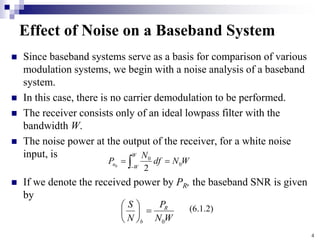
 The noise power at the output of the receiver, for a white noise
input, is
 If we denote the received power by PR, the baseband SNR is given
by
(6.1.2)
W
N
df
N
P
W
W
n 0
0
2
0

 
W
N
P
N
S R
b 0







5
White process (Section 5.3.2)
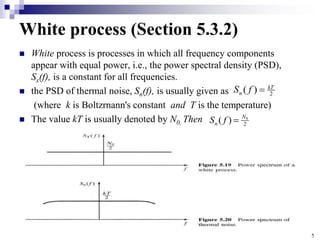
 White process is processes in which all frequency components
appear with equal power, i.e., the power spectral density (PSD),
Sx(f), is a constant for all frequencies.
 the PSD of thermal noise, Sn(f), is usually given as
(where k is Boltzrnann's constant and T is the temperature)
 The value kT is usually denoted by N0, Then
2
)
( kT
n f
S 
2
0
)
( N
n f
S 
6
Effect of Noise on DSB-SC AM
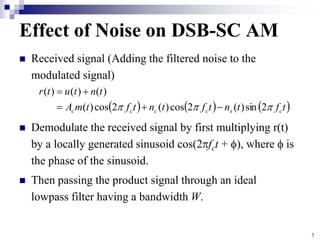
 Transmitted signal :
 The received signal at the output of the receiver noise-
limiting filter : Sum of this signal and filtered noise
 Recall from Section 5.3.3 and 2.7 that a filtered noise process
can be expressed in terms of its in-phase and quadrature
components as
(where nc(t) is in-phase component and ns(t) is quadrature
component)
 
t
f
t
m
A
t
u c
c 
2
cos
)
(
)
( 
)
2
sin(
)
(
)
2
cos(
)
(
)
2
sin(
)
(
sin
)
(
)
2
cos(
)
(
cos
)
(
)]
(
2
cos[
)
(
)
(
t
f
t
n
t
f
t
n
t
f
t
t
A
t
f
t
t
A
t
t
f
t
A
t
n
c
s
c
c
c
c
c














7
Effect of Noise on DSB-SC AM
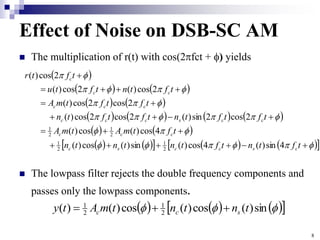
 Received signal (Adding the filtered noise to the
modulated signal)
 Demodulate the received signal by first multiplying r(t)
by a locally generated sinusoid cos(2fct + ), where  is
the phase of the sinusoid.
 Then passing the product signal through an ideal
lowpass filter having a bandwidth W.
     
t
f
t
n
t
f
t
n
t
f
t
m
A
t
n
t
u
t
r
c
s
c
c
c
c 

 2
sin
)
(
2
cos
)
(
2
cos
)
(
)
(
)
(
)
(





8
Effect of Noise on DSB-SC AM
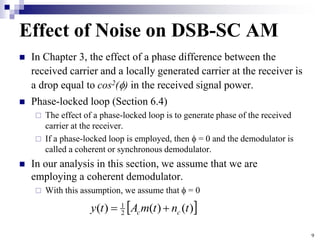
 The multiplication of r(t) with cos(2fct + ) yields
 The lowpass filter rejects the double frequency components and
passes only the lowpass components.
 
   
   
       
   
   
     
 












































t
f
t
n
t
f
t
n
t
n
t
n
t
f
t
m
A
t
m
A
t
f
t
f
t
n
t
f
t
f
t
n
t
f
t
f
t
m
A
t
f
t
n
t
f
t
u
t
f
t
r
c
s
c
c
s
c
c
c
c
c
c
s
c
c
c
c
c
c
c
c
c
4
sin
)
(
4
cos
)
(
sin
)
(
cos
)
(
4
cos
)
(
cos
)
(
2
cos
2
sin
)
(
2
cos
2
cos
)
(
2
cos
2
cos
)
(
2
cos
)
(
2
cos
)
(
2
cos
)
(
2
1
2
1
2
1
2
1
     
 


 sin
)
(
cos
)
(
cos
)
(
)
( 2
1
2
1
t
n
t
n
t
m
A
t
y s
c
c 


9
Effect of Noise on DSB-SC AM
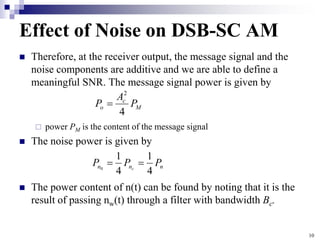
 In Chapter 3, the effect of a phase difference between the
received carrier and a locally generated carrier at the receiver is
a drop equal to cos2() in the received signal power.
 Phase-locked loop (Section 6.4)
 The effect of a phase-locked loop is to generate phase of the received
carrier at the receiver.
 If a phase-locked loop is employed, then  = 0 and the demodulator is
called a coherent or synchronous demodulator.
 In our analysis in this section, we assume that we are
employing a coherent demodulator.
 With this assumption, we assume that  = 0
 
)
(
)
(
)
( 2
1
t
n
t
m
A
t
y c
c 

10
Effect of Noise on DSB-SC AM
 Therefore, at the receiver output, the message signal and the
noise components are additive and we are able to define a
meaningful SNR. The message signal power is given by
 power PM is the content of the message signal
 The noise power is given by
 The power content of n(t) can be found by noting that it is the
result of passing nw(t) through a filter with bandwidth Bc.
M
c
o P
A
P
4
2

n
n
n P
P
P c
4
1
4
1
0


11
Effect of Noise on DSB-SC AM
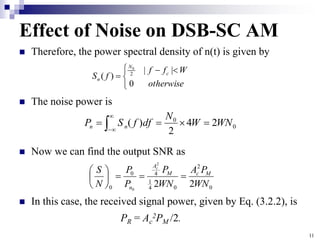
 Therefore, the power spectral density of n(t) is given by
 The noise power is
 Now we can find the output SNR as
 In this case, the received signal power, given by Eq. (3.2.2), is
PR = Ac
2PM /2.


 


otherwise
W
f
f
f
S c
N
n
0
|
|
)
( 2
0
0
0
2
4
2
)
( WN
W
N
df
f
S
P n
n 


 



0
2
0
4
1
4
0
0 2
2
2
0
WN
P
A
WN
P
P
P
N
S M
c
M
A
n
c









12
Effect of Noise on DSB-SC AM
 The output SNR for DSB-SC AM may be expressed as
 which is identical to baseband SNR which is given by Equation (6.1.2).
 In DSB-SC AM, the output SNR is the same as the SNR for a
baseband system
 DSB-SC AM does not provide any SNR improvement over
a simple baseband communication system
W
N
P
N
S R
DSB 0
0







13
Effect of Noise on SSB AM
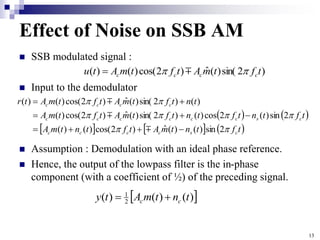
 SSB modulated signal :
 Input to the demodulator
 Assumption : Demodulation with an ideal phase reference.
 Hence, the output of the lowpass filter is the in-phase
component (with a coefficient of ½) of the preceding signal.
)
2
sin(
)
(
ˆ
)
2
cos(
)
(
)
( t
f
t
m
A
t
f
t
m
A
t
u c
c
c
c 
 

   
     
t
f
t
n
t
m
A
t
f
t
n
t
m
A
t
f
t
n
t
f
t
n
t
f
t
m
A
t
f
t
m
A
t
n
t
f
t
m
A
t
f
t
m
A
t
r
c
s
c
c
c
c
c
s
c
c
c
c
c
c
c
c
c
c








2
sin
)
(
)
(
ˆ
)
2
cos(
)
(
)
(
2
sin
)
(
2
cos
)
(
)
2
sin(
)
(
ˆ
)
2
cos(
)
(
)
(
)
2
sin(
)
(
ˆ
)
2
cos(
)
(
)
(












 
)
(
)
(
)
( 2
1
t
n
t
m
A
t
y c
c 

14
Effect of Noise on SSB AM
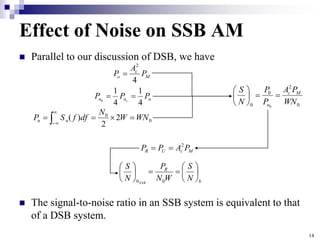
 Parallel to our discussion of DSB, we have
 The signal-to-noise ratio in an SSB system is equivalent to that
of a DSB system.
0
2
0
0 0
WN
P
A
P
P
N
S M
c
n








M
c
U
R P
A
P
P 2


b
R
N
S
W
N
P
N
S
SSB














0
0
M
c
o P
A
P
4
2

n
n
n P
P
P c
4
1
4
1
0


0
0
2
2
)
( WN
W
N
df
f
S
P n
n 


 



15
Effect of Noise on Conventional AM
 DSB AM signal :
 Received signal at the input to the demodulator
 a is the modulation index
 mn(t) is normalized so that its minimum value is -1
 If a synchronous demodulator is employed, the situation is basically
similar to the DSB case, except that we have 1 + amn(t) instead of m(t).
 After mixing and lowpass filtering
)
2
cos(
)]
(
1
[
)
( t
f
t
am
A
t
u c
n
c 


   
   
t
f
t
n
t
f
t
n
t
am
A
t
f
t
n
t
f
t
n
t
f
t
am
A
t
n
t
f
t
am
A
t
r
c
s
c
c
n
c
c
s
c
c
c
n
c
c
n
c






2
sin
)
(
)
2
cos(
)
(
)]
(
1
[
2
sin
)
(
2
cos
)
(
)
2
cos(
)]
(
1
[
)
(
)
2
cos(
)]
(
1
[
)
(











 
)
(
)
(
)
( 2
1
t
n
t
am
A
t
y c
n
c 

16
Effect of Noise on Conventional AM
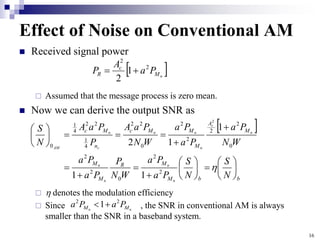
 Received signal power
 Assumed that the message process is zero mean.
 Now we can derive the output SNR as
  denotes the modulation efficiency
 Since , the SNR in conventional AM is always
smaller than the SNR in a baseband system.
 
n
M
c
R P
a
A
P 2
2
1
2


 
b
b
M
M
R
M
M
M
A
M
M
M
c
n
M
c
N
S
N
S
P
a
P
a
W
N
P
P
a
P
a
W
N
P
a
P
a
P
a
W
N
P
a
A
P
P
a
A
N
S
n
n
n
n
n
c
n
n
n
c
n
AM





























2
2
0
2
2
0
2
2
2
2
0
2
2
4
1
2
2
4
1
0
1
1
1
1
2
2
n
n M
M P
a
P
a 2
2
1

17
Effect of Noise on Conventional AM
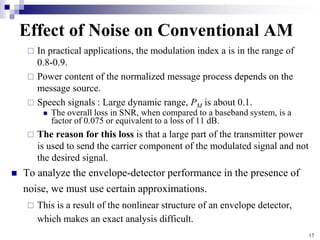
 In practical applications, the modulation index a is in the range of
0.8-0.9.
 Power content of the normalized message process depends on the
message source.
 Speech signals : Large dynamic range, PM is about 0.1.
 The overall loss in SNR, when compared to a baseband system, is a
factor of 0.075 or equivalent to a loss of 11 dB.
 The reason for this loss is that a large part of the transmitter power
is used to send the carrier component of the modulated signal and not
the desired signal.
 To analyze the envelope-detector performance in the presence of
noise, we must use certain approximations.
 This is a result of the nonlinear structure of an envelope detector,
which makes an exact analysis difficult.
18
Effect of Noise on Conventional AM
 In this case, the demodulator detects the envelope of the
received signal and the noise process.
 The input to the envelope detector is
 Therefore, the envelope of r ( t ) is given by
 Now we assume that the signal component in r ( t ) is much
stronger than the noise component. Then
 Therefore, we have a high probability that
   
t
f
t
n
t
f
t
n
t
am
A
t
r c
s
c
c
n
c 
 2
sin
)
(
)
2
cos(
)
(
)]
(
1
[
)
( 



  )
(
)
(
)]
(
1
[
)
( 2
2
t
n
t
n
t
am
A
t
V s
c
n
c
r 



  1
)]
(
1
[
)
( 

 t
am
A
t
n
P n
c
c
)
(
)]
(
1
[
)
( t
n
t
am
A
t
V c
n
c
r 


19
Effect of Noise on Conventional AM
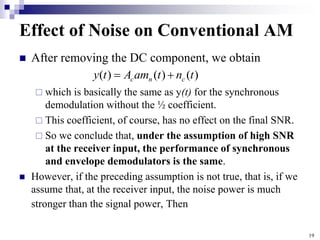
 After removing the DC component, we obtain
 which is basically the same as y(t) for the synchronous
demodulation without the ½ coefficient.
 This coefficient, of course, has no effect on the final SNR.
 So we conclude that, under the assumption of high SNR
at the receiver input, the performance of synchronous
and envelope demodulators is the same.
 However, if the preceding assumption is not true, that is, if we
assume that, at the receiver input, the noise power is much
stronger than the signal power, Then
)
(
)
(
)
( t
n
t
am
A
t
y c
n
c 

20
Effect of Noise on Conventional AM
 (a) : is small compared with the other components
 (b) : ;the envelope of the noise process
 Use the approximation
, where
 
   
 
 
)
(
1
)
(
)
(
)
(
)
(
1
)
(
)
(
1
)
(
)
(
1
)
(
)
(
)
(
2
1
)
(
)
(
)]
(
1
)[
(
2
)
(
)
(
)]
(
1
[
)
(
)
(
)]
(
1
[
)
(
2
2
2
2
2
2
2
2
2
2
2
t
am
t
V
t
n
A
t
V
t
am
t
V
t
n
A
t
V
t
am
t
n
t
n
t
n
A
t
n
t
n
t
am
t
n
A
t
n
t
n
t
am
A
t
n
t
n
t
am
A
t
V
n
n
c
c
n
n
n
c
c
n
b
n
s
c
c
c
s
c
a
n
c
c
s
c
n
c
s
c
n
c
r



































2
2
)]
(
1
[ t
am
A n
c 
)
(
)
(
)
( 2
2
t
V
t
n
t
n n
s
c 


 
small
for
,
1
1 2


  
)
(
1
)
(
)
(
)
(
2
2
2
t
am
t
n
t
n
t
n
A
n
s
c
c
c




21
Effect of Noise on Conventional AM
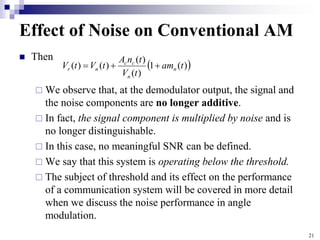
 Then
 We observe that, at the demodulator output, the signal and
the noise components are no longer additive.
 In fact, the signal component is multiplied by noise and is
no longer distinguishable.
 In this case, no meaningful SNR can be defined.
 We say that this system is operating below the threshold.
 The subject of threshold and its effect on the performance
of a communication system will be covered in more detail
when we discuss the noise performance in angle
modulation.
 
)
(
1
)
(
)
(
)
(
)
( t
am
t
V
t
n
A
t
V
t
V n
n
c
c
n
r 



Noise in AM systems.ppt

  • 1.
    Chapter 6. Effectof Noise on Analog Communication Systems Essentials of Communication Systems Engineering
  • 2.
    2 Introduction  Angle modulationsystems and FM can provide a high degree of noise immunity  This noise immunity is obtained at the price of sacrificing channel bandwidth  Bandwidth requirements of angle modulation systems are considerably higher than that of amplitude modulation systems  This chapter deals with the followings:  Effect of noise on amplitude modulation systems  Effect of noise on angle modulation systems  Carrier-phase estimation using a phase-locked loop (PLL)  Analyze the effects of transmission loss and noise on analog communication systems
  • 3.
    3 EFFECT OF NOISEON AMPLITUDE- MODULATION SYSTEMS  Effect of Noise on a Baseband System  Effect of Noise on DSB-SC AM  Effect of Noise on SSB-AM  Effect of Noise on Conventional AM
  • 4.
    4 Effect of Noiseon a Baseband System  Since baseband systems serve as a basis for comparison of various modulation systems, we begin with a noise analysis of a baseband system.  In this case, there is no carrier demodulation to be performed.  The receiver consists only of an ideal lowpass filter with the bandwidth W.  The noise power at the output of the receiver, for a white noise input, is  If we denote the received power by PR, the baseband SNR is given by (6.1.2) W N df N P W W n 0 0 2 0    W N P N S R b 0       
  • 5.
    5 White process (Section5.3.2)  White process is processes in which all frequency components appear with equal power, i.e., the power spectral density (PSD), Sx(f), is a constant for all frequencies.  the PSD of thermal noise, Sn(f), is usually given as (where k is Boltzrnann's constant and T is the temperature)  The value kT is usually denoted by N0, Then 2 ) ( kT n f S  2 0 ) ( N n f S 
  • 6.
    6 Effect of Noiseon DSB-SC AM  Transmitted signal :  The received signal at the output of the receiver noise- limiting filter : Sum of this signal and filtered noise  Recall from Section 5.3.3 and 2.7 that a filtered noise process can be expressed in terms of its in-phase and quadrature components as (where nc(t) is in-phase component and ns(t) is quadrature component)   t f t m A t u c c  2 cos ) ( ) (  ) 2 sin( ) ( ) 2 cos( ) ( ) 2 sin( ) ( sin ) ( ) 2 cos( ) ( cos ) ( )] ( 2 cos[ ) ( ) ( t f t n t f t n t f t t A t f t t A t t f t A t n c s c c c c c              
  • 7.
    7 Effect of Noiseon DSB-SC AM  Received signal (Adding the filtered noise to the modulated signal)  Demodulate the received signal by first multiplying r(t) by a locally generated sinusoid cos(2fct + ), where  is the phase of the sinusoid.  Then passing the product signal through an ideal lowpass filter having a bandwidth W.       t f t n t f t n t f t m A t n t u t r c s c c c c    2 sin ) ( 2 cos ) ( 2 cos ) ( ) ( ) ( ) (     
  • 8.
    8 Effect of Noiseon DSB-SC AM  The multiplication of r(t) with cos(2fct + ) yields  The lowpass filter rejects the double frequency components and passes only the lowpass components.                                                                               t f t n t f t n t n t n t f t m A t m A t f t f t n t f t f t n t f t f t m A t f t n t f t u t f t r c s c c s c c c c c c s c c c c c c c c c 4 sin ) ( 4 cos ) ( sin ) ( cos ) ( 4 cos ) ( cos ) ( 2 cos 2 sin ) ( 2 cos 2 cos ) ( 2 cos 2 cos ) ( 2 cos ) ( 2 cos ) ( 2 cos ) ( 2 1 2 1 2 1 2 1            sin ) ( cos ) ( cos ) ( ) ( 2 1 2 1 t n t n t m A t y s c c   
  • 9.
    9 Effect of Noiseon DSB-SC AM  In Chapter 3, the effect of a phase difference between the received carrier and a locally generated carrier at the receiver is a drop equal to cos2() in the received signal power.  Phase-locked loop (Section 6.4)  The effect of a phase-locked loop is to generate phase of the received carrier at the receiver.  If a phase-locked loop is employed, then  = 0 and the demodulator is called a coherent or synchronous demodulator.  In our analysis in this section, we assume that we are employing a coherent demodulator.  With this assumption, we assume that  = 0   ) ( ) ( ) ( 2 1 t n t m A t y c c  
  • 10.
    10 Effect of Noiseon DSB-SC AM  Therefore, at the receiver output, the message signal and the noise components are additive and we are able to define a meaningful SNR. The message signal power is given by  power PM is the content of the message signal  The noise power is given by  The power content of n(t) can be found by noting that it is the result of passing nw(t) through a filter with bandwidth Bc. M c o P A P 4 2  n n n P P P c 4 1 4 1 0  
  • 11.
    11 Effect of Noiseon DSB-SC AM  Therefore, the power spectral density of n(t) is given by  The noise power is  Now we can find the output SNR as  In this case, the received signal power, given by Eq. (3.2.2), is PR = Ac 2PM /2.       otherwise W f f f S c N n 0 | | ) ( 2 0 0 0 2 4 2 ) ( WN W N df f S P n n         0 2 0 4 1 4 0 0 2 2 2 0 WN P A WN P P P N S M c M A n c         
  • 12.
    12 Effect of Noiseon DSB-SC AM  The output SNR for DSB-SC AM may be expressed as  which is identical to baseband SNR which is given by Equation (6.1.2).  In DSB-SC AM, the output SNR is the same as the SNR for a baseband system  DSB-SC AM does not provide any SNR improvement over a simple baseband communication system W N P N S R DSB 0 0       
  • 13.
    13 Effect of Noiseon SSB AM  SSB modulated signal :  Input to the demodulator  Assumption : Demodulation with an ideal phase reference.  Hence, the output of the lowpass filter is the in-phase component (with a coefficient of ½) of the preceding signal. ) 2 sin( ) ( ˆ ) 2 cos( ) ( ) ( t f t m A t f t m A t u c c c c               t f t n t m A t f t n t m A t f t n t f t n t f t m A t f t m A t n t f t m A t f t m A t r c s c c c c c s c c c c c c c c c c         2 sin ) ( ) ( ˆ ) 2 cos( ) ( ) ( 2 sin ) ( 2 cos ) ( ) 2 sin( ) ( ˆ ) 2 cos( ) ( ) ( ) 2 sin( ) ( ˆ ) 2 cos( ) ( ) (               ) ( ) ( ) ( 2 1 t n t m A t y c c  
  • 14.
    14 Effect of Noiseon SSB AM  Parallel to our discussion of DSB, we have  The signal-to-noise ratio in an SSB system is equivalent to that of a DSB system. 0 2 0 0 0 WN P A P P N S M c n         M c U R P A P P 2   b R N S W N P N S SSB               0 0 M c o P A P 4 2  n n n P P P c 4 1 4 1 0   0 0 2 2 ) ( WN W N df f S P n n        
  • 15.
    15 Effect of Noiseon Conventional AM  DSB AM signal :  Received signal at the input to the demodulator  a is the modulation index  mn(t) is normalized so that its minimum value is -1  If a synchronous demodulator is employed, the situation is basically similar to the DSB case, except that we have 1 + amn(t) instead of m(t).  After mixing and lowpass filtering ) 2 cos( )] ( 1 [ ) ( t f t am A t u c n c            t f t n t f t n t am A t f t n t f t n t f t am A t n t f t am A t r c s c c n c c s c c c n c c n c       2 sin ) ( ) 2 cos( ) ( )] ( 1 [ 2 sin ) ( 2 cos ) ( ) 2 cos( )] ( 1 [ ) ( ) 2 cos( )] ( 1 [ ) (              ) ( ) ( ) ( 2 1 t n t am A t y c n c  
  • 16.
    16 Effect of Noiseon Conventional AM  Received signal power  Assumed that the message process is zero mean.  Now we can derive the output SNR as   denotes the modulation efficiency  Since , the SNR in conventional AM is always smaller than the SNR in a baseband system.   n M c R P a A P 2 2 1 2     b b M M R M M M A M M M c n M c N S N S P a P a W N P P a P a W N P a P a P a W N P a A P P a A N S n n n n n c n n n c n AM                              2 2 0 2 2 0 2 2 2 2 0 2 2 4 1 2 2 4 1 0 1 1 1 1 2 2 n n M M P a P a 2 2 1 
  • 17.
    17 Effect of Noiseon Conventional AM  In practical applications, the modulation index a is in the range of 0.8-0.9.  Power content of the normalized message process depends on the message source.  Speech signals : Large dynamic range, PM is about 0.1.  The overall loss in SNR, when compared to a baseband system, is a factor of 0.075 or equivalent to a loss of 11 dB.  The reason for this loss is that a large part of the transmitter power is used to send the carrier component of the modulated signal and not the desired signal.  To analyze the envelope-detector performance in the presence of noise, we must use certain approximations.  This is a result of the nonlinear structure of an envelope detector, which makes an exact analysis difficult.
  • 18.
    18 Effect of Noiseon Conventional AM  In this case, the demodulator detects the envelope of the received signal and the noise process.  The input to the envelope detector is  Therefore, the envelope of r ( t ) is given by  Now we assume that the signal component in r ( t ) is much stronger than the noise component. Then  Therefore, we have a high probability that     t f t n t f t n t am A t r c s c c n c   2 sin ) ( ) 2 cos( ) ( )] ( 1 [ ) (       ) ( ) ( )] ( 1 [ ) ( 2 2 t n t n t am A t V s c n c r       1 )] ( 1 [ ) (    t am A t n P n c c ) ( )] ( 1 [ ) ( t n t am A t V c n c r   
  • 19.
    19 Effect of Noiseon Conventional AM  After removing the DC component, we obtain  which is basically the same as y(t) for the synchronous demodulation without the ½ coefficient.  This coefficient, of course, has no effect on the final SNR.  So we conclude that, under the assumption of high SNR at the receiver input, the performance of synchronous and envelope demodulators is the same.  However, if the preceding assumption is not true, that is, if we assume that, at the receiver input, the noise power is much stronger than the signal power, Then ) ( ) ( ) ( t n t am A t y c n c  
  • 20.
    20 Effect of Noiseon Conventional AM  (a) : is small compared with the other components  (b) : ;the envelope of the noise process  Use the approximation , where           ) ( 1 ) ( ) ( ) ( ) ( 1 ) ( ) ( 1 ) ( ) ( 1 ) ( ) ( ) ( 2 1 ) ( ) ( )] ( 1 )[ ( 2 ) ( ) ( )] ( 1 [ ) ( ) ( )] ( 1 [ ) ( 2 2 2 2 2 2 2 2 2 2 2 t am t V t n A t V t am t V t n A t V t am t n t n t n A t n t n t am t n A t n t n t am A t n t n t am A t V n n c c n n n c c n b n s c c c s c a n c c s c n c s c n c r                                    2 2 )] ( 1 [ t am A n c  ) ( ) ( ) ( 2 2 t V t n t n n s c      small for , 1 1 2      ) ( 1 ) ( ) ( ) ( 2 2 2 t am t n t n t n A n s c c c    
  • 21.
    21 Effect of Noiseon Conventional AM  Then  We observe that, at the demodulator output, the signal and the noise components are no longer additive.  In fact, the signal component is multiplied by noise and is no longer distinguishable.  In this case, no meaningful SNR can be defined.  We say that this system is operating below the threshold.  The subject of threshold and its effect on the performance of a communication system will be covered in more detail when we discuss the noise performance in angle modulation.   ) ( 1 ) ( ) ( ) ( ) ( t am t V t n A t V t V n n c c n r   