INTRODUCTION 
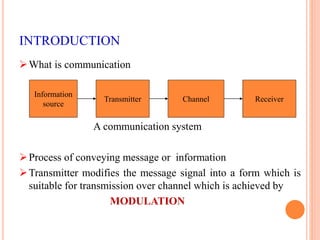
What is communication 
Transmitter Channel Receiver 
A communication system 
Process of conveying message or information 
Transmitter modifies the message signal into a form which is 
suitable for transmission over channel which is achieved by 
MODULATION 
Information 
source
WHAT IS MODULATION 
MODULATION is the basic requirement for transmitting 
the message signal through free space 
 It is the process of transmission of information signal 
(low frequency audio signal) using a high frequency 
carrier signal
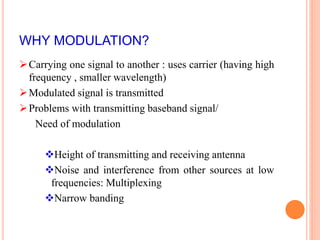
WHY MODULATION? 
Carrying one signal to another : uses carrier (having high 
frequency , smaller wavelength) 
Modulated signal is transmitted 
Problems with transmitting baseband signal/ 
Need of modulation 
Height of transmitting and receiving antenna 
Noise and interference from other sources at low 
frequencies: Multiplexing 
Narrow banding
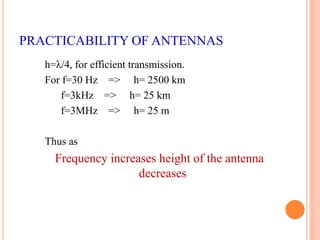
PRACTICABILITY OF ANTENNAS 
h=λ/4, for efficient transmission. 
For f=30 Hz => h= 2500 km 
f=3kHz => h= 25 km 
f=3MHz => h= 25 m 
Thus as 
Frequency increases height of the antenna 
decreases
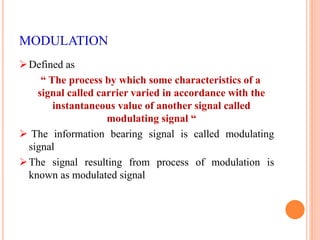
MODULATION 
Defined as 
“ The process by which some characteristics of a 
signal called carrier varied in accordance with the 
instantaneous value of another signal called 
modulating signal “ 
 The information bearing signal is called modulating 
signal 
The signal resulting from process of modulation is 
known as modulated signal
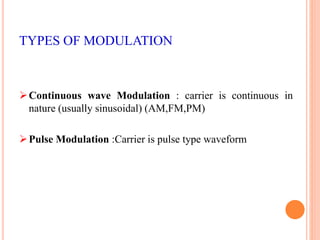
TYPES OF MODULATION 
Continuous wave Modulation : carrier is continuous in 
nature (usually sinusoidal) (AM,FM,PM) 
Pulse Modulation :Carrier is pulse type waveform
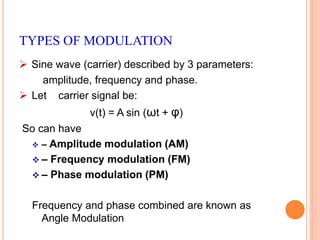
TYPES OF MODULATION 
 Sine wave (carrier) described by 3 parameters: 
amplitude, frequency and phase. 
 Let carrier signal be: 
v(t) = A sin (ωt + φ) 
So can have 
 – Amplitude modulation (AM) 
 – Frequency modulation (FM) 
 – Phase modulation (PM) 
Frequency and phase combined are known as 
Angle Modulation
AMPLITUDE MODULATION 
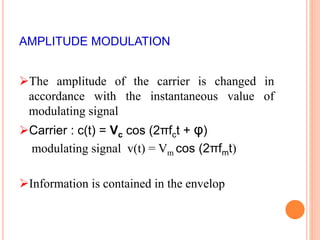
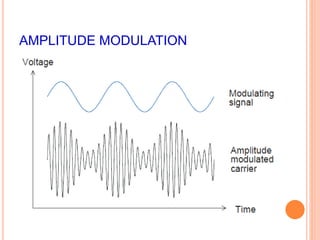
The amplitude of the carrier is changed in 
accordance with the instantaneous value of 
modulating signal 
Carrier : c(t) = Vc cos (2πfct + φ) 
modulating signal v(t) = Vm cos (2πfmt) 
Information is contained in the envelop
AMPLITUDE MODULATION
AMPLITUDE MODULATION 
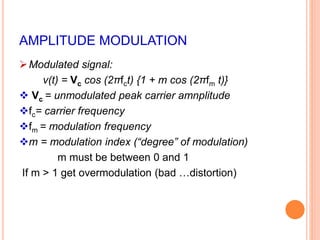
Modulated signal: 
v(t) = Vc cos (2πfct) {1 + m cos (2πfm t)} 
 Vc = unmodulated peak carrier amnplitude 
fc= carrier frequency 
fm = modulation frequency 
m = modulation index (“degree” of modulation) 
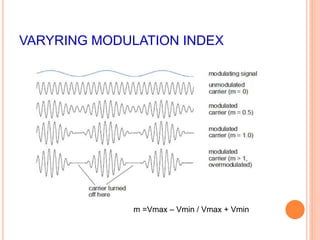
m must be between 0 and 1 
If m > 1 get overmodulation (bad …distortion)
VARYRING MODULATION INDEX 
m =Vmax – Vmin / Vmax + Vmin
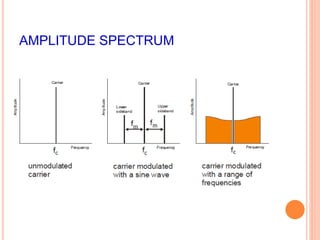
AMPLITUDE SPECTRUM 
Modulation produces two new components called 
sidebands, at frequencies above and below the 
carrier 
The spacing in frequency between carrier and 
sidebands is equal to fm (the modulating frequency) 
Bandwidth requirement : 2 fm
AMPLITUDE SPECTRUM
WHERE DO THE SIDEBANDS COME FROM 
Expand v(t) = Vc cos (2π fct) {1 + m cos (2π fm t)} 
Using trig identities to get: 
v(t) = Vc cos (2π fct) 
+0.5m Vc cos (2π [fc- fm ]t) 
+0.5m Vc cos (2π [fc+ fm ]t) 
 This expression consists of 3 sine waves at 
frequencies of carrier (fc), lower sideband (fc-fm) 
and upper sideband (fc+fm). fc= carrier frequency
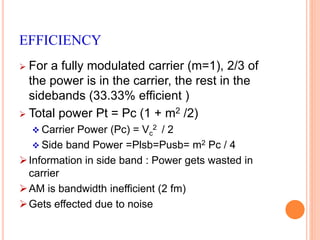
EFFICIENCY 
 For a fully modulated carrier (m=1), 2/3 of 
the power is in the carrier, the rest in the 
sidebands (33.33% efficient ) 
 Total power Pt = Pc (1 + m2 /2) 
 Carrier Power (Pc) = Vc 
2 / 2 
 Side band Power =Plsb=Pusb= m2 Pc / 4 
 Information in side band : Power gets wasted in 
carrier 
AM is bandwidth inefficient (2 fm) 
Gets effected due to noise
VARIATIONS OF AM 
 Double Sideband with carrier (AM): This is the most 
widely used type of AM modulation. In fact, all radio 
channels in the AM band use this type of modulation. 
Double Sideband Suppressed Carrier (DSBSC): This 
is the same as the AM modulation above but without the 
carrier. 
Single Sideband (SSB): In this modulation, only half of 
the signal of the DSBSC is used. 
Vestigial Sideband (VSB): This is a modification of the 
SSB to ease the generation and reception of the signal.
Amplitude Modulation ppt

Amplitude Modulation ppt

  • 2.
    INTRODUCTION What iscommunication Transmitter Channel Receiver A communication system Process of conveying message or information Transmitter modifies the message signal into a form which is suitable for transmission over channel which is achieved by MODULATION Information source
  • 3.
    WHAT IS MODULATION MODULATION is the basic requirement for transmitting the message signal through free space  It is the process of transmission of information signal (low frequency audio signal) using a high frequency carrier signal
  • 4.
    WHY MODULATION? Carryingone signal to another : uses carrier (having high frequency , smaller wavelength) Modulated signal is transmitted Problems with transmitting baseband signal/ Need of modulation Height of transmitting and receiving antenna Noise and interference from other sources at low frequencies: Multiplexing Narrow banding
  • 5.
    PRACTICABILITY OF ANTENNAS h=λ/4, for efficient transmission. For f=30 Hz => h= 2500 km f=3kHz => h= 25 km f=3MHz => h= 25 m Thus as Frequency increases height of the antenna decreases
  • 6.
    MODULATION Defined as “ The process by which some characteristics of a signal called carrier varied in accordance with the instantaneous value of another signal called modulating signal “  The information bearing signal is called modulating signal The signal resulting from process of modulation is known as modulated signal
  • 7.
    TYPES OF MODULATION Continuous wave Modulation : carrier is continuous in nature (usually sinusoidal) (AM,FM,PM) Pulse Modulation :Carrier is pulse type waveform
  • 8.
    TYPES OF MODULATION  Sine wave (carrier) described by 3 parameters: amplitude, frequency and phase.  Let carrier signal be: v(t) = A sin (ωt + φ) So can have  – Amplitude modulation (AM)  – Frequency modulation (FM)  – Phase modulation (PM) Frequency and phase combined are known as Angle Modulation
  • 9.
    AMPLITUDE MODULATION Theamplitude of the carrier is changed in accordance with the instantaneous value of modulating signal Carrier : c(t) = Vc cos (2πfct + φ) modulating signal v(t) = Vm cos (2πfmt) Information is contained in the envelop
  • 10.
  • 11.
    AMPLITUDE MODULATION Modulatedsignal: v(t) = Vc cos (2πfct) {1 + m cos (2πfm t)}  Vc = unmodulated peak carrier amnplitude fc= carrier frequency fm = modulation frequency m = modulation index (“degree” of modulation) m must be between 0 and 1 If m > 1 get overmodulation (bad …distortion)
  • 12.
    VARYRING MODULATION INDEX m =Vmax – Vmin / Vmax + Vmin
  • 13.
    AMPLITUDE SPECTRUM Modulationproduces two new components called sidebands, at frequencies above and below the carrier The spacing in frequency between carrier and sidebands is equal to fm (the modulating frequency) Bandwidth requirement : 2 fm
  • 14.
  • 15.
    WHERE DO THESIDEBANDS COME FROM Expand v(t) = Vc cos (2π fct) {1 + m cos (2π fm t)} Using trig identities to get: v(t) = Vc cos (2π fct) +0.5m Vc cos (2π [fc- fm ]t) +0.5m Vc cos (2π [fc+ fm ]t)  This expression consists of 3 sine waves at frequencies of carrier (fc), lower sideband (fc-fm) and upper sideband (fc+fm). fc= carrier frequency
  • 16.
    EFFICIENCY  Fora fully modulated carrier (m=1), 2/3 of the power is in the carrier, the rest in the sidebands (33.33% efficient )  Total power Pt = Pc (1 + m2 /2)  Carrier Power (Pc) = Vc 2 / 2  Side band Power =Plsb=Pusb= m2 Pc / 4  Information in side band : Power gets wasted in carrier AM is bandwidth inefficient (2 fm) Gets effected due to noise
  • 17.
    VARIATIONS OF AM  Double Sideband with carrier (AM): This is the most widely used type of AM modulation. In fact, all radio channels in the AM band use this type of modulation. Double Sideband Suppressed Carrier (DSBSC): This is the same as the AM modulation above but without the carrier. Single Sideband (SSB): In this modulation, only half of the signal of the DSBSC is used. Vestigial Sideband (VSB): This is a modification of the SSB to ease the generation and reception of the signal.