1
Ms. SANGEETHA B L
Asst. Professor
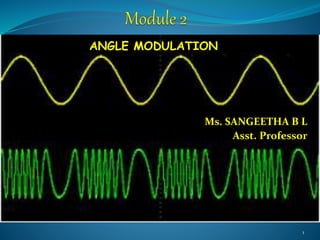
ANGLE MODULATION
OUTLINE
2
Introduction
Generation of FM Waves
Direct Method
FM
Indirect method
Freq stereo multiplexing
Balanced freq discriminator
PM
Demodulation of FM waves
PLL
Examples
INTRODUCTION
s(t) =Ac cos[θ(t)]
 Instantaneous frequency of angle modulated wave s(t) is
given by,
fi(t) =(1/2π)dθ(t)/dt
 In the case of an un-modulated carrier, the angle
becomes
θ(t) = 2πfct + fc
3
• Angle modulation is the process by which the angle
(frequency or phase) of the carrier signal is changed in
accordance with the message signal
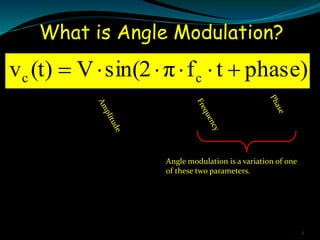
What is Angle Modulation?
phase)tfπsin(2V(t)v cc 
Angle modulation is a variation of one
of these two parameters.
4
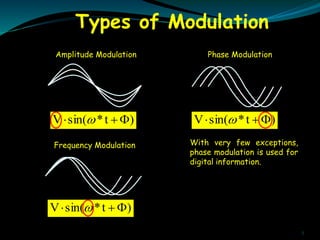
Types of Modulation
Amplitude Modulation
Frequency Modulation
Phase Modulation
With very few exceptions,
phase modulation is used for
digital information.
)t*sin(V  
)t*sin(V  
)t*sin(V  
5
PHASE MODULATION
 Form of angle modulation in which the angular
argument q(t) is varied linearly with the message signal
m(t).
q(t) = 2pfct + kpm(t)
S(t) = Accos [2pfct + kpm(t)]
6
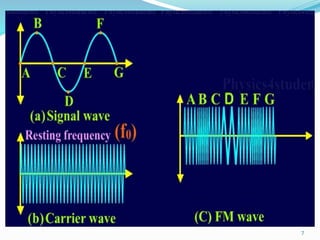
FREQUENCY MODULATION
• Form of angle modulation in which the instantaneous
frequency fi(t) is varied linearly with the message signal m(t).
fi(t) = fc + kfm(t)
S(t) = Ac cos [2pfct + 2pkf ∫m(t) dt]
7
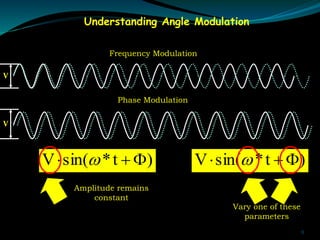
Understanding Angle Modulation
)t*sin(V  
Vary one of these
parameters
Frequency Modulation
Phase Modulation
V
V
)t*sin(V  
Amplitude remains
constant
8
9
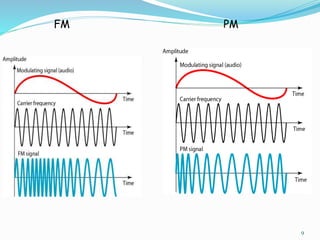
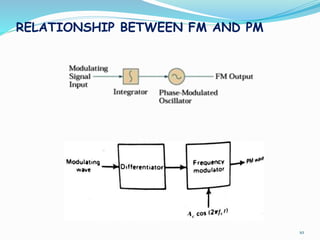
FM PM
RELATIONSHIP BETWEEN FM AND PM
10
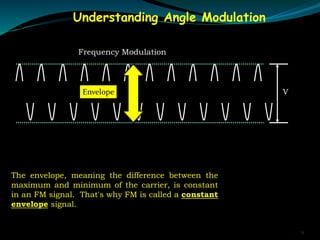
Understanding Angle Modulation
Frequency Modulation
VEnvelope
The envelope, meaning the difference between the
maximum and minimum of the carrier, is constant
in an FM signal. That's why FM is called a constant
envelope signal.
11
ADVANTAGES OVER AM
• Freedom from interference: All natural and
external noise consist of amplitude variations, thus
receiver usually cannot distinguish between
amplitude of noise or desired signal. AM is noisy
than FM.
• Operate in very high frequency band (VHF): 88MHz-
108MHz
• Can transmit musical programs with higher degree of
fidelity.
12
APPLICATIONS
• Commercial radio broadcasting
• Television sound transmission
• Two way mobile radio
• Cellular radio
• Microwave and satellite communication system
13
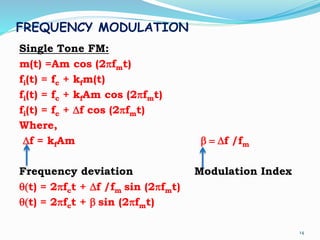
FREQUENCY MODULATION
Single Tone FM:
m(t) =Am cos (2pfmt)
fi(t) = fc + kfm(t)
fi(t) = fc + kfAm cos (2pfmt)
fi(t) = fc + Df cos (2pfmt)
Where,
Df = kfAm b  Df /fm
Frequency deviation Modulation Index
q(t) = 2pfct + Df /fm sin (2pfmt)
q(t) = 2pfct + b sin (2pfmt)
14
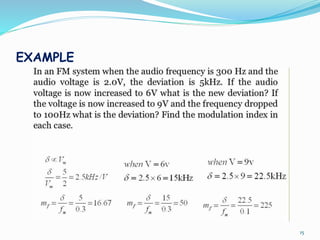
EXAMPLE
15
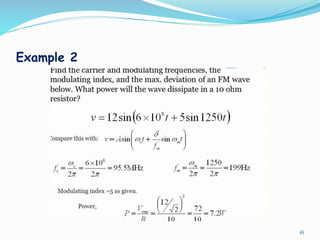
Example 2
16
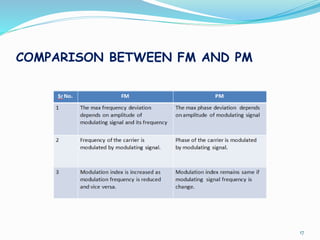
COMPARISON BETWEEN FM AND PM
17
SPECTRUM ANALYSIS OF SINUSOIDAL FM
WAVE
 s(t) = Ac cos[2pfct + b sin (2pfmt)]
 sI(t) = Ac cos[b sin (2pfmt)]
 sQ(t) = Ac sin[b sin (2pfmt)]
...
…
 This is the desired Fourier series representation of the
single tone FM wave s(t).
18




n
mcnc tnffJAts ])(2cos[)()( pb
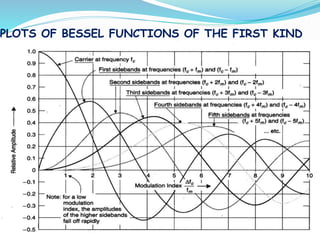
PLOTS OF BESSEL FUNCTIONS OF THE FIRST KIND
19
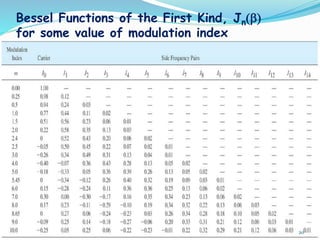
Bessel Functions of the First Kind, Jn(b)
for some value of modulation index
20
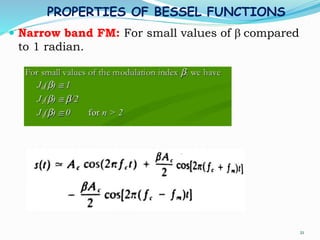
PROPERTIES OF BESSEL FUNCTIONS
 Narrow band FM: For small values of b compared
to 1 radian.
21
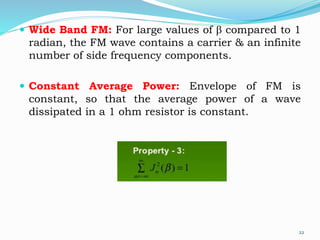
 Wide Band FM: For large values of b compared to 1
radian, the FM wave contains a carrier & an infinite
number of side frequency components.
 Constant Average Power: Envelope of FM is
constant, so that the average power of a wave
dissipated in a 1 ohm resistor is constant.
22
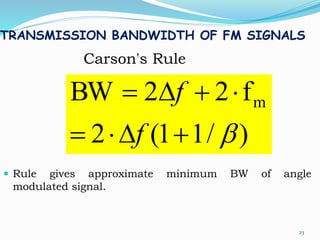
TRANSMISSION BANDWIDTH OF FM SIGNALS
 Rule gives approximate minimum BW of angle
modulated signal.
23
Carson's Rule
)/11(2
f22BW m
bD
D
f
f
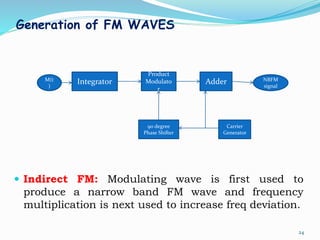
Generation of FM WAVES
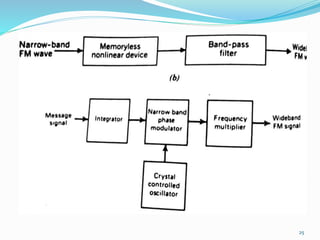
 Indirect FM: Modulating wave is first used to
produce a narrow band FM wave and frequency
multiplication is next used to increase freq deviation.
24
Integrator
Product
Modulato
r
90 degree
Phase Shifter
Carrier
Generator
AdderM(t
)
NBFM
signal
25
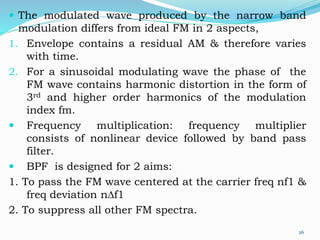
 The modulated wave produced by the narrow band
modulation differs from ideal FM in 2 aspects,
1. Envelope contains a residual AM & therefore varies
with time.
2. For a sinusoidal modulating wave the phase of the
FM wave contains harmonic distortion in the form of
3rd and higher order harmonics of the modulation
index fm.
 Frequency multiplication: frequency multiplier
consists of nonlinear device followed by band pass
filter.
 BPF is designed for 2 aims:
1. To pass the FM wave centered at the carrier freq nf1 &
freq deviation nDf1
2. To suppress all other FM spectra.
26
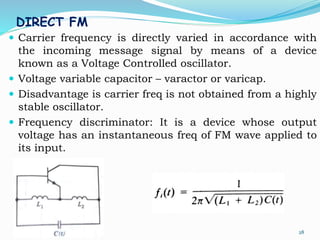
DIRECT FM
 Carrier frequency is directly varied in accordance with
the incoming message signal by means of a device
known as a Voltage Controlled oscillator.
 Voltage variable capacitor – varactor or varicap.
 Disadvantage is carrier freq is not obtained from a highly
stable oscillator.
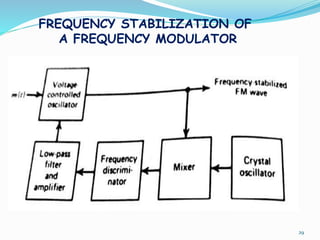
 Frequency discriminator: It is a device whose output
voltage has an instantaneous freq of FM wave applied to
its input.
28
29
FREQUENCY STABILIZATION OF
A FREQUENCY MODULATOR
Advantages of FM using Varactor Diode
 1. High frequency stability as crystal oscillator is
isolated from modulator.
Disadvantages
 1. To avoid distortion, the amplitude of modulating
signal is to be kept small.
 2. The varactor diode must have non linear
characteristics of capacitance vs. voltage.
Application
 This method is used for low index narrow band FM
generation.
30
FM DEMODULATION
• It is a process of getting back or regenerate the
original modulating signal from the modulated FM
signal.
• It can be achieved by converting the frequency
deviation of FM signal to the variation of equivalent
voltage.
• The demodulator will produce an output where its
instantaneous amplitude is proportional to the
instantaneous frequency of the input FM signal.
• To detect an FM signal, it is necessary to have a
circuit whose output voltage varies linearly with the
frequency of the input signal.
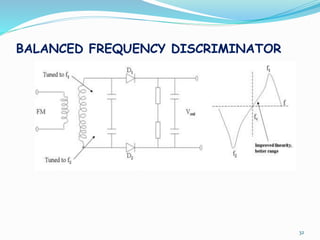
• The most commonly used demodulator are balanced
freq discriminator and the PLL demodulator. Can be
use to detect either NBFM or WBFM.
31
BALANCED FREQUENCY DISCRIMINATOR
32
ZERO CROSSING DETECTOR
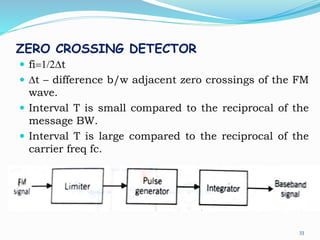
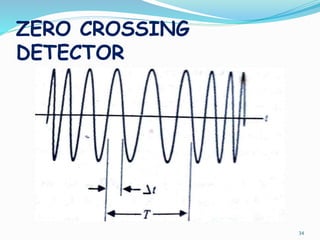
 fi1/2Dt
 Dt – difference b/w adjacent zero crossings of the FM
wave.
 Interval T is small compared to the reciprocal of the
message BW.
 Interval T is large compared to the reciprocal of the
carrier freq fc.
33
ZERO CROSSING
DETECTOR
34
PLL
35
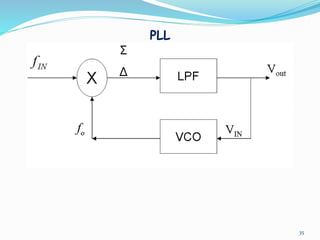
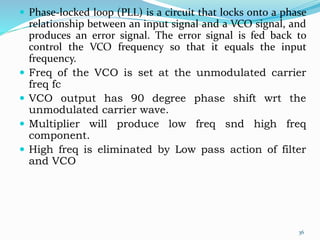
 Phase-locked loop (PLL) is a circuit that locks onto a phase
relationship between an input signal and a VCO signal, and
produces an error signal. The error signal is fed back to
control the VCO frequency so that it equals the input
frequency.
 Freq of the VCO is set at the unmodulated carrier
freq fc
 VCO output has 90 degree phase shift wrt the
unmodulated carrier wave.
 Multiplier will produce low freq snd high freq
component.
 High freq is eliminated by Low pass action of filter
and VCO
36
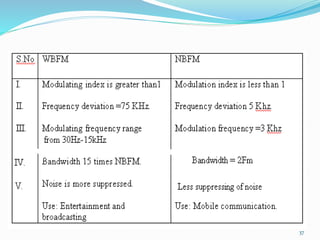
COMPARISON OF WBFM AND NBFM
37
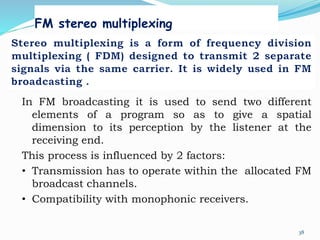
FM stereo multiplexing
38
In FM broadcasting it is used to send two different
elements of a program so as to give a spatial
dimension to its perception by the listener at the
receiving end.
This process is influenced by 2 factors:
• Transmission has to operate within the allocated FM
broadcast channels.
• Compatibility with monophonic receivers.
39
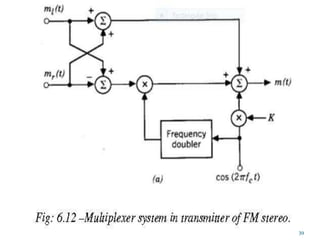
Let ml(t) and mr(t) denote the 2 signals picked up by left
hand and right hand microphones at the
transmitting end.
• They are applied to simple matrixer that generates
sum signal ml(t)+mr(t), difference ml(t)-mr(t).
• The sum signal is left unprocessed in its baseband
form; this is available for monophonic reception.
• The difference signal and a 38-kHz
subcarrier(derived from 19khz crystal oscillator by
frequency doubling ) are applied to product
modulator ,thereby producing DSBSC modulated
wave.
40
• In addition to sum signal and DSBSC
modulated wave , the multiplexed signal m(t)
also includes a 19khz signal to provide
reference for coherent detection of the
difference signal at the stereo receiver.
• Thus the multiplexed signal is given by:
m(t)=[ml(t)+mr(t)]+[ml(t)-mr(t)] cos (4пfct) +
K cos (2пfct).
41
42
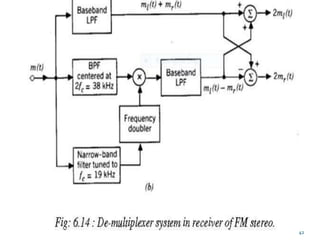
• The multiplexed signal m(t) is recovered from the FM
wave.
• m(t) is applied to de-multiplexing System.
• Individual components of the multiplexed signals are
separated using three appropriate filters.
• The signal is frequency-doubled to produce the
desired 38kHz subcarrier, the subcarrier enables the
coherent detection of the DSBSC modulated wave
thereby recovering the difference signal.
• The baseband low-pass filter is designed to pass the
sum signal
• Finally , the simple matrixer reconstruct the left hand
signal ml(t) and the right hand signal mr(t) and
applies them to the respective speaker.
43
44

Angle Modulation

  • 1.
    1 Ms. SANGEETHA BL Asst. Professor ANGLE MODULATION
  • 2.
    OUTLINE 2 Introduction Generation of FMWaves Direct Method FM Indirect method Freq stereo multiplexing Balanced freq discriminator PM Demodulation of FM waves PLL Examples
  • 3.
    INTRODUCTION s(t) =Ac cos[θ(t)] Instantaneous frequency of angle modulated wave s(t) is given by, fi(t) =(1/2π)dθ(t)/dt  In the case of an un-modulated carrier, the angle becomes θ(t) = 2πfct + fc 3 • Angle modulation is the process by which the angle (frequency or phase) of the carrier signal is changed in accordance with the message signal
  • 4.
    What is AngleModulation? phase)tfπsin(2V(t)v cc  Angle modulation is a variation of one of these two parameters. 4
  • 5.
    Types of Modulation AmplitudeModulation Frequency Modulation Phase Modulation With very few exceptions, phase modulation is used for digital information. )t*sin(V   )t*sin(V   )t*sin(V   5
  • 6.
    PHASE MODULATION  Formof angle modulation in which the angular argument q(t) is varied linearly with the message signal m(t). q(t) = 2pfct + kpm(t) S(t) = Accos [2pfct + kpm(t)] 6 FREQUENCY MODULATION • Form of angle modulation in which the instantaneous frequency fi(t) is varied linearly with the message signal m(t). fi(t) = fc + kfm(t) S(t) = Ac cos [2pfct + 2pkf ∫m(t) dt]
  • 7.
  • 8.
    Understanding Angle Modulation )t*sin(V  Vary one of these parameters Frequency Modulation Phase Modulation V V )t*sin(V   Amplitude remains constant 8
  • 9.
  • 10.
  • 11.
    Understanding Angle Modulation FrequencyModulation VEnvelope The envelope, meaning the difference between the maximum and minimum of the carrier, is constant in an FM signal. That's why FM is called a constant envelope signal. 11
  • 12.
    ADVANTAGES OVER AM •Freedom from interference: All natural and external noise consist of amplitude variations, thus receiver usually cannot distinguish between amplitude of noise or desired signal. AM is noisy than FM. • Operate in very high frequency band (VHF): 88MHz- 108MHz • Can transmit musical programs with higher degree of fidelity. 12
  • 13.
    APPLICATIONS • Commercial radiobroadcasting • Television sound transmission • Two way mobile radio • Cellular radio • Microwave and satellite communication system 13
  • 14.
    FREQUENCY MODULATION Single ToneFM: m(t) =Am cos (2pfmt) fi(t) = fc + kfm(t) fi(t) = fc + kfAm cos (2pfmt) fi(t) = fc + Df cos (2pfmt) Where, Df = kfAm b  Df /fm Frequency deviation Modulation Index q(t) = 2pfct + Df /fm sin (2pfmt) q(t) = 2pfct + b sin (2pfmt) 14
  • 15.
  • 16.
  • 17.
  • 18.
    SPECTRUM ANALYSIS OFSINUSOIDAL FM WAVE  s(t) = Ac cos[2pfct + b sin (2pfmt)]  sI(t) = Ac cos[b sin (2pfmt)]  sQ(t) = Ac sin[b sin (2pfmt)] ... …  This is the desired Fourier series representation of the single tone FM wave s(t). 18     n mcnc tnffJAts ])(2cos[)()( pb
  • 19.
    PLOTS OF BESSELFUNCTIONS OF THE FIRST KIND 19
  • 20.
    Bessel Functions ofthe First Kind, Jn(b) for some value of modulation index 20
  • 21.
    PROPERTIES OF BESSELFUNCTIONS  Narrow band FM: For small values of b compared to 1 radian. 21
  • 22.
     Wide BandFM: For large values of b compared to 1 radian, the FM wave contains a carrier & an infinite number of side frequency components.  Constant Average Power: Envelope of FM is constant, so that the average power of a wave dissipated in a 1 ohm resistor is constant. 22
  • 23.
    TRANSMISSION BANDWIDTH OFFM SIGNALS  Rule gives approximate minimum BW of angle modulated signal. 23 Carson's Rule )/11(2 f22BW m bD D f f
  • 24.
    Generation of FMWAVES  Indirect FM: Modulating wave is first used to produce a narrow band FM wave and frequency multiplication is next used to increase freq deviation. 24 Integrator Product Modulato r 90 degree Phase Shifter Carrier Generator AdderM(t ) NBFM signal
  • 25.
  • 26.
     The modulatedwave produced by the narrow band modulation differs from ideal FM in 2 aspects, 1. Envelope contains a residual AM & therefore varies with time. 2. For a sinusoidal modulating wave the phase of the FM wave contains harmonic distortion in the form of 3rd and higher order harmonics of the modulation index fm.  Frequency multiplication: frequency multiplier consists of nonlinear device followed by band pass filter.  BPF is designed for 2 aims: 1. To pass the FM wave centered at the carrier freq nf1 & freq deviation nDf1 2. To suppress all other FM spectra. 26
  • 27.
    DIRECT FM  Carrierfrequency is directly varied in accordance with the incoming message signal by means of a device known as a Voltage Controlled oscillator.  Voltage variable capacitor – varactor or varicap.  Disadvantage is carrier freq is not obtained from a highly stable oscillator.  Frequency discriminator: It is a device whose output voltage has an instantaneous freq of FM wave applied to its input. 28
  • 28.
  • 29.
    Advantages of FMusing Varactor Diode  1. High frequency stability as crystal oscillator is isolated from modulator. Disadvantages  1. To avoid distortion, the amplitude of modulating signal is to be kept small.  2. The varactor diode must have non linear characteristics of capacitance vs. voltage. Application  This method is used for low index narrow band FM generation. 30
  • 30.
    FM DEMODULATION • Itis a process of getting back or regenerate the original modulating signal from the modulated FM signal. • It can be achieved by converting the frequency deviation of FM signal to the variation of equivalent voltage. • The demodulator will produce an output where its instantaneous amplitude is proportional to the instantaneous frequency of the input FM signal. • To detect an FM signal, it is necessary to have a circuit whose output voltage varies linearly with the frequency of the input signal. • The most commonly used demodulator are balanced freq discriminator and the PLL demodulator. Can be use to detect either NBFM or WBFM. 31
  • 31.
  • 32.
    ZERO CROSSING DETECTOR fi1/2Dt  Dt – difference b/w adjacent zero crossings of the FM wave.  Interval T is small compared to the reciprocal of the message BW.  Interval T is large compared to the reciprocal of the carrier freq fc. 33
  • 33.
  • 34.
  • 35.
     Phase-locked loop(PLL) is a circuit that locks onto a phase relationship between an input signal and a VCO signal, and produces an error signal. The error signal is fed back to control the VCO frequency so that it equals the input frequency.  Freq of the VCO is set at the unmodulated carrier freq fc  VCO output has 90 degree phase shift wrt the unmodulated carrier wave.  Multiplier will produce low freq snd high freq component.  High freq is eliminated by Low pass action of filter and VCO 36
  • 36.
    COMPARISON OF WBFMAND NBFM 37
  • 37.
    FM stereo multiplexing 38 InFM broadcasting it is used to send two different elements of a program so as to give a spatial dimension to its perception by the listener at the receiving end. This process is influenced by 2 factors: • Transmission has to operate within the allocated FM broadcast channels. • Compatibility with monophonic receivers.
  • 38.
  • 39.
    Let ml(t) andmr(t) denote the 2 signals picked up by left hand and right hand microphones at the transmitting end. • They are applied to simple matrixer that generates sum signal ml(t)+mr(t), difference ml(t)-mr(t). • The sum signal is left unprocessed in its baseband form; this is available for monophonic reception. • The difference signal and a 38-kHz subcarrier(derived from 19khz crystal oscillator by frequency doubling ) are applied to product modulator ,thereby producing DSBSC modulated wave. 40
  • 40.
    • In additionto sum signal and DSBSC modulated wave , the multiplexed signal m(t) also includes a 19khz signal to provide reference for coherent detection of the difference signal at the stereo receiver. • Thus the multiplexed signal is given by: m(t)=[ml(t)+mr(t)]+[ml(t)-mr(t)] cos (4пfct) + K cos (2пfct). 41
  • 41.
  • 42.
    • The multiplexedsignal m(t) is recovered from the FM wave. • m(t) is applied to de-multiplexing System. • Individual components of the multiplexed signals are separated using three appropriate filters. • The signal is frequency-doubled to produce the desired 38kHz subcarrier, the subcarrier enables the coherent detection of the DSBSC modulated wave thereby recovering the difference signal. • The baseband low-pass filter is designed to pass the sum signal • Finally , the simple matrixer reconstruct the left hand signal ml(t) and the right hand signal mr(t) and applies them to the respective speaker. 43
  • 43.