ANGLE MODULATION
DIKSHA PRAKASH
TOPICS COVERED
• Introduction
• Concept of Angle Modulation : Basic Definition
– Phase Modulation (PM) Definition
– Frequency Modulation (FM) Definition
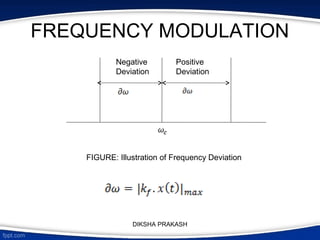
• Frequency Deviation
• Relationship between Phase Modulation (PM)
and Frequency Modulation (FM)
• Single Tone Frequency Modulation
DIKSHA PRAKASH
INTRODUCTION
• Frequency or phase of message signal is
varied according to the message signal.
• The amplitude is kept constant.
DIKSHA PRAKASH
Concept of Angle Modulation :
Basic Definition
DEFINITION
Total phase angle of the carrier wave is
varied according to the instantaneous
value of the modulating signal keeping the
amplitude constant.
DIKSHA PRAKASH
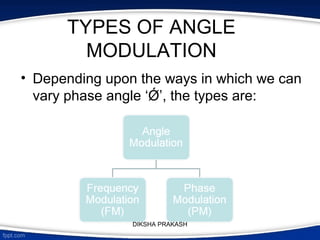
TYPES OF ANGLE
MODULATION
• Depending upon the ways in which we can
vary phase angle ‘Ǿ’, the types are:
DIKSHA PRAKASH
APPLICATIONS OF ANGLE
MODULATION
• Radio Broadcasting
• Two way mobile radio
• Microwave communication
• TV sound transmission
• Cellular radio
• Satellite communication
DIKSHA PRAKASH
ADVANTAGES AND
DISADVANTAGES
DIKSHA PRAKASH
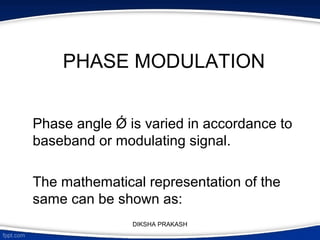
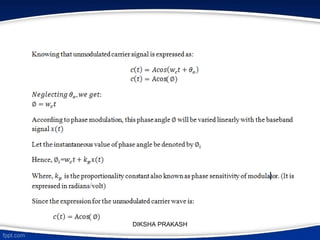
PHASE MODULATION
Phase angle Ǿ is varied in accordance to
baseband or modulating signal.
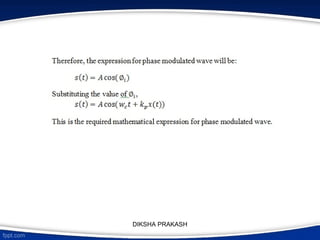
The mathematical representation of the
same can be shown as:
DIKSHA PRAKASH
DIKSHA PRAKASH
DIKSHA PRAKASH
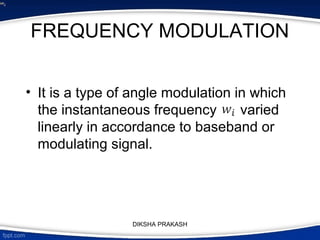
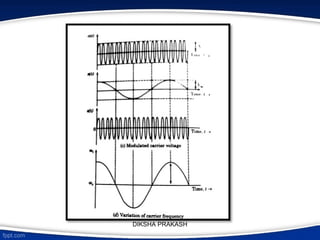
FREQUENCY MODULATION
• It is a type of angle modulation in which
the instantaneous frequency varied
linearly in accordance to baseband or
modulating signal.
DIKSHA PRAKASH
FREQUENCY MODULATION
Negative
Deviation
Positive
Deviation
FIGURE: Illustration of Frequency Deviation
DIKSHA PRAKASH
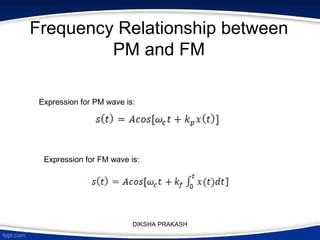
Frequency Relationship between
PM and FM
Expression for PM wave is:
Expression for FM wave is:
DIKSHA PRAKASH
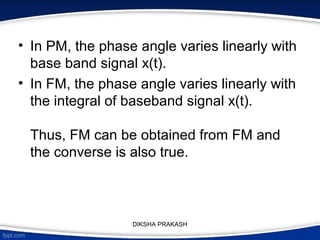
• In PM, the phase angle varies linearly with
base band signal x(t).
• In FM, the phase angle varies linearly with
the integral of baseband signal x(t).
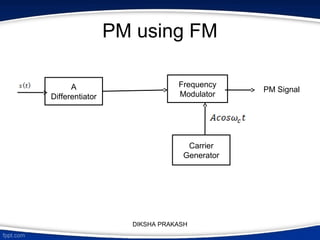
Thus, FM can be obtained from FM and
the converse is also true.
DIKSHA PRAKASH
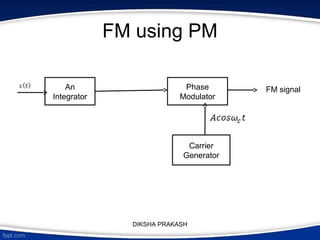
FM using PM
FM signalAn
Integrator
Phase
Modulator
Carrier
Generator
DIKSHA PRAKASH
PM using FM
A
Differentiator
Frequency
Modulator
Carrier
Generator
PM Signal
DIKSHA PRAKASH
SINGLE TONE FREQUENCY
MODULATION
• General expression for FM wave:
Equation shows non-linear modulation
process.
Hence to avoid complexity, we use single
tone frequency modulation.
DIKSHA PRAKASH
DIKSHA PRAKASH
INFERENCES
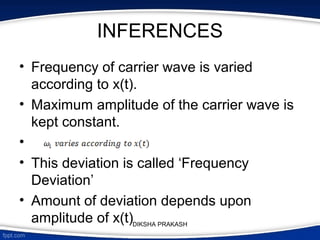
• Frequency of carrier wave is varied
according to x(t).
• Maximum amplitude of the carrier wave is
kept constant.
•
• This deviation is called ‘Frequency
Deviation’
• Amount of deviation depends upon
amplitude of x(t)DIKSHA PRAKASH
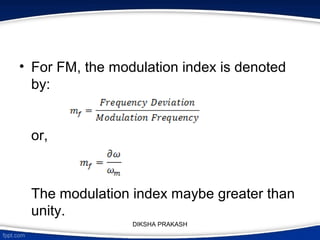
• For FM, the modulation index is denoted
by:
or,
The modulation index maybe greater than
unity.
DIKSHA PRAKASH
MATHEMATICAL EXPRESSION
& NUMERICALS
DIKSHA PRAKASH

Angle modulation