Presentation
On
Multirate Digital Signal Processing
Presented By
Md. Tanvir Amin
1
Multirate Digital Signal Processing
• Systems that employ multiple sampling rates in the processing of
digital signals are called Multirate digital signal processing systems.
• Multirate systems are sometimes used for sampling-rate
conversion
• In most applications multirate systems are used to improve the
performance, or for increased computational efficiency.
2
Multirate Digital Signal Processing
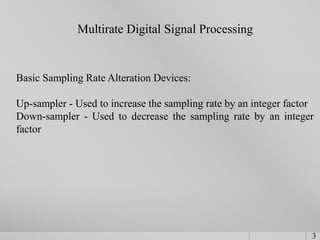
Basic Sampling Rate Alteration Devices:
Up-sampler - Used to increase the sampling rate by an integer factor
Down-sampler - Used to decrease the sampling rate by an integer
factor
3
Up-Sampler
Time-Domain Characterization:
An up-sampler with an up-sampling factor L, where L is a positive
integer, develops an output sequence with a sampling rate that
is L times larger than that of the input sequence x[n]
Block-diagram representation
L
x[n] ]
[n
xu
]
[n
xu
4
Down-Sampler
Time-Domain Characterization:
An down-sampler with a down-sampling factor M, where M is a
positive integer, develops an output sequence y[n] with a sampling rate
that is (1/M)-th of that of the input sequence x[n]
Block-diagram representation
M
x[n] y[n]
5
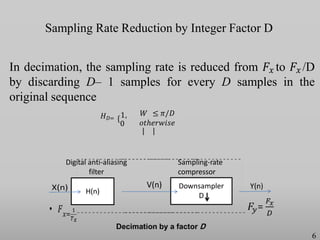
Sampling Rate Reduction by Integer Factor D
H(n)
Downsampler
D
In decimation, the sampling rate is reduced from 𝐹𝑥 to 𝐹𝑥 /D
by discarding D– 1 samples for every D samples in the
original sequence
𝐻𝐷= {1,
0
𝑊 ≤ 𝜋/𝐷
𝑜𝑡ℎ𝑒𝑟𝑤𝑖𝑠𝑒
Digital anti-aliasing
filter
Sampling-rate
compressor
6
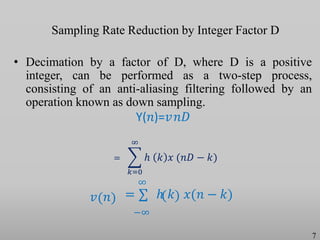
Sampling Rate Reduction by Integer Factor D
• Decimation by a factor of D, where D is a positive
integer, can be performed as a two-step process,
consisting of an anti-aliasing filtering followed by an
operation known as down sampling.
Y(𝑛)=𝑣𝑛𝐷
𝑣 𝑛
∞
= ∑ ℎ 𝑘 𝑥(𝑛 − 𝑘)
−∞
7
ℎ 𝑘 𝑥 (𝑛𝐷 − 𝑘)
∞
𝑘=0
=
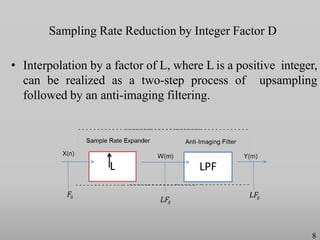
Sampling Rate Reduction by Integer Factor D
• Interpolation by a factor of L, where L is a positive integer,
can be realized as a two-step process of upsampling
followed by an anti-imaging filtering.
L LPF
8
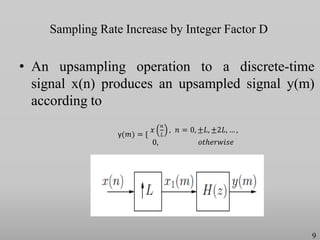
Sampling Rate Increase by Integer Factor D
• An upsampling operation to a discrete-time
signal x(n) produces an upsampled signal y(m)
according to
y 𝑚 = {
𝑥
𝑛
𝐿
0,
, 𝑛 = 0, ±𝐿, ±2𝐿, … ,
𝑜𝑡ℎ𝑒𝑟𝑤𝑖𝑠𝑒
9
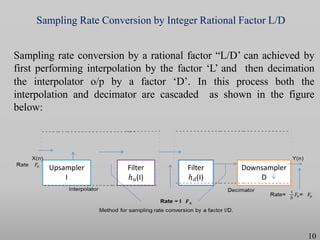
Sampling rate conversion by a rational factor “L/D’ can achieved by
first performing interpolation by the factor ‘L’ and then decimation
the interpolator o/p by a factor ‘D’. In this process both the
interpolation and decimator are cascaded as shown in the figure
below:
Upsampler
I
Filter
ℎ𝑢(I)
Downsampler
D
Filter
ℎ𝑑(I)
Sampling Rate Conversion by Integer Rational Factor L/D
10
Applications of Multirate DSP
11
12
Applications of Multirate DSP
13
Applications of Multirate DSP
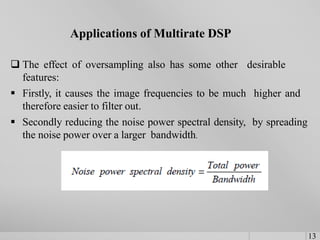
 The effect of oversampling also has some other desirable
features:
 Firstly, it causes the image frequencies to be much higher and
therefore easier to filter out.
 Secondly reducing the noise power spectral density, by spreading
the noise power over a larger bandwidth.
Thank You
14

Multirate signal processing

  • 1.
    Presentation On Multirate Digital SignalProcessing Presented By Md. Tanvir Amin 1
  • 2.
    Multirate Digital SignalProcessing • Systems that employ multiple sampling rates in the processing of digital signals are called Multirate digital signal processing systems. • Multirate systems are sometimes used for sampling-rate conversion • In most applications multirate systems are used to improve the performance, or for increased computational efficiency. 2
  • 3.
    Multirate Digital SignalProcessing Basic Sampling Rate Alteration Devices: Up-sampler - Used to increase the sampling rate by an integer factor Down-sampler - Used to decrease the sampling rate by an integer factor 3
  • 4.
    Up-Sampler Time-Domain Characterization: An up-samplerwith an up-sampling factor L, where L is a positive integer, develops an output sequence with a sampling rate that is L times larger than that of the input sequence x[n] Block-diagram representation L x[n] ] [n xu ] [n xu 4
  • 5.
    Down-Sampler Time-Domain Characterization: An down-samplerwith a down-sampling factor M, where M is a positive integer, develops an output sequence y[n] with a sampling rate that is (1/M)-th of that of the input sequence x[n] Block-diagram representation M x[n] y[n] 5
  • 6.
    Sampling Rate Reductionby Integer Factor D H(n) Downsampler D In decimation, the sampling rate is reduced from 𝐹𝑥 to 𝐹𝑥 /D by discarding D– 1 samples for every D samples in the original sequence 𝐻𝐷= {1, 0 𝑊 ≤ 𝜋/𝐷 𝑜𝑡ℎ𝑒𝑟𝑤𝑖𝑠𝑒 Digital anti-aliasing filter Sampling-rate compressor 6
  • 7.
    Sampling Rate Reductionby Integer Factor D • Decimation by a factor of D, where D is a positive integer, can be performed as a two-step process, consisting of an anti-aliasing filtering followed by an operation known as down sampling. Y(𝑛)=𝑣𝑛𝐷 𝑣 𝑛 ∞ = ∑ ℎ 𝑘 𝑥(𝑛 − 𝑘) −∞ 7 ℎ 𝑘 𝑥 (𝑛𝐷 − 𝑘) ∞ 𝑘=0 =
  • 8.
    Sampling Rate Reductionby Integer Factor D • Interpolation by a factor of L, where L is a positive integer, can be realized as a two-step process of upsampling followed by an anti-imaging filtering. L LPF 8
  • 9.
    Sampling Rate Increaseby Integer Factor D • An upsampling operation to a discrete-time signal x(n) produces an upsampled signal y(m) according to y 𝑚 = { 𝑥 𝑛 𝐿 0, , 𝑛 = 0, ±𝐿, ±2𝐿, … , 𝑜𝑡ℎ𝑒𝑟𝑤𝑖𝑠𝑒 9
  • 10.
    Sampling rate conversionby a rational factor “L/D’ can achieved by first performing interpolation by the factor ‘L’ and then decimation the interpolator o/p by a factor ‘D’. In this process both the interpolation and decimator are cascaded as shown in the figure below: Upsampler I Filter ℎ𝑢(I) Downsampler D Filter ℎ𝑑(I) Sampling Rate Conversion by Integer Rational Factor L/D 10
  • 11.
  • 12.
  • 13.
    13 Applications of MultirateDSP  The effect of oversampling also has some other desirable features:  Firstly, it causes the image frequencies to be much higher and therefore easier to filter out.  Secondly reducing the noise power spectral density, by spreading the noise power over a larger bandwidth.
  • 14.