e d
                              h e
                                as
                              R
                           i r 03 A N
                         za E- LT
                       U P U
                    d C M
                   a -
                 m 09 ZU
              a m 20 B
          u h           T
         M          E &
                 UC                                                 1
McGraw-Hill                          ©The McGraw-Hill Companies, Inc., 2000
Note

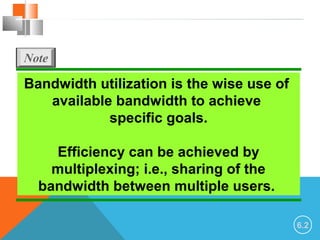
Bandwidth utilization is the wise use of
   available bandwidth to achieve
            specific goals.

    Efficiency can be achieved by
    multiplexing; i.e., sharing of the
  bandwidth between multiple users.

                                           6.2
6-1 MULTIPLEXING
 Whenever the bandwidth of a medium linking two
 devices is greater than the bandwidth needs of the
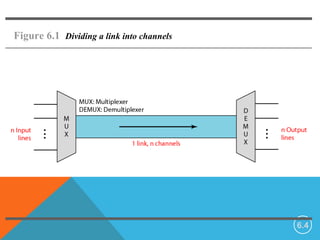
 devices, the link can be shared. Multiplexing is the set
 of techniques that allows the (simultaneous)
 transmission of multiple signals across a single data
 link. As data and telecommunications use increases,
 so does traffic.
Topics discussed in this section:
 Frequency-Division Multiplexing
 Synchronous Time-Division Multiplexing

                                                            6.3
Figure 6.1 Dividing a link into channels


                                           6.4
Note

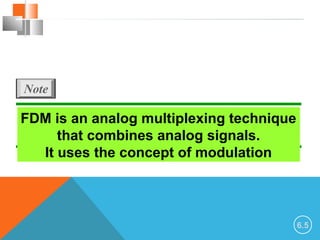
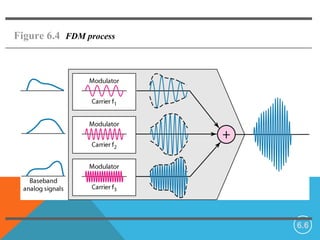
FDM is an analog multiplexing technique
     that combines analog signals.
  It uses the concept of modulation


                                          6.5
Figure 6.4 FDM process


                         6.6
Figure 6.5 FDM demultiplexing example


                                        6.7
Figure 6.12 Time Division Multiplexing (TDM)


                                               6.8
Note


TDM is a digital multiplexing technique
for combining several low-rate digital
   channels into one high-rate one.


                                          6.9
Figure 6.13 Synchronous time-division multiplexing


                                                     6.
                                                     10
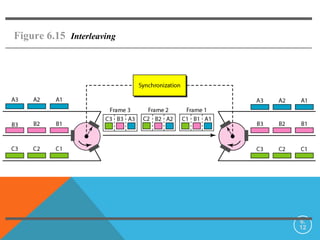
INTERLEAVING


The process of taking a group
 of bits from each input line
 for multiplexing is called
 interleaving  .


                                6.11
Figure 6.15 Interleaving


                           6.
                           12
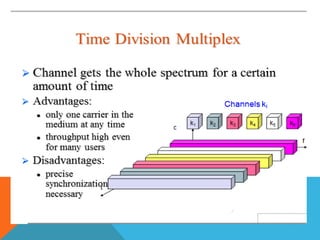
FREQUENCY DIVISION MULTIPLEX
Separation of spectrum into smaller
frequency bands
Channel gets band of the spectrum for the         Channels
                                                     ki
whole time
Advantages:                           k 3 k   4    k5   k6
  no dynamic coordination needed
  works also for analog signals
Disadvantages:
  waste of bandwidth
  if traffic distributed unevenly
  inflexible
  guard spaces
                                    t
6.15
WHY FDM IS FOR ANALOG SIGNALS AND
  TDM IS FOR DIGITAL SIGNALS?
FDM stnds for frequency division
multiplexing and it is used only in case of
analog signals because analog signals are
continuous in nature and the signal have
frequency.
TDM-stands for time division multiplexing
and it is used only in case of digital
signals because digital signals are
discrete in nature and are in the form of 0
and 1s. and are time dependent.
                                          6.16
ADVANTAGES & DISADVANTAGES OF
                TDM & FDM
In TDM, different users share the same channel based on
time slots alloted to them. Each user or source is given a
particular time slot to send its information.

1. The entire channel BW is available for a particular time
interval unlike in FDM where the channel BW is split into
smaller segments. This enables higher data rates.

2. All users share the same frequency, so spectrum
efficieny is increased. Available channel BW is no more a
constraint.


                                                         6.17
18
McGraw-Hill   ©The McGraw-Hill Companies, Inc., 2000

Tdm & fdm

  • 1.
    e d h e as R i r 03 A N za E- LT U P U d C M a - m 09 ZU a m 20 B u h T M E & UC 1 McGraw-Hill ©The McGraw-Hill Companies, Inc., 2000
  • 2.
    Note Bandwidth utilization isthe wise use of available bandwidth to achieve specific goals. Efficiency can be achieved by multiplexing; i.e., sharing of the bandwidth between multiple users. 6.2
  • 3.
    6-1 MULTIPLEXING Wheneverthe bandwidth of a medium linking two devices is greater than the bandwidth needs of the devices, the link can be shared. Multiplexing is the set of techniques that allows the (simultaneous) transmission of multiple signals across a single data link. As data and telecommunications use increases, so does traffic. Topics discussed in this section:  Frequency-Division Multiplexing  Synchronous Time-Division Multiplexing 6.3
  • 4.
    Figure 6.1 Dividinga link into channels 6.4
  • 5.
    Note FDM is ananalog multiplexing technique that combines analog signals. It uses the concept of modulation 6.5
  • 6.
    Figure 6.4 FDMprocess 6.6
  • 7.
    Figure 6.5 FDMdemultiplexing example 6.7
  • 8.
    Figure 6.12 TimeDivision Multiplexing (TDM) 6.8
  • 9.
    Note TDM is adigital multiplexing technique for combining several low-rate digital channels into one high-rate one. 6.9
  • 10.
    Figure 6.13 Synchronoustime-division multiplexing 6. 10
  • 11.
    INTERLEAVING The process oftaking a group of bits from each input line for multiplexing is called interleaving . 6.11
  • 12.
  • 13.
    FREQUENCY DIVISION MULTIPLEX Separationof spectrum into smaller frequency bands Channel gets band of the spectrum for the Channels ki whole time Advantages: k 3 k 4 k5 k6 no dynamic coordination needed works also for analog signals Disadvantages: waste of bandwidth if traffic distributed unevenly inflexible guard spaces t
  • 15.
  • 16.
    WHY FDM ISFOR ANALOG SIGNALS AND TDM IS FOR DIGITAL SIGNALS? FDM stnds for frequency division multiplexing and it is used only in case of analog signals because analog signals are continuous in nature and the signal have frequency. TDM-stands for time division multiplexing and it is used only in case of digital signals because digital signals are discrete in nature and are in the form of 0 and 1s. and are time dependent. 6.16
  • 17.
    ADVANTAGES & DISADVANTAGESOF TDM & FDM In TDM, different users share the same channel based on time slots alloted to them. Each user or source is given a particular time slot to send its information. 1. The entire channel BW is available for a particular time interval unlike in FDM where the channel BW is split into smaller segments. This enables higher data rates. 2. All users share the same frequency, so spectrum efficieny is increased. Available channel BW is no more a constraint. 6.17
  • 18.
    18 McGraw-Hill ©The McGraw-Hill Companies, Inc., 2000