Guided Media
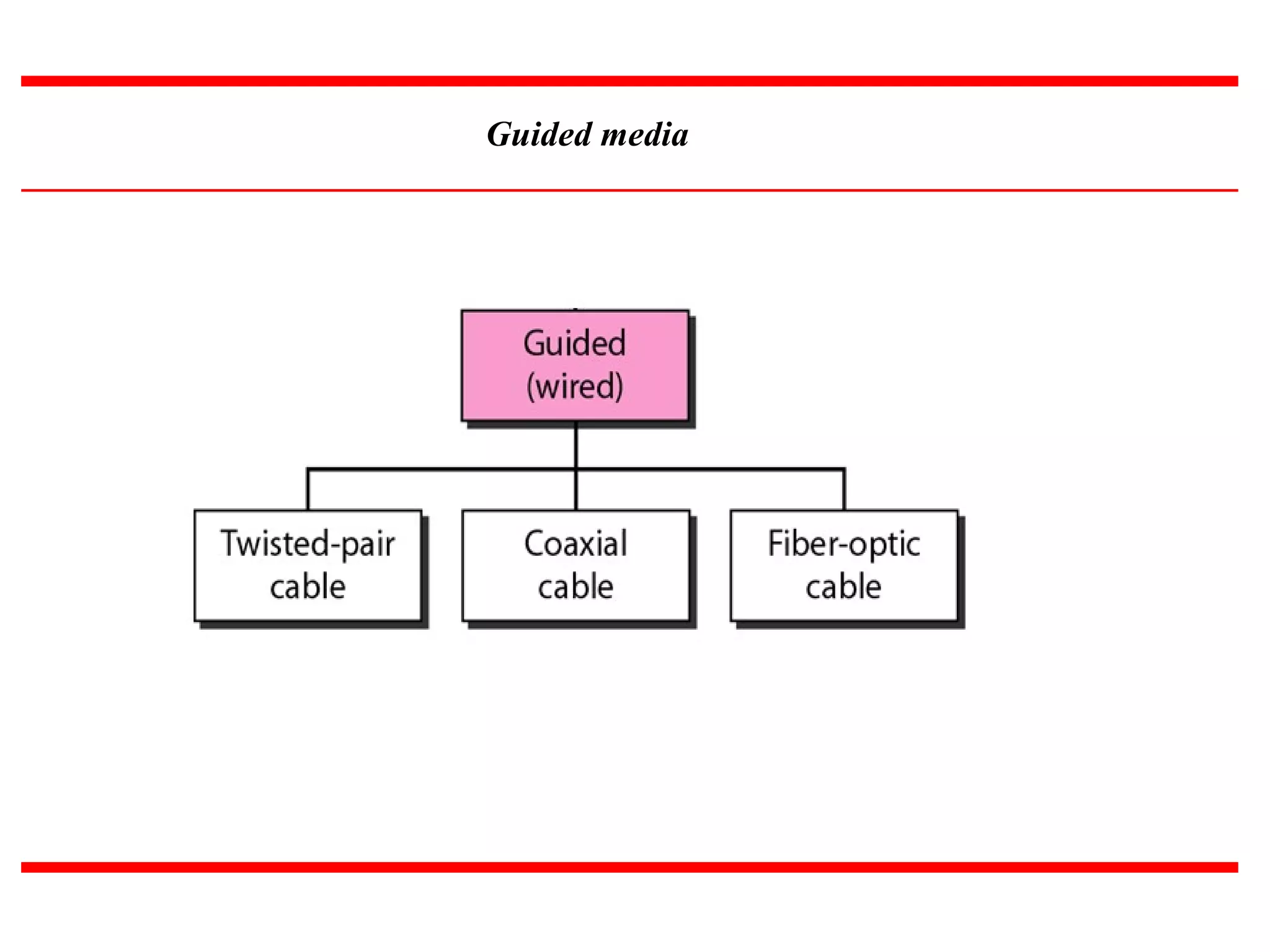
Guided media, which are those that provide a
conduit from one device to another, include
twisted-pair cable, coaxial cable, and fiber-optic
cable.
Guided media
Twisted-Pair Cable
A twisted pair consists of two conductors (normally copper), each with
its own plastic insulation, twisted together.
One of the wires is used to carry signals to the receiver, and the other
is used only as a ground reference. The receiver uses the difference
between the two.
In addition to the signal sent by the sender on one of the wires,
interference (noise) and crosstalk may affect both wires and create
unwanted signals.
Figure 7.3 Twisted-pair cable
UTP and STP cables
Applications
   Twisted-pair cables are used in telephone lines to
    provide voice and data channels.
   The local loop-the line that connects subscribers to the
    central telephone office ---commonly consists of
    unshielded twisted-pair cables.
   The DSL lines that are used by the telephone companies
    to provide high-data-rate connections also use the
    high-bandwidth capability of unshielded twisted-pair
    cables.
Coaxial Cable
Coaxial cable carries signals of higher frequency ranges than
those in twisted pair cable, in part because the two media are
constructed quite differently. Instead of having two wires, coax
has a central core conductor of solid or stranded wire.
The outer metallic wrapping serves both as a shield against
noise and as the second conductor, which completes the circuit.
Coaxial cable
Coaxial Cable Connectors

To connect coaxial cable to devices, we need coaxial
connectors.
The most common type of connector used today is the Bayone-
Neill-Concelman (BNe), connector. Figure shows three popular
types of these connectors: the BNC connector, the BNC T
connector, and the BNC terminator.
BNC connectors
Fiber-Optic Cable

A fiber-optic cable is made of glass or plastic and transmits
signals in the form of light.
To understand optical fiber, we first need to explore several
aspects of the nature of light.
Light travels in a straight line as long as it is moving
through a single uniform substance.
If a ray of light traveling through one substance suddenly
enters another substance the ray changes direction.
Fiber optics: Bending of light ray
Propagation Modes

Two modes (multimode and single mode)
for propagating light along optical channels,
each requiring fiber with different physical
characteristics. Multimode can be
implemented in two forms: step-index or
graded-index
Optical fiber
Fiber construction
Advantages
   Higher bandwidth
   Immunity to electromagnetic interference
   Resistance to corrosive materials
   Lightweight
   Less signal attenuation.
Disadvantages
   Installation and maintenance
   Unidirectional light propagation
   Cost
Guided media

Guided media

  • 2.
    Guided Media Guided media,which are those that provide a conduit from one device to another, include twisted-pair cable, coaxial cable, and fiber-optic cable.
  • 3.
  • 4.
    Twisted-Pair Cable A twistedpair consists of two conductors (normally copper), each with its own plastic insulation, twisted together. One of the wires is used to carry signals to the receiver, and the other is used only as a ground reference. The receiver uses the difference between the two. In addition to the signal sent by the sender on one of the wires, interference (noise) and crosstalk may affect both wires and create unwanted signals.
  • 5.
  • 6.
  • 7.
    Applications  Twisted-pair cables are used in telephone lines to provide voice and data channels.  The local loop-the line that connects subscribers to the central telephone office ---commonly consists of unshielded twisted-pair cables.  The DSL lines that are used by the telephone companies to provide high-data-rate connections also use the high-bandwidth capability of unshielded twisted-pair cables.
  • 8.
    Coaxial Cable Coaxial cablecarries signals of higher frequency ranges than those in twisted pair cable, in part because the two media are constructed quite differently. Instead of having two wires, coax has a central core conductor of solid or stranded wire. The outer metallic wrapping serves both as a shield against noise and as the second conductor, which completes the circuit.
  • 9.
  • 10.
    Coaxial Cable Connectors Toconnect coaxial cable to devices, we need coaxial connectors. The most common type of connector used today is the Bayone- Neill-Concelman (BNe), connector. Figure shows three popular types of these connectors: the BNC connector, the BNC T connector, and the BNC terminator.
  • 11.
  • 12.
    Fiber-Optic Cable A fiber-opticcable is made of glass or plastic and transmits signals in the form of light. To understand optical fiber, we first need to explore several aspects of the nature of light. Light travels in a straight line as long as it is moving through a single uniform substance. If a ray of light traveling through one substance suddenly enters another substance the ray changes direction.
  • 13.
  • 14.
    Propagation Modes Two modes(multimode and single mode) for propagating light along optical channels, each requiring fiber with different physical characteristics. Multimode can be implemented in two forms: step-index or graded-index
  • 15.
  • 16.
  • 17.
    Advantages  Higher bandwidth  Immunity to electromagnetic interference  Resistance to corrosive materials  Lightweight  Less signal attenuation.
  • 18.
    Disadvantages  Installation and maintenance  Unidirectional light propagation  Cost

Editor's Notes

  • #12 Bayone-Neill-Concelman