By
Alankrit Mishra
What Is Horn Antenna?
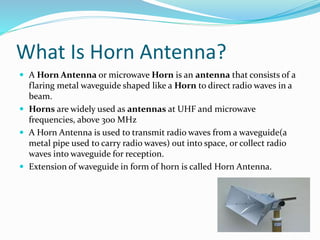
 A Horn Antenna or microwave Horn is an antenna that consists of a
flaring metal waveguide shaped like a Horn to direct radio waves in a
beam.
 Horns are widely used as antennas at UHF and microwave
frequencies, above 300 MHz
 A Horn Antenna is used to transmit radio waves from a waveguide(a
metal pipe used to carry radio waves) out into space, or collect radio
waves into waveguide for reception.
 Extension of waveguide in form of horn is called Horn Antenna.
Working:-
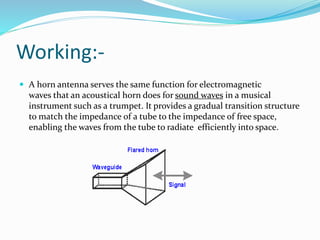
 A horn antenna serves the same function for electromagnetic
waves that an acoustical horn does for sound waves in a musical
instrument such as a trumpet. It provides a gradual transition structure
to match the impedance of a tube to the impedance of free space,
enabling the waves from the tube to radiate efficiently into space.
Types :-
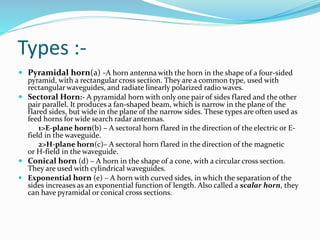
 Pyramidal horn(a) -A horn antenna with the horn in the shape of a four-sided
pyramid, with a rectangular cross section. They are a common type, used with
rectangular waveguides, and radiate linearly polarized radio waves.
 Sectoral Horn:- A pyramidal horn with only one pair of sides flared and the other
pair parallel. It produces a fan-shaped beam, which is narrow in the plane of the
flared sides, but wide in the plane of the narrow sides. These types are often used as
feed horns for wide search radar antennas.
1>E-plane horn(b) – A sectoral horn flared in the direction of the electric or E-
field in the waveguide.
2>H-plane horn(c)– A sectoral horn flared in the direction of the magnetic
or H-field in the waveguide.
 Conical horn (d) – A horn in the shape of a cone, with a circular cross section.
They are used with cylindrical waveguides.
 Exponential horn (e) – A horn with curved sides, in which the separation of the
sides increases as an exponential function of length. Also called a scalar horn, they
can have pyramidal or conical cross sections.
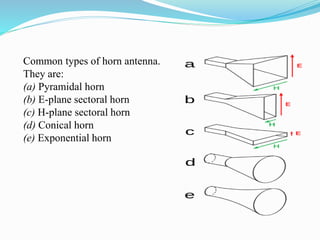
Common types of horn antenna.
They are:
(a) Pyramidal horn
(b) E-plane sectoral horn
(c) H-plane sectoral horn
(d) Conical horn
(e) Exponential horn
GAIN
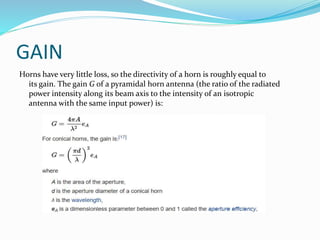
Horns have very little loss, so the directivity of a horn is roughly equal to
its gain. The gain G of a pyramidal horn antenna (the ratio of the radiated
power intensity along its beam axis to the intensity of an isotropic
antenna with the same input power) is:
Advantages
 Since these don’t have any resonant elements, they can
operate over wide range of frequencies, a wide
bandwidth.
 The useable B.W of horn antennas is typically of the
order 10:1, and can be up to 20:1(ex: allowing it to
operate from 1 GHz to 20 GHz)
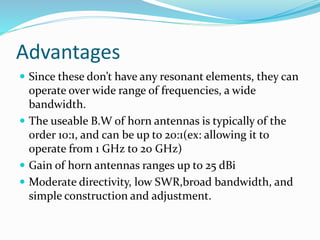
 Gain of horn antennas ranges up to 25 dBi
 Moderate directivity, low SWR,broad bandwidth, and
simple construction and adjustment.
Applications
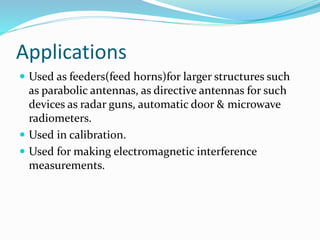
 Used as feeders(feed horns)for larger structures such
as parabolic antennas, as directive antennas for such
devices as radar guns, automatic door & microwave
radiometers.
 Used in calibration.
 Used for making electromagnetic interference
measurements.
Helical Antenna
Alankrit Mishra
1NH14EC009

Horn antenna

  • 1.
  • 2.
    What Is HornAntenna?  A Horn Antenna or microwave Horn is an antenna that consists of a flaring metal waveguide shaped like a Horn to direct radio waves in a beam.  Horns are widely used as antennas at UHF and microwave frequencies, above 300 MHz  A Horn Antenna is used to transmit radio waves from a waveguide(a metal pipe used to carry radio waves) out into space, or collect radio waves into waveguide for reception.  Extension of waveguide in form of horn is called Horn Antenna.
  • 3.
    Working:-  A hornantenna serves the same function for electromagnetic waves that an acoustical horn does for sound waves in a musical instrument such as a trumpet. It provides a gradual transition structure to match the impedance of a tube to the impedance of free space, enabling the waves from the tube to radiate efficiently into space.
  • 4.
    Types :-  Pyramidalhorn(a) -A horn antenna with the horn in the shape of a four-sided pyramid, with a rectangular cross section. They are a common type, used with rectangular waveguides, and radiate linearly polarized radio waves.  Sectoral Horn:- A pyramidal horn with only one pair of sides flared and the other pair parallel. It produces a fan-shaped beam, which is narrow in the plane of the flared sides, but wide in the plane of the narrow sides. These types are often used as feed horns for wide search radar antennas. 1>E-plane horn(b) – A sectoral horn flared in the direction of the electric or E- field in the waveguide. 2>H-plane horn(c)– A sectoral horn flared in the direction of the magnetic or H-field in the waveguide.  Conical horn (d) – A horn in the shape of a cone, with a circular cross section. They are used with cylindrical waveguides.  Exponential horn (e) – A horn with curved sides, in which the separation of the sides increases as an exponential function of length. Also called a scalar horn, they can have pyramidal or conical cross sections.
  • 5.
    Common types ofhorn antenna. They are: (a) Pyramidal horn (b) E-plane sectoral horn (c) H-plane sectoral horn (d) Conical horn (e) Exponential horn
  • 6.
    GAIN Horns have verylittle loss, so the directivity of a horn is roughly equal to its gain. The gain G of a pyramidal horn antenna (the ratio of the radiated power intensity along its beam axis to the intensity of an isotropic antenna with the same input power) is:
  • 7.
    Advantages  Since thesedon’t have any resonant elements, they can operate over wide range of frequencies, a wide bandwidth.  The useable B.W of horn antennas is typically of the order 10:1, and can be up to 20:1(ex: allowing it to operate from 1 GHz to 20 GHz)  Gain of horn antennas ranges up to 25 dBi  Moderate directivity, low SWR,broad bandwidth, and simple construction and adjustment.
  • 8.
    Applications  Used asfeeders(feed horns)for larger structures such as parabolic antennas, as directive antennas for such devices as radar guns, automatic door & microwave radiometers.  Used in calibration.  Used for making electromagnetic interference measurements.
  • 9.