1. What is modulation?


• Modulation is the process of putting information
 onto a high frequency carrier for transmission
 (frequency translation).
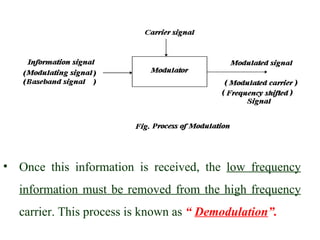
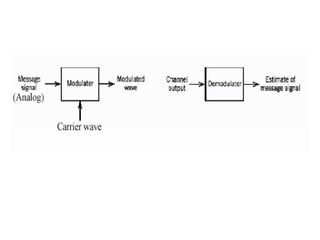
• Once this information is received, the low frequency
  information must be removed from the high frequency
  carrier. This process is known as “ Demodulation”.
2. What are the reasons for
             modulation?


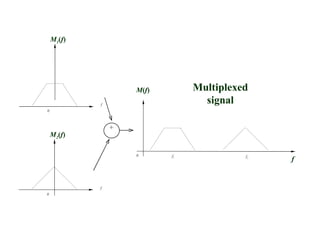
1. Frequency division multiplexing (To support multiple
  transmissions via a single channel)

  To avoid interference
M1(f)


                    M(f)        Multiplexed
            f
                                  signal
0


                +
    M2(f)

                    0      f1             f2
                                               f


            f
0
2. Practicality of Antennas


  Transmitting very low frequencies require antennas with
  miles in wavelength
ANALOG AND DIGITAL

Analog-to-analog conversion is the representation of
analog information by an analog signal. One may ask
why we need to modulate an analog signal; it is
already analog. Modulation is needed if the medium is
bandpass in nature or if only a bandpass channel is
available to us.
Topics discussed in this section:
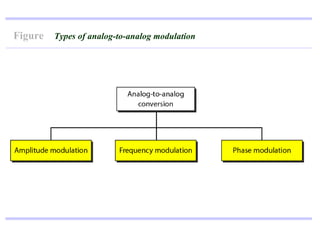
Amplitude Modulation
Frequency Modulation
Phase Modulation
Figure Types of analog-to-analog modulation
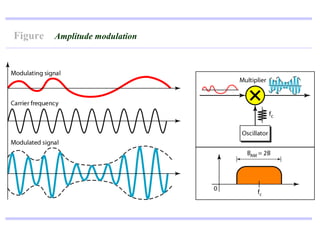
Figure Amplitude modulation
Note


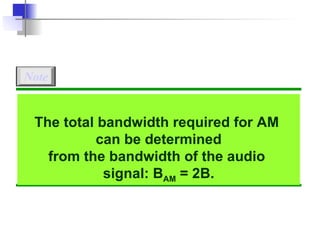
 The total bandwidth required for AM
          can be determined
   from the bandwidth of the audio
            signal: BAM = 2B.
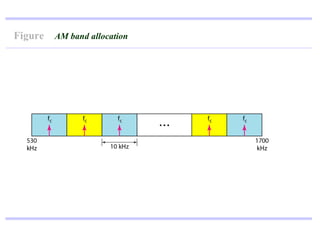
Figure   AM band allocation
Note

The total bandwidth required for FM can
  be determined from the bandwidth
  of the audio signal: BFM = 2(1 + β)B.
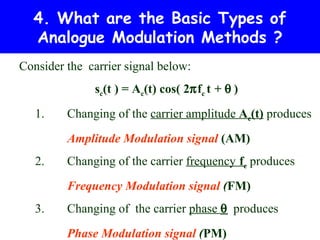
4. What are the Basic Types of
  Analogue Modulation Methods ?
Consider the carrier signal below:
              sc(t ) = Ac(t) cos( 2πfc t + θ )
   1.    Changing of the carrier amplitude Ac(t) produces
         Amplitude Modulation signal (AM)
   2.    Changing of the carrier frequency fc produces
         Frequency Modulation signal (FM)
   3.    Changing of the carrier phase θ produces
         Phase Modulation signal (PM)
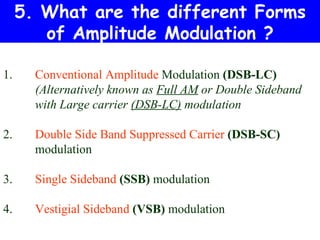
5. What are the different Forms
        of Amplitude Modulation ?

1.     Conventional Amplitude Modulation (DSB-LC)
       (Alternatively known as Full AM or Double Sideband
       with Large carrier (DSB-LC) modulation

2.     Double Side Band Suppressed Carrier (DSB-SC)
       modulation

3.     Single Sideband (SSB) modulation

4.     Vestigial Sideband (VSB) modulation
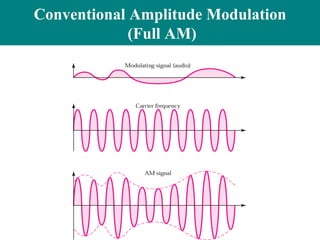
Conventional Amplitude Modulation
             (Full AM)
6. Derive the Frequency Spectrum for Full-AM
            Modulation (DSB-LC)
6. Derive the Frequency Spectrum for Full-AM
            Modulation (DSB-LC)

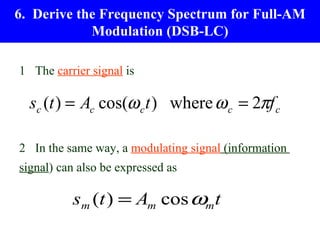
1 The carrier signal is

  sc (t ) = Ac cos(ω c t ) where ω c = 2πf c

2 In the same way, a modulating signal (information
signal) can also be expressed as

          sm (t ) = Am cos ωm t
3 The amplitude-modulated wave can be expressed as

       s (t ) = [ Ac + sm (t )] cos(ω c t )

4 By substitution

      s (t ) = [ Ac + Am cos(ω mt )] cos(ω c t )

5 The modulation index.


                            Am
                        m =
                            Ac
6     Therefore The full AM signal may be
     written as

       s (t ) = Ac (1 + m cos(ω mt )) cos(ω c t )

 cos A cos B = 1 / 2[cos( A + B ) + cos( A − B )]

                          mAc                    mAc
s (t ) = Ac (cos ω ct ) +     cos(ω c + ω m )t +     cos(ω c − ω m )t
                           2                      2
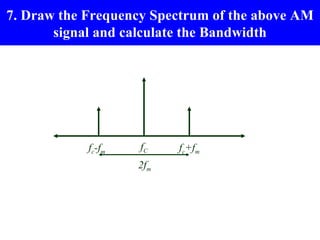
7. Draw the Frequency Spectrum of the above AM
       signal and calculate the Bandwidth


            fc-fm   fC    fc+fm
                    2fm
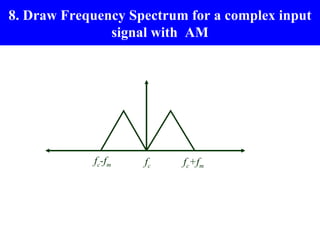
8. Draw Frequency Spectrum for a complex input
               signal with AM


             fc-fm   fc   fc+fm
Frequency Spectrum of an AM signal

The frequency spectrum of AM waveform contains
three parts:

  1. A component at the carrier frequency fc
  2. An upper side band (USB), whose highest frequency
     component is at fc+fm
  3. A lower side band (LSB), whose highest frequency
     component is at fc-fm
The bandwidth of the modulated waveform is twice the
information signal bandwidth.
• Because of the two side bands in the frequency spectrum its
   often called Double Sideband with Large Carrier.(DSB-
   LC)


• The information in the base band (information) signal is
   duplicated in the LSB and USB and the carrier conveys no
   information.
Modulation Index (m)
 9. What is the significance of modulation index ?


• m is merely defined as a parameter, which determines the
   amount of modulation.

• What is the degree of modulation required to establish a
   desirable AM communication link?

         Answer is to maintain m<1.0 (m<100%).

• This is important for successful retrieval of the original
   transmitted information at the receiver end.
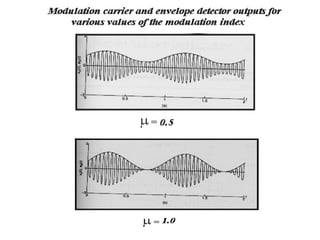
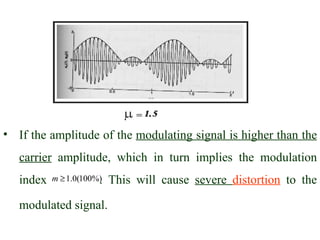
• If the amplitude of the modulating signal is higher than the
   carrier amplitude, which in turn implies the modulation
   index   m ≥ 1.0(100%)
                       .   This will cause severe distortion to the

   modulated signal.
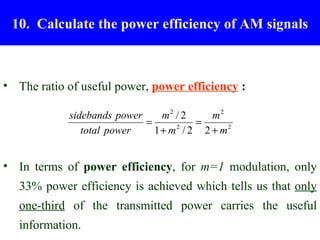
10. Calculate the power efficiency of AM signals


• The ratio of useful power, power efficiency :

            sidebands power     m2 / 2    m2
                            =          =
               total power    1 + m / 2 2 + m2
                                   2


• In terms of power efficiency, for m=1 modulation, only
   33% power efficiency is achieved which tells us that only
   one-third of the transmitted power carries the useful
   information.

Amplitute modulation

  • 1.
    1. What ismodulation? • Modulation is the process of putting information onto a high frequency carrier for transmission (frequency translation).
  • 2.
    • Once thisinformation is received, the low frequency information must be removed from the high frequency carrier. This process is known as “ Demodulation”.
  • 4.
    2. What arethe reasons for modulation? 1. Frequency division multiplexing (To support multiple transmissions via a single channel) To avoid interference
  • 5.
    M1(f) M(f) Multiplexed f signal 0 + M2(f) 0 f1 f2 f f 0
  • 6.
    2. Practicality ofAntennas Transmitting very low frequencies require antennas with miles in wavelength
  • 7.
    ANALOG AND DIGITAL Analog-to-analogconversion is the representation of analog information by an analog signal. One may ask why we need to modulate an analog signal; it is already analog. Modulation is needed if the medium is bandpass in nature or if only a bandpass channel is available to us. Topics discussed in this section: Amplitude Modulation Frequency Modulation Phase Modulation
  • 8.
    Figure Types ofanalog-to-analog modulation
  • 9.
  • 10.
    Note The totalbandwidth required for AM can be determined from the bandwidth of the audio signal: BAM = 2B.
  • 11.
    Figure AM band allocation
  • 12.
    Note The total bandwidthrequired for FM can be determined from the bandwidth of the audio signal: BFM = 2(1 + β)B.
  • 13.
    4. What arethe Basic Types of Analogue Modulation Methods ? Consider the carrier signal below: sc(t ) = Ac(t) cos( 2πfc t + θ ) 1. Changing of the carrier amplitude Ac(t) produces Amplitude Modulation signal (AM) 2. Changing of the carrier frequency fc produces Frequency Modulation signal (FM) 3. Changing of the carrier phase θ produces Phase Modulation signal (PM)
  • 14.
    5. What arethe different Forms of Amplitude Modulation ? 1. Conventional Amplitude Modulation (DSB-LC) (Alternatively known as Full AM or Double Sideband with Large carrier (DSB-LC) modulation 2. Double Side Band Suppressed Carrier (DSB-SC) modulation 3. Single Sideband (SSB) modulation 4. Vestigial Sideband (VSB) modulation
  • 15.
  • 16.
    6. Derive theFrequency Spectrum for Full-AM Modulation (DSB-LC)
  • 17.
    6. Derive theFrequency Spectrum for Full-AM Modulation (DSB-LC) 1 The carrier signal is sc (t ) = Ac cos(ω c t ) where ω c = 2πf c 2 In the same way, a modulating signal (information signal) can also be expressed as sm (t ) = Am cos ωm t
  • 18.
    3 The amplitude-modulatedwave can be expressed as s (t ) = [ Ac + sm (t )] cos(ω c t ) 4 By substitution s (t ) = [ Ac + Am cos(ω mt )] cos(ω c t ) 5 The modulation index. Am m = Ac
  • 19.
    6 Therefore The full AM signal may be written as s (t ) = Ac (1 + m cos(ω mt )) cos(ω c t ) cos A cos B = 1 / 2[cos( A + B ) + cos( A − B )] mAc mAc s (t ) = Ac (cos ω ct ) + cos(ω c + ω m )t + cos(ω c − ω m )t 2 2
  • 20.
    7. Draw theFrequency Spectrum of the above AM signal and calculate the Bandwidth fc-fm fC fc+fm 2fm
  • 21.
    8. Draw FrequencySpectrum for a complex input signal with AM fc-fm fc fc+fm
  • 22.
    Frequency Spectrum ofan AM signal The frequency spectrum of AM waveform contains three parts: 1. A component at the carrier frequency fc 2. An upper side band (USB), whose highest frequency component is at fc+fm 3. A lower side band (LSB), whose highest frequency component is at fc-fm The bandwidth of the modulated waveform is twice the information signal bandwidth.
  • 23.
    • Because ofthe two side bands in the frequency spectrum its often called Double Sideband with Large Carrier.(DSB- LC) • The information in the base band (information) signal is duplicated in the LSB and USB and the carrier conveys no information.
  • 24.
    Modulation Index (m) 9. What is the significance of modulation index ? • m is merely defined as a parameter, which determines the amount of modulation. • What is the degree of modulation required to establish a desirable AM communication link? Answer is to maintain m<1.0 (m<100%). • This is important for successful retrieval of the original transmitted information at the receiver end.
  • 26.
    • If theamplitude of the modulating signal is higher than the carrier amplitude, which in turn implies the modulation index m ≥ 1.0(100%) . This will cause severe distortion to the modulated signal.
  • 27.
    10. Calculate thepower efficiency of AM signals • The ratio of useful power, power efficiency : sidebands power m2 / 2 m2 = = total power 1 + m / 2 2 + m2 2 • In terms of power efficiency, for m=1 modulation, only 33% power efficiency is achieved which tells us that only one-third of the transmitted power carries the useful information.