PHASE MODULATION
Angle Modulation
Phase modulation (PM) is a form of
modulation that represents information as
variations in the instantaneous phase of a
carrier wave.
Modification in phase according to low
frequency will give phase modulation.
PM changes the phase angle of the complex
envelope in direct proportion to the message
signal.
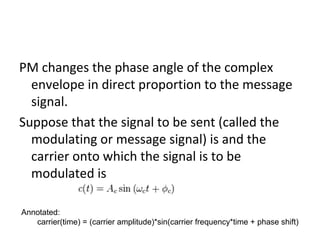
Suppose that the signal to be sent (called the
modulating or message signal) is and the
carrier onto which the signal is to be
modulated is
Annotated:
carrier(time) = (carrier amplitude)*sin(carrier frequency*time + phase shift)
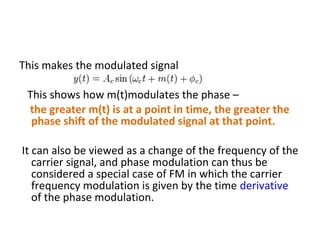
This makes the modulated signal
This shows how m(t)modulates the phase –
the greater m(t) is at a point in time, the greater the
phase shift of the modulated signal at that point.
It can also be viewed as a change of the frequency of the
carrier signal, and phase modulation can thus be
considered a special case of FM in which the carrier
frequency modulation is given by the time derivative
of the phase modulation.
Theory
• The mathematics of the spectral behavior reveals
that there are two regions of particular interest:
• For small amplitude signals, PM is similar to
amplitude modulation (AM) and exhibits its
unfortunate doubling of baseband bandwidth
and poor efficiency.
• For a single large sinusoidal signal, PM is similar
to FM, and its bandwidth is approximately
• where is the modulation index
This is also known as Carson's Rule for PM.
Modulation index
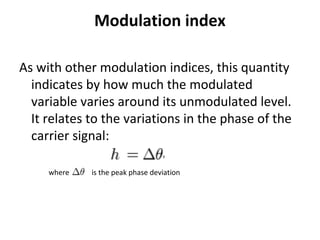
As with other modulation indices, this quantity
indicates by how much the modulated
variable varies around its unmodulated level.
It relates to the variations in the phase of the
carrier signal:
where is the peak phase deviation
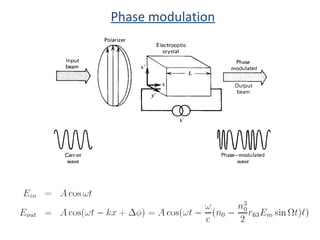
Phase modulation
Phase modulation
Mach-Zehnder
Interferometer with
a phase modulator
In one arm
Optical fibre version of
the same
interferometer
Bonus Assignment: Difference
between FM and PM
Hint:
In FM, the information of a signal is encoded in its frequency. Similarly for PM, the
information is encoded in its phase. Both modulation schemes use a carrier frequency as a
reference.
A FM modulated signal with message signal x(t) has the form
A sin(2π(fc+δ(f))t) where δf) is the frequency deviation and is a function of x(t).
A PM modulated signal with message signal x(t) has the form
A sin(2 π fc*t + p) where p is the phase and is a function of x(t).
Digital signals usually use PM as its possible to formulate orthogonal codes which provide
error correction capabilities in a noisy transmission channel.
Fm receivers are less complex. In Fm lower frequencies produce variation to the modulation
index.
Phase of the carrier is varied in accordance to the message signal in PM.
Pm receivers require proper synchronization so it is complex. Modulation index is
independent of audio frequency.
Bonus Assignment: Difference
between FM and PM
Hint:
In FM, the information of a signal is encoded in its frequency. Similarly for PM, the
information is encoded in its phase. Both modulation schemes use a carrier frequency as a
reference.
A FM modulated signal with message signal x(t) has the form
A sin(2π(fc+δ(f))t) where δf) is the frequency deviation and is a function of x(t).
A PM modulated signal with message signal x(t) has the form
A sin(2 π fc*t + p) where p is the phase and is a function of x(t).
Digital signals usually use PM as its possible to formulate orthogonal codes which provide
error correction capabilities in a noisy transmission channel.
Fm receivers are less complex. In Fm lower frequencies produce variation to the modulation
index.
Phase of the carrier is varied in accordance to the message signal in PM.
Pm receivers require proper synchronization so it is complex. Modulation index is
independent of audio frequency.

Phase modulation

  • 1.
  • 2.
    Phase modulation (PM)is a form of modulation that represents information as variations in the instantaneous phase of a carrier wave. Modification in phase according to low frequency will give phase modulation.
  • 3.
    PM changes thephase angle of the complex envelope in direct proportion to the message signal. Suppose that the signal to be sent (called the modulating or message signal) is and the carrier onto which the signal is to be modulated is Annotated: carrier(time) = (carrier amplitude)*sin(carrier frequency*time + phase shift)
  • 4.
    This makes themodulated signal This shows how m(t)modulates the phase – the greater m(t) is at a point in time, the greater the phase shift of the modulated signal at that point. It can also be viewed as a change of the frequency of the carrier signal, and phase modulation can thus be considered a special case of FM in which the carrier frequency modulation is given by the time derivative of the phase modulation.
  • 5.
    Theory • The mathematicsof the spectral behavior reveals that there are two regions of particular interest: • For small amplitude signals, PM is similar to amplitude modulation (AM) and exhibits its unfortunate doubling of baseband bandwidth and poor efficiency. • For a single large sinusoidal signal, PM is similar to FM, and its bandwidth is approximately • where is the modulation index This is also known as Carson's Rule for PM.
  • 6.
    Modulation index As withother modulation indices, this quantity indicates by how much the modulated variable varies around its unmodulated level. It relates to the variations in the phase of the carrier signal: where is the peak phase deviation
  • 7.
  • 8.
    Phase modulation Mach-Zehnder Interferometer with aphase modulator In one arm Optical fibre version of the same interferometer
  • 9.
    Bonus Assignment: Difference betweenFM and PM Hint: In FM, the information of a signal is encoded in its frequency. Similarly for PM, the information is encoded in its phase. Both modulation schemes use a carrier frequency as a reference. A FM modulated signal with message signal x(t) has the form A sin(2π(fc+δ(f))t) where δf) is the frequency deviation and is a function of x(t). A PM modulated signal with message signal x(t) has the form A sin(2 π fc*t + p) where p is the phase and is a function of x(t). Digital signals usually use PM as its possible to formulate orthogonal codes which provide error correction capabilities in a noisy transmission channel. Fm receivers are less complex. In Fm lower frequencies produce variation to the modulation index. Phase of the carrier is varied in accordance to the message signal in PM. Pm receivers require proper synchronization so it is complex. Modulation index is independent of audio frequency.
  • 10.
    Bonus Assignment: Difference betweenFM and PM Hint: In FM, the information of a signal is encoded in its frequency. Similarly for PM, the information is encoded in its phase. Both modulation schemes use a carrier frequency as a reference. A FM modulated signal with message signal x(t) has the form A sin(2π(fc+δ(f))t) where δf) is the frequency deviation and is a function of x(t). A PM modulated signal with message signal x(t) has the form A sin(2 π fc*t + p) where p is the phase and is a function of x(t). Digital signals usually use PM as its possible to formulate orthogonal codes which provide error correction capabilities in a noisy transmission channel. Fm receivers are less complex. In Fm lower frequencies produce variation to the modulation index. Phase of the carrier is varied in accordance to the message signal in PM. Pm receivers require proper synchronization so it is complex. Modulation index is independent of audio frequency.