OBJECTIVE
PUBLISHED GUIDANCES
TYPES OF ANALYTICAL METHOD TO BE VALIDATED
CONSIDERATIONS PRIOR TO METHOD VALIDATION
TYPICAL ANALYTICAL PERFORMANCE
CHARACTERISTICS USED IN METHOD VALIDATION
REVALIDATION
POSSIBLE QUESTIONS
REFERENCES
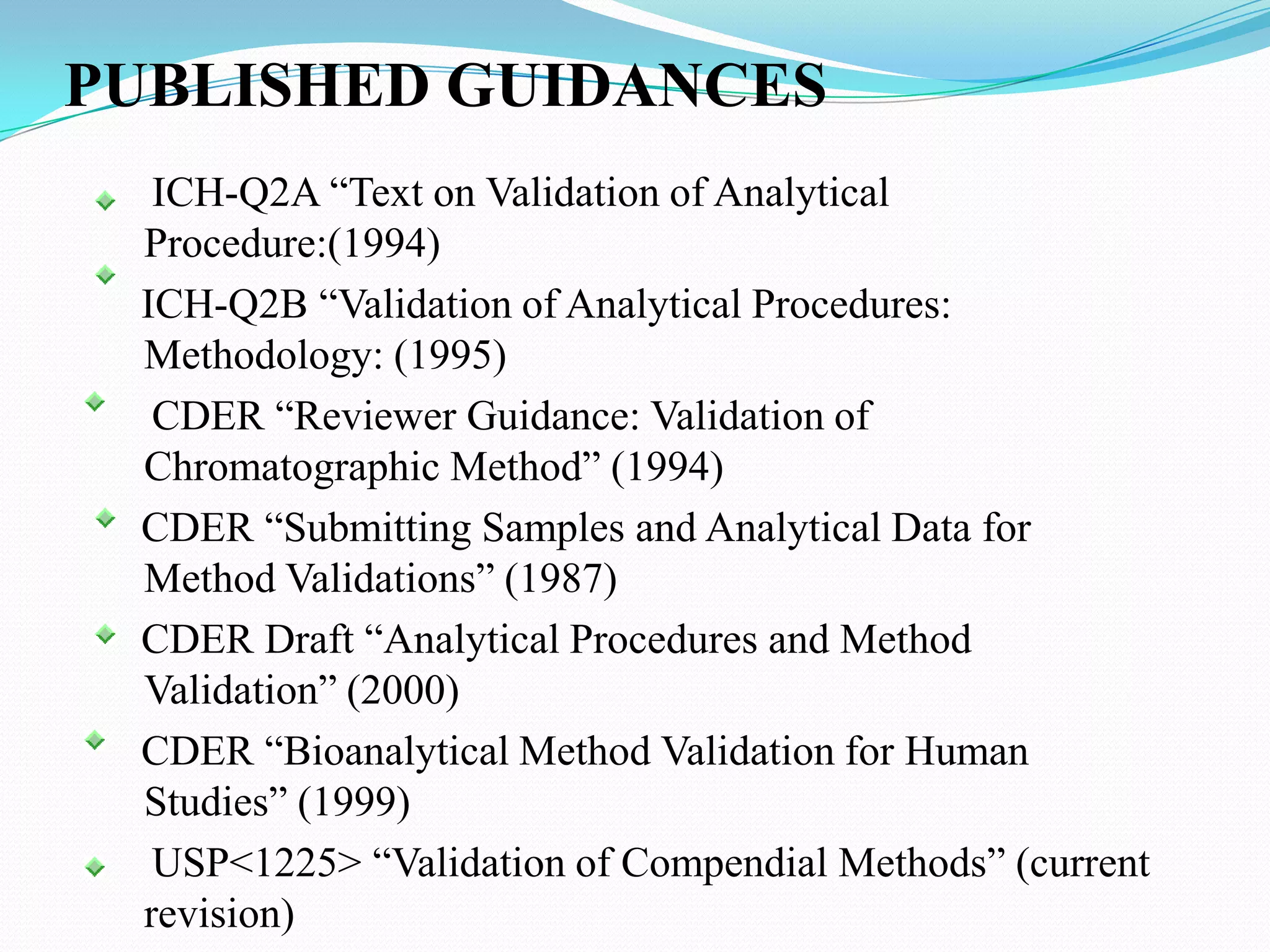
PUBLISHED GUIDANCES
  ICH-Q2A “Text on Validation of Analytical
 Procedure:(1994)
 ICH-Q2B “Validation of Analytical Procedures:
 Methodology: (1995)
  CDER “Reviewer Guidance: Validation of
 Chromatographic Method” (1994)
 CDER “Submitting Samples and Analytical Data for
 Method Validations” (1987)
 CDER Draft “Analytical Procedures and Method
 Validation” (2000)
 CDER “Bioanalytical Method Validation for Human
 Studies” (1999)
  USP<1225> “Validation of Compendial Methods” (current
 revision)
SUBMISSION TO THE COMPENDIA
  RATIONALE
 PROPOSED ANALYTICAL PROCEDURE
  DATA ELEMENTS
TYPES OF ANALYTICAL
PROCEDURES TO BE VALIDATED
 Identification tests.
 Quantitative tests for impurities' content.
 Limit tests for the control of impurities.
 Quantitative tests of the active moiety in samples
  of drug.
 substance or drug product or other selected
  component(s) in the drug product.
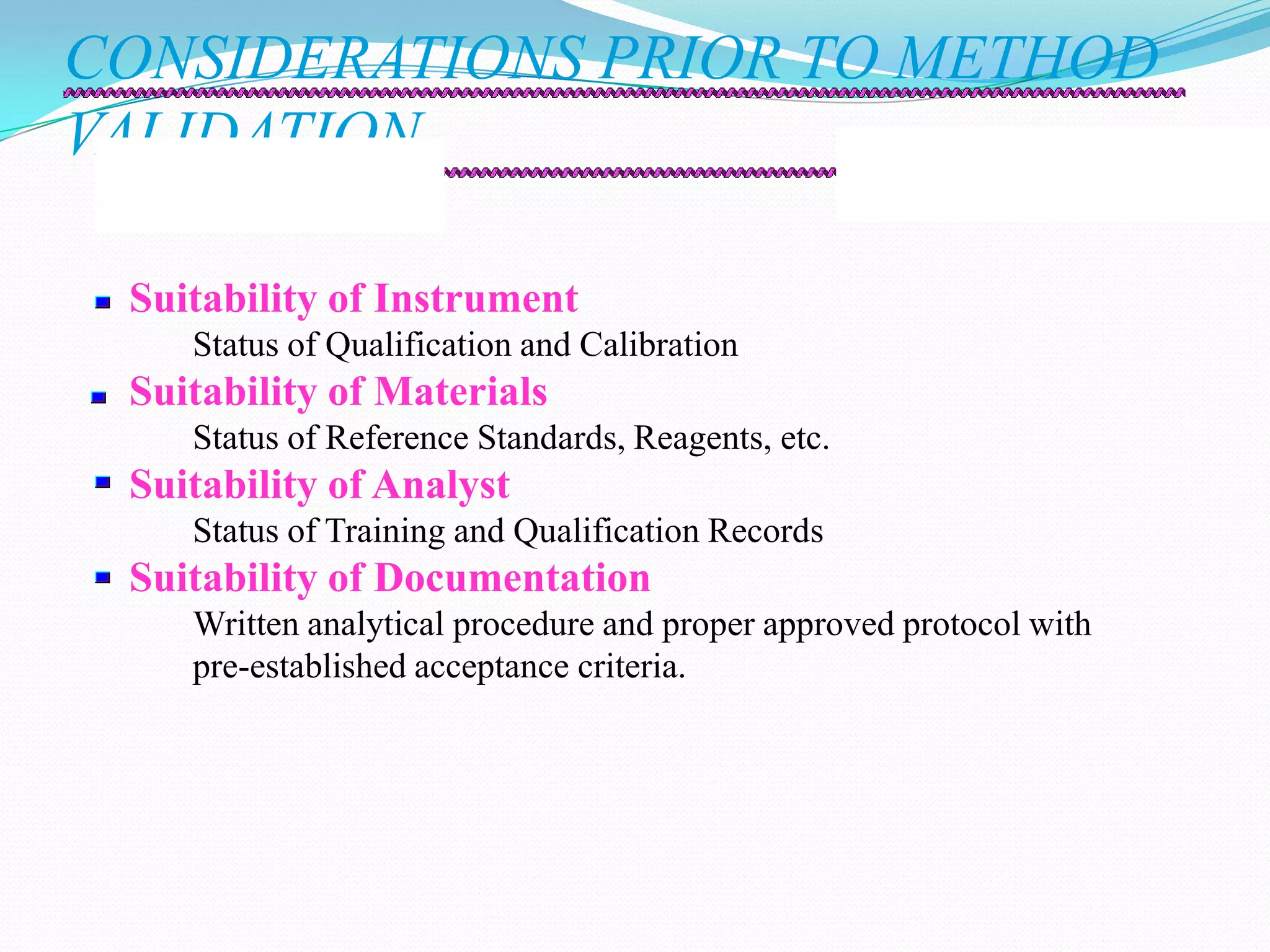
CONSIDERATIONS PRIOR TO METHOD
VALIDATION

 Suitability of Instrument
    Status of Qualification and Calibration
 Suitability of Materials
    Status of Reference Standards, Reagents, etc.
 Suitability of Analyst
    Status of Training and Qualification Records
 Suitability of Documentation
    Written analytical procedure and proper approved protocol with
    pre-established acceptance criteria.
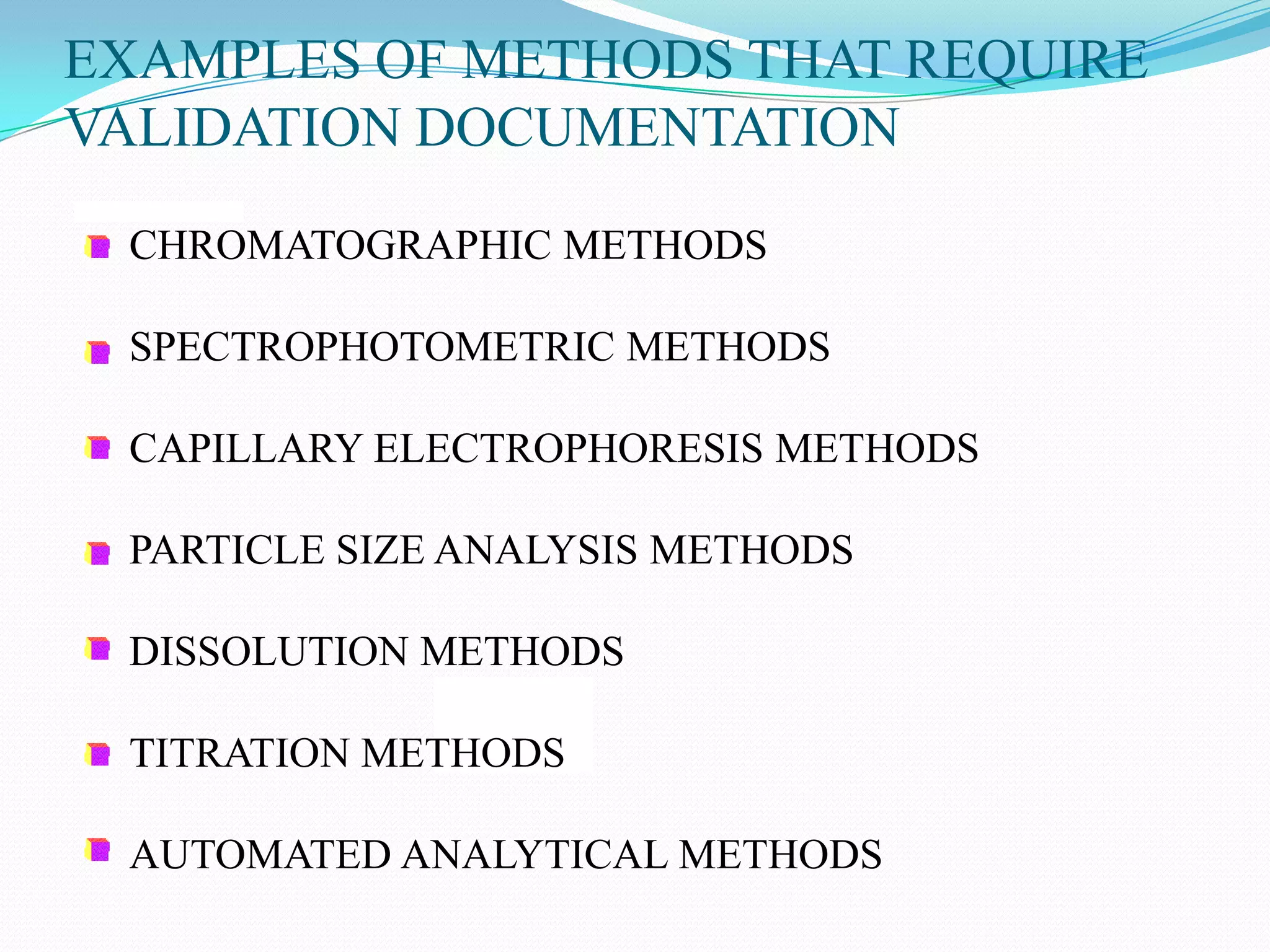
EXAMPLES OF METHODS THAT REQUIRE
VALIDATION DOCUMENTATION

 CHROMATOGRAPHIC METHODS

 SPECTROPHOTOMETRIC METHODS

 CAPILLARY ELECTROPHORESIS METHODS

 PARTICLE SIZE ANALYSIS METHODS

 DISSOLUTION METHODS

 TITRATION METHODS

 AUTOMATED ANALYTICAL METHODS
ANALYTICAL METHOD VALIDATION
   Validation of an analytical method is the process
   by which it is established, by laboratory studies,
   that the performance characteristics of the method
   meet the requirements for the intended analytical
   applications.
TYPICAL ANALYTICAL PERFORMANCE
CHARACTERISTICS USED IN METHOD VALIDATION
   Specificity (Selectivity)
   Linearity
   Range
   Accuracy
   Precision
   Detection Limit
   Quantitation Limit
   Robustness
   System Suitability Testing
SPECIFICITY
 SPECIFICITY is the ability to assess unequivocally the analyte in
 presence of components which may be expected to be present.
 DETERMINATION
 IDENTIFICATION TESTS
 ASSAY AND IMPURITY TEST(S)
   Impurities are available
   Impurities are not available
LINEARITY
  LINEARITY of an analytical procedure is its ability (within a given
  range) to obtain test results which are directly proportional to the
  concentration (amount) of analyte in the sample.

  DETERMINATION- Linearity should be evaluated by visual
  inspection of a plot of signals as a function of analyte concentration or
  content.


                            For the establishment of linearity, a minimum of five
         NOTE               concentrations is recommended.
RANGE
 RANGE of an analytical procedure is the interval between the
 upper and lower concentration (amounts) of analyte in the sample
 (including these concentrations) for which it has been
 demonstrated that the analytical procedure has a suitable level of
 precision, accuracy and linearity.

 DETERMINATION-The specified range is normally
 derived from linearity studies and depends on the intended
 application of the procedure.
ACCURACY
ACCURACY of an analytical method is the closeness of test
results obtained by that method to the true value.
DETERMINATION-Accuracy should be established across
the specified range of the analytical procedure.
ASSAY
     Drug Substance
     Drug Product
IMPURITIES (QUANTITATION)


                     Accuracy should be assessed using a minimum of 9
       NOTE          determinations over a minimum of 3 concentration
                     levels covering the specified range (i.e., three
                     concentrations and three replicates of each).
PRECISION
PRECISION of an analytical method is the degree of agreement among
individual test results when the method is applied repeatedly to multiple
samplings of a homogenous sample.
DETERMINATION- A sufficient number of aliquots of a
homogeneous sample are assayed to be able to calculate statistically valid
estimates of standard deviation or relative standard deviation.
   Repeatability
   Intermediate precision
   Reproducibilty
DETECTION LIMIT
    DETECTION LIMIT of an individual analytical
    procedure is the lowest amount of analyte in a sample which can
    be detected but not necessarily quantitated, under the stated
    experimental conditions.

    DETERMINATION- Several approaches for determining
    the detection limit are possible, depending on whether the
    procedure is a non-instrumental or instrumental.

    BASED ON VISUAL EXAMINATION
    BASED ON SIGNAL TO NOISE RATIO
QUANTITATION LIMIT

  QUANTITATION LIMIT of an individual analytical
  procedure is the lowest amount of analyte in a sample which can be
  quantitatively determined with suitable precision and accuracy.

  DETERMINATION- Several approaches for determining the
  detection limit are possible, depending on whether the procedure is a
  non-instrumental or instrumental.

  BASED ON VISUAL EXAMINATION
  BASED ON SIGNAL TO NOISE RATIO
LOQ, LOD and SNR
Limit of Quantitation            Peak B
Limit of Detection               LOQ
Signal to Noise Ratio

                        Peak A
                        LOD

  Baseline      noise
RUGGEDNESS
 RUGGEDNESS of an analytical method is the degree of
 reproducibility of test results obtained by the analysis of the same
 samples under a variety of conditions, such as different laboratories
 different analyst, different instruments, different lots of reagent,
 different elapsed assay times, different assay temperatures, different
 days, etc.


                      Included in
    NOTE

                       but not in
ROBUSTNESS
  ROBUSTNESS of an analytical procedure is a measure of its
  capacity to remain unaffected by small, but deliberate variations in
  method parameters and provides an indication of its reliability during
  normal usage.

  DETERMINATION- The evaluation of robustness should be
  considered during the development phase and depends on the type of
  procedure under study.
SYSTEM SUITABILITY TESTING
 SYSTEM SUITABILITY TESTING                         is
 an integral part of many analytical procedures. The
 tests are based on the concept that the equipment,
 electronics, analytical operations and samples to be
 analyzed constitute an integral system that can be
 evaluated as such.
Recommended Validation Characteristics of the Various Types of Tests
REVALIDATION MAY BE NECESSARY IN
THE FOLLOWING CIRCUMSTANCES:
  changes in the synthesis of the drug substance;
  changes in the composition of the finished
  product;
  changes in the analytical procedure;
  The degree of revalidation required depends on
  the nature of the changes. Certain other changes
  may require validation as well.
The United State Pharmacopoeia 24; The National
Formulary 19; 2000: [1225] VALIDATION OF
COMPENDIAL METHODS.
www.labcompliance.com/methods/meth_va
htm#introduction
http://www.fda.gov/cder/guidance/2396dft.htm
www.fda.gov/ohrms/dockets/
ac/02/slides/3841s1_07_lachman.PPT
http://www.fda.gov/cder/guidance/ameth.htm
http://www.ich.org
http://www.fda.gov/cder/guidance/425
2fnl.htm
http://www.pharmtech.com/pharmtech/dat
a/articlestandard/pharmtech/102003/483
14/article.pdf
http://www.ivstandards.com/tech/reliabilit
y/part17.asp
http://www.aoac.org/
Analytical method validation

Analytical method validation

  • 2.
    OBJECTIVE PUBLISHED GUIDANCES TYPES OFANALYTICAL METHOD TO BE VALIDATED CONSIDERATIONS PRIOR TO METHOD VALIDATION TYPICAL ANALYTICAL PERFORMANCE CHARACTERISTICS USED IN METHOD VALIDATION REVALIDATION POSSIBLE QUESTIONS REFERENCES
  • 3.
    PUBLISHED GUIDANCES ICH-Q2A “Text on Validation of Analytical Procedure:(1994) ICH-Q2B “Validation of Analytical Procedures: Methodology: (1995) CDER “Reviewer Guidance: Validation of Chromatographic Method” (1994) CDER “Submitting Samples and Analytical Data for Method Validations” (1987) CDER Draft “Analytical Procedures and Method Validation” (2000) CDER “Bioanalytical Method Validation for Human Studies” (1999) USP<1225> “Validation of Compendial Methods” (current revision)
  • 4.
    SUBMISSION TO THECOMPENDIA RATIONALE PROPOSED ANALYTICAL PROCEDURE DATA ELEMENTS
  • 5.
    TYPES OF ANALYTICAL PROCEDURESTO BE VALIDATED  Identification tests.  Quantitative tests for impurities' content.  Limit tests for the control of impurities.  Quantitative tests of the active moiety in samples of drug.  substance or drug product or other selected component(s) in the drug product.
  • 6.
    CONSIDERATIONS PRIOR TOMETHOD VALIDATION Suitability of Instrument Status of Qualification and Calibration Suitability of Materials Status of Reference Standards, Reagents, etc. Suitability of Analyst Status of Training and Qualification Records Suitability of Documentation Written analytical procedure and proper approved protocol with pre-established acceptance criteria.
  • 7.
    EXAMPLES OF METHODSTHAT REQUIRE VALIDATION DOCUMENTATION CHROMATOGRAPHIC METHODS SPECTROPHOTOMETRIC METHODS CAPILLARY ELECTROPHORESIS METHODS PARTICLE SIZE ANALYSIS METHODS DISSOLUTION METHODS TITRATION METHODS AUTOMATED ANALYTICAL METHODS
  • 8.
    ANALYTICAL METHOD VALIDATION Validation of an analytical method is the process by which it is established, by laboratory studies, that the performance characteristics of the method meet the requirements for the intended analytical applications.
  • 9.
    TYPICAL ANALYTICAL PERFORMANCE CHARACTERISTICSUSED IN METHOD VALIDATION Specificity (Selectivity) Linearity Range Accuracy Precision Detection Limit Quantitation Limit Robustness System Suitability Testing
  • 10.
    SPECIFICITY SPECIFICITY isthe ability to assess unequivocally the analyte in presence of components which may be expected to be present. DETERMINATION IDENTIFICATION TESTS ASSAY AND IMPURITY TEST(S)  Impurities are available  Impurities are not available
  • 11.
    LINEARITY LINEARITYof an analytical procedure is its ability (within a given range) to obtain test results which are directly proportional to the concentration (amount) of analyte in the sample. DETERMINATION- Linearity should be evaluated by visual inspection of a plot of signals as a function of analyte concentration or content. For the establishment of linearity, a minimum of five NOTE concentrations is recommended.
  • 13.
    RANGE RANGE ofan analytical procedure is the interval between the upper and lower concentration (amounts) of analyte in the sample (including these concentrations) for which it has been demonstrated that the analytical procedure has a suitable level of precision, accuracy and linearity. DETERMINATION-The specified range is normally derived from linearity studies and depends on the intended application of the procedure.
  • 14.
    ACCURACY ACCURACY of ananalytical method is the closeness of test results obtained by that method to the true value. DETERMINATION-Accuracy should be established across the specified range of the analytical procedure. ASSAY  Drug Substance  Drug Product IMPURITIES (QUANTITATION) Accuracy should be assessed using a minimum of 9 NOTE determinations over a minimum of 3 concentration levels covering the specified range (i.e., three concentrations and three replicates of each).
  • 15.
    PRECISION PRECISION of ananalytical method is the degree of agreement among individual test results when the method is applied repeatedly to multiple samplings of a homogenous sample. DETERMINATION- A sufficient number of aliquots of a homogeneous sample are assayed to be able to calculate statistically valid estimates of standard deviation or relative standard deviation. Repeatability Intermediate precision Reproducibilty
  • 16.
    DETECTION LIMIT DETECTION LIMIT of an individual analytical procedure is the lowest amount of analyte in a sample which can be detected but not necessarily quantitated, under the stated experimental conditions. DETERMINATION- Several approaches for determining the detection limit are possible, depending on whether the procedure is a non-instrumental or instrumental. BASED ON VISUAL EXAMINATION BASED ON SIGNAL TO NOISE RATIO
  • 17.
    QUANTITATION LIMIT QUANTITATION LIMIT of an individual analytical procedure is the lowest amount of analyte in a sample which can be quantitatively determined with suitable precision and accuracy. DETERMINATION- Several approaches for determining the detection limit are possible, depending on whether the procedure is a non-instrumental or instrumental. BASED ON VISUAL EXAMINATION BASED ON SIGNAL TO NOISE RATIO
  • 18.
    LOQ, LOD andSNR Limit of Quantitation Peak B Limit of Detection LOQ Signal to Noise Ratio Peak A LOD Baseline noise
  • 19.
    RUGGEDNESS RUGGEDNESS ofan analytical method is the degree of reproducibility of test results obtained by the analysis of the same samples under a variety of conditions, such as different laboratories different analyst, different instruments, different lots of reagent, different elapsed assay times, different assay temperatures, different days, etc. Included in NOTE but not in
  • 20.
    ROBUSTNESS ROBUSTNESSof an analytical procedure is a measure of its capacity to remain unaffected by small, but deliberate variations in method parameters and provides an indication of its reliability during normal usage. DETERMINATION- The evaluation of robustness should be considered during the development phase and depends on the type of procedure under study.
  • 21.
    SYSTEM SUITABILITY TESTING SYSTEM SUITABILITY TESTING is an integral part of many analytical procedures. The tests are based on the concept that the equipment, electronics, analytical operations and samples to be analyzed constitute an integral system that can be evaluated as such.
  • 22.
    Recommended Validation Characteristicsof the Various Types of Tests
  • 23.
    REVALIDATION MAY BENECESSARY IN THE FOLLOWING CIRCUMSTANCES: changes in the synthesis of the drug substance; changes in the composition of the finished product; changes in the analytical procedure; The degree of revalidation required depends on the nature of the changes. Certain other changes may require validation as well.
  • 24.
    The United StatePharmacopoeia 24; The National Formulary 19; 2000: [1225] VALIDATION OF COMPENDIAL METHODS. www.labcompliance.com/methods/meth_va htm#introduction http://www.fda.gov/cder/guidance/2396dft.htm www.fda.gov/ohrms/dockets/ ac/02/slides/3841s1_07_lachman.PPT http://www.fda.gov/cder/guidance/ameth.htm
  • 25.