ANALYTICAL & BIO-
ANALYTICAL METHOD
VALIDATION
1
2
VIGNAN PHARMACY COLLEGE,VADLAMUDI.
 Validation is a documented evidence which high degree of
assurance that specific process will produce a product meeting it’s
pre determined specifications and quality attributes..
 Drug substances and drug product manufacturers must perform
validations, it is very important that this understanding be shared
throughout the organization.
 The term validation generally to cover the entire spectrum of
cGMP.
3
VIGNAN PHARMACY COLLEGE,VADLAMUDI.
ANALYTICAL METHOD VALIDATION
 Validation of an analytical method is the process by which it is
established, by laboratory studies, that the performance
characteristics of the method meet the requirements for the
intended analytical applications.
 The process to Confirm that the analytical procedure employed
for a specific test is suitable for intended use and that they
support the identity, quality, purity and potency of the drug
substances and drug products. 4
VIGNAN PHARMACY COLLEGE,VADLAMUDI.
5
VIGNAN PHARMACY COLLEGE,VADLAMUDI.
CONCEPT OF REVALIDATION
When we make any changes inWhen we make any changes in
 Analytical procedureAnalytical procedure
 Drug substance (e.g. synthetic route)Drug substance (e.g. synthetic route)
 Drug product (e.g. composition)Drug product (e.g. composition)
6
VIGNAN PHARMACY COLLEGE,VADLAMUDI.
PARAMETERSPARAMETERS
Specificity
LOD & LOQ (if applicable)
Linearity
Precision
i. System Suitability
ii. Method Repeatability
iii. Intermediate Precision (or) Ruggedness
iv. Method Reproducibility
Accuracy (or) Recovery
Robustness
7
VIGNAN PHARMACY COLLEGE,VADLAMUDI.
DEFINITION
 SpecificitySpecificity of analytical method as its ability to measure
accurately an analyte in the presence of interference,
such as synthetic precursors, excipients, enantiomers
and known (or likely) degradation product that may be
expected to be present in the sample matrix.
1. SPECIFICITY
8
VIGNAN PHARMACY COLLEGE,VADLAMUDI.
2. LIMIT OF DETECTION AND LIMIT OF
QUANTIFICATION (LOD & LOQ)
2. LIMIT OF DETECTION AND LIMIT OF
QUANTIFICATION (LOD & LOQ)
DEFINITIONDEFINITION
LOD:LOD: Lowest amount of analyte in a sample which can be detectedLowest amount of analyte in a sample which can be detected
but not necessarily quantitated, under the stated experimentalbut not necessarily quantitated, under the stated experimental
conditions (LOD)conditions (LOD)
LOQ:LOQ: Lowest amount of analyte in a sample which can beLowest amount of analyte in a sample which can be
quantitatively determined with suitable precision and accuracyquantitatively determined with suitable precision and accuracy
(LOQ)(LOQ)
9
VIGNAN PHARMACY COLLEGE,VADLAMUDI.
10VIGNAN PHARMACY COLLEGE,VADLAMUDI.
3. LINEARITY
DEFINITIONDEFINITION
TheThe LinearityLinearity of an analytical procedure is its ability (within a given range) toof an analytical procedure is its ability (within a given range) to
obtain test results that are directly proportional to the concentration (amount) ofobtain test results that are directly proportional to the concentration (amount) of
analyte in the sampleanalyte in the sample
Range: The interval between the upper and lower level( Including these level)Range: The interval between the upper and lower level( Including these level)
that have been demonstrated to be determined with precision, accuracy andthat have been demonstrated to be determined with precision, accuracy and
linearity.linearity.
11
VIGNAN PHARMACY COLLEGE,VADLAMUDI.
4. PRECISION
DEFINITIONDEFINITION
Closeness of agreement (degree of scatter) between a series ofCloseness of agreement (degree of scatter) between a series of
measurements obtained from multiple sampling of the samemeasurements obtained from multiple sampling of the same
homogenous sample under the prescribed conditions.homogenous sample under the prescribed conditions.
Precision may be considered at ….Precision may be considered at ….
1.1. System precision (System suitability)System precision (System suitability)
2.2. Method RepeatabilityMethod Repeatability
3.3. Intermediate precisionIntermediate precision
4.4. ReproducibilityReproducibility 12
VIGNAN PHARMACY COLLEGE,VADLAMUDI.
Repeatability:Repeatability: precision under same operating conditions (with-in a laboratory overprecision under same operating conditions (with-in a laboratory over
a short period of time using the same analyst with the same equipment)a short period of time using the same analyst with the same equipment)
Measurement / Injection repeatability (System Precision)Measurement / Injection repeatability (System Precision)
Method repeatability (Method Precision)Method repeatability (Method Precision)
Intermediate precisionIntermediate precision: precision under different laboratory conditions (within-: precision under different laboratory conditions (within-
laboratory variation, as on different days, or with different analysts, or equipmentslaboratory variation, as on different days, or with different analysts, or equipments
within the same laboratory)within the same laboratory)
ReproducibilityReproducibility: precision between laboratories / intermediate precision can be: precision between laboratories / intermediate precision can be
considered during the standardization of a procedure before it is submitted to theconsidered during the standardization of a procedure before it is submitted to the
pharmacopoeiapharmacopoeia
13
VIGNAN PHARMACY COLLEGE,VADLAMUDI.
5. ACCURACY
DEFINITIONDEFINITION
The accuracy of an analytical procedure expresses the closeness ofThe accuracy of an analytical procedure expresses the closeness of
agreement between the value, which is accepted either as aagreement between the value, which is accepted either as a
conventional true value or an accepted reference value and the valueconventional true value or an accepted reference value and the value
foundfound
 It is some times termed as truenessIt is some times termed as trueness
14
VIGNAN PHARMACY COLLEGE,VADLAMUDI.
6. ROBUSTNESS
DEFINTIONDEFINTION
Measure of its capacity to remain unaffected by small, but deliberateMeasure of its capacity to remain unaffected by small, but deliberate
variations in method parameters and provides indication of its reliabilityvariations in method parameters and provides indication of its reliability
during its normal usageduring its normal usage
varying method parameters within a realistic range and the quantitativevarying method parameters within a realistic range and the quantitative
influence of the variables is determined, and, if the influence of theinfluence of the variables is determined, and, if the influence of the
parameter is within a previously specified tolerance, then, the parameter isparameter is within a previously specified tolerance, then, the parameter is
said to be within the method’s robustness range.said to be within the method’s robustness range.
15
VIGNAN PHARMACY COLLEGE,VADLAMUDI.
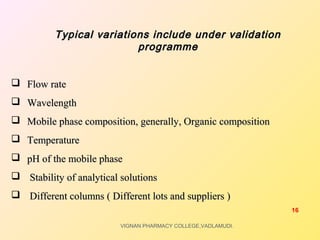
Typical variations include under validationTypical variations include under validation
programmeprogramme
 Flow rateFlow rate
 WavelengthWavelength
 Mobile phase composition, generally, Organic compositionMobile phase composition, generally, Organic composition
 TemperatureTemperature
 pH of the mobile phasepH of the mobile phase
 Stability of analytical solutionsStability of analytical solutions
 Different columns ( Different lots and suppliers )Different columns ( Different lots and suppliers )
16
VIGNAN PHARMACY COLLEGE,VADLAMUDI.
VALIDATION REPORT
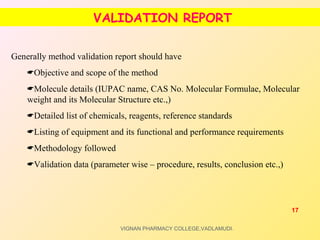
Generally method validation report should have
Objective and scope of the method
Molecule details (IUPAC name, CAS No. Molecular Formulae, Molecular
weight and its Molecular Structure etc.,)
Detailed list of chemicals, reagents, reference standards
Listing of equipment and its functional and performance requirements
Methodology followed
Validation data (parameter wise – procedure, results, conclusion etc.,)
17
VIGNAN PHARMACY COLLEGE,VADLAMUDI.
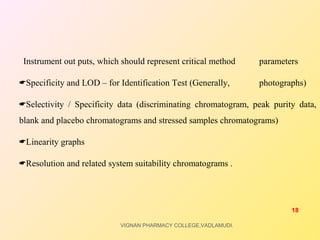
Instrument out puts, which should represent critical method parameters
Specificity and LOD – for Identification Test (Generally, photographs)
Selectivity / Specificity data (discriminating chromatogram, peak purity data,
blank and placebo chromatograms and stressed samples chromatograms)
Linearity graphs
Resolution and related system suitability chromatograms .
18
VIGNAN PHARMACY COLLEGE,VADLAMUDI.
BIO ANALYTICAL METHOD
VALIDATION
19
VIGNAN PHARMACY COLLEGE,VADLAMUDI.
 INTRODUCTION OF BIO ANLAYTICAL METHOD
VALIDATION.
 BASIC STEPS IN BIO ANALYTICAL METHOD
VALIDATION.
 VALIDATION PARAMETERS.
 CONCLUSION.
 REFERENCE.
20
VIGNAN PHARMACY COLLEGE,VADLAMUDI.
INTRODUCTION
 It involves the quantitative determination of drug and its
metabolites in biological fluids .
 It plays a vital role in the evaluation & interpretation of the
bioavailability, bioequivalence, pharmacokinetic and
toxicokinetic study data.
21
VIGNAN PHARMACY COLLEGE,VADLAMUDI.
BASIC STEPS OF BIOANALYTICAL
PROCESS
22
VIGNAN PHARMACY COLLEGE,VADLAMUDI.
1) SELECTIVITY
It is the ability of an analytical method to identify and
quantify the analyte in the presence of other
components in the sample.
LLOQ – It is the lowest amount of analyte in the sample
that can be quantified with accuracy and precision.
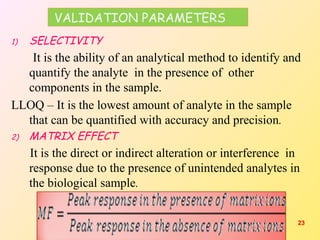
2) MATRIX EFFECT
It is the direct or indirect alteration or interference in
response due to the presence of unintended analytes in
the biological sample.
VALIDATION PARAMETERS
23
If MF = 1 ( No matrix effect)
If MF < 1 ( Suppression)
If MF > 1 ( Enhancement)
3) SENSITIVITY
 Sensitivity test should be conducted to prove the
reproducibility for samples at LOQ.
ACCEPTANCE CRITERIA FOR LOQ :
For accuracy : ± 20%
For precision : ≤ 20%
For S/N ratio: 5: 1
24
VIGNAN PHARMACY COLLEGE,VADLAMUDI.
4) CALIBRATION AND QC STANDARDS
 Calibration standard is the biological matrix to which a known amount
of analyte is added.
 QC standard is a spiked sample used to monitor the performance of a
bioanalytical method and is used to assess the integrity and validate
the results of unknown samples.
5) RECOVERY (OR) EXTRACTION EFFICIENCY
 Determined by comparing the detector response of the analyte (or) IS
from an extracted sample to the detector response of the analyte from
an unextracted sample representing 100% recovery.
25
VIGNAN PHARMACY COLLEGE,VADLAMUDI.
6) DILUTION INTEGRITY
 Dilution of the study samples is performed when the
obtained concentration is exceeding the ULOQ, or when
there is less sample availability compared to the method
requirement.( can be tested on dilutions from 1:2 to 1:10
& dilution integrity will be evaluated at 1:2to 1:4)
ACCEPTANCE CRITERIA :
QC samples , Accuracy = ±15%
Precision = ≤15%
26
VIGNAN PHARMACY COLLEGE,VADLAMUDI.
7) CARRYOVER
It is the appearance of an analyte signal in
blank sample peaks after the analysis of
samples with a high analyte concentration.
To evaluate carryover a blank sample will
be placed ULQ standard in a sequence.
It is insignificant when blank sample
response is ≤ 20% of LOQ sample.
27
VIGNAN PHARMACY COLLEGE,VADLAMUDI.
 It is evaluated when different anticoagulants in plasma
are used in the preparation of the QC and Calibration
control standards.
 Anticoagulant effect is nullified ,when QC standard
shows,
 Accuracy = ±15% and Precision = ≤15%
9) STABILITY EVALUATION
 The stability of analyte in the matrix during collection,
storage of samples should be assessed
8) ANTICOAGULANT EFFECT
28
VIGNAN PHARMACY COLLEGE,VADLAMUDI.
Short term stability of analyte and IS In solvent
29
MATRIX STABILITY
AUTO SAMPLER STABILITY
 It is evaluated to cover the anticipated run time for the
analytical batch and to handle the situations like system
malfunctioning.
ALL THE QC SAMPLE
CONC. ARE BACK
CALCULATED USING
CALIBRATION CURVE 30
 It is performed to evaluate the stability of the samples,
which are kept on bench during the extraction process.
The anticipated time is usually 4 to 24 hrs
BENCH TOP STABILITY
31
VIGNAN PHARMACY COLLEGE,VADLAMUDI.
LONG TERM STABILITY
 It is performed to demonstrate the stability of the
analyte in the matrix for longer duration of time.
ACCEPTENCE CRITERIA :
 The relative means of back calculated
concentration (test/reference) for both levels must
be within 85-115%.
32
VIGNAN PHARMACY COLLEGE,VADLAMUDI.
FREEZE THAW STABILITY
 It is performed , to evaluate the stability of the
analyte in the matrix after multiple cycles of freezing
and thawing.
33
VIGNAN PHARMACY COLLEGE,VADLAMUDI.
CONCLUSION
 Validation is done according to standard protocol and
used it always produce a product which meets its
predetermined specification and quality control.
 Bioanalytical methods must be validated to objectively
demonstrate the fitness for their intended use.
 Bioanalysis and the production of pharmacokinetic, toxicokinetic
and metabolic data plays a fundamental role in pharmaceutical
research and development involved in the drug discovery and
development process.
34
VIGNAN PHARMACY COLLEGE,VADLAMUDI.
REFERENCE
 Bioanalytical Method Validation and Its
Pharmaceutical Application- A Review article
from Pharmaceutica Analytica
 James agalloco,frederick J. Carleton. Validation
of pharmaceutical process, third edition, Page no
5.
 The United State Pharmacopoeia 24; The National
Formulary 19; 2000: [1225] VALIDATION OF
COMPENDIAL METHODS.
35
VIGNAN PHARMACY COLLEGE,VADLAMUDI.
36VIGNAN PHARMACY COLLEGE,VADLAMUDI.

validation

  • 1.
    ANALYTICAL & BIO- ANALYTICALMETHOD VALIDATION 1
  • 2.
  • 3.
     Validation isa documented evidence which high degree of assurance that specific process will produce a product meeting it’s pre determined specifications and quality attributes..  Drug substances and drug product manufacturers must perform validations, it is very important that this understanding be shared throughout the organization.  The term validation generally to cover the entire spectrum of cGMP. 3 VIGNAN PHARMACY COLLEGE,VADLAMUDI.
  • 4.
    ANALYTICAL METHOD VALIDATION Validation of an analytical method is the process by which it is established, by laboratory studies, that the performance characteristics of the method meet the requirements for the intended analytical applications.  The process to Confirm that the analytical procedure employed for a specific test is suitable for intended use and that they support the identity, quality, purity and potency of the drug substances and drug products. 4 VIGNAN PHARMACY COLLEGE,VADLAMUDI.
  • 5.
  • 6.
    CONCEPT OF REVALIDATION Whenwe make any changes inWhen we make any changes in  Analytical procedureAnalytical procedure  Drug substance (e.g. synthetic route)Drug substance (e.g. synthetic route)  Drug product (e.g. composition)Drug product (e.g. composition) 6 VIGNAN PHARMACY COLLEGE,VADLAMUDI.
  • 7.
    PARAMETERSPARAMETERS Specificity LOD & LOQ(if applicable) Linearity Precision i. System Suitability ii. Method Repeatability iii. Intermediate Precision (or) Ruggedness iv. Method Reproducibility Accuracy (or) Recovery Robustness 7 VIGNAN PHARMACY COLLEGE,VADLAMUDI.
  • 8.
    DEFINITION  SpecificitySpecificity ofanalytical method as its ability to measure accurately an analyte in the presence of interference, such as synthetic precursors, excipients, enantiomers and known (or likely) degradation product that may be expected to be present in the sample matrix. 1. SPECIFICITY 8 VIGNAN PHARMACY COLLEGE,VADLAMUDI.
  • 9.
    2. LIMIT OFDETECTION AND LIMIT OF QUANTIFICATION (LOD & LOQ) 2. LIMIT OF DETECTION AND LIMIT OF QUANTIFICATION (LOD & LOQ) DEFINITIONDEFINITION LOD:LOD: Lowest amount of analyte in a sample which can be detectedLowest amount of analyte in a sample which can be detected but not necessarily quantitated, under the stated experimentalbut not necessarily quantitated, under the stated experimental conditions (LOD)conditions (LOD) LOQ:LOQ: Lowest amount of analyte in a sample which can beLowest amount of analyte in a sample which can be quantitatively determined with suitable precision and accuracyquantitatively determined with suitable precision and accuracy (LOQ)(LOQ) 9 VIGNAN PHARMACY COLLEGE,VADLAMUDI.
  • 10.
  • 11.
    3. LINEARITY DEFINITIONDEFINITION TheThe LinearityLinearityof an analytical procedure is its ability (within a given range) toof an analytical procedure is its ability (within a given range) to obtain test results that are directly proportional to the concentration (amount) ofobtain test results that are directly proportional to the concentration (amount) of analyte in the sampleanalyte in the sample Range: The interval between the upper and lower level( Including these level)Range: The interval between the upper and lower level( Including these level) that have been demonstrated to be determined with precision, accuracy andthat have been demonstrated to be determined with precision, accuracy and linearity.linearity. 11 VIGNAN PHARMACY COLLEGE,VADLAMUDI.
  • 12.
    4. PRECISION DEFINITIONDEFINITION Closeness ofagreement (degree of scatter) between a series ofCloseness of agreement (degree of scatter) between a series of measurements obtained from multiple sampling of the samemeasurements obtained from multiple sampling of the same homogenous sample under the prescribed conditions.homogenous sample under the prescribed conditions. Precision may be considered at ….Precision may be considered at …. 1.1. System precision (System suitability)System precision (System suitability) 2.2. Method RepeatabilityMethod Repeatability 3.3. Intermediate precisionIntermediate precision 4.4. ReproducibilityReproducibility 12 VIGNAN PHARMACY COLLEGE,VADLAMUDI.
  • 13.
    Repeatability:Repeatability: precision undersame operating conditions (with-in a laboratory overprecision under same operating conditions (with-in a laboratory over a short period of time using the same analyst with the same equipment)a short period of time using the same analyst with the same equipment) Measurement / Injection repeatability (System Precision)Measurement / Injection repeatability (System Precision) Method repeatability (Method Precision)Method repeatability (Method Precision) Intermediate precisionIntermediate precision: precision under different laboratory conditions (within-: precision under different laboratory conditions (within- laboratory variation, as on different days, or with different analysts, or equipmentslaboratory variation, as on different days, or with different analysts, or equipments within the same laboratory)within the same laboratory) ReproducibilityReproducibility: precision between laboratories / intermediate precision can be: precision between laboratories / intermediate precision can be considered during the standardization of a procedure before it is submitted to theconsidered during the standardization of a procedure before it is submitted to the pharmacopoeiapharmacopoeia 13 VIGNAN PHARMACY COLLEGE,VADLAMUDI.
  • 14.
    5. ACCURACY DEFINITIONDEFINITION The accuracyof an analytical procedure expresses the closeness ofThe accuracy of an analytical procedure expresses the closeness of agreement between the value, which is accepted either as aagreement between the value, which is accepted either as a conventional true value or an accepted reference value and the valueconventional true value or an accepted reference value and the value foundfound  It is some times termed as truenessIt is some times termed as trueness 14 VIGNAN PHARMACY COLLEGE,VADLAMUDI.
  • 15.
    6. ROBUSTNESS DEFINTIONDEFINTION Measure ofits capacity to remain unaffected by small, but deliberateMeasure of its capacity to remain unaffected by small, but deliberate variations in method parameters and provides indication of its reliabilityvariations in method parameters and provides indication of its reliability during its normal usageduring its normal usage varying method parameters within a realistic range and the quantitativevarying method parameters within a realistic range and the quantitative influence of the variables is determined, and, if the influence of theinfluence of the variables is determined, and, if the influence of the parameter is within a previously specified tolerance, then, the parameter isparameter is within a previously specified tolerance, then, the parameter is said to be within the method’s robustness range.said to be within the method’s robustness range. 15 VIGNAN PHARMACY COLLEGE,VADLAMUDI.
  • 16.
    Typical variations includeunder validationTypical variations include under validation programmeprogramme  Flow rateFlow rate  WavelengthWavelength  Mobile phase composition, generally, Organic compositionMobile phase composition, generally, Organic composition  TemperatureTemperature  pH of the mobile phasepH of the mobile phase  Stability of analytical solutionsStability of analytical solutions  Different columns ( Different lots and suppliers )Different columns ( Different lots and suppliers ) 16 VIGNAN PHARMACY COLLEGE,VADLAMUDI.
  • 17.
    VALIDATION REPORT Generally methodvalidation report should have Objective and scope of the method Molecule details (IUPAC name, CAS No. Molecular Formulae, Molecular weight and its Molecular Structure etc.,) Detailed list of chemicals, reagents, reference standards Listing of equipment and its functional and performance requirements Methodology followed Validation data (parameter wise – procedure, results, conclusion etc.,) 17 VIGNAN PHARMACY COLLEGE,VADLAMUDI.
  • 18.
    Instrument out puts,which should represent critical method parameters Specificity and LOD – for Identification Test (Generally, photographs) Selectivity / Specificity data (discriminating chromatogram, peak purity data, blank and placebo chromatograms and stressed samples chromatograms) Linearity graphs Resolution and related system suitability chromatograms . 18 VIGNAN PHARMACY COLLEGE,VADLAMUDI.
  • 19.
    BIO ANALYTICAL METHOD VALIDATION 19 VIGNANPHARMACY COLLEGE,VADLAMUDI.
  • 20.
     INTRODUCTION OFBIO ANLAYTICAL METHOD VALIDATION.  BASIC STEPS IN BIO ANALYTICAL METHOD VALIDATION.  VALIDATION PARAMETERS.  CONCLUSION.  REFERENCE. 20 VIGNAN PHARMACY COLLEGE,VADLAMUDI.
  • 21.
    INTRODUCTION  It involvesthe quantitative determination of drug and its metabolites in biological fluids .  It plays a vital role in the evaluation & interpretation of the bioavailability, bioequivalence, pharmacokinetic and toxicokinetic study data. 21 VIGNAN PHARMACY COLLEGE,VADLAMUDI.
  • 22.
    BASIC STEPS OFBIOANALYTICAL PROCESS 22 VIGNAN PHARMACY COLLEGE,VADLAMUDI.
  • 23.
    1) SELECTIVITY It isthe ability of an analytical method to identify and quantify the analyte in the presence of other components in the sample. LLOQ – It is the lowest amount of analyte in the sample that can be quantified with accuracy and precision. 2) MATRIX EFFECT It is the direct or indirect alteration or interference in response due to the presence of unintended analytes in the biological sample. VALIDATION PARAMETERS 23
  • 24.
    If MF =1 ( No matrix effect) If MF < 1 ( Suppression) If MF > 1 ( Enhancement) 3) SENSITIVITY  Sensitivity test should be conducted to prove the reproducibility for samples at LOQ. ACCEPTANCE CRITERIA FOR LOQ : For accuracy : ± 20% For precision : ≤ 20% For S/N ratio: 5: 1 24 VIGNAN PHARMACY COLLEGE,VADLAMUDI.
  • 25.
    4) CALIBRATION ANDQC STANDARDS  Calibration standard is the biological matrix to which a known amount of analyte is added.  QC standard is a spiked sample used to monitor the performance of a bioanalytical method and is used to assess the integrity and validate the results of unknown samples. 5) RECOVERY (OR) EXTRACTION EFFICIENCY  Determined by comparing the detector response of the analyte (or) IS from an extracted sample to the detector response of the analyte from an unextracted sample representing 100% recovery. 25 VIGNAN PHARMACY COLLEGE,VADLAMUDI.
  • 26.
    6) DILUTION INTEGRITY Dilution of the study samples is performed when the obtained concentration is exceeding the ULOQ, or when there is less sample availability compared to the method requirement.( can be tested on dilutions from 1:2 to 1:10 & dilution integrity will be evaluated at 1:2to 1:4) ACCEPTANCE CRITERIA : QC samples , Accuracy = ±15% Precision = ≤15% 26 VIGNAN PHARMACY COLLEGE,VADLAMUDI.
  • 27.
    7) CARRYOVER It isthe appearance of an analyte signal in blank sample peaks after the analysis of samples with a high analyte concentration. To evaluate carryover a blank sample will be placed ULQ standard in a sequence. It is insignificant when blank sample response is ≤ 20% of LOQ sample. 27 VIGNAN PHARMACY COLLEGE,VADLAMUDI.
  • 28.
     It isevaluated when different anticoagulants in plasma are used in the preparation of the QC and Calibration control standards.  Anticoagulant effect is nullified ,when QC standard shows,  Accuracy = ±15% and Precision = ≤15% 9) STABILITY EVALUATION  The stability of analyte in the matrix during collection, storage of samples should be assessed 8) ANTICOAGULANT EFFECT 28 VIGNAN PHARMACY COLLEGE,VADLAMUDI.
  • 29.
    Short term stabilityof analyte and IS In solvent 29
  • 30.
    MATRIX STABILITY AUTO SAMPLERSTABILITY  It is evaluated to cover the anticipated run time for the analytical batch and to handle the situations like system malfunctioning. ALL THE QC SAMPLE CONC. ARE BACK CALCULATED USING CALIBRATION CURVE 30
  • 31.
     It isperformed to evaluate the stability of the samples, which are kept on bench during the extraction process. The anticipated time is usually 4 to 24 hrs BENCH TOP STABILITY 31 VIGNAN PHARMACY COLLEGE,VADLAMUDI.
  • 32.
    LONG TERM STABILITY It is performed to demonstrate the stability of the analyte in the matrix for longer duration of time. ACCEPTENCE CRITERIA :  The relative means of back calculated concentration (test/reference) for both levels must be within 85-115%. 32 VIGNAN PHARMACY COLLEGE,VADLAMUDI.
  • 33.
    FREEZE THAW STABILITY It is performed , to evaluate the stability of the analyte in the matrix after multiple cycles of freezing and thawing. 33 VIGNAN PHARMACY COLLEGE,VADLAMUDI.
  • 34.
    CONCLUSION  Validation isdone according to standard protocol and used it always produce a product which meets its predetermined specification and quality control.  Bioanalytical methods must be validated to objectively demonstrate the fitness for their intended use.  Bioanalysis and the production of pharmacokinetic, toxicokinetic and metabolic data plays a fundamental role in pharmaceutical research and development involved in the drug discovery and development process. 34 VIGNAN PHARMACY COLLEGE,VADLAMUDI.
  • 35.
    REFERENCE  Bioanalytical MethodValidation and Its Pharmaceutical Application- A Review article from Pharmaceutica Analytica  James agalloco,frederick J. Carleton. Validation of pharmaceutical process, third edition, Page no 5.  The United State Pharmacopoeia 24; The National Formulary 19; 2000: [1225] VALIDATION OF COMPENDIAL METHODS. 35 VIGNAN PHARMACY COLLEGE,VADLAMUDI.
  • 36.