PHARMACEUTICAL DOCUMENTATION
7/26/2018 1‘IF IT’S NOT WRITTEN DOWN, THEN IT DIDN’T HAPPEN!’
Mr. K V NANDA KUMAR
Creative Head
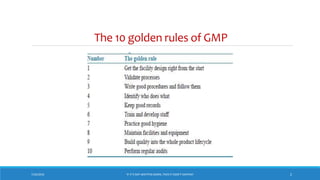
The 10 golden rules of GMP
7/26/2018 ‘IF IT’S NOT WRITTEN DOWN, THEN IT DIDN’T HAPPEN!’ 2
INTRODUCTION
Documentation is the cornerstone of any company’s quality management
system and is an essential GMP requirement.
It is critical that anyone dealing with GMP documents and documentation
systems understand the regulatory requirements and adopts best practice.
It defines a system of information and control so that risks inherent in
misinterpretation and/or error in oral communication are minimized.
7/26/2018 3‘IF IT’S NOT WRITTEN DOWN, THEN IT DIDN’T HAPPEN!’
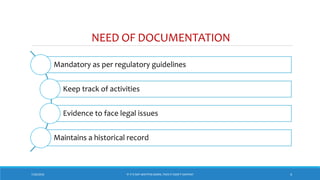
NEED OF DOCUMENTATION
Mandatory as per regulatory guidelines
Keep track of activities
Evidence to face legal issues
Maintains a historical record
7/26/2018 4‘IF IT’S NOT WRITTEN DOWN, THEN IT DIDN’T HAPPEN!’
OBJECTIVES OF DOCUMENTS
To define the specifications and procedures for all materials and method of
manufacture and control.
To ensure that all personal concern with manufacture know what to do and
when to do it.
To ensure that authorized persons have all the information necessary to
decide whether or not to realize a batch of a drug for sale.
To ensure the existence of documented evidence, trace ability, and to
provide records and an audit trail that will permit investigation.
It ensures the availability of the data needed for validation, review and
statistical analysis.
7/26/2018 5‘IF IT’S NOT WRITTEN DOWN, THEN IT DIDN’T HAPPEN!’
SCOPE
Good documentation encompasses practically all the aspect of
pharmaceutical production :
Building and premises: installation, validation , cleaning and maintenance
Personnel : Training, hygiene etc
Equipment : installation , calibration , validation , maintenance , cleaning
Materials: specification, testing, ware-housing, use, rejection/disposal.
Processing: individual steps in the process of manufacturing including
controls thereof.
Finished goods: specifications, testing, storage, distribution, and
rejection/disposal.
7/26/2018 6‘IF IT’S NOT WRITTEN DOWN, THEN IT DIDN’T HAPPEN!’
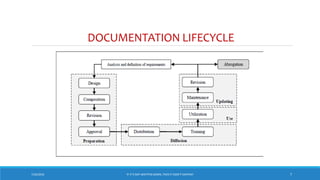
DOCUMENTATION LIFECYCLE
7/26/2018 ‘IF IT’S NOT WRITTEN DOWN, THEN IT DIDN’T HAPPEN!’ 7
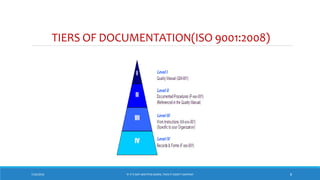
TIERS OF DOCUMENTATION(ISO 9001:2008)
7/26/2018 ‘IF IT’S NOT WRITTEN DOWN, THEN IT DIDN’T HAPPEN!’ 8
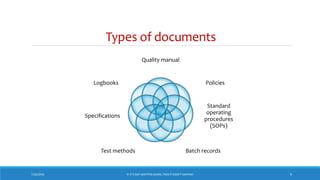
Types of documents
Quality manual
Policies
Standard
operating
procedures
(SOPs)
Batch recordsTest methods
Specifications
Logbooks
7/26/2018 ‘IF IT’S NOT WRITTEN DOWN, THEN IT DIDN’T HAPPEN!’ 9
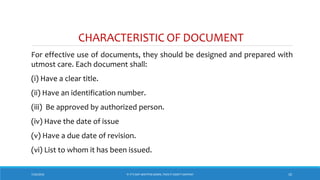
CHARACTERISTIC OF DOCUMENT
For effective use of documents, they should be designed and prepared with
utmost care. Each document shall:
(i) Have a clear title.
(ii) Have an identification number.
(iii) Be approved by authorized person.
(iv) Have the date of issue
(v) Have a due date of revision.
(vi) List to whom it has been issued.
7/26/2018 10‘IF IT’S NOT WRITTEN DOWN, THEN IT DIDN’T HAPPEN!’
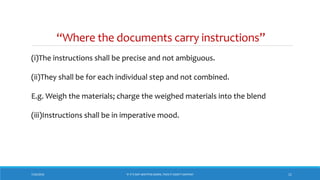
“Where the documents carry instructions”
(i)The instructions shall be precise and not ambiguous.
(ii)They shall be for each individual step and not combined.
E.g. Weigh the materials; charge the weighed materials into the blend
(iii)Instructions shall be in imperative mood.
7/26/2018 11‘IF IT’S NOT WRITTEN DOWN, THEN IT DIDN’T HAPPEN!’
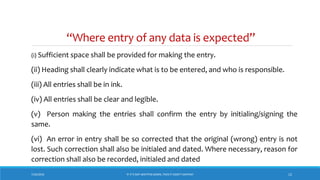
“Where entry of any data is expected”
(i) Sufficient space shall be provided for making the entry.
(ii) Heading shall clearly indicate what is to be entered, and who is responsible.
(iii) All entries shall be in ink.
(iv) All entries shall be clear and legible.
(v) Person making the entries shall confirm the entry by initialing/signing the
same.
(vi) An error in entry shall be so corrected that the original (wrong) entry is not
lost. Such correction shall also be initialed and dated. Where necessary, reason for
correction shall also be recorded, initialed and dated
7/26/2018 ‘IF IT’S NOT WRITTEN DOWN, THEN IT DIDN’T HAPPEN!’ 12
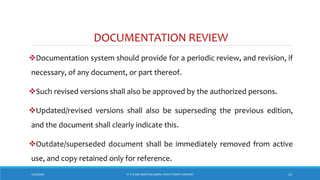
DOCUMENTATION REVIEW
Documentation system should provide for a periodic review, and revision, if
necessary, of any document, or part thereof.
Such revised versions shall also be approved by the authorized persons.
Updated/revised versions shall also be superseding the previous edition,
and the document shall clearly indicate this.
Outdate/superseded document shall be immediately removed from active
use, and copy retained only for reference.
7/26/2018 ‘IF IT’S NOT WRITTEN DOWN, THEN IT DIDN’T HAPPEN!’ 13
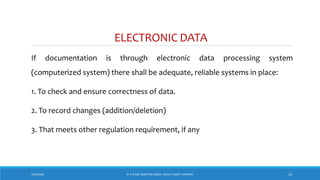
ELECTRONIC DATA
If documentation is through electronic data processing system
(computerized system) there shall be adequate, reliable systems in place:
1. To check and ensure correctness of data.
2. To record changes (addition/deletion)
3. That meets other regulation requirement, if any
7/26/2018 ‘IF IT’S NOT WRITTEN DOWN, THEN IT DIDN’T HAPPEN!’ 14
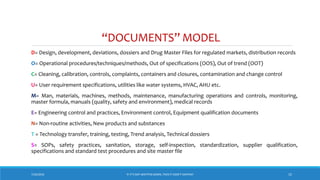
“DOCUMENTS” MODEL
D= Design, development, deviations, dossiers and Drug Master Files for regulated markets, distribution records
O= Operational procedures/techniques/methods, Out of specifications (OOS), Out of trend (OOT)
C= Cleaning, calibration, controls, complaints, containers and closures, contamination and change control
U= User requirement specifications, utilities like water systems, HVAC, AHU etc.
M= Man, materials, machines, methods, maintenance, manufacturing operations and controls, monitoring,
master formula, manuals (quality, safety and environment), medical records
E= Engineering control and practices, Environment control, Equipment qualification documents
N= Non-routine activities, New products and substances
T = Technology transfer, training, testing, Trend analysis, Technical dossiers
S= SOPs, safety practices, sanitation, storage, self-inspection, standardization, supplier qualification,
specifications and standard test procedures and site master file
7/26/2018 ‘IF IT’S NOT WRITTEN DOWN, THEN IT DIDN’T HAPPEN!’ 15
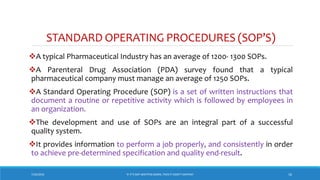
STANDARD OPERATING PROCEDURES (SOP’S)
A typical Pharmaceutical Industry has an average of 1200- 1300 SOPs.
A Parenteral Drug Association (PDA) survey found that a typical
pharmaceutical company must manage an average of 1250 SOPs.
A Standard Operating Procedure (SOP) is a set of written instructions that
document a routine or repetitive activity which is followed by employees in
an organization.
The development and use of SOPs are an integral part of a successful
quality system.
It provides information to perform a job properly, and consistently in order
to achieve pre-determined specification and quality end-result.
7/26/2018 ‘IF IT’S NOT WRITTEN DOWN, THEN IT DIDN’T HAPPEN!’ 16
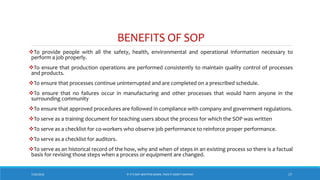
BENEFITS OF SOP
To provide people with all the safety, health, environmental and operational information necessary to
perform a job properly.
To ensure that production operations are performed consistently to maintain quality control of processes
and products.
To ensure that processes continue uninterrupted and are completed on a prescribed schedule.
To ensure that no failures occur in manufacturing and other processes that would harm anyone in the
surrounding community
To ensure that approved procedures are followed in compliance with company and government regulations.
To serve as a training document for teaching users about the process for which the SOP was written
To serve as a checklist for co-workers who observe job performance to reinforce proper performance.
To serve as a checklist for auditors.
To serve as an historical record of the how, why and when of steps in an existing process so there is a factual
basis for revising those steps when a process or equipment are changed.
7/26/2018 ‘IF IT’S NOT WRITTEN DOWN, THEN IT DIDN’T HAPPEN!’ 17
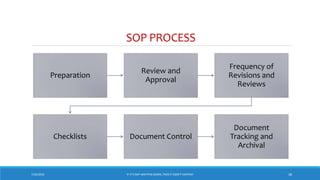
SOP PROCESS
Preparation
Review and
Approval
Frequency of
Revisions and
Reviews
Checklists Document Control
Document
Tracking and
Archival
7/26/2018 ‘IF IT’S NOT WRITTEN DOWN, THEN IT DIDN’T HAPPEN!’ 18
“How to write?”
7/26/2018 ‘IF IT’S NOT WRITTEN DOWN, THEN IT DIDN’T HAPPEN!’ 19
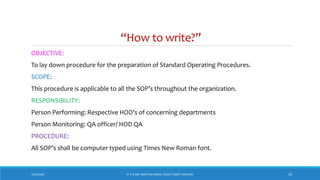
OBJECTIVE:
To lay down procedure for the preparation of Standard Operating Procedures.
SCOPE:
This procedure is applicable to all the SOP’s throughout the organization.
RESPONSIBILITY:
Person Performing: Respective HOD’s of concerning departments
Person Monitoring: QA officer/ HOD QA
PROCEDURE:
All SOP’s shall be computer typed using Times New Roman font.
“How to write?”
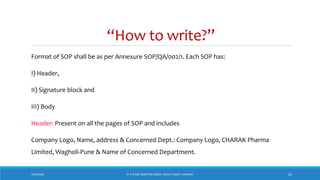
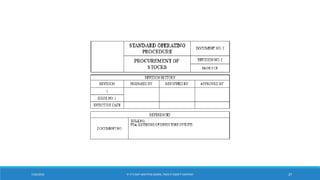
Format of SOP shall be as per Annexure SOP/QA/002/1. Each SOP has:
I) Header,
II) Signature block and
III) Body
Header: Present on all the pages of SOP and includes
Company Logo, Name, address & Concerned Dept.: Company Logo, CHARAK Pharma
Limited, Wagholi-Pune & Name of Concerned Department.
7/26/2018 ‘IF IT’S NOT WRITTEN DOWN, THEN IT DIDN’T HAPPEN!’ 20
“How to write?”
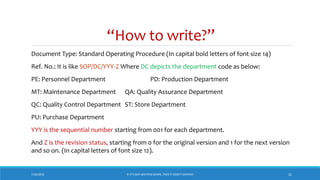
Document Type: Standard Operating Procedure (In capital bold letters of font size 14)
Ref. No.: It is like SOP/DC/YYY-Z Where DC depicts the department code as below:
PE: Personnel Department PD: Production Department
MT: Maintenance Department QA: Quality Assurance Department
QC: Quality Control Department ST: Store Department
PU: Purchase Department
YYY is the sequential number starting from 001 for each department.
And Z is the revision status, starting from 0 for the original version and 1 for the next version
and so on. (In capital letters of font size 12).
7/26/2018 ‘IF IT’S NOT WRITTEN DOWN, THEN IT DIDN’T HAPPEN!’ 21
“How to write?”
7/26/2018 ‘IF IT’S NOT WRITTEN DOWN, THEN IT DIDN’T HAPPEN!’ 22
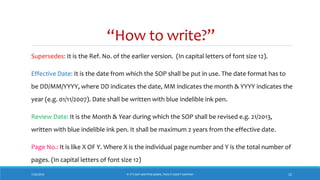
Supersedes: It is the Ref. No. of the earlier version. (In capital letters of font size 12).
Effective Date: It is the date from which the SOP shall be put in use. The date format has to
be DD/MM/YYYY, where DD indicates the date, MM indicates the month & YYYY indicates the
year (e.g. 01/11/2007). Date shall be written with blue indelible ink pen.
Review Date: It is the Month & Year during which the SOP shall be revised e.g. 21/2013,
written with blue indelible ink pen. It shall be maximum 2 years from the effective date.
Page No.: It is like X OF Y. Where X is the individual page number and Y is the total number of
pages. (In capital letters of font size 12)
“How to write?”
7/26/2018 ‘IF IT’S NOT WRITTEN DOWN, THEN IT DIDN’T HAPPEN!’ 23
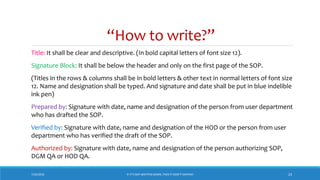
Title: It shall be clear and descriptive. (In bold capital letters of font size 12).
Signature Block: It shall be below the header and only on the first page of the SOP.
(Titles in the rows & columns shall be in bold letters & other text in normal letters of font size
12. Name and designation shall be typed. And signature and date shall be put in blue indelible
ink pen)
Prepared by: Signature with date, name and designation of the person from user department
who has drafted the SOP.
Verified by: Signature with date, name and designation of the HOD or the person from user
department who has verified the draft of the SOP.
Authorized by: Signature with date, name and designation of the person authorizing SOP,
DGM QA or HOD QA.
“How to write?”
7/26/2018 ‘IF IT’S NOT WRITTEN DOWN, THEN IT DIDN’T HAPPEN!’ 24
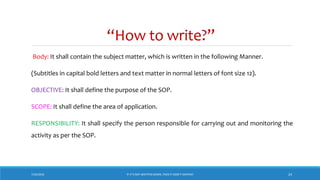
Body: It shall contain the subject matter, which is written in the following Manner.
(Subtitles in capital bold letters and text matter in normal letters of font size 12).
OBJECTIVE: It shall define the purpose of the SOP.
SCOPE: It shall define the area of application.
RESPONSIBILITY: It shall specify the person responsible for carrying out and monitoring the
activity as per the SOP.
“How to write?”
7/26/2018 ‘IF IT’S NOT WRITTEN DOWN, THEN IT DIDN’T HAPPEN!’ 25
PROCEDURE: It shall give all steps required by the process in a proper sequence and
instructions to be followed while carrying out the activity so as to achieve the desired goals.
Procedure shall be:
a) Logically lay out.
b) Written in the imperative (authoritative) tense.
c) User friendly.
d) Simple to understand and in plain unambiguous English.
e) To the point with no unnecessary information.
f) In standardized terminology.
“How to write?”
7/26/2018 ‘IF IT’S NOT WRITTEN DOWN, THEN IT DIDN’T HAPPEN!’ 26
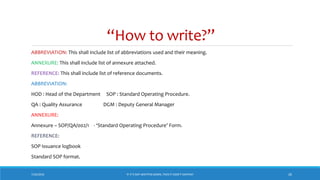
ABBREVIATION: This shall include list of abbreviations used and their meaning.
ANNEXURE: This shall include list of annexure attached.
REFERENCE: This shall include list of reference documents.
ABBREVIATION:
HOD : Head of the Department SOP : Standard Operating Procedure.
QA : Quality Assurance DGM : Deputy General Manager
ANNEXURE:
Annexure – SOP/QA/002/1 - ‘Standard Operating Procedure’ Form.
REFERENCE:
SOP issuance logbook
Standard SOP format.
7/26/2018 ‘IF IT’S NOT WRITTEN DOWN, THEN IT DIDN’T HAPPEN!’ 27
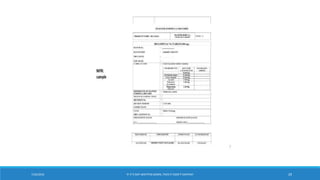
MASTER FORMULA RECORD
Master formula record (MFR) is a master document for any pharmaceutical
product.
It contains all information about the manufacturing process for the product.
MFR is prepared by the research and development team of the company
and all other documents like BMR and BPR are prepared using MFR by the
manufacturing units.
7/26/2018 ‘IF IT’S NOT WRITTEN DOWN, THEN IT DIDN’T HAPPEN!’ 28
7/26/2018 ‘IF IT’S NOT WRITTEN DOWN, THEN IT DIDN’T HAPPEN!’ 29
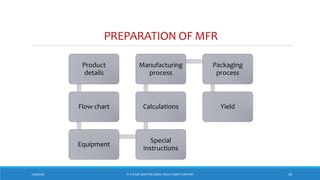
PREPARATION OF MFR
Product
details
Flow chart
Equipment
Special
instructions
Calculations
Manufacturing
process
Packaging
process
Yield
7/26/2018 ‘IF IT’S NOT WRITTEN DOWN, THEN IT DIDN’T HAPPEN!’ 30
BATCH FORMULA RECORD
A batch manufacturing record is a document designed to provide a
complete record of the manufacturing history of a batch of product.
The US Food and Drug administration defines a batch as “a specific quantity
of a drug or other material that is intended to have uniform character and
quality, within specified limits, and is produced according to a single
manufacturing order during the same cycle of manufacture”.
7/26/2018 ‘IF IT’S NOT WRITTEN DOWN, THEN IT DIDN’T HAPPEN!’ 31
PREPARATION OF BMR
They normally contain information that relates to the following aspects of the manufacture of a batch of product:
Dates of start and finish of manufacture.
Lists all materials used and amounts of each used.
Lists of packaging materials used.
Details of the steps completed in the manufacturing process and times of completion.
Initials of the person responsible at every stage.
Details and results of all in-process checks.
Reference to any equipment used.
Batch yield and reconciliation.
Any deviations.
Quality Control information.
7/26/2018 ‘IF IT’S NOT WRITTEN DOWN, THEN IT DIDN’T HAPPEN!’ 32
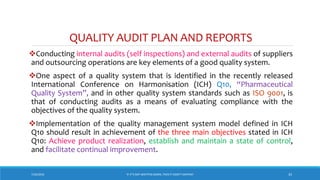
QUALITY AUDIT PLAN AND REPORTS
Conducting internal audits (self inspections) and external audits of suppliers
and outsourcing operations are key elements of a good quality system.
One aspect of a quality system that is identified in the recently released
International Conference on Harmonisation (ICH) Q10, “Pharmaceutical
Quality System”, and in other quality system standards such as ISO 9001, is
that of conducting audits as a means of evaluating compliance with the
objectives of the quality system.
Implementation of the quality management system model defined in ICH
Q10 should result in achievement of the three main objectives stated in ICH
Q10: Achieve product realization, establish and maintain a state of control,
and facilitate continual improvement.
7/26/2018 ‘IF IT’S NOT WRITTEN DOWN, THEN IT DIDN’T HAPPEN!’ 33
Documentation and communication
The audit results should be documented and communicated to management.
The method of documentation and communication including the security and confidentiality of
the audit reports should be defined in the procedure.
It is important to remember that those responsible for the audited operation should always
receive a copy of the report, including outsourcing management and supplier management.
Such reports should clearly describe the audit team observations including specific examples
when possible.
If commitments have been made to implement corrective actions, such commitments should be
included in the report.
Security of audit reports should be strictly enforced and distribution of the report should be
limited.
 When providing audit reports to external sources such as outsourcing companies or suppliers, a
subset of the internal report may be provided as long as the observations are included
7/26/2018 ‘IF IT’S NOT WRITTEN DOWN, THEN IT DIDN’T HAPPEN!’ 34
SPECIFICATION AND TEST PROCEDURES
A specification is defined as a list of tests, references to analytical
procedures, and appropriate acceptance criteria, which are numerical limits,
ranges, or other criteria for the tests described.
It establishes the set of criteria to which a drug substance or drug product
should conform to be considered acceptable for its intended use.
"Conformance to specifications" means that the drug substance and / or
drug product, when tested according to the listed analytical procedures, will
meet the listed acceptance criteria.
Specifications are critical quality standards that are proposed and justified
by the manufacturer and approved by regulatory authorities as conditions of
approval.
7/26/2018 ‘IF IT’S NOT WRITTEN DOWN, THEN IT DIDN’T HAPPEN!’ 35
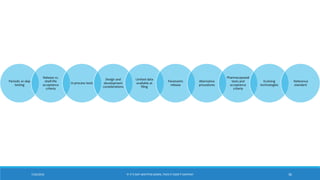
7/26/2018 ‘IF IT’S NOT WRITTEN DOWN, THEN IT DIDN’T HAPPEN!’ 36
Periodic or skip
testing
Release vs.
shelf-life
acceptance
criteria
In-process tests
Design and
development
considerations
Limited data
available at
filing
Parametric
release
Alternative
procedures
Pharmacopoeial
tests and
acceptance
criteria
Evolving
technologies
Reference
standard
PROTOCOLS AND REPORTS
A protocol is a written statement to conduct the process along with the
procedure, test method, equipment handling, specifications, acceptance
criteria, report and approval.
The report summarizes all results, gives recommendations for fixing errors
and/or improving the overall quality of the speech corpus and gives an
executive summary.
7/26/2018 ‘IF IT’S NOT WRITTEN DOWN, THEN IT DIDN’T HAPPEN!’ 37
DISTRIBUTION RECORDS
Distribution forms an important activity of the integrated supply chain management of
pharmaceutical products.
Various persons and entities are often responsible for the handling storage and distribution
of such products.
The guidelines are intended to apply to all steps in the entire distribution/supply chain
Permanent information, written or electronic, should exist for each stored product
indicating recommended storage conditions, any precautions to be observed and retest
dates.
Pharmacopoeial requirements and current national regulations concerning labels and
containers should be respected at all times.
Procedures should be in place for temperature mapping, security services at the
warehouse, destruction of unsaleable stocks and on retention of the records.
7/26/2018 ‘IF IT’S NOT WRITTEN DOWN, THEN IT DIDN’T HAPPEN!’ 38
ELECTRONIC DATA
Electronic data can stand for
data in general that is exchanged via electronic communication lines
digital data in particular
Data (computing), i.e. computer - processable data as opposed to executable code
The Pharmaceutical industries are in a highly regulated environment, hence it requires effective
document management processes.
Having timely accurate data is critical for the success of any company.
Data has never been easy to manage, and is especially true in pharmaceutical industry.
Note that electronic information includes everything such as emails, adverse event reports,
complaints, batch records, quality control records - everything that is stored electronically.
Several technologies are being used currently in pharmaceutical industry to manage their huge
volumes of data generated on daily basis.
7/26/2018 ‘IF IT’S NOT WRITTEN DOWN, THEN IT DIDN’T HAPPEN!’ 39
CONCLUSION
Just as with GMPs, the goal of implementing strict compliance with GDPs
will help pharmaceutical companies establish consistent practices that will
minimize risk of misinterpretation, errors in communication and ensure
product quality.
Setting and following good document practices is not only an essential
aspect of compliance with federal regulations, but also critical to consumer
health.
7/26/2018 ‘IF IT’S NOT WRITTEN DOWN, THEN IT DIDN’T HAPPEN!’ 40
THANK YOU
7/26/2018 ‘IF IT’S NOT WRITTEN DOWN, THEN IT DIDN’T HAPPEN!’ 41

Pharmaceutical documentation

  • 1.
    PHARMACEUTICAL DOCUMENTATION 7/26/2018 1‘IFIT’S NOT WRITTEN DOWN, THEN IT DIDN’T HAPPEN!’ Mr. K V NANDA KUMAR Creative Head
  • 2.
    The 10 goldenrules of GMP 7/26/2018 ‘IF IT’S NOT WRITTEN DOWN, THEN IT DIDN’T HAPPEN!’ 2
  • 3.
    INTRODUCTION Documentation is thecornerstone of any company’s quality management system and is an essential GMP requirement. It is critical that anyone dealing with GMP documents and documentation systems understand the regulatory requirements and adopts best practice. It defines a system of information and control so that risks inherent in misinterpretation and/or error in oral communication are minimized. 7/26/2018 3‘IF IT’S NOT WRITTEN DOWN, THEN IT DIDN’T HAPPEN!’
  • 4.
    NEED OF DOCUMENTATION Mandatoryas per regulatory guidelines Keep track of activities Evidence to face legal issues Maintains a historical record 7/26/2018 4‘IF IT’S NOT WRITTEN DOWN, THEN IT DIDN’T HAPPEN!’
  • 5.
    OBJECTIVES OF DOCUMENTS Todefine the specifications and procedures for all materials and method of manufacture and control. To ensure that all personal concern with manufacture know what to do and when to do it. To ensure that authorized persons have all the information necessary to decide whether or not to realize a batch of a drug for sale. To ensure the existence of documented evidence, trace ability, and to provide records and an audit trail that will permit investigation. It ensures the availability of the data needed for validation, review and statistical analysis. 7/26/2018 5‘IF IT’S NOT WRITTEN DOWN, THEN IT DIDN’T HAPPEN!’
  • 6.
    SCOPE Good documentation encompassespractically all the aspect of pharmaceutical production : Building and premises: installation, validation , cleaning and maintenance Personnel : Training, hygiene etc Equipment : installation , calibration , validation , maintenance , cleaning Materials: specification, testing, ware-housing, use, rejection/disposal. Processing: individual steps in the process of manufacturing including controls thereof. Finished goods: specifications, testing, storage, distribution, and rejection/disposal. 7/26/2018 6‘IF IT’S NOT WRITTEN DOWN, THEN IT DIDN’T HAPPEN!’
  • 7.
    DOCUMENTATION LIFECYCLE 7/26/2018 ‘IFIT’S NOT WRITTEN DOWN, THEN IT DIDN’T HAPPEN!’ 7
  • 8.
    TIERS OF DOCUMENTATION(ISO9001:2008) 7/26/2018 ‘IF IT’S NOT WRITTEN DOWN, THEN IT DIDN’T HAPPEN!’ 8
  • 9.
    Types of documents Qualitymanual Policies Standard operating procedures (SOPs) Batch recordsTest methods Specifications Logbooks 7/26/2018 ‘IF IT’S NOT WRITTEN DOWN, THEN IT DIDN’T HAPPEN!’ 9
  • 10.
    CHARACTERISTIC OF DOCUMENT Foreffective use of documents, they should be designed and prepared with utmost care. Each document shall: (i) Have a clear title. (ii) Have an identification number. (iii) Be approved by authorized person. (iv) Have the date of issue (v) Have a due date of revision. (vi) List to whom it has been issued. 7/26/2018 10‘IF IT’S NOT WRITTEN DOWN, THEN IT DIDN’T HAPPEN!’
  • 11.
    “Where the documentscarry instructions” (i)The instructions shall be precise and not ambiguous. (ii)They shall be for each individual step and not combined. E.g. Weigh the materials; charge the weighed materials into the blend (iii)Instructions shall be in imperative mood. 7/26/2018 11‘IF IT’S NOT WRITTEN DOWN, THEN IT DIDN’T HAPPEN!’
  • 12.
    “Where entry ofany data is expected” (i) Sufficient space shall be provided for making the entry. (ii) Heading shall clearly indicate what is to be entered, and who is responsible. (iii) All entries shall be in ink. (iv) All entries shall be clear and legible. (v) Person making the entries shall confirm the entry by initialing/signing the same. (vi) An error in entry shall be so corrected that the original (wrong) entry is not lost. Such correction shall also be initialed and dated. Where necessary, reason for correction shall also be recorded, initialed and dated 7/26/2018 ‘IF IT’S NOT WRITTEN DOWN, THEN IT DIDN’T HAPPEN!’ 12
  • 13.
    DOCUMENTATION REVIEW Documentation systemshould provide for a periodic review, and revision, if necessary, of any document, or part thereof. Such revised versions shall also be approved by the authorized persons. Updated/revised versions shall also be superseding the previous edition, and the document shall clearly indicate this. Outdate/superseded document shall be immediately removed from active use, and copy retained only for reference. 7/26/2018 ‘IF IT’S NOT WRITTEN DOWN, THEN IT DIDN’T HAPPEN!’ 13
  • 14.
    ELECTRONIC DATA If documentationis through electronic data processing system (computerized system) there shall be adequate, reliable systems in place: 1. To check and ensure correctness of data. 2. To record changes (addition/deletion) 3. That meets other regulation requirement, if any 7/26/2018 ‘IF IT’S NOT WRITTEN DOWN, THEN IT DIDN’T HAPPEN!’ 14
  • 15.
    “DOCUMENTS” MODEL D= Design,development, deviations, dossiers and Drug Master Files for regulated markets, distribution records O= Operational procedures/techniques/methods, Out of specifications (OOS), Out of trend (OOT) C= Cleaning, calibration, controls, complaints, containers and closures, contamination and change control U= User requirement specifications, utilities like water systems, HVAC, AHU etc. M= Man, materials, machines, methods, maintenance, manufacturing operations and controls, monitoring, master formula, manuals (quality, safety and environment), medical records E= Engineering control and practices, Environment control, Equipment qualification documents N= Non-routine activities, New products and substances T = Technology transfer, training, testing, Trend analysis, Technical dossiers S= SOPs, safety practices, sanitation, storage, self-inspection, standardization, supplier qualification, specifications and standard test procedures and site master file 7/26/2018 ‘IF IT’S NOT WRITTEN DOWN, THEN IT DIDN’T HAPPEN!’ 15
  • 16.
    STANDARD OPERATING PROCEDURES(SOP’S) A typical Pharmaceutical Industry has an average of 1200- 1300 SOPs. A Parenteral Drug Association (PDA) survey found that a typical pharmaceutical company must manage an average of 1250 SOPs. A Standard Operating Procedure (SOP) is a set of written instructions that document a routine or repetitive activity which is followed by employees in an organization. The development and use of SOPs are an integral part of a successful quality system. It provides information to perform a job properly, and consistently in order to achieve pre-determined specification and quality end-result. 7/26/2018 ‘IF IT’S NOT WRITTEN DOWN, THEN IT DIDN’T HAPPEN!’ 16
  • 17.
    BENEFITS OF SOP Toprovide people with all the safety, health, environmental and operational information necessary to perform a job properly. To ensure that production operations are performed consistently to maintain quality control of processes and products. To ensure that processes continue uninterrupted and are completed on a prescribed schedule. To ensure that no failures occur in manufacturing and other processes that would harm anyone in the surrounding community To ensure that approved procedures are followed in compliance with company and government regulations. To serve as a training document for teaching users about the process for which the SOP was written To serve as a checklist for co-workers who observe job performance to reinforce proper performance. To serve as a checklist for auditors. To serve as an historical record of the how, why and when of steps in an existing process so there is a factual basis for revising those steps when a process or equipment are changed. 7/26/2018 ‘IF IT’S NOT WRITTEN DOWN, THEN IT DIDN’T HAPPEN!’ 17
  • 18.
    SOP PROCESS Preparation Review and Approval Frequencyof Revisions and Reviews Checklists Document Control Document Tracking and Archival 7/26/2018 ‘IF IT’S NOT WRITTEN DOWN, THEN IT DIDN’T HAPPEN!’ 18
  • 19.
    “How to write?” 7/26/2018‘IF IT’S NOT WRITTEN DOWN, THEN IT DIDN’T HAPPEN!’ 19 OBJECTIVE: To lay down procedure for the preparation of Standard Operating Procedures. SCOPE: This procedure is applicable to all the SOP’s throughout the organization. RESPONSIBILITY: Person Performing: Respective HOD’s of concerning departments Person Monitoring: QA officer/ HOD QA PROCEDURE: All SOP’s shall be computer typed using Times New Roman font.
  • 20.
    “How to write?” Formatof SOP shall be as per Annexure SOP/QA/002/1. Each SOP has: I) Header, II) Signature block and III) Body Header: Present on all the pages of SOP and includes Company Logo, Name, address & Concerned Dept.: Company Logo, CHARAK Pharma Limited, Wagholi-Pune & Name of Concerned Department. 7/26/2018 ‘IF IT’S NOT WRITTEN DOWN, THEN IT DIDN’T HAPPEN!’ 20
  • 21.
    “How to write?” DocumentType: Standard Operating Procedure (In capital bold letters of font size 14) Ref. No.: It is like SOP/DC/YYY-Z Where DC depicts the department code as below: PE: Personnel Department PD: Production Department MT: Maintenance Department QA: Quality Assurance Department QC: Quality Control Department ST: Store Department PU: Purchase Department YYY is the sequential number starting from 001 for each department. And Z is the revision status, starting from 0 for the original version and 1 for the next version and so on. (In capital letters of font size 12). 7/26/2018 ‘IF IT’S NOT WRITTEN DOWN, THEN IT DIDN’T HAPPEN!’ 21
  • 22.
    “How to write?” 7/26/2018‘IF IT’S NOT WRITTEN DOWN, THEN IT DIDN’T HAPPEN!’ 22 Supersedes: It is the Ref. No. of the earlier version. (In capital letters of font size 12). Effective Date: It is the date from which the SOP shall be put in use. The date format has to be DD/MM/YYYY, where DD indicates the date, MM indicates the month & YYYY indicates the year (e.g. 01/11/2007). Date shall be written with blue indelible ink pen. Review Date: It is the Month & Year during which the SOP shall be revised e.g. 21/2013, written with blue indelible ink pen. It shall be maximum 2 years from the effective date. Page No.: It is like X OF Y. Where X is the individual page number and Y is the total number of pages. (In capital letters of font size 12)
  • 23.
    “How to write?” 7/26/2018‘IF IT’S NOT WRITTEN DOWN, THEN IT DIDN’T HAPPEN!’ 23 Title: It shall be clear and descriptive. (In bold capital letters of font size 12). Signature Block: It shall be below the header and only on the first page of the SOP. (Titles in the rows & columns shall be in bold letters & other text in normal letters of font size 12. Name and designation shall be typed. And signature and date shall be put in blue indelible ink pen) Prepared by: Signature with date, name and designation of the person from user department who has drafted the SOP. Verified by: Signature with date, name and designation of the HOD or the person from user department who has verified the draft of the SOP. Authorized by: Signature with date, name and designation of the person authorizing SOP, DGM QA or HOD QA.
  • 24.
    “How to write?” 7/26/2018‘IF IT’S NOT WRITTEN DOWN, THEN IT DIDN’T HAPPEN!’ 24 Body: It shall contain the subject matter, which is written in the following Manner. (Subtitles in capital bold letters and text matter in normal letters of font size 12). OBJECTIVE: It shall define the purpose of the SOP. SCOPE: It shall define the area of application. RESPONSIBILITY: It shall specify the person responsible for carrying out and monitoring the activity as per the SOP.
  • 25.
    “How to write?” 7/26/2018‘IF IT’S NOT WRITTEN DOWN, THEN IT DIDN’T HAPPEN!’ 25 PROCEDURE: It shall give all steps required by the process in a proper sequence and instructions to be followed while carrying out the activity so as to achieve the desired goals. Procedure shall be: a) Logically lay out. b) Written in the imperative (authoritative) tense. c) User friendly. d) Simple to understand and in plain unambiguous English. e) To the point with no unnecessary information. f) In standardized terminology.
  • 26.
    “How to write?” 7/26/2018‘IF IT’S NOT WRITTEN DOWN, THEN IT DIDN’T HAPPEN!’ 26 ABBREVIATION: This shall include list of abbreviations used and their meaning. ANNEXURE: This shall include list of annexure attached. REFERENCE: This shall include list of reference documents. ABBREVIATION: HOD : Head of the Department SOP : Standard Operating Procedure. QA : Quality Assurance DGM : Deputy General Manager ANNEXURE: Annexure – SOP/QA/002/1 - ‘Standard Operating Procedure’ Form. REFERENCE: SOP issuance logbook Standard SOP format.
  • 27.
    7/26/2018 ‘IF IT’SNOT WRITTEN DOWN, THEN IT DIDN’T HAPPEN!’ 27
  • 28.
    MASTER FORMULA RECORD Masterformula record (MFR) is a master document for any pharmaceutical product. It contains all information about the manufacturing process for the product. MFR is prepared by the research and development team of the company and all other documents like BMR and BPR are prepared using MFR by the manufacturing units. 7/26/2018 ‘IF IT’S NOT WRITTEN DOWN, THEN IT DIDN’T HAPPEN!’ 28
  • 29.
    7/26/2018 ‘IF IT’SNOT WRITTEN DOWN, THEN IT DIDN’T HAPPEN!’ 29
  • 30.
    PREPARATION OF MFR Product details Flowchart Equipment Special instructions Calculations Manufacturing process Packaging process Yield 7/26/2018 ‘IF IT’S NOT WRITTEN DOWN, THEN IT DIDN’T HAPPEN!’ 30
  • 31.
    BATCH FORMULA RECORD Abatch manufacturing record is a document designed to provide a complete record of the manufacturing history of a batch of product. The US Food and Drug administration defines a batch as “a specific quantity of a drug or other material that is intended to have uniform character and quality, within specified limits, and is produced according to a single manufacturing order during the same cycle of manufacture”. 7/26/2018 ‘IF IT’S NOT WRITTEN DOWN, THEN IT DIDN’T HAPPEN!’ 31
  • 32.
    PREPARATION OF BMR Theynormally contain information that relates to the following aspects of the manufacture of a batch of product: Dates of start and finish of manufacture. Lists all materials used and amounts of each used. Lists of packaging materials used. Details of the steps completed in the manufacturing process and times of completion. Initials of the person responsible at every stage. Details and results of all in-process checks. Reference to any equipment used. Batch yield and reconciliation. Any deviations. Quality Control information. 7/26/2018 ‘IF IT’S NOT WRITTEN DOWN, THEN IT DIDN’T HAPPEN!’ 32
  • 33.
    QUALITY AUDIT PLANAND REPORTS Conducting internal audits (self inspections) and external audits of suppliers and outsourcing operations are key elements of a good quality system. One aspect of a quality system that is identified in the recently released International Conference on Harmonisation (ICH) Q10, “Pharmaceutical Quality System”, and in other quality system standards such as ISO 9001, is that of conducting audits as a means of evaluating compliance with the objectives of the quality system. Implementation of the quality management system model defined in ICH Q10 should result in achievement of the three main objectives stated in ICH Q10: Achieve product realization, establish and maintain a state of control, and facilitate continual improvement. 7/26/2018 ‘IF IT’S NOT WRITTEN DOWN, THEN IT DIDN’T HAPPEN!’ 33
  • 34.
    Documentation and communication Theaudit results should be documented and communicated to management. The method of documentation and communication including the security and confidentiality of the audit reports should be defined in the procedure. It is important to remember that those responsible for the audited operation should always receive a copy of the report, including outsourcing management and supplier management. Such reports should clearly describe the audit team observations including specific examples when possible. If commitments have been made to implement corrective actions, such commitments should be included in the report. Security of audit reports should be strictly enforced and distribution of the report should be limited.  When providing audit reports to external sources such as outsourcing companies or suppliers, a subset of the internal report may be provided as long as the observations are included 7/26/2018 ‘IF IT’S NOT WRITTEN DOWN, THEN IT DIDN’T HAPPEN!’ 34
  • 35.
    SPECIFICATION AND TESTPROCEDURES A specification is defined as a list of tests, references to analytical procedures, and appropriate acceptance criteria, which are numerical limits, ranges, or other criteria for the tests described. It establishes the set of criteria to which a drug substance or drug product should conform to be considered acceptable for its intended use. "Conformance to specifications" means that the drug substance and / or drug product, when tested according to the listed analytical procedures, will meet the listed acceptance criteria. Specifications are critical quality standards that are proposed and justified by the manufacturer and approved by regulatory authorities as conditions of approval. 7/26/2018 ‘IF IT’S NOT WRITTEN DOWN, THEN IT DIDN’T HAPPEN!’ 35
  • 36.
    7/26/2018 ‘IF IT’SNOT WRITTEN DOWN, THEN IT DIDN’T HAPPEN!’ 36 Periodic or skip testing Release vs. shelf-life acceptance criteria In-process tests Design and development considerations Limited data available at filing Parametric release Alternative procedures Pharmacopoeial tests and acceptance criteria Evolving technologies Reference standard
  • 37.
    PROTOCOLS AND REPORTS Aprotocol is a written statement to conduct the process along with the procedure, test method, equipment handling, specifications, acceptance criteria, report and approval. The report summarizes all results, gives recommendations for fixing errors and/or improving the overall quality of the speech corpus and gives an executive summary. 7/26/2018 ‘IF IT’S NOT WRITTEN DOWN, THEN IT DIDN’T HAPPEN!’ 37
  • 38.
    DISTRIBUTION RECORDS Distribution formsan important activity of the integrated supply chain management of pharmaceutical products. Various persons and entities are often responsible for the handling storage and distribution of such products. The guidelines are intended to apply to all steps in the entire distribution/supply chain Permanent information, written or electronic, should exist for each stored product indicating recommended storage conditions, any precautions to be observed and retest dates. Pharmacopoeial requirements and current national regulations concerning labels and containers should be respected at all times. Procedures should be in place for temperature mapping, security services at the warehouse, destruction of unsaleable stocks and on retention of the records. 7/26/2018 ‘IF IT’S NOT WRITTEN DOWN, THEN IT DIDN’T HAPPEN!’ 38
  • 39.
    ELECTRONIC DATA Electronic datacan stand for data in general that is exchanged via electronic communication lines digital data in particular Data (computing), i.e. computer - processable data as opposed to executable code The Pharmaceutical industries are in a highly regulated environment, hence it requires effective document management processes. Having timely accurate data is critical for the success of any company. Data has never been easy to manage, and is especially true in pharmaceutical industry. Note that electronic information includes everything such as emails, adverse event reports, complaints, batch records, quality control records - everything that is stored electronically. Several technologies are being used currently in pharmaceutical industry to manage their huge volumes of data generated on daily basis. 7/26/2018 ‘IF IT’S NOT WRITTEN DOWN, THEN IT DIDN’T HAPPEN!’ 39
  • 40.
    CONCLUSION Just as withGMPs, the goal of implementing strict compliance with GDPs will help pharmaceutical companies establish consistent practices that will minimize risk of misinterpretation, errors in communication and ensure product quality. Setting and following good document practices is not only an essential aspect of compliance with federal regulations, but also critical to consumer health. 7/26/2018 ‘IF IT’S NOT WRITTEN DOWN, THEN IT DIDN’T HAPPEN!’ 40
  • 41.
    THANK YOU 7/26/2018 ‘IFIT’S NOT WRITTEN DOWN, THEN IT DIDN’T HAPPEN!’ 41