PREPARED BY:
DEVIPRIYA PV
M PHARM
Department of Pharmaceutical Analysis
ANALYTICAL METHOD
VALIDATION
DEFINITION
2
“Documented programme which provides a high degree
of assurance that an analytical assay method will
consistently determine the presence, absence or quality
of one or more attributes with accuracy and precision”
OBJECTIVE
3
 To obtain consistent , reliable and accurate data.
 The results from method validation can be used to
judge the quality, reliability and consistency of
analytical results, which is an integral part of any good
analytical practice.
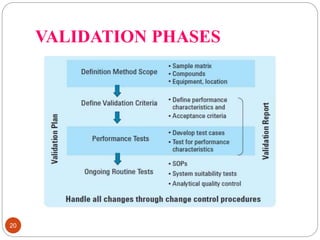
4
 Analytical methods need to be validated, verified, or
revalidated in the following instances:
1. Before initial use in routine testing.
2. When transferred to another laboratory.
3. Whenever the conditions or method parameters for
which the method has been validated change and the
change is outside the original scope of the method.
ICH
5
 Requirements:
 Analytical methods should be validated unless the method
employed is included in the relevant pharmacopoeia or other
recognized standard reference.
 The degree of analytical validation performed should reflect
the purpose of the analysis and the stage of the API
production process.
 Appropriate qualification of analytical equipment should be
considered before starting validation of analytical methods.
USP
6
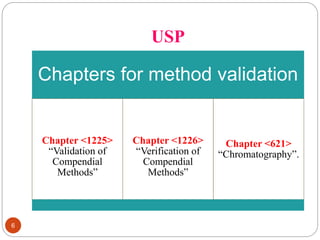
Chapters for method validation
Chapter <1225>
“Validation of
Compendial
Methods”
Chapter <1226>
“Verification of
Compendial
Methods”
Chapter <621>
“Chromatography”.
PARAMETERS FOR METHOD
VALIDATION
7
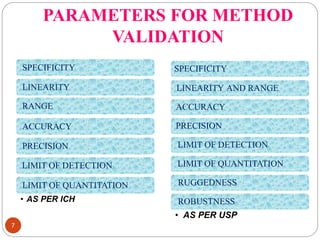
SPECIFICITY
LINEARITY
RANGE
ACCURACY
PRECISION
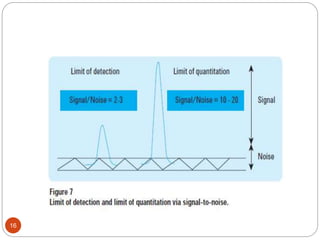
LIMIT OF DETECTION
LIMIT OF QUANTITATION
• AS PER ICH
SPECIFICITY
LINEARITY AND RANGE
ACCURACY
PRECISION
LIMIT OF DETECTION
LIMIT OF QUANTITATION
RUGGEDNESS
ROBUSTNESS
• AS PER USP
SPECIFICITY
8
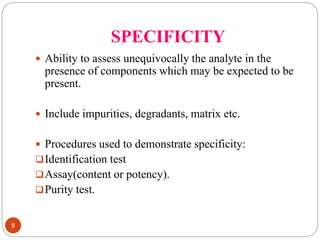
 Ability to assess unequivocally the analyte in the
presence of components which may be expected to be
present.
 Include impurities, degradants, matrix etc.
 Procedures used to demonstrate specificity:
Identification test
Assay(content or potency).
Purity test.
ACCURACY
9
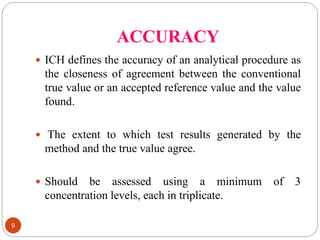
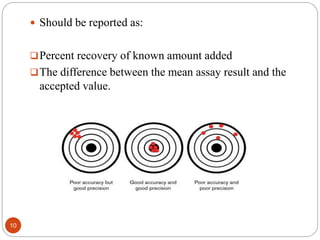
 ICH defines the accuracy of an analytical procedure as
the closeness of agreement between the conventional
true value or an accepted reference value and the value
found.
 The extent to which test results generated by the
method and the true value agree.
 Should be assessed using a minimum of 3
concentration levels, each in triplicate.
10
 Should be reported as:
Percent recovery of known amount added
The difference between the mean assay result and the
accepted value.
PRECISION
11
 The closeness of agreement between a series of
measurements obtained from multiple sampling of the
same homogeneous sample under the prescribed
conditions.
 Precision may be considered at three levels:
 Repeatability
 Intermediate precision
 Reproducibility
LINEARITY
12
 ICH defines linearity of an analytical procedure as its
ability to obtain test results that are directly
proportional to the concentration of analyte in the
sample.
 Evaluated by:
Visual inspection of plot.
Statistical methods.
Acceptance criteria
RANGE
13
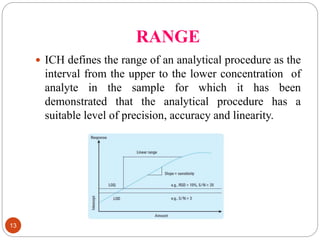
 ICH defines the range of an analytical procedure as the
interval from the upper to the lower concentration of
analyte in the sample for which it has been
demonstrated that the analytical procedure has a
suitable level of precision, accuracy and linearity.
LIMIT OF DETECTION(LOD)
14
 ICH defines the detection limit of an individual
analytical procedure as the lowest amount of analyte in
a sample which can be detected but not necessarily
quantitated as an exact value.
 Evaluated by:
Signal to noise ratio
Visual evaluation
Standard deviation of the response and the slope.
LIMIT OF QUANTITATION(LOQ)
15
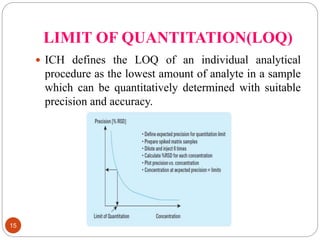
 ICH defines the LOQ of an individual analytical
procedure as the lowest amount of analyte in a sample
which can be quantitatively determined with suitable
precision and accuracy.
16
RUGGEDNESS
17
 The degree of reproducibility of results obtained under
a variety of conditions, such as different laboratories,
analysts, instruments, environmental conditions,
operators and materials.
 Expressed as %RSD.
 Determined by the analysis of aliquots from
homogeneous lots in different laboratories.
ROBUSTNESS
18
 ICH defines the robustness of an analytical procedure
as a measure of its capacity to remain unaffected by
small, but deliberate variations in method parameters.
 It provides an indication of the procedure’s reliability
during normal usage.
METHOD VALIDATION PROCESS
19
 The validity of a specific method should be
demonstrated in laboratory experiments using samples
or standards that are similar to unknown samples
analyzed routinely.
 The process is broken down in phases because of the
length of time and complexity.
VALIDATION PHASES
20
21
VALIDATION PLANNING
22
 The master plan should include:
 Purpose and scope.
 Glossary.
 Responsibilities, like user departments, management, QA
 Method performance characteristics and approaches for
testing.
 Steps for method validation.
 Selection of tests and acceptance criteria.
 Approach and parameters for system suitability testing.
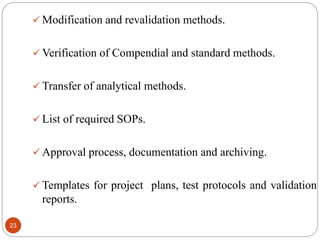
23
 Modification and revalidation methods.
 Verification of Compendial and standard methods.
 Transfer of analytical methods.
 List of required SOPs.
 Approval process, documentation and archiving.
 Templates for project plans, test protocols and validation
reports.
TESTING FOR PERFORMANCE
CHARACTERISTICS
24
 PREPARATION:
 Any chemicals used to determine critical validation
parameters, should be available in sufficient quantities,
accurately identified, sufficiently stable and checked for
exact composition and purity according to specifications.
 Any other materials and consumables, should be new and
qualified.
25
 Analytical equipment should be clearly defined, well
characterized, qualified or calibrated
 Operators should be sufficiently familiar with the
technique and equipment.
 TEST EXECUTION:
 Specificity/selectivity
 Repeatability of retention times and peak areas
 Linearity, LOQ, LOD , range
 Accuracy at different concentrations
 Intermediate precision
 Reproducibility
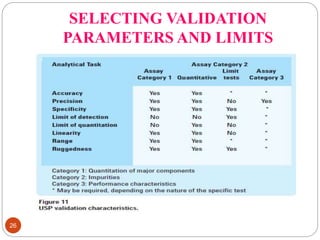
SELECTING VALIDATION
PARAMETERS AND LIMITS
26
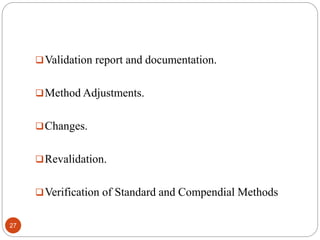
27
Validation report and documentation.
Method Adjustments.
Changes.
Revalidation.
Verification of Standard and Compendial Methods
VALIDATION OF BIOLOGICALS
28
 A substance that is produced by or extracted from a
biological source and that needs for its characterization
and the determination of its quality a combination of
physical-chemical-biological testing, together with the
production process and its control.
CONTENT OF ANALYTICAL
PROCEDURES
29
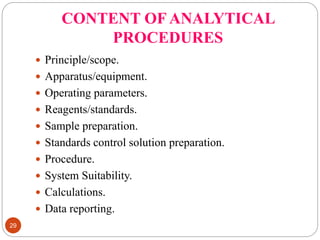
 Principle/scope.
 Apparatus/equipment.
 Operating parameters.
 Reagents/standards.
 Sample preparation.
 Standards control solution preparation.
 Procedure.
 System Suitability.
 Calculations.
 Data reporting.
30
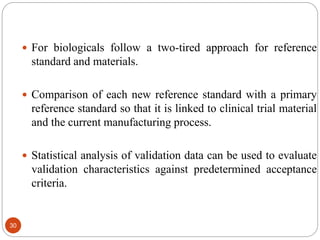
 For biologicals follow a two-tired approach for reference
standard and materials.
 Comparison of each new reference standard with a primary
reference standard so that it is linked to clinical trial material
and the current manufacturing process.
 Statistical analysis of validation data can be used to evaluate
validation characteristics against predetermined acceptance
criteria.
31

Analytical method validation

  • 1.
    PREPARED BY: DEVIPRIYA PV MPHARM Department of Pharmaceutical Analysis ANALYTICAL METHOD VALIDATION
  • 2.
    DEFINITION 2 “Documented programme whichprovides a high degree of assurance that an analytical assay method will consistently determine the presence, absence or quality of one or more attributes with accuracy and precision”
  • 3.
    OBJECTIVE 3  To obtainconsistent , reliable and accurate data.  The results from method validation can be used to judge the quality, reliability and consistency of analytical results, which is an integral part of any good analytical practice.
  • 4.
    4  Analytical methodsneed to be validated, verified, or revalidated in the following instances: 1. Before initial use in routine testing. 2. When transferred to another laboratory. 3. Whenever the conditions or method parameters for which the method has been validated change and the change is outside the original scope of the method.
  • 5.
    ICH 5  Requirements:  Analyticalmethods should be validated unless the method employed is included in the relevant pharmacopoeia or other recognized standard reference.  The degree of analytical validation performed should reflect the purpose of the analysis and the stage of the API production process.  Appropriate qualification of analytical equipment should be considered before starting validation of analytical methods.
  • 6.
    USP 6 Chapters for methodvalidation Chapter <1225> “Validation of Compendial Methods” Chapter <1226> “Verification of Compendial Methods” Chapter <621> “Chromatography”.
  • 7.
    PARAMETERS FOR METHOD VALIDATION 7 SPECIFICITY LINEARITY RANGE ACCURACY PRECISION LIMITOF DETECTION LIMIT OF QUANTITATION • AS PER ICH SPECIFICITY LINEARITY AND RANGE ACCURACY PRECISION LIMIT OF DETECTION LIMIT OF QUANTITATION RUGGEDNESS ROBUSTNESS • AS PER USP
  • 8.
    SPECIFICITY 8  Ability toassess unequivocally the analyte in the presence of components which may be expected to be present.  Include impurities, degradants, matrix etc.  Procedures used to demonstrate specificity: Identification test Assay(content or potency). Purity test.
  • 9.
    ACCURACY 9  ICH definesthe accuracy of an analytical procedure as the closeness of agreement between the conventional true value or an accepted reference value and the value found.  The extent to which test results generated by the method and the true value agree.  Should be assessed using a minimum of 3 concentration levels, each in triplicate.
  • 10.
    10  Should bereported as: Percent recovery of known amount added The difference between the mean assay result and the accepted value.
  • 11.
    PRECISION 11  The closenessof agreement between a series of measurements obtained from multiple sampling of the same homogeneous sample under the prescribed conditions.  Precision may be considered at three levels:  Repeatability  Intermediate precision  Reproducibility
  • 12.
    LINEARITY 12  ICH defineslinearity of an analytical procedure as its ability to obtain test results that are directly proportional to the concentration of analyte in the sample.  Evaluated by: Visual inspection of plot. Statistical methods. Acceptance criteria
  • 13.
    RANGE 13  ICH definesthe range of an analytical procedure as the interval from the upper to the lower concentration of analyte in the sample for which it has been demonstrated that the analytical procedure has a suitable level of precision, accuracy and linearity.
  • 14.
    LIMIT OF DETECTION(LOD) 14 ICH defines the detection limit of an individual analytical procedure as the lowest amount of analyte in a sample which can be detected but not necessarily quantitated as an exact value.  Evaluated by: Signal to noise ratio Visual evaluation Standard deviation of the response and the slope.
  • 15.
    LIMIT OF QUANTITATION(LOQ) 15 ICH defines the LOQ of an individual analytical procedure as the lowest amount of analyte in a sample which can be quantitatively determined with suitable precision and accuracy.
  • 16.
  • 17.
    RUGGEDNESS 17  The degreeof reproducibility of results obtained under a variety of conditions, such as different laboratories, analysts, instruments, environmental conditions, operators and materials.  Expressed as %RSD.  Determined by the analysis of aliquots from homogeneous lots in different laboratories.
  • 18.
    ROBUSTNESS 18  ICH definesthe robustness of an analytical procedure as a measure of its capacity to remain unaffected by small, but deliberate variations in method parameters.  It provides an indication of the procedure’s reliability during normal usage.
  • 19.
    METHOD VALIDATION PROCESS 19 The validity of a specific method should be demonstrated in laboratory experiments using samples or standards that are similar to unknown samples analyzed routinely.  The process is broken down in phases because of the length of time and complexity.
  • 20.
  • 21.
  • 22.
    VALIDATION PLANNING 22  Themaster plan should include:  Purpose and scope.  Glossary.  Responsibilities, like user departments, management, QA  Method performance characteristics and approaches for testing.  Steps for method validation.  Selection of tests and acceptance criteria.  Approach and parameters for system suitability testing.
  • 23.
    23  Modification andrevalidation methods.  Verification of Compendial and standard methods.  Transfer of analytical methods.  List of required SOPs.  Approval process, documentation and archiving.  Templates for project plans, test protocols and validation reports.
  • 24.
    TESTING FOR PERFORMANCE CHARACTERISTICS 24 PREPARATION:  Any chemicals used to determine critical validation parameters, should be available in sufficient quantities, accurately identified, sufficiently stable and checked for exact composition and purity according to specifications.  Any other materials and consumables, should be new and qualified.
  • 25.
    25  Analytical equipmentshould be clearly defined, well characterized, qualified or calibrated  Operators should be sufficiently familiar with the technique and equipment.  TEST EXECUTION:  Specificity/selectivity  Repeatability of retention times and peak areas  Linearity, LOQ, LOD , range  Accuracy at different concentrations  Intermediate precision  Reproducibility
  • 26.
  • 27.
    27 Validation report anddocumentation. Method Adjustments. Changes. Revalidation. Verification of Standard and Compendial Methods
  • 28.
    VALIDATION OF BIOLOGICALS 28 A substance that is produced by or extracted from a biological source and that needs for its characterization and the determination of its quality a combination of physical-chemical-biological testing, together with the production process and its control.
  • 29.
    CONTENT OF ANALYTICAL PROCEDURES 29 Principle/scope.  Apparatus/equipment.  Operating parameters.  Reagents/standards.  Sample preparation.  Standards control solution preparation.  Procedure.  System Suitability.  Calculations.  Data reporting.
  • 30.
    30  For biologicalsfollow a two-tired approach for reference standard and materials.  Comparison of each new reference standard with a primary reference standard so that it is linked to clinical trial material and the current manufacturing process.  Statistical analysis of validation data can be used to evaluate validation characteristics against predetermined acceptance criteria.
  • 31.