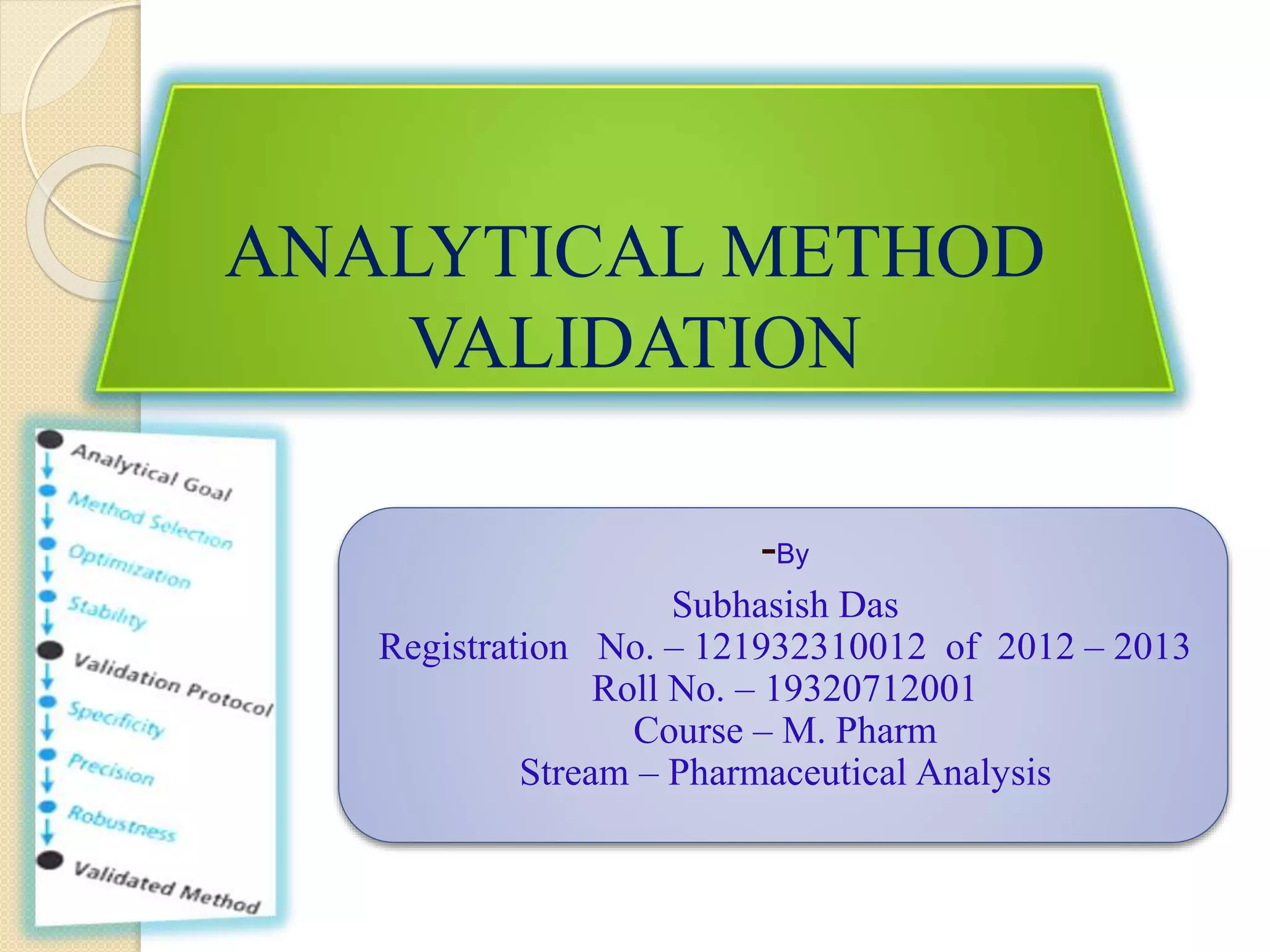
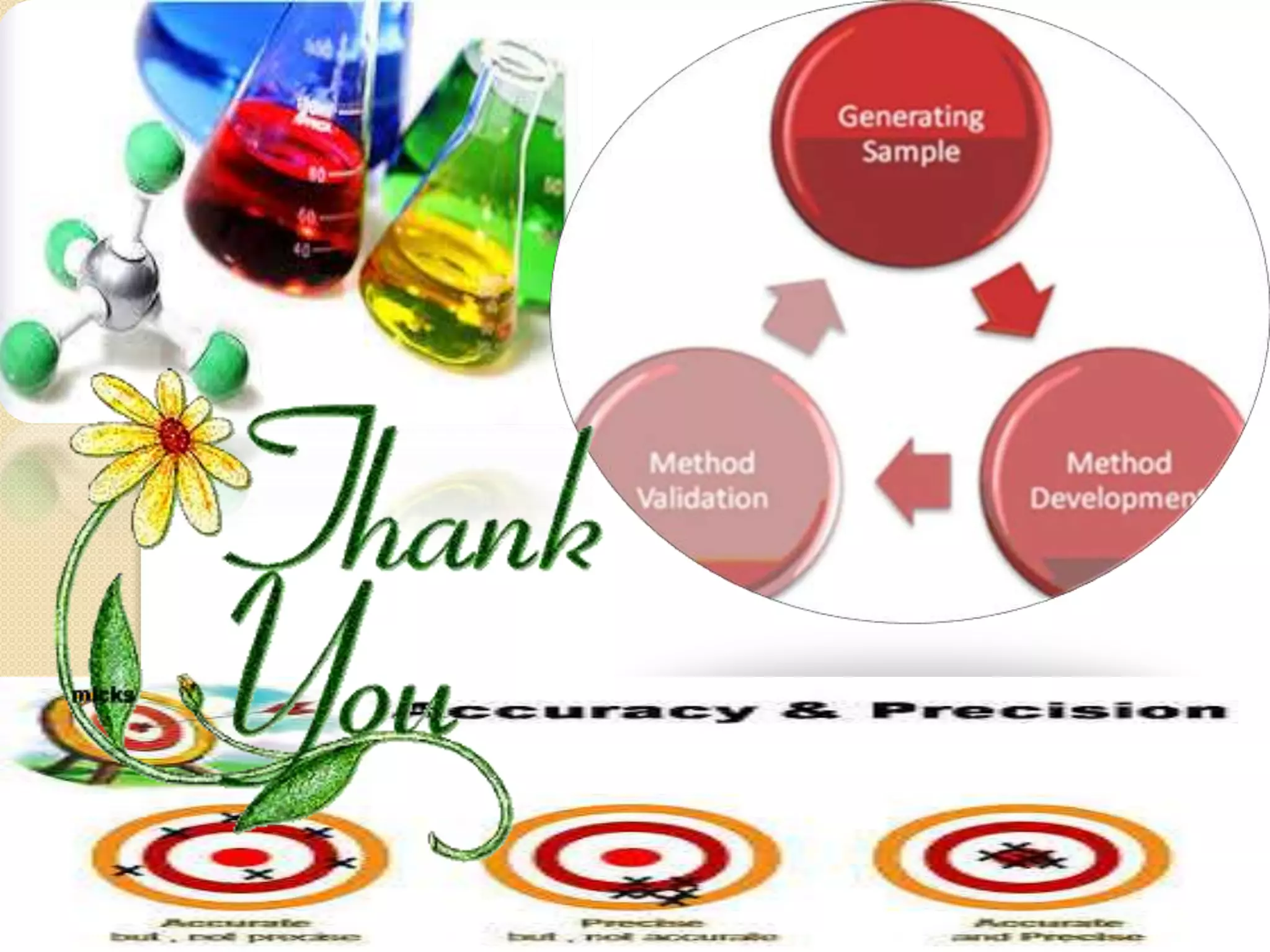
ANALYTICAL METHOD
VALIDATION
-By
Subhasish Das
Registration No. – 121932310012 of 2012 – 2013
Roll No. – 19320712001
Course – M. Pharm
Stream – Pharmaceutical Analysis
OBJECTIVES
To discuss various aspects of
analytical method validation.
Principles of analytical method
validation.
Approaches to analytical method
validation.
Characteristics of analytical
procedures.
DEFINITION
 U.S. FDA-Establishing documented evidence
which provides a high degree of assurance that a
specific process will consistently produce a
product meeting its predetermined specifications
and quality attributes.
 WHO- Documented act of providing that any
procedure, process, equipment material, activity
or system actually leads to the expected result.
PRINCIPLE
 Guideline presents information on the
characteristics to be considered.
 Manufacturers to demonstrate -
analytical procedure is suitable for its
intended purpose.
 Validate analytical methods - whether
they indicate stability or not.
 Validated by R&D before being
transferred to the quality control unit
when appropriate
ANALYTICAL PROCEDURES TO BE
VALIDATED
 Identification tests.
 Quantitative tests for impurities’ content
 Limit test for the control of impurities.
 Quantitative tests of the active moiety of
drug substance or drug product or other
selected component(s) in the drug product
 Dissolution testing and determination of
particle size
WHY VALIDATION ?
 When should verification or revalidation be done?
◦ changes in the process for synthesis of the
drug substance.
◦ changes in the composition of the finished
product.
◦ changes in the analytical procedure
◦ transfer of methods from one laboratory to
another.
◦ changes in major pieces of equipment
instruments.
 Extent depends on the nature of the change(s)
 Evidence of “analyst proficiency”.
DOCUMENTATIONS OF
VALIDATION
 Protocol: includes procedures and acceptance
criteria.
 Report: documented results.
 Justification needed when non-pharmacopoeial
methods are used (if pharmacopoeial methods are
available). Justification to include data, e.g.
comparisons with the pharmacopoeial or other
methods.
 Detailed standard test methods.
VALIDATION
CHARACTERISTICS
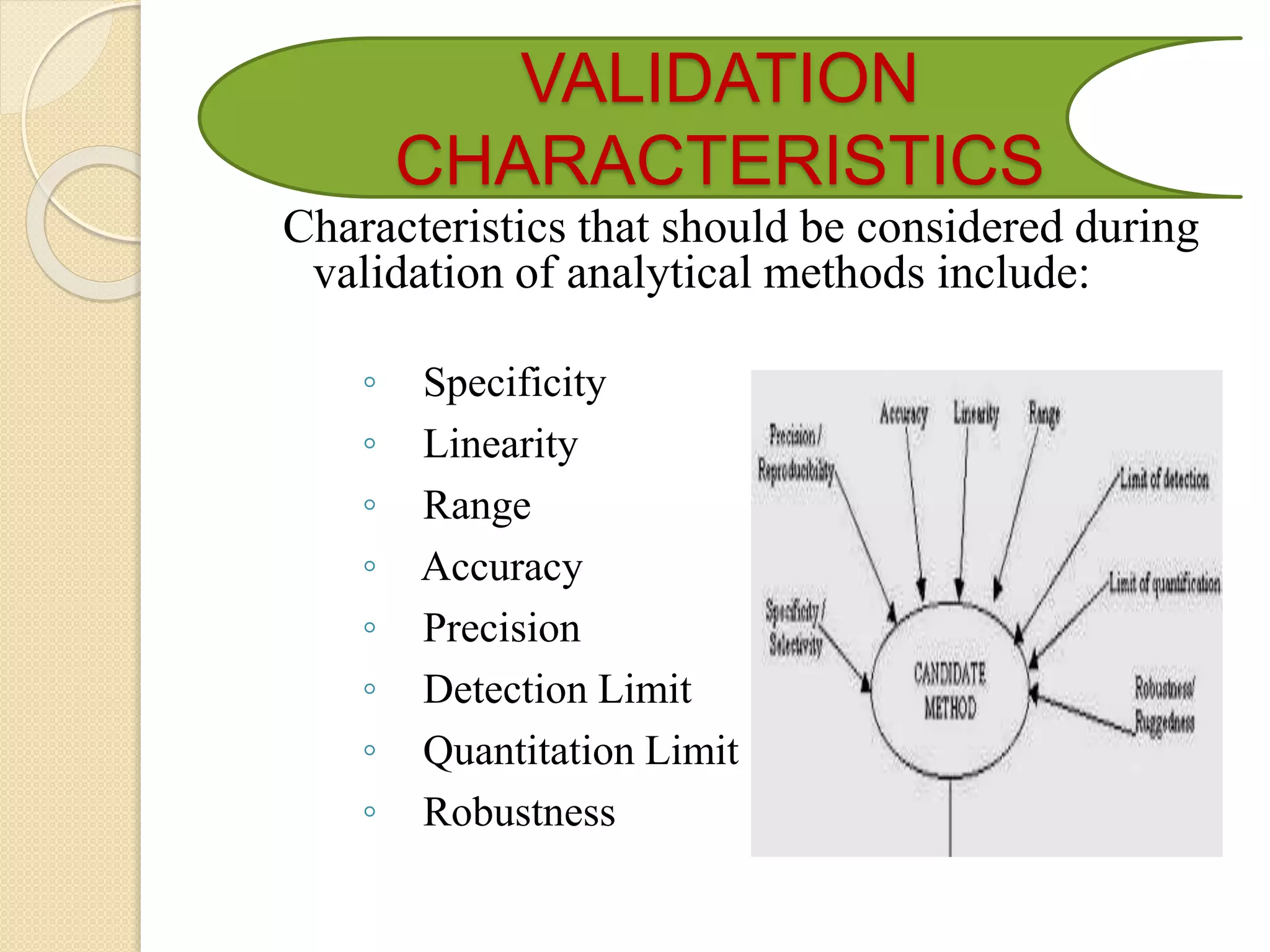
Characteristics that should be considered during
validation of analytical methods include:
◦ Specificity
◦ Linearity
◦ Range
◦ Accuracy
◦ Precision
◦ Detection Limit
◦ Quantitation Limit
◦ Robustness
ACCURACY
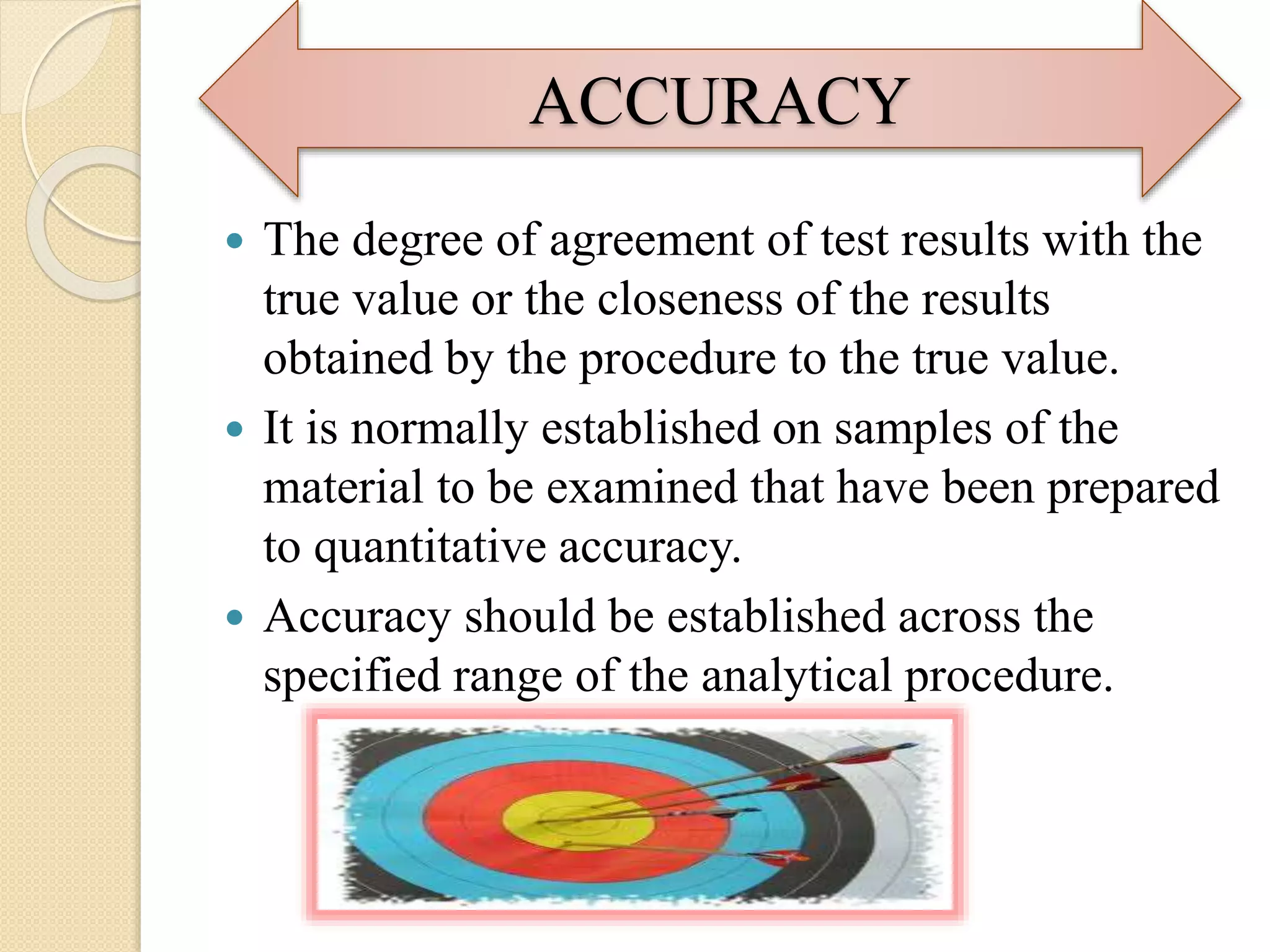
 The degree of agreement of test results with the
true value or the closeness of the results
obtained by the procedure to the true value.
 It is normally established on samples of the
material to be examined that have been prepared
to quantitative accuracy.
 Accuracy should be established across the
specified range of the analytical procedure.
PRECISION
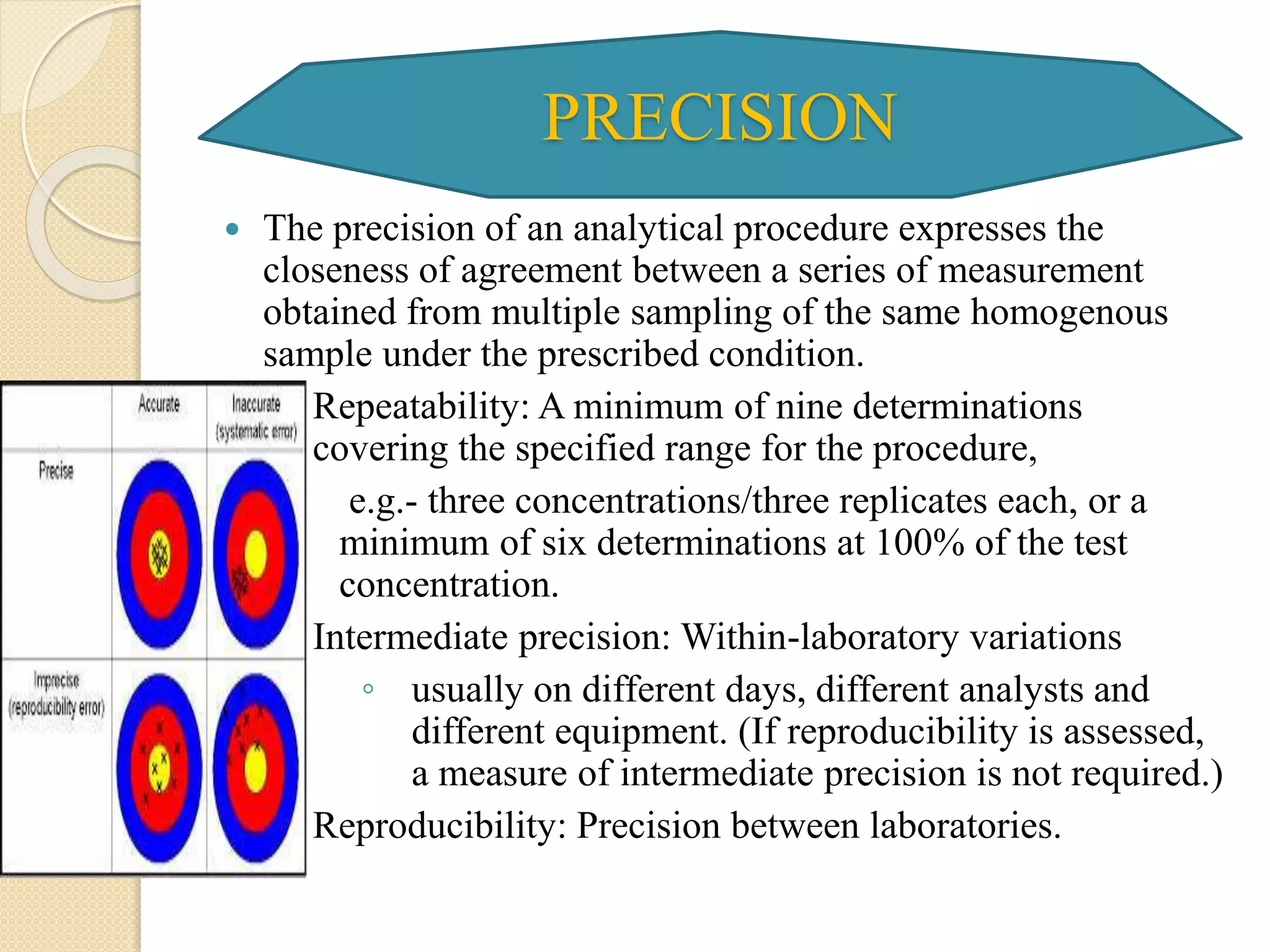
 The precision of an analytical procedure expresses the
closeness of agreement between a series of measurement
obtained from multiple sampling of the same homogenous
sample under the prescribed condition.
 Repeatability: A minimum of nine determinations
covering the specified range for the procedure,
e.g.- three concentrations/three replicates each, or a
minimum of six determinations at 100% of the test
concentration.
 Intermediate precision: Within-laboratory variations
◦ usually on different days, different analysts and
different equipment. (If reproducibility is assessed,
a measure of intermediate precision is not required.)
 Reproducibility: Precision between laboratories.
ROBUSTNES
S
 The ability of the procedure to provide analytical results of acceptable
accuracy and precision under a variety of conditions. The results from
separate samples are influenced by changes in the operational or
environmental conditions. Robustness should be considered during the
development phase, and should show the reliability of an analysis when
deliberate variations are made in method parameters.
 Factors that can have an effect on robustness when performing
chromatographic analysis include:
◦ stability of test and standard samples and solutions
◦ reagents (e.g. different suppliers)
◦ different columns (e.g. different lots and/or suppliers)
◦ extraction time
◦ variations of pH of a mobile phase
◦ variations in mobile phase composition
◦ temperature
◦ flow rate
LINEARITY
It indicates the ability to produce results that are
directly proportional to the concentration of the
analyte in samples.
◦ A series of samples should be prepared in
which the analyte concentrations span the
claimed range of the procedure. If there is a
linear relationship, test results should be
evaluated by appropriate statistical methods.
◦ A minimum of five concentrations should be
used.
RANGE
•It is an expression of the lowest and
highest levels of analyte that have been
demonstrated to be determinable for the
product .
•The specified range is normally derived
from linearity studies
SPECIFICITY
It is the ability to measure unequivocally
the desired analyte in the presence of
components such as excipients and
impurities that may also be expected to be
present.
An investigation of specificity should be
conducted during the validation of
identification tests, the determination of
impurities and assay
LOD
Detection limit (limit of detection):
It is the smallest quantity of an analyte that can
be detected, and not necessarily determined, in a
quantitative fashion
 Approaches (instrumental or non
instrumental):
◦ visual evaluation.
◦ signal to noise ratio.
◦ standard deviation of the response and
the slope.
◦ standard deviation of the blank.
◦ calibration curve.
LOQ
Quantitation limit (limit of quantitation):
It is the lowest concentration of an analyte in a sample
that may be determined with acceptable accuracy and
precision .
 Approaches (instrumental or non-instrumental):
◦ visual evaluation.
◦ signal to noise ratio.
◦ standard deviation of the response and the
slope.
◦ standard deviation of the blank.
◦ calibration curve.
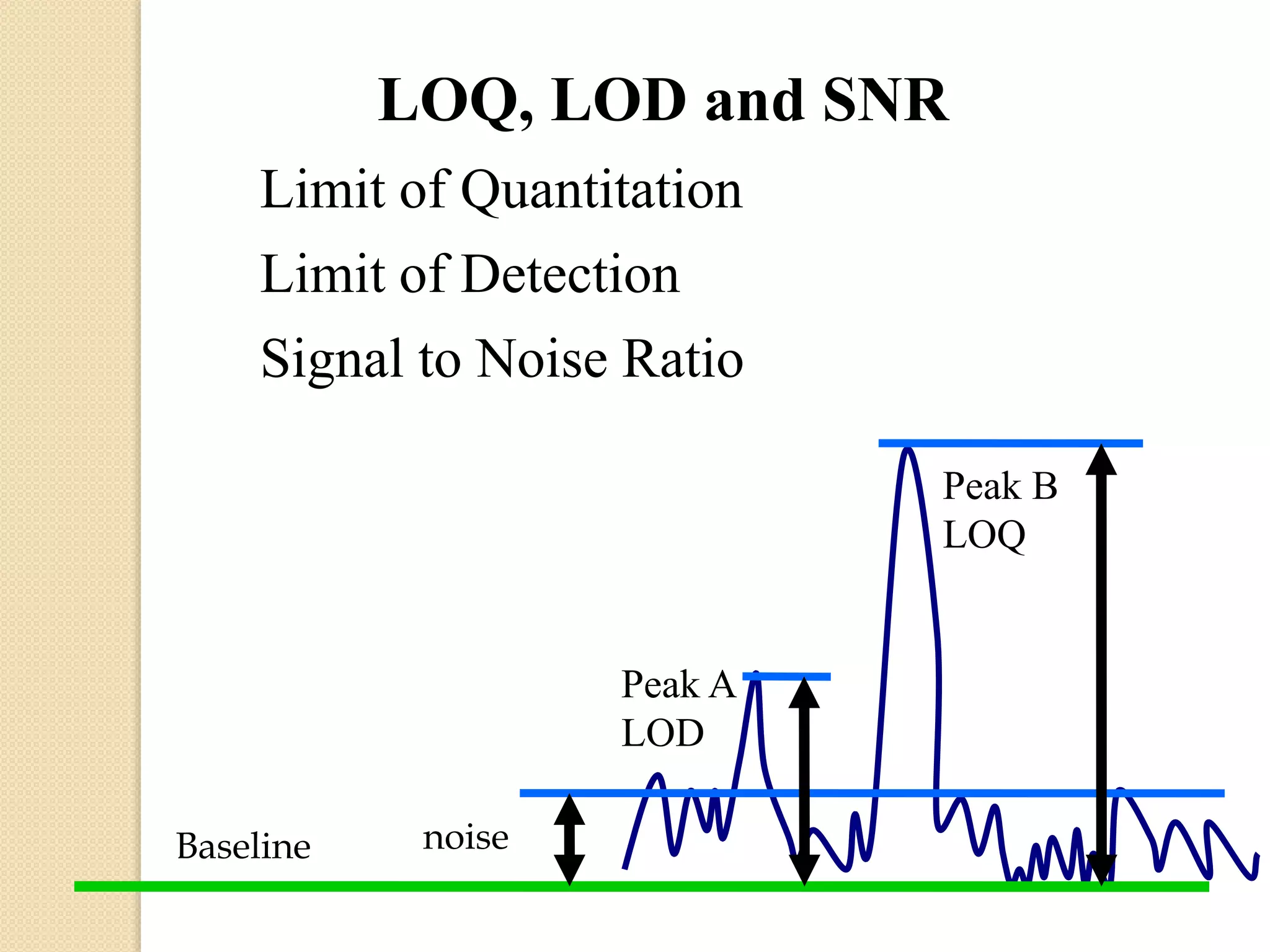
LOQ, LOD and SNR
Limit of Quantitation
Limit of Detection
Signal to Noise Ratio
noise
Peak A
LOD
Peak B
LOQ
Baseline
SYSTEM SUITABILITY
TESTING
 Integral part of many analytical procedures.
 Based on the concept that:
◦ the equipment, electronics, analytical
operations and samples to be analysed
constitute an integral system that can be
evaluated as such.
 Depends on the type of procedure being
evaluated.
◦ e.g. resolution test for an HPLC
procedure .
◦ Group session.
REFERENCES
 Buick, A. R., Doig, M. V., Jeal, S. C., Land, G. S., and McDowall,
R. D. Method validation in the bioanalytical laboratory. J. Pharm.
Biomed. Anal. 8 (8–12), 629 (1990).
 Carr, G. P., and Wahlichs, J. C. A practical approach to method
validation in pharmaceutical analysis. J. Pharm. Biomed. Anal. 8
(8–12), 613 (1990).
 Debesis, E., Boehlert J. P., Givand T. E., and Sheridan J. C.
Submitting HPLC methods to the compendia and regulatory
agencies. Pharm. Tech. 120, (1982).
 Development and Validation of Analytical Methods: Progress in
Pharmaceutical and BiomedicalAnalysis, Volume 3. Riley, C. M.,
and Rosanske, T. W., eds. Elsevier (Pergamon), Tarrytown,
NY,1996.
Analytical method validation

Analytical method validation

  • 1.
    ANALYTICAL METHOD VALIDATION -By Subhasish Das RegistrationNo. – 121932310012 of 2012 – 2013 Roll No. – 19320712001 Course – M. Pharm Stream – Pharmaceutical Analysis
  • 2.
    OBJECTIVES To discuss variousaspects of analytical method validation. Principles of analytical method validation. Approaches to analytical method validation. Characteristics of analytical procedures.
  • 3.
    DEFINITION  U.S. FDA-Establishingdocumented evidence which provides a high degree of assurance that a specific process will consistently produce a product meeting its predetermined specifications and quality attributes.  WHO- Documented act of providing that any procedure, process, equipment material, activity or system actually leads to the expected result.
  • 4.
    PRINCIPLE  Guideline presentsinformation on the characteristics to be considered.  Manufacturers to demonstrate - analytical procedure is suitable for its intended purpose.  Validate analytical methods - whether they indicate stability or not.  Validated by R&D before being transferred to the quality control unit when appropriate
  • 5.
    ANALYTICAL PROCEDURES TOBE VALIDATED  Identification tests.  Quantitative tests for impurities’ content  Limit test for the control of impurities.  Quantitative tests of the active moiety of drug substance or drug product or other selected component(s) in the drug product  Dissolution testing and determination of particle size
  • 6.
    WHY VALIDATION ? When should verification or revalidation be done? ◦ changes in the process for synthesis of the drug substance. ◦ changes in the composition of the finished product. ◦ changes in the analytical procedure ◦ transfer of methods from one laboratory to another. ◦ changes in major pieces of equipment instruments.  Extent depends on the nature of the change(s)  Evidence of “analyst proficiency”.
  • 7.
    DOCUMENTATIONS OF VALIDATION  Protocol:includes procedures and acceptance criteria.  Report: documented results.  Justification needed when non-pharmacopoeial methods are used (if pharmacopoeial methods are available). Justification to include data, e.g. comparisons with the pharmacopoeial or other methods.  Detailed standard test methods.
  • 8.
    VALIDATION CHARACTERISTICS Characteristics that shouldbe considered during validation of analytical methods include: ◦ Specificity ◦ Linearity ◦ Range ◦ Accuracy ◦ Precision ◦ Detection Limit ◦ Quantitation Limit ◦ Robustness
  • 9.
    ACCURACY  The degreeof agreement of test results with the true value or the closeness of the results obtained by the procedure to the true value.  It is normally established on samples of the material to be examined that have been prepared to quantitative accuracy.  Accuracy should be established across the specified range of the analytical procedure.
  • 10.
    PRECISION  The precisionof an analytical procedure expresses the closeness of agreement between a series of measurement obtained from multiple sampling of the same homogenous sample under the prescribed condition.  Repeatability: A minimum of nine determinations covering the specified range for the procedure, e.g.- three concentrations/three replicates each, or a minimum of six determinations at 100% of the test concentration.  Intermediate precision: Within-laboratory variations ◦ usually on different days, different analysts and different equipment. (If reproducibility is assessed, a measure of intermediate precision is not required.)  Reproducibility: Precision between laboratories.
  • 11.
    ROBUSTNES S  The abilityof the procedure to provide analytical results of acceptable accuracy and precision under a variety of conditions. The results from separate samples are influenced by changes in the operational or environmental conditions. Robustness should be considered during the development phase, and should show the reliability of an analysis when deliberate variations are made in method parameters.  Factors that can have an effect on robustness when performing chromatographic analysis include: ◦ stability of test and standard samples and solutions ◦ reagents (e.g. different suppliers) ◦ different columns (e.g. different lots and/or suppliers) ◦ extraction time ◦ variations of pH of a mobile phase ◦ variations in mobile phase composition ◦ temperature ◦ flow rate
  • 12.
    LINEARITY It indicates theability to produce results that are directly proportional to the concentration of the analyte in samples. ◦ A series of samples should be prepared in which the analyte concentrations span the claimed range of the procedure. If there is a linear relationship, test results should be evaluated by appropriate statistical methods. ◦ A minimum of five concentrations should be used.
  • 13.
    RANGE •It is anexpression of the lowest and highest levels of analyte that have been demonstrated to be determinable for the product . •The specified range is normally derived from linearity studies
  • 14.
    SPECIFICITY It is theability to measure unequivocally the desired analyte in the presence of components such as excipients and impurities that may also be expected to be present. An investigation of specificity should be conducted during the validation of identification tests, the determination of impurities and assay
  • 15.
    LOD Detection limit (limitof detection): It is the smallest quantity of an analyte that can be detected, and not necessarily determined, in a quantitative fashion  Approaches (instrumental or non instrumental): ◦ visual evaluation. ◦ signal to noise ratio. ◦ standard deviation of the response and the slope. ◦ standard deviation of the blank. ◦ calibration curve.
  • 16.
    LOQ Quantitation limit (limitof quantitation): It is the lowest concentration of an analyte in a sample that may be determined with acceptable accuracy and precision .  Approaches (instrumental or non-instrumental): ◦ visual evaluation. ◦ signal to noise ratio. ◦ standard deviation of the response and the slope. ◦ standard deviation of the blank. ◦ calibration curve.
  • 17.
    LOQ, LOD andSNR Limit of Quantitation Limit of Detection Signal to Noise Ratio noise Peak A LOD Peak B LOQ Baseline
  • 18.
    SYSTEM SUITABILITY TESTING  Integralpart of many analytical procedures.  Based on the concept that: ◦ the equipment, electronics, analytical operations and samples to be analysed constitute an integral system that can be evaluated as such.  Depends on the type of procedure being evaluated. ◦ e.g. resolution test for an HPLC procedure . ◦ Group session.
  • 19.
    REFERENCES  Buick, A.R., Doig, M. V., Jeal, S. C., Land, G. S., and McDowall, R. D. Method validation in the bioanalytical laboratory. J. Pharm. Biomed. Anal. 8 (8–12), 629 (1990).  Carr, G. P., and Wahlichs, J. C. A practical approach to method validation in pharmaceutical analysis. J. Pharm. Biomed. Anal. 8 (8–12), 613 (1990).  Debesis, E., Boehlert J. P., Givand T. E., and Sheridan J. C. Submitting HPLC methods to the compendia and regulatory agencies. Pharm. Tech. 120, (1982).  Development and Validation of Analytical Methods: Progress in Pharmaceutical and BiomedicalAnalysis, Volume 3. Riley, C. M., and Rosanske, T. W., eds. Elsevier (Pergamon), Tarrytown, NY,1996.