Analytical Method Of Validation
Prepared by:
Ghanshyam Nawale
Roll No. 09
M Pharm QA Department 1st year
Under the Guidance of : Prof. Dr. Parag Pathade sir
K.B.H.S.S. Trust’s Institute of Pharmacy, Bhaygaon Road, Opp. Jajuwadi ,
Malegaon Camp, Malegaon, Nashik- 423105
Defination
o USFDA: Establishing Documented evidence which
provides a high dgree of assurance that a specific process
will consistently produce a product meeting its
predetermined specifications and quality attributes.
o WHO: Documented act of providing that any procedure,
process, equipment material, activity or system actually
leads to the expected result.
Introduction
o Method Validation : Established documented evidance that
provide a high degree of assurance that a specific method, and
the instrucments included in the method, will consistently yield
results that accurately reflecct the quality characteristics of the
product tested.
o Method validation is the process to conform that the analytical
procedure employed for a specific test is sutaible for its intended
use.
Why Validation?
 Change in the process for systhesis of the drug substance .
 Changes in the composition of the finished product.
 Changes in the analytical procedure.
 Transfer of methods from one laboratory to anothers.
 Changes in major pieces of equipment instruments.
ANALYTICAL PROCEDURES TO BE VALIDATED :
o Identification tests
o Quantitative tests for impurities content
o Limit tests for the control of impurities.
o Quantitative tests of the active moiety of drug substance or drug
product or other selected components in the drug product
o Dissolution testing and determnation of partical size.
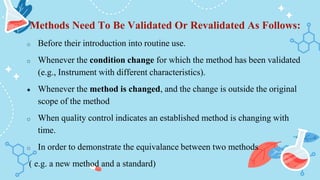
Methods Need To Be Validated Or Revalidated As Follows:
o Before their introduction into routine use.
o Whenever the condition change for which the method has been validated
(e.g., Instrument with different characteristics).
● Whenever the method is changed, and the change is outside the original
scope of the method
o When quality control indicates an established method is changing with
time.
o In order to demonstrate the equivalance between two methods
( e.g. a new method and a standard)
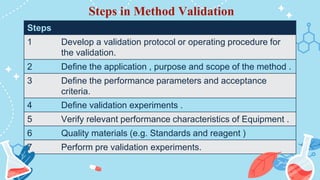
Steps in Method Validation
Steps
1 Develop a validation protocol or operating procedure for
the validation.
2 Define the application , purpose and scope of the method .
3 Define the performance parameters and acceptance
criteria.
4 Define validation experiments .
5 Verify relevant performance characteristics of Equipment .
6 Quality materials (e.g. Standards and reagent )
7 Perform pre validation experiments.
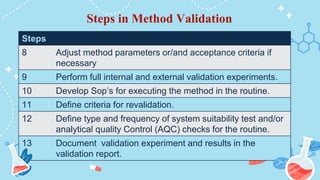
Steps in Method Validation
Steps
8 Adjust method parameters or/and acceptance criteria if
necessary
9 Perform full internal and external validation experiments.
10 Develop Sop’s for executing the method in the routine.
11 Define criteria for revalidation.
12 Define type and frequency of system suitability test and/or
analytical quality Control (AQC) checks for the routine.
13 Document validation experiment and results in the
validation report.
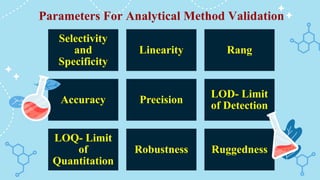
Parameters For Analytical Method Validation
Selectivity
and
Specificity
Linearity Rang
Accuracy Precision
LOD- Limit
of Detection
LOQ- Limit
of
Quantitation
Robustness Ruggedness
Parameters For Analytical Method Validation
Specificity
Specificity is the ability to assess Clearly the analytic in the presence of
components which may be expected to be present. Typically these
might include impurities, degradants, matrix, etc.
Linearity
The linearity of an analytical procedure is its ability (within a given
range) to obtain test results which are directly proportional to the
concentration (amount) of analyte in the sample.
Parameters For Analytical Method Validation
Range :
The range of an analytical procedure is the interval between the upper
and lower level these have been demonstrated to be determined with
precision, accuracy and linearity using the method as written.
Accuracy:
The accuracy of an analytical procedure expresses the closeness of
agreement between the value which is accepted either as a conventional
true value or an accepted reference value and the value found.
Parameters For Analytical Method Validation
Precision:
The precision of an analytical procedure expresses the closeness of
agreement (degree of scatter) between a series of measurements
obtained from multiple sampling of the same homogeneous sample
under the prescribed conditions. Precision may be considered at three
levels: repeatability, intermediate precision and reproducibility.
Parameters For Analytical Method Validation
Limit Of Detection (LOD):
The detection limit of an individual analytical procedure is the
lowest of analyte in a sample which can be detected but not
necessarily quantified as an exact value.
Parameters For Analytical Method Validation
Limit of Quantitation (LOQ):
The quatitation of an individual analytical procedure is the lowest
amount of analyte in a sample which can be quatitatively
determine with suitable precision and accuracy. The quatitative limit
is a parameter of quatitative assays for low levels of compounds in
sample matrices and used particularly for the determination of
impurities and/or degradation products.
Parameters For Analytical Method Validation
Robustness :
The robustness of an analytical procedure is a measure of its capacity to remain
unaffected by small, but deliberate variations in method parameters and
provides an indication of its reliability during normal usage.
Ruggedness:
Ruggedness of an anlytical method is degree of reproducibility of test result
obtained by the analysis of the same samples under a variety of conditions, such
as different laboratories, analysts, instruments, reagents, temperature, time etc.
REFERANCE
1. Sheetal Vikas Patil , Vibhavi M. Chatur , Dr. MD. Rageeb MD. Usman
Priyanka. V. patil , A text Book of “ Pharmaceutical Validation “ , PV
Book Publication .
2. B.T. Loftus And R. A . Nash, ‘ Pharmaceutical Process Validation”,
Drugs and pharma Sci. series, vol. 129,3rd ED., Marcel Dekker INc.,
N.Y.
3. The theory and practice of industrial Pharmacy, 3rd Edition, leon
Lachman, Herbert A. Lieberman, Joseph. L. Karig, Varghese
Publishing House, Bombay.
1. Explain “Accuracy ” of assay method with example.?
[7.5 marks] april 2022
2. Write a short Note on the LOD and LOQ of the analytical
validation.? (5 Marks) april 2019.
3. Discuss the different parameters of Method Validation as per
ICH Guidelines.
4. What are the steps involved in analytical Method Validation.?
Previous Year Question
Thank You ..

Analytical Methods Validation| PV M Pharmacy QA

  • 1.
    Analytical Method OfValidation Prepared by: Ghanshyam Nawale Roll No. 09 M Pharm QA Department 1st year Under the Guidance of : Prof. Dr. Parag Pathade sir K.B.H.S.S. Trust’s Institute of Pharmacy, Bhaygaon Road, Opp. Jajuwadi , Malegaon Camp, Malegaon, Nashik- 423105
  • 2.
    Defination o USFDA: EstablishingDocumented evidence which provides a high dgree of assurance that a specific process will consistently produce a product meeting its predetermined specifications and quality attributes. o WHO: Documented act of providing that any procedure, process, equipment material, activity or system actually leads to the expected result.
  • 3.
    Introduction o Method Validation: Established documented evidance that provide a high degree of assurance that a specific method, and the instrucments included in the method, will consistently yield results that accurately reflecct the quality characteristics of the product tested. o Method validation is the process to conform that the analytical procedure employed for a specific test is sutaible for its intended use.
  • 4.
    Why Validation?  Changein the process for systhesis of the drug substance .  Changes in the composition of the finished product.  Changes in the analytical procedure.  Transfer of methods from one laboratory to anothers.  Changes in major pieces of equipment instruments.
  • 5.
    ANALYTICAL PROCEDURES TOBE VALIDATED : o Identification tests o Quantitative tests for impurities content o Limit tests for the control of impurities. o Quantitative tests of the active moiety of drug substance or drug product or other selected components in the drug product o Dissolution testing and determnation of partical size.
  • 6.
    Methods Need ToBe Validated Or Revalidated As Follows: o Before their introduction into routine use. o Whenever the condition change for which the method has been validated (e.g., Instrument with different characteristics). ● Whenever the method is changed, and the change is outside the original scope of the method o When quality control indicates an established method is changing with time. o In order to demonstrate the equivalance between two methods ( e.g. a new method and a standard)
  • 7.
    Steps in MethodValidation Steps 1 Develop a validation protocol or operating procedure for the validation. 2 Define the application , purpose and scope of the method . 3 Define the performance parameters and acceptance criteria. 4 Define validation experiments . 5 Verify relevant performance characteristics of Equipment . 6 Quality materials (e.g. Standards and reagent ) 7 Perform pre validation experiments.
  • 8.
    Steps in MethodValidation Steps 8 Adjust method parameters or/and acceptance criteria if necessary 9 Perform full internal and external validation experiments. 10 Develop Sop’s for executing the method in the routine. 11 Define criteria for revalidation. 12 Define type and frequency of system suitability test and/or analytical quality Control (AQC) checks for the routine. 13 Document validation experiment and results in the validation report.
  • 9.
    Parameters For AnalyticalMethod Validation Selectivity and Specificity Linearity Rang Accuracy Precision LOD- Limit of Detection LOQ- Limit of Quantitation Robustness Ruggedness
  • 10.
    Parameters For AnalyticalMethod Validation Specificity Specificity is the ability to assess Clearly the analytic in the presence of components which may be expected to be present. Typically these might include impurities, degradants, matrix, etc. Linearity The linearity of an analytical procedure is its ability (within a given range) to obtain test results which are directly proportional to the concentration (amount) of analyte in the sample.
  • 11.
    Parameters For AnalyticalMethod Validation Range : The range of an analytical procedure is the interval between the upper and lower level these have been demonstrated to be determined with precision, accuracy and linearity using the method as written. Accuracy: The accuracy of an analytical procedure expresses the closeness of agreement between the value which is accepted either as a conventional true value or an accepted reference value and the value found.
  • 12.
    Parameters For AnalyticalMethod Validation Precision: The precision of an analytical procedure expresses the closeness of agreement (degree of scatter) between a series of measurements obtained from multiple sampling of the same homogeneous sample under the prescribed conditions. Precision may be considered at three levels: repeatability, intermediate precision and reproducibility.
  • 13.
    Parameters For AnalyticalMethod Validation Limit Of Detection (LOD): The detection limit of an individual analytical procedure is the lowest of analyte in a sample which can be detected but not necessarily quantified as an exact value.
  • 14.
    Parameters For AnalyticalMethod Validation Limit of Quantitation (LOQ): The quatitation of an individual analytical procedure is the lowest amount of analyte in a sample which can be quatitatively determine with suitable precision and accuracy. The quatitative limit is a parameter of quatitative assays for low levels of compounds in sample matrices and used particularly for the determination of impurities and/or degradation products.
  • 15.
    Parameters For AnalyticalMethod Validation Robustness : The robustness of an analytical procedure is a measure of its capacity to remain unaffected by small, but deliberate variations in method parameters and provides an indication of its reliability during normal usage. Ruggedness: Ruggedness of an anlytical method is degree of reproducibility of test result obtained by the analysis of the same samples under a variety of conditions, such as different laboratories, analysts, instruments, reagents, temperature, time etc.
  • 16.
    REFERANCE 1. Sheetal VikasPatil , Vibhavi M. Chatur , Dr. MD. Rageeb MD. Usman Priyanka. V. patil , A text Book of “ Pharmaceutical Validation “ , PV Book Publication . 2. B.T. Loftus And R. A . Nash, ‘ Pharmaceutical Process Validation”, Drugs and pharma Sci. series, vol. 129,3rd ED., Marcel Dekker INc., N.Y. 3. The theory and practice of industrial Pharmacy, 3rd Edition, leon Lachman, Herbert A. Lieberman, Joseph. L. Karig, Varghese Publishing House, Bombay.
  • 17.
    1. Explain “Accuracy” of assay method with example.? [7.5 marks] april 2022 2. Write a short Note on the LOD and LOQ of the analytical validation.? (5 Marks) april 2019. 3. Discuss the different parameters of Method Validation as per ICH Guidelines. 4. What are the steps involved in analytical Method Validation.? Previous Year Question
  • 18.