PRESENTED BY
TANVIR AHMED
ID-11515025
DEPAERMENT OF PHARMACY
COMILLA UNIVERSITY
Welcome to the Presentation
Program
The Presentation topic is-
What is Process Validation
 Method validation is the process of documenting / proving that an
analytical method provides analytical data acceptable for the
intended use
 A pharmaceutical drug product must meet all its specifications
through out its entire shelf-life.
 The performance of product characteristics through out the shelf-
life must be tested by analytical method for the product’s
chemical, physiochemical, microbiological and biological
characteristics.
 The method of analysis used must be validated. This is required to
ensure the product’s safety and efficacy through out all phases of
its shelf-life.
Why Process Validation is needed-
 The main objective of analytical validation is to ensure that a
selected analytical procedure will give reproducible and reliable
results that match with standard.
 To establish a record keeping system that considers all concept
of manufacturing process which includes controlled testing.
 To evaluate all possible sources of variation in process.
 To identify all sources of variation those are possible from the
materials, machines, methods and men.
 To evaluate the requirement for in-process testing and
evaluation.
 To document everything that is done to follow establish
procedures and protocols as closely as possible.
Steps of Process Validation
Process validation involves a series of activities taking place over the
lifecycle of the product and process. This guidance describes process
validation activities in three stages.
 Stage 1- Process Design - knowledge gained through development and
scale-up activities
 Stage 2 – Process Qualification: to determine if the process is capable
of reproducible commercial manufacturing.
 Stage 3 – Continued Process Verification: Ongoing assurance is gained
during routine production that the process remains in a state of control.
Validation Parameters Method
 Specificity (Selectivity)
 Linearity
 Accuracy
 Precision
 Limit of Detection
 Limit of Quantification
 Heat sensitivity
Linearity
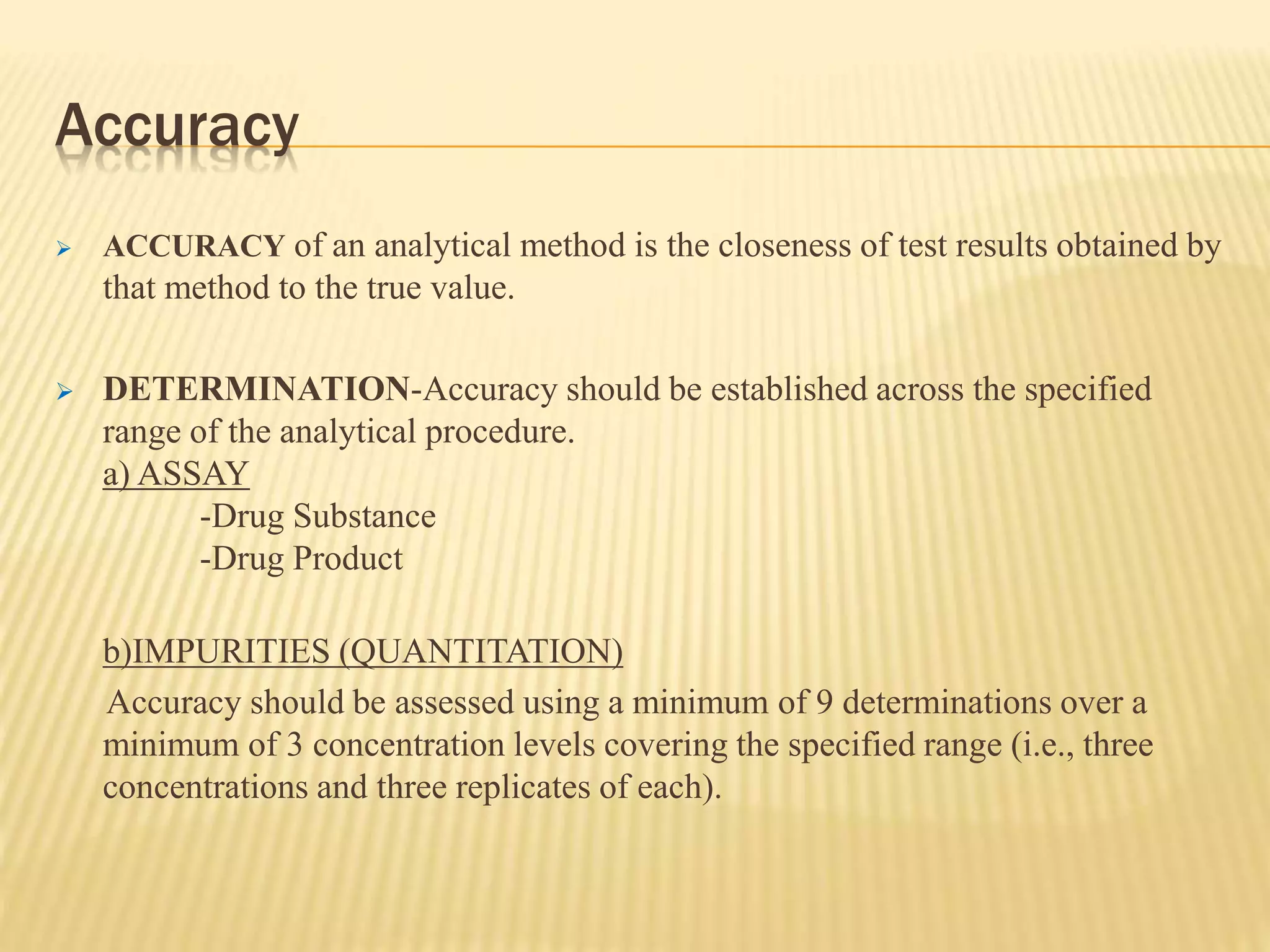
 LINEARITY of an analytical procedure is its ability (within a given
range) to obtain test results which are directly proportional to the
concentration (amount) of analyte in the sample.
 DETERMINATION- Linearity should be evaluated by visual
inspection of a plot of signals as a function of analyte concentration or
content.
NOTE - For the establishment of linearity, a minimum of five
concentrations is recommended
Graphical representation of Linearity
Accuracy
 ACCURACY of an analytical method is the closeness of test results obtained by
that method to the true value.
 DETERMINATION-Accuracy should be established across the specified
range of the analytical procedure.
a) ASSAY
-Drug Substance
-Drug Product
b)IMPURITIES (QUANTITATION)
Accuracy should be assessed using a minimum of 9 determinations over a
minimum of 3 concentration levels covering the specified range (i.e., three
concentrations and three replicates of each).
Precision
 PRECISION of an analytical method is the degree of agreement among
individual test results when the method is applied repeatedly to multiple
samplings of a homogenous sample.
 DETERMINATION- A sufficient number of aliquots of a homogeneous
sample are assayed to be able to calculate statistically valid estimates of
standard deviation .It may be considered at three level-
a) Repeatability
b) Intermediate precision
c) Reproducibilty
Limit of Detection
 DETECTION LIMIT of an individual analytical procedure is the lowest
amount of analyte in a sample which can be detected but not necessarily
quantitated, under the stated experimental conditions.
 DETERMINATION- Several approaches for determining the detection
limit are possible, depending on whether the procedure is a non-
instrumental or instrumental.
- BASED ON VISUAL EXAMINATION
- BASED ON SIGNAL TO NOISE RATIO
Limit of Quantification
 QUANTITATION LIMIT The quantitation limit of an individual
analytical procedure is the lowest amount of analyte in a sample which
can be quantitatively determined with suitable precision and accuracy.
 Determination: It is a parameter of quantitative assays for low levels of
compounds in sample matrices, and is used particularly for the
determination of impurities and/or degradation products.
 Depends on - Several approaches for determining the quantitation limit
are possible, depending on whether the procedure is a non-instrumental
or instrumental.
SYSTEM SUITABILITY
 SYSTEM SUITABILITY TESTING is an integral part of many
analytical procedures.
 The tests are based on the concept that the equipment, electronics,
analytical operations and samples to be analyzed constitute an
integral system that can be evaluated as such.
Analytical process validation

Analytical process validation

  • 1.
    PRESENTED BY TANVIR AHMED ID-11515025 DEPAERMENTOF PHARMACY COMILLA UNIVERSITY Welcome to the Presentation Program
  • 2.
  • 3.
    What is ProcessValidation  Method validation is the process of documenting / proving that an analytical method provides analytical data acceptable for the intended use  A pharmaceutical drug product must meet all its specifications through out its entire shelf-life.  The performance of product characteristics through out the shelf- life must be tested by analytical method for the product’s chemical, physiochemical, microbiological and biological characteristics.  The method of analysis used must be validated. This is required to ensure the product’s safety and efficacy through out all phases of its shelf-life.
  • 4.
    Why Process Validationis needed-  The main objective of analytical validation is to ensure that a selected analytical procedure will give reproducible and reliable results that match with standard.  To establish a record keeping system that considers all concept of manufacturing process which includes controlled testing.  To evaluate all possible sources of variation in process.  To identify all sources of variation those are possible from the materials, machines, methods and men.  To evaluate the requirement for in-process testing and evaluation.  To document everything that is done to follow establish procedures and protocols as closely as possible.
  • 5.
    Steps of ProcessValidation Process validation involves a series of activities taking place over the lifecycle of the product and process. This guidance describes process validation activities in three stages.  Stage 1- Process Design - knowledge gained through development and scale-up activities  Stage 2 – Process Qualification: to determine if the process is capable of reproducible commercial manufacturing.  Stage 3 – Continued Process Verification: Ongoing assurance is gained during routine production that the process remains in a state of control.
  • 6.
    Validation Parameters Method Specificity (Selectivity)  Linearity  Accuracy  Precision  Limit of Detection  Limit of Quantification  Heat sensitivity
  • 7.
    Linearity  LINEARITY ofan analytical procedure is its ability (within a given range) to obtain test results which are directly proportional to the concentration (amount) of analyte in the sample.  DETERMINATION- Linearity should be evaluated by visual inspection of a plot of signals as a function of analyte concentration or content. NOTE - For the establishment of linearity, a minimum of five concentrations is recommended
  • 8.
  • 9.
    Accuracy  ACCURACY ofan analytical method is the closeness of test results obtained by that method to the true value.  DETERMINATION-Accuracy should be established across the specified range of the analytical procedure. a) ASSAY -Drug Substance -Drug Product b)IMPURITIES (QUANTITATION) Accuracy should be assessed using a minimum of 9 determinations over a minimum of 3 concentration levels covering the specified range (i.e., three concentrations and three replicates of each).
  • 10.
    Precision  PRECISION ofan analytical method is the degree of agreement among individual test results when the method is applied repeatedly to multiple samplings of a homogenous sample.  DETERMINATION- A sufficient number of aliquots of a homogeneous sample are assayed to be able to calculate statistically valid estimates of standard deviation .It may be considered at three level- a) Repeatability b) Intermediate precision c) Reproducibilty
  • 11.
    Limit of Detection DETECTION LIMIT of an individual analytical procedure is the lowest amount of analyte in a sample which can be detected but not necessarily quantitated, under the stated experimental conditions.  DETERMINATION- Several approaches for determining the detection limit are possible, depending on whether the procedure is a non- instrumental or instrumental. - BASED ON VISUAL EXAMINATION - BASED ON SIGNAL TO NOISE RATIO
  • 12.
    Limit of Quantification QUANTITATION LIMIT The quantitation limit of an individual analytical procedure is the lowest amount of analyte in a sample which can be quantitatively determined with suitable precision and accuracy.  Determination: It is a parameter of quantitative assays for low levels of compounds in sample matrices, and is used particularly for the determination of impurities and/or degradation products.  Depends on - Several approaches for determining the quantitation limit are possible, depending on whether the procedure is a non-instrumental or instrumental.
  • 13.
    SYSTEM SUITABILITY  SYSTEMSUITABILITY TESTING is an integral part of many analytical procedures.  The tests are based on the concept that the equipment, electronics, analytical operations and samples to be analyzed constitute an integral system that can be evaluated as such.