In pharmaceutical Industries
AUTHOR - ASAD K. MULLA.
Cipla Medica,Yemen.
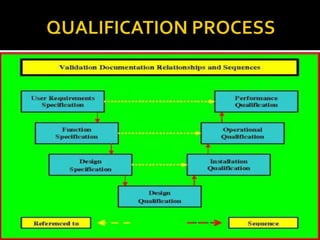
URS [User Requirement Specification]
DQ [Design Qualification]
IQ [Installation Qualification]
OQ [Operation Qualification]
PQ [Performance Qualification]
 Once the end user requirements specification or
URS as it is commonly called; is documented,
agreed and approved they form the basic URS
Level-1 document.The engineers (or vendor) can
then commence the preliminary design to establish
exactly what functions are required for each of the
items specified in the user requirements
specification, the end user has listed. Once this
functionality is documented and approved it forms
the URS Level-2 document.This is the final level of
the URS unless software is used.
User Requirements Specification (URS) Scope
includes but is not limited to;
Level-1, full details of end user operability.
Level-2, full details of functionality.
Level-3, software functionality interface.
A full description of the required system performance.
Performance criteria, critical parameters and operating
range.
Cleaning and maintenance requirements.
Appropriate regulatory requirements.
Documentation requirements.
Training requirements.
All none industry standard testing that may be
required.
DOs
• Interview all stakeholders. Who is going to use the equipment?
Who is going to maintain the equipment? Who is going to be
responsible for the product? Each of these people has an interest in
how the equipment is operated.Their needs should be included in
the URS.
•Work with the validation group to establish a validation plan.The
time to plan for validation is at the beginning when you're writing
the URS, rather than at the end when the equipment hits the floor. If
you wait until the end, you're putting the cart before the horse.This
can lead to a compromised plan or the need to retest or re-qualify
equipment.
• Include a good overview.This section should describe the machine
and what it's supposed to do. It should also include background
information, such as similar machines and processes currently being
used.
• Pay attention to word choice. Words like "shall" and "will" typically
define requirements. Words like "may" and "ought" define goals that
are desired but not necessarily required. Make sure your word choice
clearly differentiates requirements from desired outcomes.
• Include supporting documentation. If a standard or other
specification is referred to, it should be included as an attachment.
DON'Ts
• Don't use time-based metrics.Today, performance metrics are almost
always written as a time-dependent measurement. For example,
"100 products per minute."This approach is too vague and does not
take into account product yield and quality.
• Don't use broad, sweeping statements. For example, "must be 21 CFR
Part 11 compliant." Be specific about the elements within the
compliance.What part of 21 CFR Part 11 needs to be compliant?Which
records do you need to comply with?
• Don't cover functional requirement specifications (FRS) in the URS.
The overall intention of the URS is to describe what the equipment is
supposed to do. How it performs is not a function of the URS.
• Don't place multiple requirements in a single section.This makes it
hard to test and validate each independent requirement. Each
requirement should be numbered and stand on its own.
• Don't duplicate requirements in multiple sections.You don't want the
same requirements repeated in five different sections of the document.
This causes unnecessary work. Rather, collect the requirements in a
general section and test them once.
DOCUMENT ATTACHEDTO URS COPY:
Proposed and Existing Layout.
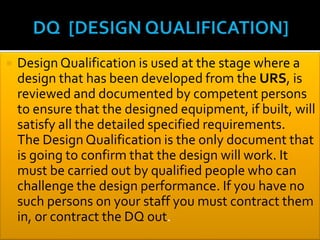
 Design Qualification is used at the stage where a
design that has been developed from the URS, is
reviewed and documented by competent persons
to ensure that the designed equipment, if built, will
satisfy all the detailed specified requirements.
 The Design Qualification is the only document that
is going to confirm that the design will work. It
must be carried out by qualified people who can
challenge the design performance. If you have no
such persons on your staff you must contract them
in, or contract the DQ out.
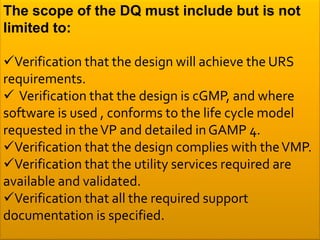
The scope of the DQ must include but is not
limited to:
Verification that the design will achieve the URS
requirements.
 Verification that the design is cGMP, and where
software is used , conforms to the life cycle model
requested in theVP and detailed inGAMP 4.
Verification that the design complies with theVMP.
Verification that the utility services required are
available and validated.
Verification that all the required support
documentation is specified.
Verification that the system will be calibratable.
Verification that the system will be maintainable.
Verification of operation staff training
requirements.
Verification that the system will operate in a
manner safe to both product and staff.
Verification that the system conforms to all
applicable national standards and guidelines.
DOCUMENT ATTACHEDTO DQ COPY:
Purchase Order copy.
Packing List.
 The InstallationQualification (IQ) execution;
verifies that the equipment, and its ancillary
systems or sub-systems have been installed in
accordance with installation drawings and or
specifications. It further details a list of all the
cGMP requirements that are applicable to this
particular installation qualification.These
requirements must all be satisfied before the IQ
can be completed and the qualification process is
allowed to progress to the execution of the
OperationalQualification (OQ).
Installation Qualification (IQ) protocol comes with an
interactive SOP as an attached prefixed document. As
you follow the requirements specified in the SOP, you
complete the actual IQ protocol.This makes it a really
easy and straight forward document to use.The IQ is
normally a stand-alone document, however, with careful
pre-planning, certain aspects of the IQ activities can be
integrated with the Factory AcceptanceTesting (FAT),
and the equipment CommissionTesting.
The IQ should not start with the Factory Acceptance
Testing (FAT) or Commissioning tasks, but it should start
before these tasks are completed; enabling the
validation team to witness and document the final FAT
and commissioning testing.The integration of these
activities greatly reduces the costly and time consuming
replication of unnecessary retesting
The scope of the IQ testing/inspections will
cover the under listed subjects, but is not
restricted to them alone.
Verification that all components parts .
Verify installation is as specified .
Insert a brief description of what part of the
validated product process.
Insert a brief description of the operational
function.
 Verify supply voltages conform.
Verify that electrical installation qualification
(IQ) complies.
Verify that all alarms and visual displays are .
Confirm that the issue level of software .
Identify and verify that serial numbers and model
number of all .
Review all calibration certificates.
Verify where used, there is signals continuity.
Verify signal continuity.
Verify that the ambient conditions.
Verify that the documentation provided by the
maintenance of the system.
DOCUMENT ATTACHEDTO IQ COPY:
Calibration Certificate.
MOC (Metal Of Content).
Draft copy of SOPs.
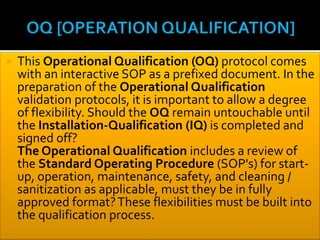
 This Operational Qualification (OQ) protocol comes
with an interactive SOP as a prefixed document. In the
preparation of the Operational Qualification
validation protocols, it is important to allow a degree
of flexibility. Should the OQ remain untouchable until
the Installation-Qualification (IQ) is completed and
signed off?
 The Operational Qualification includes a review of
the Standard Operating Procedure (SOP's) for start-
up, operation, maintenance, safety, and cleaning /
sanitization as applicable, must they be in fully
approved format?These flexibilities must be built into
the qualification process.
The document format will paginate them, and
automatically add them to the ‘Table of Contents’.
They are then part of the OQ.TheseTest Scripts can
be held as Method Statements or SOP's.This allows
the generation of a standard OQ that covers all the
many items the regulators are looking for, with the
facility to have integrated into it, the equipment
specific testing tasks. It also means that these stand
alone test scripts are available for tasks other than
validation, i.e. when system re-testing is required.
The scope of the OQ testing/inspections must
include but is not limited to:
Verification that all loop installations;
Insert a brief description of what part of the
validated product process.
Insert a brief description of the operational
function.
An integrated loop test verification.
Testing of alarms.
Testing of interlocks and permissive conditions.
Testing of database or data storage integrity.
Testing of report generation and event chronicle.
Verification of the functionality of the equipment.
Challenge of software, where required?
Review of system functionality to verify compliance
with 21 CFR Part 11.
If system must be 21 CFR Part 11 compliant,
verification.
Testing of security levels to prevent.
Testing to verify and document Power loss
Recovery.
Testing of all interfaces.
Testing for Electromagnetic interference and
compatibility.
DOCUMENT ATTACHEDTO OQ COPY:
Calibration Report.
Final copy of SOPs (Standard Operating Procedure).
Placebo Batch Record.
Training Report.
The normal expectations for PQ are given as
requiring, documented verification that facilities,
systems and equipment, as connected together,
can perform effectively and reproducibly, based on
the approved process method and product
specification. Onto that now should be graftedThe
verification that the all the requirements specified
in the User Requirements Specification (URS)
have been fully complied.
The PQ represents the final qualification of your
equipment or system.This incorporates a range of
testing to simulate your production process options and
provide assurance that your systems and your operating
documentation, are capable of subsequent process
validation activities. It is used to establish and or confirm;
Definition of performance criteria and test procedures.
Selection of critical parameters, with predefined
specifications.
Determination of the test intervals, e.g.,
(a) - Everyday.
(b) - Every time the system is used.
(c) - Before, between and after a series of runs.
Define corrective actions on what to do if the system
does not meet the established criteria.
DOCUMENT ATTACHEDTO PQ COPY:
Report or Summery of Three ProcessValidation Batches.
Report or Summery of Three CleaningValidation Batches.
Qualification

Qualification

  • 1.
    In pharmaceutical Industries AUTHOR- ASAD K. MULLA. Cipla Medica,Yemen.
  • 2.
    URS [User RequirementSpecification] DQ [Design Qualification] IQ [Installation Qualification] OQ [Operation Qualification] PQ [Performance Qualification]
  • 4.
     Once theend user requirements specification or URS as it is commonly called; is documented, agreed and approved they form the basic URS Level-1 document.The engineers (or vendor) can then commence the preliminary design to establish exactly what functions are required for each of the items specified in the user requirements specification, the end user has listed. Once this functionality is documented and approved it forms the URS Level-2 document.This is the final level of the URS unless software is used.
  • 5.
    User Requirements Specification(URS) Scope includes but is not limited to; Level-1, full details of end user operability. Level-2, full details of functionality. Level-3, software functionality interface. A full description of the required system performance. Performance criteria, critical parameters and operating range. Cleaning and maintenance requirements. Appropriate regulatory requirements. Documentation requirements. Training requirements. All none industry standard testing that may be required.
  • 6.
    DOs • Interview allstakeholders. Who is going to use the equipment? Who is going to maintain the equipment? Who is going to be responsible for the product? Each of these people has an interest in how the equipment is operated.Their needs should be included in the URS. •Work with the validation group to establish a validation plan.The time to plan for validation is at the beginning when you're writing the URS, rather than at the end when the equipment hits the floor. If you wait until the end, you're putting the cart before the horse.This can lead to a compromised plan or the need to retest or re-qualify equipment. • Include a good overview.This section should describe the machine and what it's supposed to do. It should also include background information, such as similar machines and processes currently being used. • Pay attention to word choice. Words like "shall" and "will" typically define requirements. Words like "may" and "ought" define goals that are desired but not necessarily required. Make sure your word choice clearly differentiates requirements from desired outcomes. • Include supporting documentation. If a standard or other specification is referred to, it should be included as an attachment.
  • 7.
    DON'Ts • Don't usetime-based metrics.Today, performance metrics are almost always written as a time-dependent measurement. For example, "100 products per minute."This approach is too vague and does not take into account product yield and quality. • Don't use broad, sweeping statements. For example, "must be 21 CFR Part 11 compliant." Be specific about the elements within the compliance.What part of 21 CFR Part 11 needs to be compliant?Which records do you need to comply with? • Don't cover functional requirement specifications (FRS) in the URS. The overall intention of the URS is to describe what the equipment is supposed to do. How it performs is not a function of the URS. • Don't place multiple requirements in a single section.This makes it hard to test and validate each independent requirement. Each requirement should be numbered and stand on its own.
  • 8.
    • Don't duplicaterequirements in multiple sections.You don't want the same requirements repeated in five different sections of the document. This causes unnecessary work. Rather, collect the requirements in a general section and test them once. DOCUMENT ATTACHEDTO URS COPY: Proposed and Existing Layout.
  • 9.
     Design Qualificationis used at the stage where a design that has been developed from the URS, is reviewed and documented by competent persons to ensure that the designed equipment, if built, will satisfy all the detailed specified requirements.  The Design Qualification is the only document that is going to confirm that the design will work. It must be carried out by qualified people who can challenge the design performance. If you have no such persons on your staff you must contract them in, or contract the DQ out.
  • 10.
    The scope ofthe DQ must include but is not limited to: Verification that the design will achieve the URS requirements.  Verification that the design is cGMP, and where software is used , conforms to the life cycle model requested in theVP and detailed inGAMP 4. Verification that the design complies with theVMP. Verification that the utility services required are available and validated. Verification that all the required support documentation is specified.
  • 11.
    Verification that thesystem will be calibratable. Verification that the system will be maintainable. Verification of operation staff training requirements. Verification that the system will operate in a manner safe to both product and staff. Verification that the system conforms to all applicable national standards and guidelines. DOCUMENT ATTACHEDTO DQ COPY: Purchase Order copy. Packing List.
  • 12.
     The InstallationQualification(IQ) execution; verifies that the equipment, and its ancillary systems or sub-systems have been installed in accordance with installation drawings and or specifications. It further details a list of all the cGMP requirements that are applicable to this particular installation qualification.These requirements must all be satisfied before the IQ can be completed and the qualification process is allowed to progress to the execution of the OperationalQualification (OQ).
  • 13.
    Installation Qualification (IQ)protocol comes with an interactive SOP as an attached prefixed document. As you follow the requirements specified in the SOP, you complete the actual IQ protocol.This makes it a really easy and straight forward document to use.The IQ is normally a stand-alone document, however, with careful pre-planning, certain aspects of the IQ activities can be integrated with the Factory AcceptanceTesting (FAT), and the equipment CommissionTesting. The IQ should not start with the Factory Acceptance Testing (FAT) or Commissioning tasks, but it should start before these tasks are completed; enabling the validation team to witness and document the final FAT and commissioning testing.The integration of these activities greatly reduces the costly and time consuming replication of unnecessary retesting
  • 14.
    The scope ofthe IQ testing/inspections will cover the under listed subjects, but is not restricted to them alone. Verification that all components parts . Verify installation is as specified . Insert a brief description of what part of the validated product process. Insert a brief description of the operational function.  Verify supply voltages conform. Verify that electrical installation qualification (IQ) complies. Verify that all alarms and visual displays are .
  • 15.
    Confirm that theissue level of software . Identify and verify that serial numbers and model number of all . Review all calibration certificates. Verify where used, there is signals continuity. Verify signal continuity. Verify that the ambient conditions. Verify that the documentation provided by the maintenance of the system. DOCUMENT ATTACHEDTO IQ COPY: Calibration Certificate. MOC (Metal Of Content). Draft copy of SOPs.
  • 16.
     This OperationalQualification (OQ) protocol comes with an interactive SOP as a prefixed document. In the preparation of the Operational Qualification validation protocols, it is important to allow a degree of flexibility. Should the OQ remain untouchable until the Installation-Qualification (IQ) is completed and signed off?  The Operational Qualification includes a review of the Standard Operating Procedure (SOP's) for start- up, operation, maintenance, safety, and cleaning / sanitization as applicable, must they be in fully approved format?These flexibilities must be built into the qualification process.
  • 17.
    The document formatwill paginate them, and automatically add them to the ‘Table of Contents’. They are then part of the OQ.TheseTest Scripts can be held as Method Statements or SOP's.This allows the generation of a standard OQ that covers all the many items the regulators are looking for, with the facility to have integrated into it, the equipment specific testing tasks. It also means that these stand alone test scripts are available for tasks other than validation, i.e. when system re-testing is required.
  • 18.
    The scope ofthe OQ testing/inspections must include but is not limited to: Verification that all loop installations; Insert a brief description of what part of the validated product process. Insert a brief description of the operational function. An integrated loop test verification. Testing of alarms. Testing of interlocks and permissive conditions. Testing of database or data storage integrity. Testing of report generation and event chronicle. Verification of the functionality of the equipment.
  • 19.
    Challenge of software,where required? Review of system functionality to verify compliance with 21 CFR Part 11. If system must be 21 CFR Part 11 compliant, verification. Testing of security levels to prevent. Testing to verify and document Power loss Recovery. Testing of all interfaces. Testing for Electromagnetic interference and compatibility.
  • 20.
    DOCUMENT ATTACHEDTO OQCOPY: Calibration Report. Final copy of SOPs (Standard Operating Procedure). Placebo Batch Record. Training Report.
  • 21.
    The normal expectationsfor PQ are given as requiring, documented verification that facilities, systems and equipment, as connected together, can perform effectively and reproducibly, based on the approved process method and product specification. Onto that now should be graftedThe verification that the all the requirements specified in the User Requirements Specification (URS) have been fully complied.
  • 22.
    The PQ representsthe final qualification of your equipment or system.This incorporates a range of testing to simulate your production process options and provide assurance that your systems and your operating documentation, are capable of subsequent process validation activities. It is used to establish and or confirm; Definition of performance criteria and test procedures. Selection of critical parameters, with predefined specifications. Determination of the test intervals, e.g., (a) - Everyday. (b) - Every time the system is used. (c) - Before, between and after a series of runs. Define corrective actions on what to do if the system does not meet the established criteria.
  • 23.
    DOCUMENT ATTACHEDTO PQCOPY: Report or Summery of Three ProcessValidation Batches. Report or Summery of Three CleaningValidation Batches.