1Malay N. Jivani
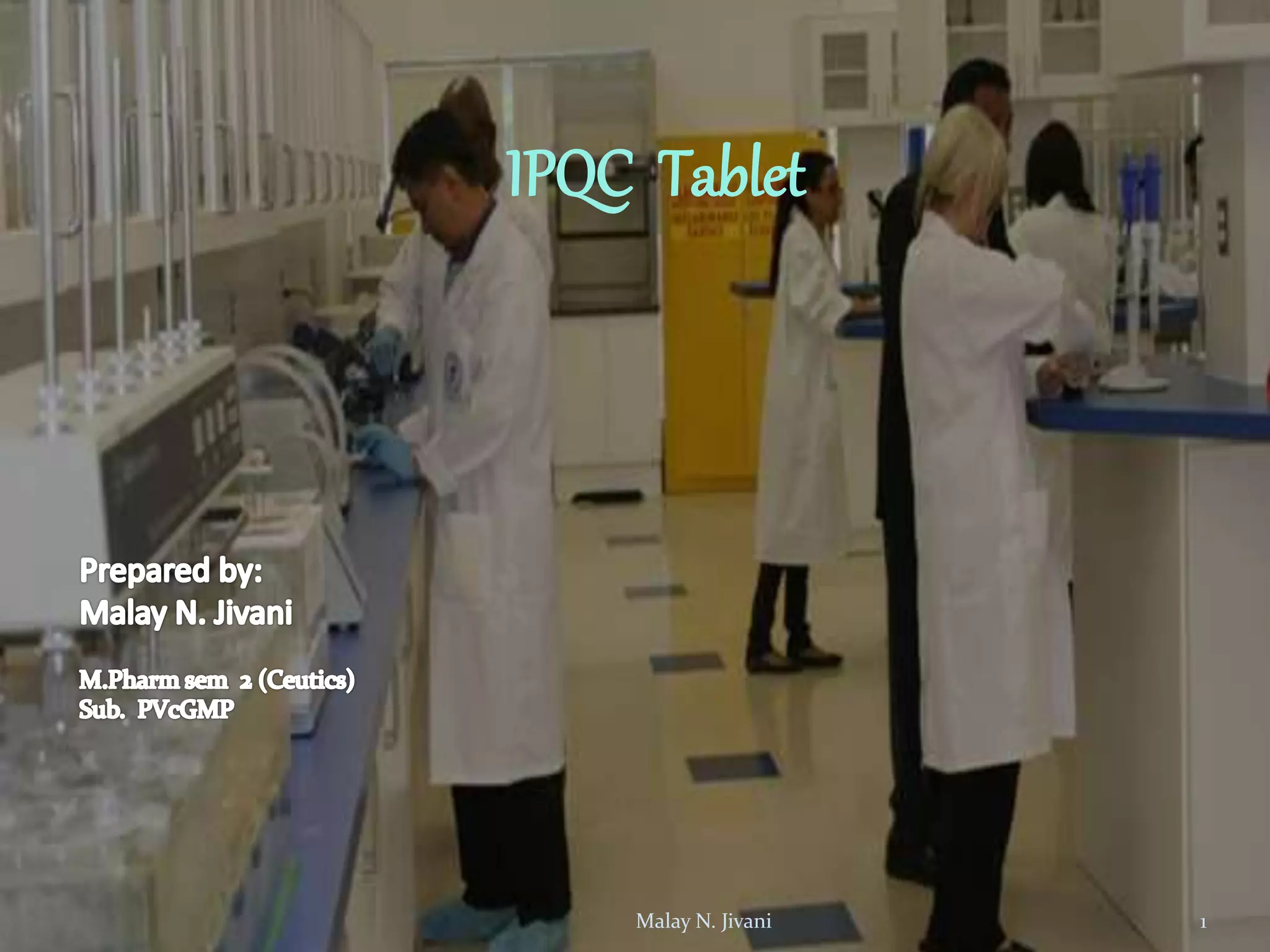
IPQC Tablet
What is IPQC ?
 IPQC is concerned with providing accurate, specific, and
definite description of procedures to be employed from the
receipt of raw materials to the release of finished dosage
forms.
 IPQC Procedures are generally quick, sipmle and rapid
tests or inspection that carried out at on going
manufacturing .
 It is a planned system to identify the materials,
equipment, process, and operations.
2Malay N. Jivani
Why we need IPQC?
 To detect the errors
 To minimize the human errors.
 Provides accurate, specific, and definite description of the
procedure to be employed.
 Rigidly followed.
 Should detect any abnormality immediately and at the
same time indicate the kind of action needed to correct the
problem.
 To enforce the flow of manufacturing and packing
operations according to established routes and
practice.
3Malay N. Jivani
Who do IPQC?
 Usually, the tests are carried out by production
personnel. This is favourable for organizational and
timely reasons, e.g. in a multi-shift operation.
 The personnel in production area referred to here do
not have to be directly responsible to the head of
production with disciplinary responsibility.
 On the basis of organisational instructions and
process descriptions, quality control personnel may
also carry out the necessary tasks.
4Malay N. Jivani
Where to to do IPQC?
 In-process controls may be carried out within the
production area provided they do not carry any risk for
the production.”
5Malay N. Jivani
In-Process Quality Control tests for
Tablets
 Hardness
 Friability
 Thickness
 Disintegration Time
 Weight variation
 Content uniformity
 Dissolution test
 Leakage testing for strip and blister packaging
6Malay N. Jivani
Hardness
 It is the load required to crush the tablet when placed on its
edge.
 It determine the need for pressure adjustments on the tableting
machine.
 Hardness can affect the disintegration.
 So if the tablet is too hard, it may not disintegrate in the required
period of time.
 And if the tablet is too soft, it will not withstand the handling
during subsequent processing such as coating or packaging.
 In general, if the tablet hardness is too high, we first check its
disintegration before rejecting the patch. And if the
disintegration is within limit, we accept the patch.
 If Hardness is high + disintegration is within time
-- accept the batch
7Malay N. Jivani
Factor effecting Hardness
 Compression of the tablet and compressive force.
• Amount of binder. (More binder à more hardness)
• Method of granulation in preparing the tablet
(wet method gives more hardness than direct
method, Slugging method gives the best
hardness).
 Limits: 5 kilograms minimum and 8 kilograms
maximum.
8Malay N. Jivani
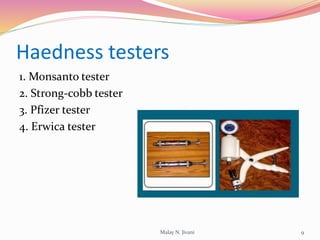
Haedness testers
1. Monsanto tester
2. Strong-cobb tester
3. Pfizer tester
4. Erwica tester
9Malay N. Jivani
Friability
 It is the tendency of tablets to powder, chip, or
fragment and this can affect the elegance appearance,
consumer acceptance of the tablet, and also add to
tablet’s weight variation or content uniformity
problems.
 Friability is a property that is related to the hardness of
the tablet.
 An instrument called friabilator is used to evaluate the
ability of the tablet to withstand abrasion in
packaging, handling, and shipping.
10Malay N. Jivani
How it determined
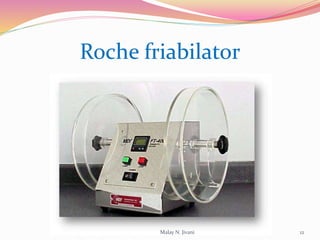
Friability of a tablet can determine in laboratory by
Roche friabilator. This consist of a plastic chamber that
revolves at 25 rpm, dropping the tablets through a
Distance of six inches in the friabilator, which is then
operate for 100 revolutions. The tablets are reweighed.
Compress tablet that lose less than 0.5 to 1.0 % of the
Tablet weigh are consider acceptable.
Friability (% loss) = W1 - W2/100
 W1 = Initial Weigh 20 tablets
 W2 = Weigh 20 tablets after 100 rotation
11Malay N. Jivani
Roche friabilator
12Malay N. Jivani
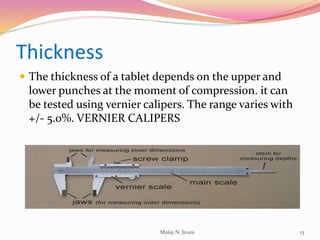
Thickness
 The thickness of a tablet depends on the upper and
lower punches at the moment of compression. it can
be tested using vernier calipers. The range varies with
+/- 5.0%. VERNIER CALIPERS
13Malay N. Jivani
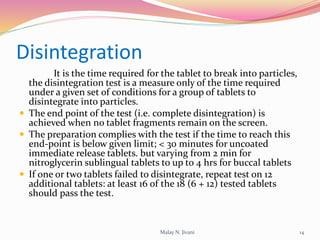
Disintegration
It is the time required for the tablet to break into particles,
the disintegration test is a measure only of the time required
under a given set of conditions for a group of tablets to
disintegrate into particles.
 The end point of the test (i.e. complete disintegration) is
achieved when no tablet fragments remain on the screen.
 The preparation complies with the test if the time to reach this
end-point is below given limit; < 30 minutes for uncoated
immediate release tablets. but varying from 2 min for
nitroglycerin sublingual tablets to up to 4 hrs for buccal tablets
 If one or two tablets failed to disintegrate, repeat test on 12
additional tablets: at least 16 of the 18 (6 + 12) tested tablets
should pass the test.
14Malay N. Jivani
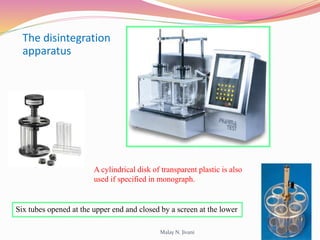
The disintegration
apparatus
Six tubes opened at the upper end and closed by a screen at the lower
A cylindrical disk of transparent plastic is also
used if specified in monograph.
15Malay N. Jivani
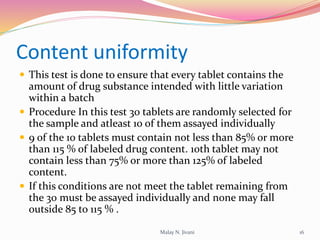
Content uniformity
 This test is done to ensure that every tablet contains the
amount of drug substance intended with little variation
within a batch
 Procedure In this test 30 tablets are randomly selected for
the sample and atleast 10 of them assayed individually
 9 of the 10 tablets must contain not less than 85% or more
than 115 % of labeled drug content. 10th tablet may not
contain less than 75% or more than 125% of labeled
content.
 If this conditions are not meet the tablet remaining from
the 30 must be assayed individually and none may fall
outside 85 to 115 % .
16Malay N. Jivani
Weight variation
 The volumetric fill of the die cavity determines the weight of the
compressed tablet .
 The weight of the tablet is the quantity of the granulation that
contains the labeled amount of the therapeutic ingredient.
 After the tablet machine in operation the weights of the tablets
are routinely checked to ensure that proper tablet weights are
made.
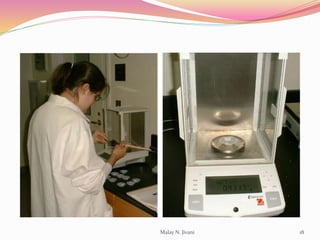
 Procedure : •
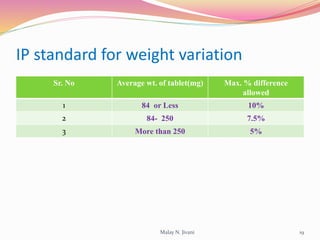
 Take 20 tablets and ,measure the individual weights of each tablets
 Take average weights of 20 tablets
 Compare the individual weight of tablets with avg weight.
 Not more than 2 tablets should deviate from avg weight by percent
deviaton and none should deviate more than twice the percentage
17Malay N. Jivani
18Malay N. Jivani
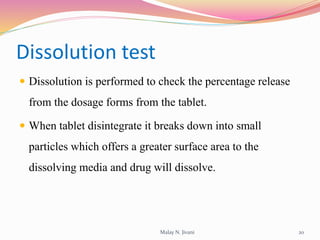
IP standard for weight variation
Sr. No Average wt. of tablet(mg) Max. % difference
allowed
1 84 or Less 10%
2 84- 250 7.5%
3 More than 250 5%
Malay N. Jivani 19
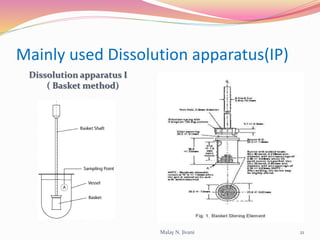
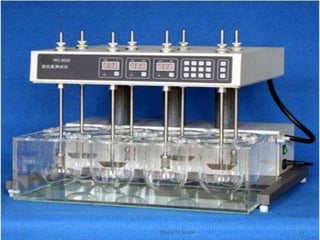
Dissolution test
 Dissolution is performed to check the percentage release
from the dosage forms from the tablet.
 When tablet disintegrate it breaks down into small
particles which offers a greater surface area to the
dissolving media and drug will dissolve.
Malay N. Jivani 20
Mainly used Dissolution apparatus(IP)
Dissolution apparatus I
( Basket method)
Malay N. Jivani 21
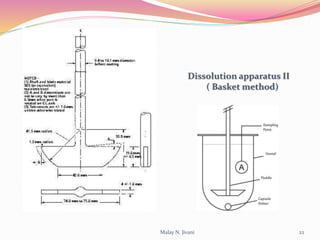
Malay N. Jivani 22
Dissolution apparatus II
( Basket method)
Malay N. Jivani 23
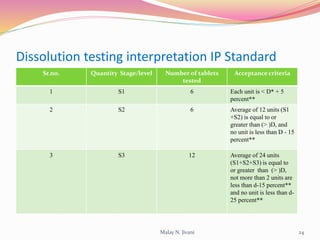
Dissolution testing interpretation IP Standard
Sr.no. Quantity Stage/level Number of tablets
tested
Acceptance criteria
1 S1 6 Each unit is < D* + 5
percent**
2 S2 6 Average of 12 units (S1
+S2) is equal to or
greater than (> )D, and
no unit is less than D - 15
percent**
3 S3 12 Average of 24 units
(S1+S2+S3) is equal to
or greater than (> )D,
not more than 2 units are
less than d-15 percent**
and no unit is less than d-
25 percent**
Malay N. Jivani 24
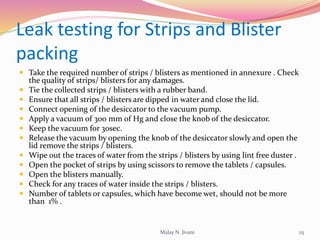
Leak testing for Strips and Blister
packing
 Take the required number of strips / blisters as mentioned in annexure . Check
the quality of strips/ blisters for any damages.
 Tie the collected strips / blisters with a rubber band.
 Ensure that all strips / blisters are dipped in water and close the lid.
 Connect opening of the desiccator to the vacuum pump.
 Apply a vacuum of 300 mm of Hg and close the knob of the desiccator.
 Keep the vacuum for 30sec.
 Release the vacuum by opening the knob of the desiccator slowly and open the
lid remove the strips / blisters.
 Wipe out the traces of water from the strips / blisters by using lint free duster .
 Open the pocket of strips by using scissors to remove the tablets / capsules.
 Open the blisters manually.
 Check for any traces of water inside the strips / blisters.
 Number of tablets or capsules, which have become wet, should not be more
than 1% .
Malay N. Jivani 25
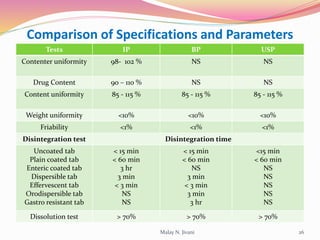
Comparison of Specifications and Parameters
Tests IP BP USP
Contenter uniformity 98- 102 % NS NS
Drug Content 90 – 110 % NS NS
Content uniformity 85 - 115 % 85 - 115 % 85 - 115 %
Weight uniformity <10% <10% <10%
Friability <1% <1% <1%
Disintegration test Disintegration time
Uncoated tab
Plain coated tab
Enteric coated tab
Dispersible tab
Effervescent tab
Orodispersible tab
Gastro resistant tab
< 15 min
< 60 min
3 hr
3 min
< 3 min
NS
NS
< 15 min
< 60 min
NS
3 min
< 3 min
3 min
3 hr
<15 min
< 60 min
NS
NS
NS
NS
NS
Dissolution test > 70% > 70% > 70%
Malay N. Jivani 26
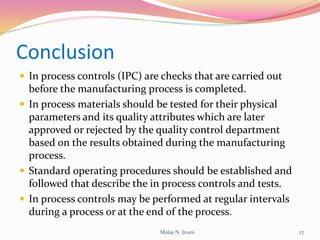
Conclusion
 In process controls (IPC) are checks that are carried out
before the manufacturing process is completed.
 In process materials should be tested for their physical
parameters and its quality attributes which are later
approved or rejected by the quality control department
based on the results obtained during the manufacturing
process.
 Standard operating procedures should be established and
followed that describe the in process controls and tests.
 In process controls may be performed at regular intervals
during a process or at the end of the process.
Malay N. Jivani 27
Referance
1. Comparative Study of In-process and Finished Products
Quality Control Tests of IP, BP & USP for Tablets International
Journal of Pharmacy Teaching & Practices 2011, Vol.2, Issue 4, 176-183.
2. Indian Pharmacopoeia-2010
3. British Pharmacopoeia-2009
4. US Pharmacopoeia-2007
5. Leon Lachman, The theory and practice of Industrial pharmacy,3rd
edition, Varghese publishing house, page no.67-68,77-78,315-317,296-
303.
Malay N. Jivani 28

Ipqc tests for tablet

  • 1.
  • 2.
    What is IPQC?  IPQC is concerned with providing accurate, specific, and definite description of procedures to be employed from the receipt of raw materials to the release of finished dosage forms.  IPQC Procedures are generally quick, sipmle and rapid tests or inspection that carried out at on going manufacturing .  It is a planned system to identify the materials, equipment, process, and operations. 2Malay N. Jivani
  • 3.
    Why we needIPQC?  To detect the errors  To minimize the human errors.  Provides accurate, specific, and definite description of the procedure to be employed.  Rigidly followed.  Should detect any abnormality immediately and at the same time indicate the kind of action needed to correct the problem.  To enforce the flow of manufacturing and packing operations according to established routes and practice. 3Malay N. Jivani
  • 4.
    Who do IPQC? Usually, the tests are carried out by production personnel. This is favourable for organizational and timely reasons, e.g. in a multi-shift operation.  The personnel in production area referred to here do not have to be directly responsible to the head of production with disciplinary responsibility.  On the basis of organisational instructions and process descriptions, quality control personnel may also carry out the necessary tasks. 4Malay N. Jivani
  • 5.
    Where to todo IPQC?  In-process controls may be carried out within the production area provided they do not carry any risk for the production.” 5Malay N. Jivani
  • 6.
    In-Process Quality Controltests for Tablets  Hardness  Friability  Thickness  Disintegration Time  Weight variation  Content uniformity  Dissolution test  Leakage testing for strip and blister packaging 6Malay N. Jivani
  • 7.
    Hardness  It isthe load required to crush the tablet when placed on its edge.  It determine the need for pressure adjustments on the tableting machine.  Hardness can affect the disintegration.  So if the tablet is too hard, it may not disintegrate in the required period of time.  And if the tablet is too soft, it will not withstand the handling during subsequent processing such as coating or packaging.  In general, if the tablet hardness is too high, we first check its disintegration before rejecting the patch. And if the disintegration is within limit, we accept the patch.  If Hardness is high + disintegration is within time -- accept the batch 7Malay N. Jivani
  • 8.
    Factor effecting Hardness Compression of the tablet and compressive force. • Amount of binder. (More binder à more hardness) • Method of granulation in preparing the tablet (wet method gives more hardness than direct method, Slugging method gives the best hardness).  Limits: 5 kilograms minimum and 8 kilograms maximum. 8Malay N. Jivani
  • 9.
    Haedness testers 1. Monsantotester 2. Strong-cobb tester 3. Pfizer tester 4. Erwica tester 9Malay N. Jivani
  • 10.
    Friability  It isthe tendency of tablets to powder, chip, or fragment and this can affect the elegance appearance, consumer acceptance of the tablet, and also add to tablet’s weight variation or content uniformity problems.  Friability is a property that is related to the hardness of the tablet.  An instrument called friabilator is used to evaluate the ability of the tablet to withstand abrasion in packaging, handling, and shipping. 10Malay N. Jivani
  • 11.
    How it determined Friabilityof a tablet can determine in laboratory by Roche friabilator. This consist of a plastic chamber that revolves at 25 rpm, dropping the tablets through a Distance of six inches in the friabilator, which is then operate for 100 revolutions. The tablets are reweighed. Compress tablet that lose less than 0.5 to 1.0 % of the Tablet weigh are consider acceptable. Friability (% loss) = W1 - W2/100  W1 = Initial Weigh 20 tablets  W2 = Weigh 20 tablets after 100 rotation 11Malay N. Jivani
  • 12.
  • 13.
    Thickness  The thicknessof a tablet depends on the upper and lower punches at the moment of compression. it can be tested using vernier calipers. The range varies with +/- 5.0%. VERNIER CALIPERS 13Malay N. Jivani
  • 14.
    Disintegration It is thetime required for the tablet to break into particles, the disintegration test is a measure only of the time required under a given set of conditions for a group of tablets to disintegrate into particles.  The end point of the test (i.e. complete disintegration) is achieved when no tablet fragments remain on the screen.  The preparation complies with the test if the time to reach this end-point is below given limit; < 30 minutes for uncoated immediate release tablets. but varying from 2 min for nitroglycerin sublingual tablets to up to 4 hrs for buccal tablets  If one or two tablets failed to disintegrate, repeat test on 12 additional tablets: at least 16 of the 18 (6 + 12) tested tablets should pass the test. 14Malay N. Jivani
  • 15.
    The disintegration apparatus Six tubesopened at the upper end and closed by a screen at the lower A cylindrical disk of transparent plastic is also used if specified in monograph. 15Malay N. Jivani
  • 16.
    Content uniformity  Thistest is done to ensure that every tablet contains the amount of drug substance intended with little variation within a batch  Procedure In this test 30 tablets are randomly selected for the sample and atleast 10 of them assayed individually  9 of the 10 tablets must contain not less than 85% or more than 115 % of labeled drug content. 10th tablet may not contain less than 75% or more than 125% of labeled content.  If this conditions are not meet the tablet remaining from the 30 must be assayed individually and none may fall outside 85 to 115 % . 16Malay N. Jivani
  • 17.
    Weight variation  Thevolumetric fill of the die cavity determines the weight of the compressed tablet .  The weight of the tablet is the quantity of the granulation that contains the labeled amount of the therapeutic ingredient.  After the tablet machine in operation the weights of the tablets are routinely checked to ensure that proper tablet weights are made.  Procedure : •  Take 20 tablets and ,measure the individual weights of each tablets  Take average weights of 20 tablets  Compare the individual weight of tablets with avg weight.  Not more than 2 tablets should deviate from avg weight by percent deviaton and none should deviate more than twice the percentage 17Malay N. Jivani
  • 18.
  • 19.
    IP standard forweight variation Sr. No Average wt. of tablet(mg) Max. % difference allowed 1 84 or Less 10% 2 84- 250 7.5% 3 More than 250 5% Malay N. Jivani 19
  • 20.
    Dissolution test  Dissolutionis performed to check the percentage release from the dosage forms from the tablet.  When tablet disintegrate it breaks down into small particles which offers a greater surface area to the dissolving media and drug will dissolve. Malay N. Jivani 20
  • 21.
    Mainly used Dissolutionapparatus(IP) Dissolution apparatus I ( Basket method) Malay N. Jivani 21
  • 22.
    Malay N. Jivani22 Dissolution apparatus II ( Basket method)
  • 23.
  • 24.
    Dissolution testing interpretationIP Standard Sr.no. Quantity Stage/level Number of tablets tested Acceptance criteria 1 S1 6 Each unit is < D* + 5 percent** 2 S2 6 Average of 12 units (S1 +S2) is equal to or greater than (> )D, and no unit is less than D - 15 percent** 3 S3 12 Average of 24 units (S1+S2+S3) is equal to or greater than (> )D, not more than 2 units are less than d-15 percent** and no unit is less than d- 25 percent** Malay N. Jivani 24
  • 25.
    Leak testing forStrips and Blister packing  Take the required number of strips / blisters as mentioned in annexure . Check the quality of strips/ blisters for any damages.  Tie the collected strips / blisters with a rubber band.  Ensure that all strips / blisters are dipped in water and close the lid.  Connect opening of the desiccator to the vacuum pump.  Apply a vacuum of 300 mm of Hg and close the knob of the desiccator.  Keep the vacuum for 30sec.  Release the vacuum by opening the knob of the desiccator slowly and open the lid remove the strips / blisters.  Wipe out the traces of water from the strips / blisters by using lint free duster .  Open the pocket of strips by using scissors to remove the tablets / capsules.  Open the blisters manually.  Check for any traces of water inside the strips / blisters.  Number of tablets or capsules, which have become wet, should not be more than 1% . Malay N. Jivani 25
  • 26.
    Comparison of Specificationsand Parameters Tests IP BP USP Contenter uniformity 98- 102 % NS NS Drug Content 90 – 110 % NS NS Content uniformity 85 - 115 % 85 - 115 % 85 - 115 % Weight uniformity <10% <10% <10% Friability <1% <1% <1% Disintegration test Disintegration time Uncoated tab Plain coated tab Enteric coated tab Dispersible tab Effervescent tab Orodispersible tab Gastro resistant tab < 15 min < 60 min 3 hr 3 min < 3 min NS NS < 15 min < 60 min NS 3 min < 3 min 3 min 3 hr <15 min < 60 min NS NS NS NS NS Dissolution test > 70% > 70% > 70% Malay N. Jivani 26
  • 27.
    Conclusion  In processcontrols (IPC) are checks that are carried out before the manufacturing process is completed.  In process materials should be tested for their physical parameters and its quality attributes which are later approved or rejected by the quality control department based on the results obtained during the manufacturing process.  Standard operating procedures should be established and followed that describe the in process controls and tests.  In process controls may be performed at regular intervals during a process or at the end of the process. Malay N. Jivani 27
  • 28.
    Referance 1. Comparative Studyof In-process and Finished Products Quality Control Tests of IP, BP & USP for Tablets International Journal of Pharmacy Teaching & Practices 2011, Vol.2, Issue 4, 176-183. 2. Indian Pharmacopoeia-2010 3. British Pharmacopoeia-2009 4. US Pharmacopoeia-2007 5. Leon Lachman, The theory and practice of Industrial pharmacy,3rd edition, Varghese publishing house, page no.67-68,77-78,315-317,296- 303. Malay N. Jivani 28